Pascal’s law states that a pressure change applied to a confined, incompressible fluid is transmitted undiminished to every point in the fluid and to the walls of its container. Because pressure equals force divided by area (P1 = P2, so F1/A1 = F2/A2), a small force on a small piston can produce a much larger force on a larger piston.
Watch a mechanic slide a trolley jack under a 1,500 kg car, pump the handle a few times with one hand, and lift the whole thing clear of the ground. No motor, no gears — just a sealed body of oil and two pistons of different sizes.
That everyday miracle runs on Pascal’s law. The same trick stops your car when you brush the brake pedal, swings the arm of a 20-tonne excavator, and tips the dentist’s chair back — all from a 17th-century insight into how liquids pass on a push.
What Is Pascal’s Law?
Take a plastic bottle filled to the brim with water, seal it, and squeeze it in the middle. Prick a pinhole anywhere — top, bottom, the far side — and water jets out with the same urgency. Your squeeze did not stay where your fingers were; the whole body of water felt it at once.
Made precise, that observation is Pascal’s law: a change in pressure applied to an enclosed, incompressible fluid at rest is transmitted undiminished to every point in the fluid and to the walls of its container. The transmitted pressure pushes at right angles to every surface it meets. You will also see it called Pascal’s principle, or the principle of transmission of fluid-pressure.
Two words in that statement do the heavy lifting. Enclosed: the fluid must be confined, or the pressure simply escapes. Incompressible: liquids barely squash, so none of the push is soaked up along the way.
Who discovered Pascal’s law?
Blaise Pascal (1623–1662), the French mathematician and physicist, established the law in 1653 in his treatise on the equilibrium of liquids, published in 1663 after his death. The SI unit of pressure — the pascal (Pa), one newton per square metre — is named in his honour.
The story goes that in 1646 Pascal burst a sturdy wooden barrel by pouring water into a long, thin vertical tube fixed to its lid. A modest amount of water, raised high, created enough pressure to split the staves — an early hint that pressure depends on far more than the sheer quantity of liquid.

The Pascal’s Law Formula
Everything starts from the definition of pressure — force spread over area:
In a confined fluid, Pascal’s law makes the transmitted pressure the same at the input piston and the output piston. Setting those two pressures equal gives the working equation of every hydraulic machine:
Rearranged for the output force:
One more relation completes the set. The liquid’s volume is fixed, so whatever volume the small piston sweeps out, the large piston must receive:
| Symbol | Meaning | SI unit |
|---|---|---|
| P | Pressure in the fluid | pascal (Pa = N/m2) |
| F1 | Input force on the small piston | newton (N) |
| A1 | Area of the small piston | square metre (m2) |
| F2 | Output force on the large piston | newton (N) |
| A2 | Area of the large piston | square metre (m2) |
| d1, d2 | Distances the pistons move | metre (m) |
Want to skip the algebra? Plug your numbers straight into our Pascal’s Law Calculator — it solves for any variable and shows every step.
Area grows with the square of diameter (A = πd2/4), so a piston 5 times wider has 25 times the area. Forget to square it and every answer comes out 5 times too small.How Pascal’s Law Works
Why should a push travel so faithfully? Picture the liquid as a crowd of molecules packed shoulder to shoulder. Lean on one edge of the crowd and, because nobody can shrink or step aside, the shove passes from neighbour to neighbour until every wall feels it.
Liquids really are that stiff. Squeezing water down by just 1% takes roughly 22 MPa — about 220 times atmospheric pressure. For any hydraulic machine you will ever meet, the volume simply does not change, so none of your push is wasted compressing the fluid.
Pressure has no favourite direction, either. At any point it pushes equally every way, and on every wall it pushes at right angles to the surface — the fluid shoving back on whatever contains it, exactly as Newton’s laws of motion demand. The change spreads at the speed of sound in the liquid — around 1.4–1.5 km/s in water and typical hydraulic oils — which is why hydraulic controls feel instant.
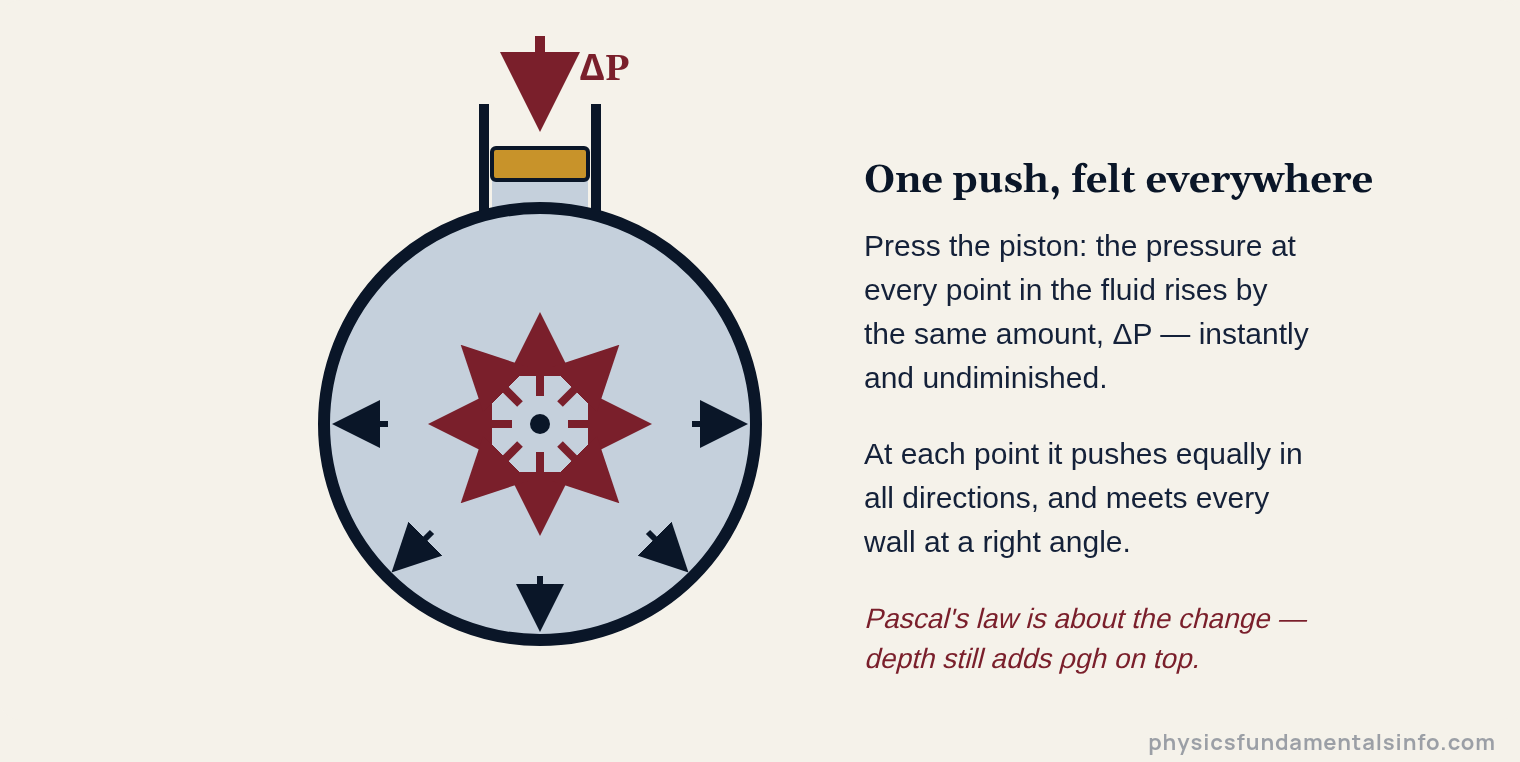
An applied pressure change ΔP reaches every point of a confined fluid, pushing at right angles to every wall.
Step by step inside a hydraulic system
- You push the small piston with force F1 acting over area A1.
- The pressure everywhere in the fluid rises by P = F1 / A1.
- That extra pressure arrives, undiminished, at the large piston.
- Pressure times area gives the output force: F2 = P × A2.
- Because A2 is larger than A1, F2 is larger than F1 — in exact proportion.
Try it yourself below. Drag the force and piston sizes and watch the pressure, output force and distance trade-off respond.
How a Hydraulic Press Multiplies Force
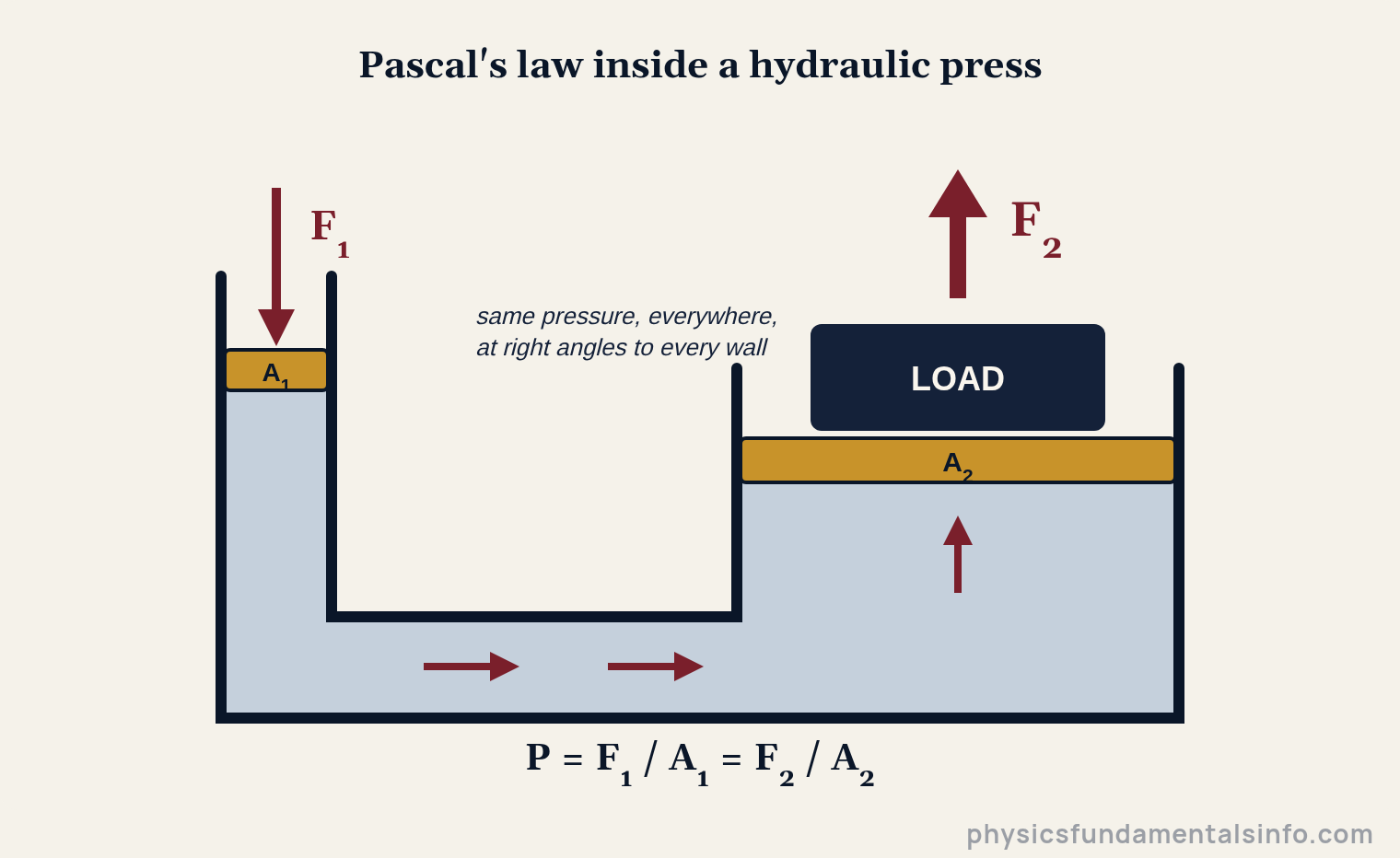
A small force on the small piston creates a pressure that acts on the large piston’s whole area — multiplying the force.
A hydraulic press is a lever made of liquid. Where a crowbar trades distance for force along a rigid bar, a press makes the same trade through a fluid — and the fluid will happily carry the advantage around corners, through narrow pipes, to several outputs at once.
The multiplication factor, called the mechanical advantage, is simply the area ratio A2/A1. Work in diameters and it becomes (d2/d1)2. Double the output piston’s diameter and you quadruple the force.
HyperPhysics runs the classic numbers for a garage car lift: a 25 cm output cylinder paired with a 1.25 cm input cylinder gives an area ratio of 400, so holding up a 6,000 N car takes a push of just 15 N on the small piston.
There is a catch — the honest kind. To raise that car 10 cm, the small piston must displace the same volume of oil, which means travelling 400 × 10 cm = 40 m. That is why you pump a jack handle over and over. The work done on the small piston equals the work delivered by the large one: force is multiplied, distance is divided, and their product never grows.
Joseph Bramah saw the industrial promise and patented the first practical hydraulic press in 1795. Its descendants now forge aircraft parts and crush scrap cars.
Real-World Examples of Pascal’s Law
Once you know the pattern — confined liquid, small piston in, big piston out — you start spotting it everywhere.
1. Car brakes
Your foot presses a small master-cylinder piston; the pressure rise travels along the brake lines and pushes larger caliper pistons at all four wheels at once. Because the pressure is the same everywhere, the braking effort stays balanced — one modest pedal push clamps every disc simultaneously.
2. Jacks and vehicle lifts
A trolley jack packs the whole principle into a suitcase-sized tool: a hand-pumped small piston, a wide ram, and a valve to hold the pressure between strokes. Garage two-post lifts scale the same idea up to hold a car above head height.
3. Excavators, loaders and tipper trucks
Every movement of a digger’s arm is a hydraulic ram extending or retracting. These systems commonly run at around 30 MPa — roughly 300 times atmospheric pressure — which is how a slim steel cylinder can tear a bucket through packed earth.

4. Aircraft systems
Planes rely on hydraulics where failure is not an option. NASA's Glenn Research Center notes that most aircraft use hydraulic systems for their brakes and landing gear, and hydraulic actuators also drive flaps and other control surfaces.
5. The quiet ones
Squeeze a toothpaste tube anywhere and paste leaves only through the nozzle — pressure transmitted, exit chosen by you. A syringe, a dentist’s chair, a barber’s chair and an office chair’s gas lift all lean on the same principle in miniature.
Common Misconceptions About Pascal’s Law
Misconception 1: A hydraulic press multiplies energy
It multiplies force, never energy. The small piston travels exactly as much farther as the force is multiplied, so work in equals work out and energy is conserved. Real machines actually deliver slightly less, because a little is lost to friction in the seals and fluid.
Misconception 2: Pressure is the same everywhere in a fluid
Pascal’s law is about the change in pressure, not the total. Absolute pressure still increases with depth by ρgh, which is why your ears pop at the bottom of a pool. In a compact jack the height differences are negligible; in a tall system they are not — Worked Problem 6 puts a number on it.
Misconception 3: It only works for liquids
Confined gases obey Pascal’s law too — that is the basis of pneumatics. But gases compress, storing energy like a spring and making the response spongy. That squishiness is exactly why air trapped in brake lines is dangerous and must be bled out.
Misconception 4: The fluid only pushes the way you pushed
Pressure has no direction of its own; it pushes at right angles to every surface it touches. Pump a jack handle horizontally and the ram can still drive a load straight up. That freedom to redirect force through bendy pipes is half the appeal of hydraulics.
Worked Problems
Work through these in order — they climb from a one-line calculation to a full brake-system analysis. Carry the units at every step.
Show Solution
Solution:
Step 1: Pressure is force per unit area: P = F / A.
Step 2: Substitute: P = 200 N / 0.004 m2.
Step 3: Solve: P = 50,000 Pa.
Answer: 50 kPa (2 significant figures)
Show Solution
Solution:
Step 1: Pascal’s law gives F1 / A1 = F2 / A2, so F2 = F1 × (A2 / A1).
Step 2: Substitute: F2 = 100 N × (0.5 m2 / 0.01 m2) = 100 N × 50.
Step 3: Solve: F2 = 5,000 N.
Answer: 5,000 N (5.0 kN) — enough to hold up a mass of about 510 kg
Show Solution
Solution:
Step 1: The output force must equal the car’s weight: F2 = mg = 1,200 kg × 9.81 m/s2 = 11,772 N.
Step 2: Rearrange Pascal’s law for the input force: F1 = F2 × (A1 / A2).
Step 3: Substitute: F1 = 11,772 N × (0.005 m2 / 0.2 m2) = 11,772 N × 0.025 = 294.3 N.
Answer: about 294 N — roughly the effort of lifting a 30 kg suitcase, holding up 1.2 tonnes of car
Show Solution
Solution:
Step 1: Areas scale with diameter squared, so A2 / A1 = (d2 / d1)2 = (16 cm / 2.0 cm)2 = 82 = 64.
Step 2: Apply F2 = F1 × (A2 / A1) = 150 N × 64.
Step 3: Solve: F2 = 9,600 N.
Answer: 9,600 N (9.6 kN) — note it is 64 times larger, not 8: always square the diameter ratio
Show Solution
Solution:
Step 1: Equal volumes give A1 d1 = A2 d2, so d1 = (A2 / A1) × d2 = 50 × 0.04 m = 2.0 m.
Step 2: Work input: W1 = F1 d1 = 100 N × 2.0 m = 200 J.
Step 3: Work output: W2 = F2 d2 = 5,000 N × 0.04 m = 200 J.
Answer: the input piston moves 2.0 m, and W1 = W2 = 200 J — force is multiplied by 50, energy not at all
Show Solution
Solution:
Step 1: The applied pressure is transmitted undiminished, but depth adds hydrostatic pressure: P2 = P1 + ρgh.
Step 2: Compute the depth term: ρgh = 850 kg/m3 × 9.81 m/s2 × 0.60 m = 5,003 Pa.
Step 3: Add: P2 = 250,000 Pa + 5,003 Pa = 255,003 Pa.
Answer: about 255 kPa — the 0.60 m drop adds only ~2%, which is why compact machines ignore it
Show Solution
Solution:
Step 1: Force on the master cylinder: F1 = 4 × 90 N = 360 N.
Step 2: Brake-line pressure: P = F1 / A1 = 360 N / (2.0 × 10⁻⁴ m2) = 1.8 × 10⁶ Pa = 1.8 MPa.
Step 3: Force on each caliper piston: F2 = P × A2 = 1.8 × 106 Pa × (8.0 × 10−4 m2) = 1,440 N.
Answer: 1.8 MPa in the line and about 1.4 kN on each caliper piston — a 90 N toe-push becomes a 16-fold clamping force per wheel
How Pascal’s Law Relates to Other Fluid Concepts
Pascal’s law is fluid statics: it describes a confined fluid at rest, or moving slowly enough that flow effects do not matter. Three neighbouring ideas complete the picture.
Pressure and depth. Gravity gives every fluid a built-in pressure gradient, P = P0 + ρgh. Pascal’s law sits on top of this: an applied change adds equally to every point, while the depth term sets the baseline each point started from.
Weight and force. Sizing any hydraulic lift starts from the load it must beat — the weight W = mg, straight from Newton’s second law. Problem 3 above is exactly that calculation.
Buoyancy and moving fluids. Archimedes’ principle is what the depth gradient does to an immersed object — a net upward force. Bernoulli’s principle takes over once the fluid flows, trading pressure against speed. Different jobs, often confused; the table sorts them out.
| Principle | Applies to | What it says | Key relation | Classic use |
|---|---|---|---|---|
| Pascal’s law | A confined fluid at rest | An applied pressure change is transmitted undiminished in all directions | F1/A1 = F2/A2 | Hydraulic press, car brakes |
| Hydrostatic pressure | Any fluid in gravity | Pressure grows with depth below the surface | P = P0 + ρgh | Dams, diving, barometers |
| Archimedes’ principle | An object in a fluid | Upthrust equals the weight of fluid displaced | Fb = ρVg | Ships, balloons, hydrometers |
| Bernoulli’s principle | A moving fluid | Along a streamline, faster flow means lower pressure | P + ½ρv2 + ρgh = constant | Venturi meters, atomisers |