The Reynolds number is the dimensionless ratio of inertial forces to viscous forces in a moving fluid, Re = ρvD/μ, where ρ is the density, v the mean velocity, D the pipe diameter and μ the dynamic viscosity. It predicts the flow regime: in a circular pipe, flow is laminar below about 2,300 and turbulent above about 4,000.
Open a kitchen tap a fraction and the water falls in a smooth, glassy column you could almost mistake for a glass rod. Open it further and the column roughens, hisses and splatters. Nothing about the water has changed except its speed, yet the flow has switched from one kind of motion to another.
That switch has a number attached to it. Engineers sizing a water main, cardiologists listening for a heart murmur and aerodynamicists testing a wing model all reach for the same dimensionless ratio, and it tells them, before any experiment, whether the fluid will glide in layers or churn.
What Is the Reynolds Number?
The Reynolds number is a dimensionless quantity that compares the inertial forces in a flow, which keep each parcel of fluid moving the way it was already moving, with the viscous forces that smooth out any disturbance. A large value means inertia wins and small wobbles grow into eddies. A small value means viscosity wins and the same wobbles are damped away before they can spread.
Think of it as a tug of war between momentum and stickiness. Honey creeping from a spoon has plenty of stickiness and almost no momentum, so its Reynolds number is tiny and its motion is perfectly orderly. Water leaving a fire hose has the opposite balance, and the jet is a churning mess of eddies from the moment it leaves the nozzle.
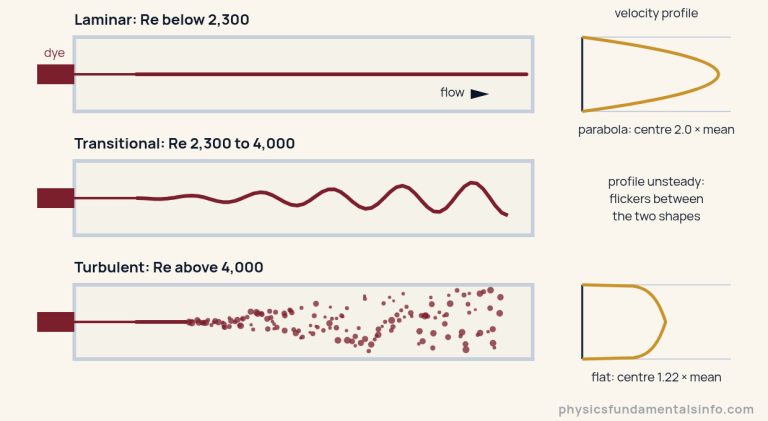
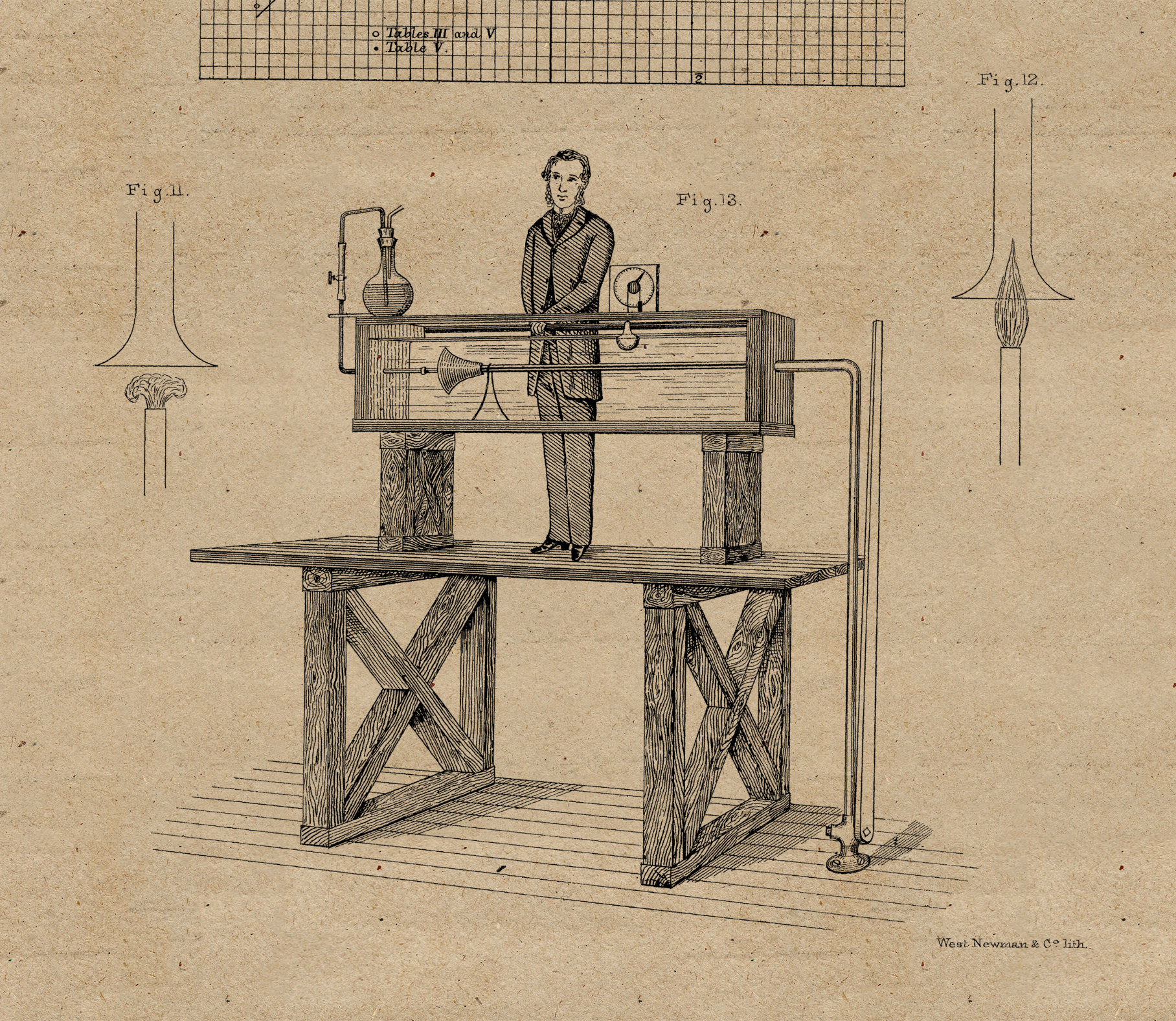
The number takes its name from Osborne Reynolds, who in 1883 injected a thread of dye into water flowing along a glass pipe and reported how the thread stayed straight at low speed, wavered as the speed rose, and finally shredded into eddies. He showed that one combination of speed, pipe size and fluid properties, rather than any of them alone, fixed the point of change. The Reynolds number entry on Wikipedia gives a fuller account of that history and of the many other flows the ratio has since been applied to.
Why it has no units
Multiply a density in kg/m³ by a velocity in m/s and a length in m and you get kg/(m·s). A dynamic viscosity in Pa·s is also kg/(m·s), so dividing one by the other leaves a bare number. That is the whole point: a Reynolds number of 24,905 describes the same balance of forces in water, air or oil, at any scale, in any consistent unit system.
The Reynolds Number Formula
For flow through a pipe the Reynolds number formula is:
An equivalent form uses the kinematic viscosity ν, the dynamic viscosity divided by the density:
Both forms give the same number, and which you use depends on which viscosity your data table quotes. To check a case in seconds, or to find the velocity, diameter or viscosity that produces a target value, use the Reynolds Number Calculator, which shows the substitution with units, names the regime and adds the smooth-pipe friction factor.
Variables and SI units
- Re: Reynolds number, dimensionless.
- ρ (rho): fluid density, in kg/m³ (water at 20 °C 998.2 kg/m³, air 1.204 kg/m³).
- v: mean velocity of the flow, in m/s; the volume flow rate Q divided by the cross-sectional area, v = 4Q / (πD²) for a circular pipe.
- D: characteristic length, in m; for a full circular pipe the inside diameter.
- μ (mu): dynamic viscosity, in Pa·s (water at 20 °C 1.002 × 10⁻³ Pa·s, which is 1.002 mPa·s or 1.002 cP).
- ν (nu): kinematic viscosity, in m²/s (water at 20 °C 1.004 × 10⁻⁶ m²/s; 1 cSt = 10-6 m²/s).
Two of those inputs cause most of the wrong answers. The velocity must be the mean over the cross-section, not the faster centreline value, and the viscosity must be in Pa·s, not mPa·s: type 1.002 where 0.001002 belongs and the domestic supply pipe of the first worked problem comes out with a Reynolds number a thousand times too small.
The length D is whatever dimension sets the scale of the flow. Inside a pipe it is the bore; for a duct that is not circular engineers use the hydraulic diameter, four times the flow area divided by the wetted perimeter; for a sphere it is the sphere’s diameter, and for a wing it is the chord. The thresholds quoted below belong to circular pipes only, and each geometry has its own.
How the Reynolds Number Works
Why should one ratio decide so much? Start with a small disturbance, a wobble in the flow a pipe-width across. Viscosity spreads momentum sideways by diffusion, and it takes a time of order D²/ν to smooth a wobble of size D out of existence. Meanwhile the flow carries the wobble downstream, and in a time of order D/v it has travelled its own size.
Divide the smoothing time by the travel time and you get (D²/ν)/(D/v) = vD/ν, which is the Reynolds number. When it is small the wobble is smoothed away long before it gets anywhere. When it is large the wobble travels, tumbles and feeds on the mean flow’s energy before viscosity can act, and the flow becomes turbulent.
Reynolds saw exactly this in his glass pipe. At low speed his dye thread ran the length of the tube as a single straight filament: laminar flow, every layer sliding past its neighbour with no mixing across the pipe. Raising the speed made the thread waver, and a little higher still it burst into eddies that tinted the whole cross-section within a few diameters of the injector.
The change is not a switch thrown at one exact number. Turbulence needs a seed, some disturbance from a rough inlet, a vibration or a bend, and a very still, smooth entry can keep pipe flow laminar well above 10,000. Below about 2,000 turbulence dies out along the pipe however the flow was disturbed; 2,300 is the conventional design limit, chosen with a margin, and between the two a disturbed flow can carry intermittent turbulent slugs.
Try it in the lab above. Push the velocity up slowly from 0.05 m/s and watch the readout cross 2,300 and then 4,000 as the dye goes from filament to cloud; then switch to glycerine and try to make it turbulent at all. Figure 1 freezes the three states the lab animates.
What Do Reynolds Number Values Mean?
A Reynolds number below 2,300 means laminar pipe flow, a value above 4,000 means turbulent pipe flow, and values between the two fall in a transition band where the flow flickers between the two states. Those are the textbook thresholds for a circular pipe, and the lab on this page and the linked calculator use them.
So what does a Reynolds number of 2,000 mean? Laminar, but close to the edge. Some texts put the critical value at 2,000 or 2,100 rather than 2,300, so a flow at 2,000 is one that a small disturbance could tip, and an engineer would not rely on it staying orderly.
The table collects the cases used throughout this article, all with 20 °C fluid properties except the oil, which is SAE 30 at 40 °C. Read down the Re column and the pattern is plain: viscous liquids in narrow tubes sit at the bottom, and ordinary water and air in ordinary pipes are turbulent almost by default.
| Fluid | Mean velocity | Pipe diameter | Reynolds number | Regime | Friction factor f (smooth pipe) |
|---|---|---|---|---|---|
| Glycerine, 20 °C | 0.1 m/s | 10 mm | 0.89 | Laminar (Re below 1) | 71.7 |
| SAE 30 oil, 40 °C | 0.5 m/s | 50 mm | 263 | Laminar | 0.243 |
| Air, 20 °C | 0.5 m/s | 20 mm | 660 | Laminar | 0.0970 |
| Water, 20 °C | 0.05 m/s | 25 mm | 1,245 | Laminar | 0.0514 |
| Water, 20 °C | 0.1 m/s | 25 mm | 2,491 | Transitional | not defined |
| Water, 20 °C | 1.0 m/s | 25 mm | 24,905 | Turbulent | 0.0252 |
| Air, 20 °C | 5.0 m/s | 100 mm | 32,986 | Turbulent | 0.0235 |
| Water, 20 °C | 2.0 m/s | 500 mm | 996,208 | Turbulent | 0.0116 |
At the bottom of the table, glycerine at Re = 0.89 sits on the edge of what fluid dynamicists call creeping flow, the regime well below Re = 1. Go slower still and inertia drops out entirely, leaving motion so orderly that it can be run backwards: stir a blob of dye into glycerine between two cylinders at a Reynolds number of a few hundredths, reverse the stirring, and the blob reassembles. At the top, a 500 mm water main at 2 m/s runs close to a million, and its friction is governed almost entirely by turbulent mixing.
Laminar vs Turbulent Flow: What Actually Changes?
Laminar flow slides in orderly layers with a parabolic velocity profile and a pressure drop proportional to velocity; turbulent flow mixes momentum across the pipe with eddies, flattens the profile and makes the pressure drop grow roughly with the square of the velocity. Everything an engineer cares about, from pump power to heat transfer, follows from that difference.
The velocity profile
In laminar pipe flow the layers nearest the wall are held back by viscosity and the fastest fluid runs along the axis at exactly twice the mean speed. Turbulent eddies drag fast fluid outward and slow fluid inward, so the centre runs only about 1.22 times the mean and the steep gradient is confined to a narrow band beside the wall. Because the shear is concentrated there, turbulent flow pays a higher friction bill at the same mean speed.
Friction factor and pressure drop
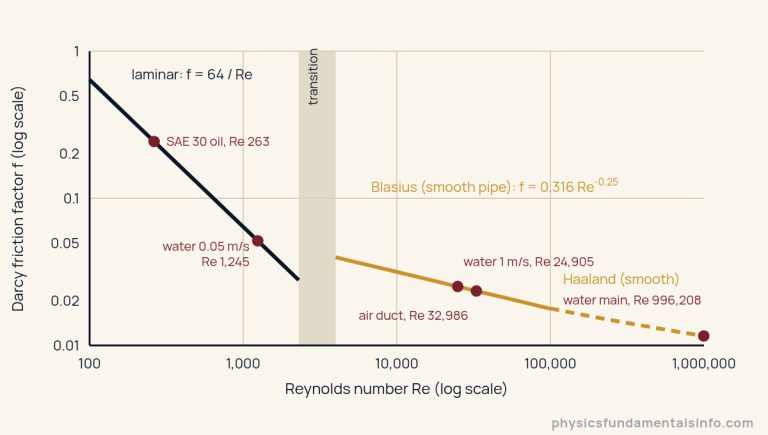
The Darcy friction factor f turns a Reynolds number into a pressure loss. For laminar flow it comes straight from the parabolic profile and holds for Re below 2,300:
For turbulent flow in a hydraulically smooth pipe the Blasius correlation is the standard first estimate, valid from about 4,000 up to 100,000:
Either value goes into the Darcy-Weisbach equation for the pressure drop per metre of pipe:
Above 100,000 a smooth pipe follows the Prandtl or Haaland fits instead, and a rough pipe needs the Colebrook equation or the Moody chart, which the Friction Factor Calculator handles when you give it the roughness. In the transition band no formula is trustworthy, and a careful engineer either avoids the band or designs for the worse of the two neighbouring values.
Entrance length
A flow entering a pipe needs some distance to settle into its final profile, and the Reynolds number sets that distance too. For laminar flow the entrance length is about 0.06 Re D, so water creeping at 0.05 m/s through a 25 mm pipe takes 0.06 × 1,245 × 0.025 m = 1.87 m to become fully developed. Turbulent flow settles far sooner, in about 4.4 Re1/6 D, which is 0.59 m for the same pipe at 1.0 m/s.
Real-World Examples of the Reynolds Number
Water supply pipes
Water at 1.0 m/s in a 25 mm domestic supply pipe has a Reynolds number of 24,905, comfortably turbulent, and a 500 mm trunk main at 2 m/s reaches almost a million. Turbulence costs pumping energy, but it also keeps sediment suspended and mixes disinfectant evenly through the water.
Ventilation ducts
Air at 5 m/s in a 100 mm duct gives Re = 32,986. Air is 830 times less dense than water, but its viscosity is also 55 times lower, so its kinematic viscosity is only 15 times greater and ordinary duct flows are turbulent just as water flows are.
Lubricating oil lines
Oil is different. SAE 30 at 40 °C moving at 0.5 m/s through a 50 mm line sits at Re = 263, deep in the laminar range, and the pressure drop follows the simple 64/Re law. Pump designers like that regime because the loss is predictable and proportional to flow rate.
Blood and the microscopic world
Take the aorta, about 25 mm across, with blood surging through it at up to 1 m/s: with each heartbeat the Reynolds number climbs into the thousands and falls back, so the flow visits the transition band with every beat. A stenosed valve narrows the passage and speeds the jet through it, and the turbulence that results is what a stethoscope picks up as a murmur. In the capillaries the number falls to around 0.001. The same creeping-flow physics governs swimming bacteria and lab-on-a-chip devices, where inertia is so weak that two streams can run side by side without mixing.
Aircraft wings and wind tunnels
A wing at cruise operates at Reynolds numbers of the order of ten million, based on the chord. A model in a wind tunnel is smaller, so to match the full-size number the tunnel must run faster, denser or colder air, a problem NASA Glenn’s Reynolds number page describes for aerodynamic testing. Matching Re is what makes a model test mean something, an idea developed in full under “similarity and dimensional analysis” in MIT’s OpenCourseWare Advanced Fluid Mechanics course.
Common Misconceptions About the Reynolds Number
Misconception 1: 2,300 is a hard switch
Nothing sudden happens at 2,300. Disturbed flow can carry turbulent patches from roughly 2,000 upward, 2,300 is the conventional limit with a margin built in, and by 4,000 almost any real pipe will have gone turbulent. Between those limits the flow can stay laminar, go turbulent, or alternate in slugs, depending on how smoothly the fluid enters the pipe.
Misconception 2: thick fluids have high Reynolds numbers
The viscosity sits in the denominator, so a thicker fluid gives a smaller number, not a larger one. Glycerine has a density 26 per cent higher than water but a viscosity 1,400 times greater, and its Reynolds number in the same pipe at the same speed is about a thousand times lower. Thick and slow is laminar; thin and fast is turbulent.
Misconception 3: the Reynolds number depends on the unit system
It does not, provided every quantity is in one consistent system. The number changes only when a unit slips in unconverted, and the usual culprit is viscosity quoted in mPa·s or centipoise and typed in as if it were Pa·s. A common student slip of exactly that kind turns the 24,905 of the domestic-pipe example into 25.
Misconception 4: any velocity will do
The formula wants the mean velocity, the flow rate divided by the pipe area. A common alternative, the centreline speed, is twice the mean in laminar flow and about 1.2 times the mean in turbulent flow, so using it inflates the Reynolds number by the same factor.
How the Reynolds Number Relates to Other Fluid Concepts
Two of the four inputs are fluid properties, and both have articles of their own. Viscosity is the resistance to shear that appears in the denominator, and its units, from Pa·s to centipoise and centistokes, are where most Reynolds-number errors are born. The density formula supplies the numerator’s ρ and, combined with viscosity, the kinematic viscosity ν.
The Reynolds number also tells you when the frictionless idealisation behind Bernoulli’s principle can be trusted. Bernoulli’s equation ignores viscous losses, and it works well for short, high-Re flows such as air over a wing or water through a nozzle; along a long pipe, the Darcy-Weisbach loss it neglects is exactly what the friction factor above measures, a loss you meet as a fall in pressure from one end to the other.
Outside pipes, the same ratio controls drag force on a moving body. The drag coefficient of a sphere is a function of Reynolds number alone: it falls as 24/Re in creeping flow, levels off near 0.5 through a wide turbulent range, and drops sharply at about 200,000 when the boundary layer itself turns turbulent, the reason golf balls are dimpled.