The flow rate formula is Q = A v: the volume of fluid crossing a fixed section each second equals the area open to the flow multiplied by the mean speed of the fluid. Its SI unit is the cubic metre per second. One rate therefore fixes a different speed in every bore a pipe has.
Turn a garden hose on and the water leaves in a lazy arc. Pinch the end with your thumb and it snaps into a jet that reaches the far hedge. Nothing has been added at the tap — the same litres per second are leaving, through a smaller hole.
That swap is the whole of this page. A flow rate ties an area to a speed, so once the rate is fixed the pipe decides the rest: a narrow section has to run fast, and a wide one is allowed to loiter.
What Is the Flow Rate Formula?
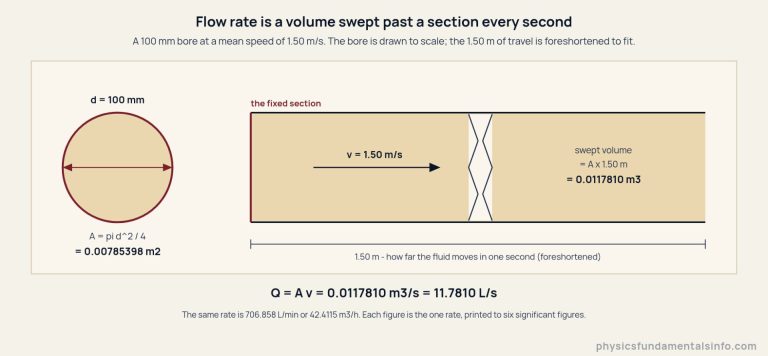
The flow rate formula, Q = A v, says that the volume of fluid passing a fixed section each second is the cross-sectional area of that section times the mean speed of the fluid through it.
Think about one second of flow. Whatever gets past the section in that second is a slug of fluid shaped like the pipe, and its length is just how far the fluid travelled. Divide that volume by the second it took and you have a rate.
Most of the time nobody hands you an area. You are handed a diameter, which is why A = pi d2 / 4 belongs in the same breath as the formula itself. That same circle turns up elsewhere as the area a pressure acts on; here it is the doorway the fluid has to get through, and it is the step most wrong answers die on.
One warning about the letter, before any arithmetic. Q counts litres here, not joules: in Fourier’s law of heat conduction the same symbol carries a flow of heat in watts. Same letter, different quantity, and nothing on this page is an energy.
How to Use the Q = Av Formula, Step by Step
Three numbers and one multiplication: take the bore, turn it into an area, then multiply by the mean speed.
| Symbol | What it is | SI unit | A 100 mm pipe at 1.50 m/s |
|---|---|---|---|
| Q | Volume flow rate: the volume crossing a fixed section each second | cubic metre per second (m3/s) | 0.0117810 m3/s, or 11.7810 L/s |
| A | Cross-sectional area open to the flow | square metre (m2) | 0.00785398 m2 |
| v | Mean speed of the fluid across that section — an average, not a reading from the middle | metre per second (m/s) | 1.50 m/s |
| d | Internal diameter of a round pipe — the inside bore, not a nominal size | metre (m) | 100 mm, which is 0.100 m |
| rho | Density of the fluid, needed only for the mass flow rate | kilogram per cubic metre (kg/m3) | 998.2 for water at 20 C |
| mdot | Mass flow rate, the kilograms crossing that section each second | kilogram per second (kg/s) | 11.7598 kg/s |
| V and t | A volume to be passed, and the time it takes at that rate | cubic metre (m3) and second (s) | 100 L in 8.48826 s |
Now put that pipe through the formula, because arithmetic is easier to trust once you have watched it land. A 100 mm bore gives an area of 0.00785398 m2, and at a mean speed of 1.50 m/s that is 0.0117810 m3/s — 11.7810 litres every second.
Type those same two boxes into the flow rate calculator and it returns 11.78 L/s at its four-figure precision, with the area, the mass flow rate and the fill time printed beside the answer. It will also run the question backwards, which is what you want when the bore is the unknown.
One slip accounts for most wrong answers here, and the area is why. A bore typed in millimetres into a formula that wants metres is out by a factor of a thousand, and squaring it makes the area out by a million. Convert first; multiply second.
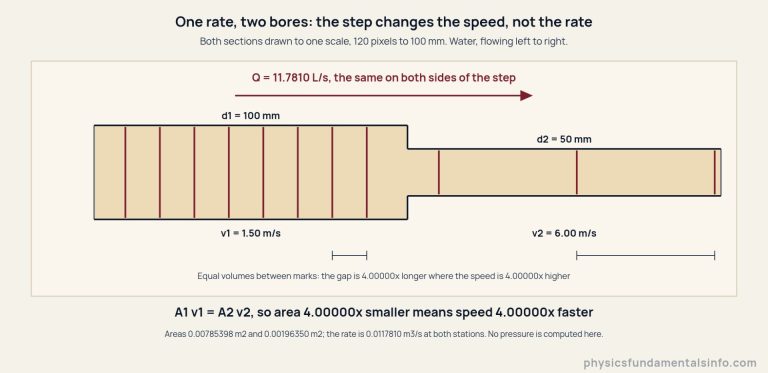
Here is the same pipe as something you can push around. The step in it is the whole point: everything upstream sets the rate, and the bore downstream only decides how fast that rate has to travel.
Flow Rate Units: L/s, L/min and m3/h
The SI unit of flow rate is the cubic metre per second, m3/s, and every other unit you meet is that same quantity rescaled. Litres per second, litres per minute and cubic metres per hour are the three that do the day-to-day work.
One rate, four ways of writing it. The 100 mm pipe above runs at 0.0117810 m3/s, and that is 11.7810 L/s, 706.858 L/min and 42.4115 m3/h — four strings, one flow.
| Unit | One of it, in m3/s | The 100 mm pipe at 1.50 m/s | Where you meet it |
|---|---|---|---|
| m3/s | 1 (the SI unit) | 0.0117810 | Physics and engineering working; every conversion passes through it |
| L/s | 0.001 | 11.7810 | Taps, hoses, laboratory rigs, fire-flow figures |
| L/min | 1/60000 | 706.858 | Pump curves, flow meters, shower and boiler ratings |
| m3/h | 1/3600 | 42.4115 | Water mains, ventilation ducts, process plant |
Two conversions carry most of the traffic: 1 L/s is 60 L/min, and 1 L/s is 3.6 m3/h. Going the other way, divide by the same numbers.
Watch what happens if you convert from a figure you have already rounded. The printed 11.7810 L/s times 60 gives 706.860 L/min, where the unrounded rate gives 706.858 — the sixth digit is wrong because the rounding came first. Carry the full rate through the conversion, then round once, at the end.
Other trades keep the same formula and swap the labels. The US Geological Survey computes a river’s discharge by “multiplying the area of water in a channel cross section by the average velocity of the water in that cross section”, and then quotes it in cubic feet per second or gallons per day. The relation is Q = A v; only the units on the answer have changed.
Why a Narrower Pipe Means a Faster Flow
A narrower section runs faster because the rate reaching it was already fixed upstream, and the only way the same volume per second fits through a smaller opening is to cross it more quickly.
Nothing is stored at a step in a pipe and nothing leaks out of it. So the volume arriving each second has to be the volume leaving each second, which gives continuity its plainest form.
That exponent is where most answers go wrong. Area follows the square of the diameter, so halving the bore quarters the area and the speed must go up four times, not two.
| Downstream bore | Area there (m2) | Mean speed there (m/s) | Flow rate (L/s) | What the lab prints |
|---|---|---|---|---|
| 100 mm (no step) | 0.00785398 | 1.50000 | 11.7810 | same area, same speed |
| 50 mm | 0.00196350 | 6.00000 | 11.7810 | area 4.00000x smaller, speed 4.00000x faster |
| 20 mm | 0.000314159 | 37.5000 | 11.7810 | area 25.0000x smaller, speed 25.0000x faster |
| 200 mm | 0.0314159 | 0.375000 | 11.7810 | area 4.00000x larger, speed 4.00000x slower |
Read down the rate column and nothing moves. Four very different downstream bores, four very different speeds, one rate — because the rate was decided by the 100 mm inlet and its 1.50 m/s, and the step downstream was never consulted.
The two factors are exactly reciprocal, and that is worth taking literally. Work them from the bores in whole millimetres, where (100/50)2 is exactly 4, and the area factor and the speed factor are the same number to every digit printed; divide the two rounded areas instead and you get 3.99999, which is the rounding talking, not the physics.
One thing this section deliberately does not do is tell you what the pressure does across that step. That belongs to Bernoulli’s principle, which trades speed against pressure along a streamline; nothing on this page computes a pressure at all.
Mass Flow Rate: When Kilograms Matter, Not Litres
Mass flow rate is the density times the volume flow rate, mdot = rho Q, and it is the figure you want whenever what is being paid for, heated or lifted is measured in kilograms rather than litres.
NASA’s Glenn Research Center builds it from the same swept slug this page started with: “If the fluid initially passes through an area A at velocity V, we can define a volume of mass to be swept out in some amount of time t”, and dividing that mass by the time gives the mass flow rate. Volume first, then density.
Keep the pipe and the speed fixed, change only the fluid, and see what moves.
| Fluid | Density (kg/m3) | Flow rate (L/s) | Mass flow rate (kg/s) |
|---|---|---|---|
| Water at 20 C | 998.2 | 11.7810 | 11.7598 |
| Air at 20 C | 1.204 | 11.7810 | 0.0141843 |
| Glycerine | 1261 | 11.7810 | 14.8558 |
| SAE 30 oil at 40 C | 876 | 11.7810 | 10.3201 |
The rate column never moves: the volume per second is the same for all four, because Q never asked what was flowing. The mass column runs from 0.0141843 kg/s to 14.8558 kg/s, because the densities behind it run from 1.204 kg/m3 for air to 1261 kg/m3 for glycerine — more than a thousandfold. That spread is the whole reason a gas is metered by mass and not by volume.
Air makes the point loudest. A 200 mm duct at 5.00 m/s moves 157.080 L/s, which sounds like a lot until you weigh it: 0.189124 kg/s, less than a fifth of a kilogram a second. Get the density wrong and the mass flow rate is wrong by exactly that factor, however good the geometry was.
How Long Will It Take to Fill?
Divide the volume by the rate: t = V / Q. A rate is a volume per second, so a volume divided by it comes back as a time.
At the 11.7810 L/s this page keeps returning to, 100 litres is gone in 8.48826 s. Scale the pipe down to something domestic and the arithmetic stops being abstract: a 15 mm pipe at 1.00 m/s carries 0.176715 L/s, or 10.6029 L/min.
That same 15 mm pipe takes 56.5884 s to deliver 10 litres and 9.43140 min to deliver 100. Watch the unit switch rather than the digits: 254.648 s is easier to act on written as 4.24413 min, and at the slowest rate the lab can reach, 1000 litres needs 35.3678 h.
One honest caveat. The division assumes the rate holds steady for the whole fill, which is true of a pump on its duty point and false of a tank emptying under its own falling level — in that case treat the answer as a first estimate and expect the real time to be longer.
Where the Flow Rate Formula Breaks Down
Q = A v is kinematics: it counts volume crossing a section and says nothing about what it would take to drive that flow. Four limits follow from that, and the first and the last are the ones that cost marks.
- It knows nothing about pressure. The formula will happily hand you a speed that no real pump could produce, because no pressure appears in it anywhere. The speed-against-pressure trade is Bernoulli’s department, not this one.
- It assumes the density does not change. One rate at every station is a statement about volume, and it only survives while the fluid is incompressible. For a gas that means well below the speed of sound, 343 m/s in air; the lab applies the same test to water at 1480 m/s, and once a downstream speed crosses the threshold for the fluid you have picked it says so out loud, printing “Past the speed of sound in air – the incompressible rule has gone”.
- Two of the lab’s fluids carry no such warning, and that is deliberate. This site publishes no speed of sound for glycerine or for SAE 30 oil, so no threshold exists for them and none was invented. Treat extreme states in those two fluids as unchecked arithmetic.
- v is a mean, not the fastest speed in the pipe. The v in Q = A v is the average speed across the whole section, so do not put a single probe reading into it and expect the rate; how the speed varies across a real pipe is a Reynolds number question, not this formula’s. And when it is viscosity and a pressure drop that set the rate rather than a pump holding a speed, the law you need is Poiseuille’s, covered with viscosity rather than here.
Common Misconceptions About Flow Rate
“Halving the diameter halves the speed”
It quadruples it. The area carries the square of the diameter, so half the bore is a quarter of the area, and a quarter of the doorway at the same rate needs four times the speed. The 50 mm row in the table above is that arithmetic: 1.50 m/s becomes 6.00000 m/s.
“A bigger pipe gives you a faster flow”
At the same flow rate, a bigger pipe gives you a slower one. Widen the 100 mm section to 200 mm and the water drops from 1.50 m/s to 0.375000 m/s while the rate stays at 11.7810 L/s. A bigger pipe lets you carry more — it does not make what you already have travel faster.
“Flow rate and flow speed are the same thing”
They are different quantities with different units: a rate is measured in m3/s, a speed in m/s. The area is what converts one into the other, which is why a figure like “6 m/s” tells you nothing about how much water is arriving until someone tells you the bore.
“The narrow section must be carrying less water”
It carries exactly the same amount per second. Nothing is stored at the step and nothing escapes, so every litre that enters the wide section leaves through the narrow one — faster, but not in smaller quantity. That identity is the point of the whole page.
“Q means heat”
Not here. The same letter does duty for a heat flow in other corners of physics, and a heat flow rate is measured in watts, not cubic metres per second. On this page Q is a volume crossing a section each second, and nothing on it is an energy.