Watts to amps is the conversion from the power a load uses to the current it draws: divide the watts by the volts, I = P / V. On single-phase AC you also divide by the power factor, I = P / (V × PF), and on balanced three-phase by sqrt(3) as well, with V the line-to-line voltage.
Turn over a kettle, a toaster or a fan heater and the label almost always gives you watts and volts. The figure that decides whether a plug, a lead or a circuit is being asked for too much is in amps, and the label rarely prints it.
Getting from one to the other takes a single division, provided you know which voltage to divide by. That proviso is the whole story. The same 2000 W rating means nearly twice the current in a North American kitchen that it does in a British one, and a modest 60 W lamp on a car battery pulls more current than most people would guess.
The Watts to Amps Formula
To convert watts to amps, divide the power by the supply voltage, and on AC divide by the power factor as well. Three versions cover almost every supply you will meet:
- I — current, in amperes (A). On three-phase it is the current in each of the three line conductors.
- P — real (active) power, in watts (W): the electrical power the load takes from the supply. For a motor this is the electrical input, not the shaft output printed on its nameplate.
- V — supply voltage, in volts (V). On AC it is the rms value; on three-phase it is the line-to-line voltage.
- PF — power factor, a dimensionless number above 0 and at most 1, equal to real power divided by apparent power. It is 1 for a purely resistive load and does not apply to DC.
- sqrt(3) — 1.732051, the factor linking the line-to-line voltage of a balanced three-phase supply to its phase voltage.
For a British kettle at a power factor of 1 the working is one line: 2000 / 230 = 8.696 A. When the supply type or the power factor changes, or you need to run the sum backwards from a known current, the Watts to Amps Calculator switches between all three formulas and prints the apparent power beside the current.
| Supply | Formula | What V means | What I means | Power factor |
|---|---|---|---|---|
| DC | I = P / V | the steady voltage across the load | the current round the circuit | does not apply |
| Single-phase AC | I = P / (V × PF) | the rms supply voltage, such as 230 V or 120 V nominal | the current in the live conductor | 1 for heaters and kettles, below 1 for motors |
| Three-phase AC (balanced) | I = P / (sqrt(3) × V × PF) | the line-to-line voltage, such as 400 V or 480 V | the current in each of the three lines | the whole load’s power factor |
Those three rows are really one equation wearing different clothes. Set PF to 1 and the single-phase version collapses into the DC one; share the same load between three lines and a sqrt(3) appears, for a reason the three-phase section below unpacks.
Try the formula live before reading on. Set the power to 2000 W, then tap the 12, 120, 230 and 400 V buttons one after another: the ammeter swings between 166.7, 16.67, 8.696 and 5.000 A, while the bar chart holds all four at once.
How Many Amps Is 1000 Watts?
A 1000 W load draws 4.348 A on 230 V, 8.333 A on 120 V and 83.33 A on 12 V DC, so the answer depends entirely on the voltage. The table runs the same 1000 W through each common supply, with a power factor of 1 throughout.
| Supply | Voltage | Working | Current drawn by 1000 W |
|---|---|---|---|
| Battery, DC | 12 V | 1000 / 12 | 83.33 A |
| Single-phase, North America nominal | 120 V | 1000 / 120 | 8.333 A |
| Single-phase, UK/Europe nominal | 230 V | 1000 / 230 | 4.348 A |
| Single-phase | 240 V | 1000 / 240 | 4.167 A |
| Three-phase, balanced | 400 V line-to-line | 1000 / (sqrt(3) × 400) | 1.443 A per line |
Read down the last column and a pattern jumps out: current falls as voltage rises. Multiply the voltage by ten, from 12 V to 120 V, and the current falls by a factor of exactly ten, from 83.33 A to 8.333 A. The watts never moved.
Any other load scales by simple proportion, because current rises in step with power at a fixed voltage. A 1500 W space heater on 120 V therefore draws 1.5 × 8.333 = 12.50 A, and half a kilowatt on 230 V would draw half of 4.348 A.
Why Do You Need the Voltage to Convert Watts to Amps?
You need the voltage because a watt measures energy per second while an amp measures charge per second, and the voltage is the energy each unit of charge delivers. Without it, a given number of watts could correspond to any current at all.
Picture charge as a fleet of delivery vans and voltage as the cargo each van carries. A trickle of heavily laden vans can bring as much cargo per hour as a stream of lightly loaded ones. Power counts the cargo arriving each hour; current only counts the vans.
Put the units in and the formula writes itself. The potential difference across a load is the energy each coulomb gives up there, in joules per coulomb, and the electric current is the number of coulombs arriving each second. Multiply them and the coulombs cancel, leaving joules per second.
NIST puts an everyday face on those units. Its introduction to the ampere describes one ampere as one coulomb crossing a point each second, and quotes an 1,800-watt hair dryer drawing 15 amps. That pairing fits a 120 V supply, since 1,800 W divided by 120 V is exactly 15 A.
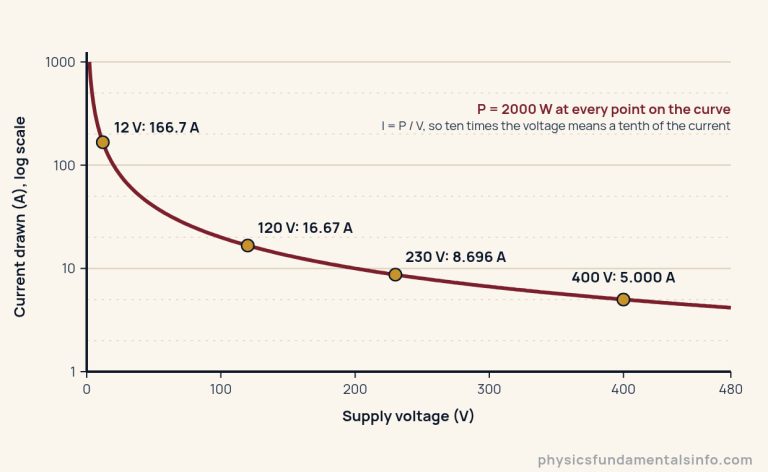
On an ordinary linear axis that curve is a hyperbola hugging the vertical axis, and the 12 V point would shoot off the top of the page. The log scale keeps all four marked supplies in view and shows the current climbing ever more steeply as the voltage falls.
What Is Power Factor, and Why Does It Raise the Current?
Power factor is the share of the supply’s volt-amperes that does useful work: real power in watts divided by apparent power in volt-amperes. When it falls below 1 the supply must deliver more current for the same watts, which is why the AC formula divides by it.
In a kettle element, current and voltage rise and fall in perfect step, so every volt-ampere turns into heat and the power factor is 1. A motor’s windings are different. They store energy in a magnetic field during one part of each cycle and hand it back during the next, which drags the current out of step with the voltage, and that returning current still flows through every wire while delivering no net energy.
- S — apparent power, in volt-amperes (VA): the voltage times the current, which is what the supply and the cables must actually carry.
- Q — reactive power, in volt-amperes reactive (var): the part that surges back and forth each cycle without doing net work.
- PF — power factor, P / S, which is also the cosine of the angle φ between P and S in the power triangle.
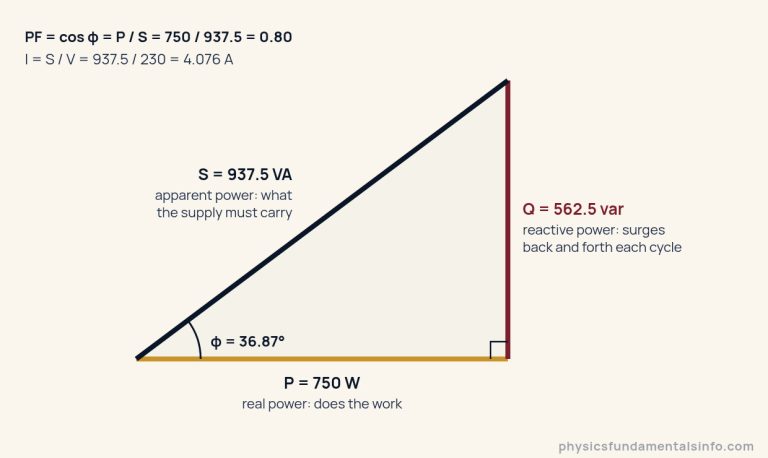
Run the numbers and the penalty is plain. At a power factor of 1 the same 750 W on 230 V would draw 3.261 A; at 0.80 it draws 4.076 A, 1.25 times as much, because 1 / 0.80 = 1.25. None of the extra current does any work, yet the supply, the cables and any generator still have to carry it.
Watts versus volt-amperes
This is why some equipment is rated in VA rather than in W. A generator or a backup supply is limited by the current its windings and electronics can carry as well as by the power its engine or battery can deliver, and the current follows volt-amperes, not watts. For a resistive heater the two numbers coincide; for the motor in Figure 2 the VA figure runs a quarter higher than the watts.
How Does Three-Phase Power Change the Formula?
On a balanced three-phase supply the load’s power is shared between three line conductors, so the current in each line is I = P / (sqrt(3) × V × PF), with V measured between two lines. The sqrt(3) comes from the geometry of three voltages peaking a third of a cycle apart.
Each line sits at the phase voltage relative to neutral: 400 / sqrt(3) = 230.9 V on a 400 V system. Because the three phase voltages point in directions 120° apart, the difference between any two of them is sqrt(3) times the size of either one, and that is how 230.9 V to neutral becomes 400 V from line to line.
Written per phase, the formula looks far less mysterious. Three phases each carrying a third of the power at the phase voltage give I = P / (3 × Vphase × PF), and since 3 × 230.94 = 692.82 = sqrt(3) × 400, the two forms are the same equation.
For a 10 kW load at 400 V and a power factor of 0.85 either form gives 16.98 A in each line. Run the same load as single-phase at 400 V and it would need 29.41 A, sqrt(3) times as much, which is a practical attraction of three-phase for heavy machinery.
The classic slip is mixing the two voltages. Put the 230 V phase figure into the sqrt(3) formula and the 10 kW load appears to draw 29.53 A; divide by 3 instead of sqrt(3) while keeping 400 V and it shrinks to 9.804 A. Only the matched pairs, sqrt(3) with line-to-line or 3 with phase voltage, return the true 16.98 A.
Real-World Examples of Watts to Amps
Reading a rating label
Most appliances print a power rating in watts and a nominal supply voltage, sometimes with a frequency and a symbol for AC. For a resistive appliance such as a kettle or heater (power factor 1), divide the first by the second and you have the current the appliance is designed to draw at full power.
Treat that result as a design figure. Real draw wanders below it whenever a thermostat or a light workload is in charge, and jumps above it for a moment when a motor or a cold lamp first switches on.

One rating, two countries
A kettle built for British mains is rated 2000 W at 230 V and draws 8.696 A. A kettle built to give the same 2000 W on 120 V would need 16.67 A, nearly double, because its element would have a far lower resistance: 7.200 Ω against 26.45 Ω. Same watts, two different kettles, very different current in the flex.
12 V systems
Low-voltage systems feel the formula hardest. A 60 W headlamp on a 12 V car battery draws 5.000 A, while a 60 W lamp on 120 V mains takes just 0.5000 A. Run a 1000 W load directly from 12 V and the battery must supply 83.33 A, and the conductor has to carry all of that without overheating, which is why battery leads are so thick.
Generators, inverters and backup supplies
A portable generator or an uninterruptible power supply often states its capacity in VA or kVA, sometimes alongside a figure in watts. Check both: a motor load at a power factor of 0.80 uses up volt-amperes a quarter faster than its watts suggest. An inverter adds its own losses on top, and Problem 7 below works through what that means for a 12 V battery.
Extension leads and three-phase workshops
Extension leads and multi-way adaptors are rated in amps, not watts. Sum the power of every appliance on one, convert the total to amps at your supply voltage, and check the answer against the current rating marked on the lead itself. A machine taking 10 kW of electrical input from 400 V three-phase at a power factor of 0.85 draws 16.98 A in each line.
Treat all of these as physics estimates, not wiring decisions. The size of a cable and the rating of a fuse or breaker are fixed by local wiring regulations and belong with a qualified electrician.
Common Misconceptions About Watts to Amps
Misconception 1: there is a fixed number of amps per watt
Charts that promise a set number of amps per 1000 watts are silently assuming a voltage. The same 1000 W is 4.348 A at 230 V and 8.333 A at 120 V, so a chart made for one country gives the wrong answer in another.
Misconception 2: more watts always means more amps
Only on the same supply. The 60 W headlamp on 12 V draws 5.000 A, more than half the 8.696 A of a 2000 W kettle on 230 V, while using about one thirty-third of the power.
Misconception 3: a 230 V appliance on 120 V draws extra current to make up its watts
It does the opposite. A heating element is a fixed resistance, not a fixed power, so on the lower voltage the current and the watts both fall. The 26.45 Ω element of a 2000 W, 230 V kettle would take 4.537 A and deliver only 544.4 W on 120 V if its resistance held steady, as Problem 6 works through.
Misconception 4: a motor’s kW rating goes straight into the formula
A motor nameplate gives its mechanical output at the shaft. The electrical input is larger, the output divided by the efficiency, and that input is the P the formula needs. A common student slip is to divide the nameplate kW by the voltage and stop there, which under-reads the current twice over: once for the efficiency and once for the power factor.
How Watts to Amps Relates to Ohm’s Law, Power and Energy Cost
Watts to amps is one corner of a small family of relations. For a resistive load, Ohm’s law, V = I × R, joins the power formula to give three ways of writing the same power: P = V × I = I² × R = V² / R. The last form is how Problem 6 finds a kettle element’s 26.45 Ω from nothing but its label.
The watt itself belongs to mechanics as much as to electricity. Power in physics is the rate of doing work, one joule per second, whether the joules lift a crate or heat a kettle, so the electrical formula and the mechanical one share a unit and a meaning.
On AC, the voltage in every formula here is the rms value: the steady voltage that would deliver the same average power into a resistor. A 230 V supply actually swings to about 325 V at its peaks, and the guide to AC vs DC current explains why the rms figure is the one that belongs in the division.
Current tells you what the wires must carry, not what running the load costs. For that you need energy, the watts multiplied by the hours, which is where electricity cost takes over: a 2000 W kettle running for six minutes uses 0.2 kWh, whatever the current in its cable. The ampere, for its part, is one of the seven SI base units, fixed since 2019 by an exact value of the elementary charge.