Electricity cost is the price you pay for the electrical energy an appliance consumes, calculated as Cost = kWh × rate. Multiply the appliance’s power in kilowatts by the hours it runs to get kilowatt-hours, then multiply that by your tariff’s price per kilowatt-hour. Watts divided by 1000 gives kilowatts.
Your kettle is rated 2000 W. The little box charging your headphones draws 5 W. One of them sounds expensive and one sounds trivial — and over a year, that instinct can be completely wrong.
The bill doesn’t charge you for watts. It charges you for watts multiplied by time, and time is where the surprises hide. Once you can do that multiplication, every appliance in your home stops being a mystery and becomes a number you can predict.
What Is Electricity Cost?
Electricity cost is the amount of money charged for the electrical energy a device uses, found by multiplying the energy consumed in kilowatt-hours by the price your supplier charges per kilowatt-hour.
Think of your meter as a taxi. The watt rating is how fast the fare ticks; the hours are how long you sit in the cab. A fast meter for thirty seconds costs less than a slow meter running all week.
That distinction — rate versus total — is the whole subject. Power (watts) is how quickly energy is transferred. Energy (kilowatt-hours) is how much has been transferred in total. You are only ever billed for the second one.
A quick note on currency before the numbers start. Rates below are written as plain figures, so 0.20 per kWh means 20 cents, 20 pence, or 20 of whatever minor unit appears on your bill. The arithmetic is identical everywhere.
The Electricity Cost Formula
The headline formula is short enough to memorise in one reading.
That version assumes you already know the kilowatt-hours. Most of the time you don’t — you have a wattage from a label and a rough idea of running time, so the working formula expands to this.
Every symbol, with its unit:
- Cost — money charged, in your local currency
- P — the appliance’s power rating, in watts (W)
- t — time the appliance actually runs, in hours (h)
- r — your tariff price, in currency per kilowatt-hour (per kWh)
- 1000 — the conversion from watts to kilowatts (1 kW = 1000 W)
The middle of that expression deserves its own name, because it is the quantity your meter physically counts:
Get E right and the rest is a single multiplication. If you’d rather skip the arithmetic on a real appliance, our Electricity Cost Calculator takes a wattage, a run time and a rate and returns the running cost directly, with the working shown step by step.
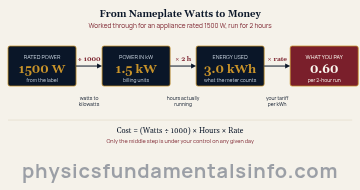
The three-step electricity cost pipeline: watts to kilowatts, kilowatts to kilowatt-hours, kilowatt-hours to money.
How Does Your Meter Turn Watts Into Money?
Your meter measures the energy passing into your home and totals it in kilowatt-hours, and the supplier multiplies that total by the tariff rate. Nothing more mysterious than that is happening behind the little spinning display.
Follow it in four steps for any single appliance.
- Read the power rating. Look for the nameplate or rating label — a small silver or printed panel on the back or base — and find a figure in W or kW.
- Convert to kilowatts. Divide watts by 1000. A 1500 W iron is 1.5 kW.
- Multiply by real running hours. Not hours plugged in — hours actually drawing power. A fridge compressor cycles on and off; a toaster runs for two minutes.
- Multiply by your rate. Take the price per kWh from your bill, not from a headline you half-remember.
Step three is where most estimates go wrong, and it is worth being honest about the uncertainty. A thermostat-controlled device — fridge, freezer, electric heater, air conditioner — spends much of its plugged-in life idle.
In practice, treat any thermostat appliance as running perhaps a third to a half of the time unless you have measured it. A plug-in energy monitor removes the guesswork entirely and usually costs less than one month of the error it corrects.
What Is a kWh, and Why Not Joules?
A kilowatt-hour is the energy transferred by a one-kilowatt device running for one hour, and it equals exactly 3.6 megajoules. Utilities bill in kWh rather than joules purely because the joule is inconveniently small for household quantities.
The conversion falls straight out of the definitions. A watt is one joule per second, and an hour is 3600 seconds, so:
Bill a house in joules and a modest month becomes a nine-digit number. The kilowatt-hour keeps everyday consumption in the range of tens and hundreds — far friendlier on paper.
Strictly, the kWh is not itself an SI unit. The joule is the SI unit of energy, and the kilowatt-hour combines the SI watt with the hour, which the NIST guide to the SI lists as a non-SI unit accepted for use with the SI (1 h = 3600 s). If SI conventions are new to you, our guide to SI units and prefixes covers the naming rules behind kilo-, mega- and the rest.
One more reason the unit sticks: it makes a bill intuitive. A single kWh runs a 10 W LED lamp for exactly 100 hours, or a 2 kW kettle for exactly 30 minutes.
Real-World Examples of Electricity Cost
The fastest way to build intuition is a ready-reckoner you can read off, so here is the arithmetic done for a spread of common wattages at a rate of 0.20 per kWh.
| Power rating | Energy in 1 hour | Cost per hour | Energy for 4 h/day, 30 days | Cost for that month |
|---|---|---|---|---|
| 10 W | 0.010 kWh | 0.002 | 1.2 kWh | 0.24 |
| 50 W | 0.050 kWh | 0.010 | 6.0 kWh | 1.20 |
| 100 W | 0.100 kWh | 0.020 | 12.0 kWh | 2.40 |
| 500 W | 0.500 kWh | 0.100 | 60 kWh | 12.00 |
| 1000 W (1 kW) | 1.000 kWh | 0.200 | 120 kWh | 24.00 |
| 2000 W (2 kW) | 2.000 kWh | 0.400 | 240 kWh | 48.00 |
| 3000 W (3 kW) | 3.000 kWh | 0.600 | 360 kWh | 72.00 |
Read down that last column and the scaling is obvious: cost is directly proportional to wattage when the hours are held fixed. Double the watts, double the bill.
But hold the watts fixed and vary the hours instead, and the ranking scrambles. Here is a year of running for five very different devices, all on one scale.
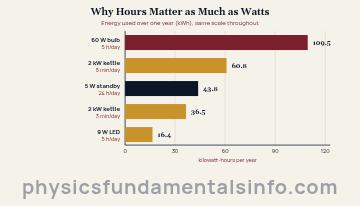
A 5 W device left on permanently uses more energy per year than a 2 kW kettle boiled for three minutes a day.
Three examples worth internalising
The humble light bulb beats the kettle. A single 60 W incandescent bulb burning five hours a day gets through 109.5 kWh a year — more than a 2 kW kettle used for five minutes daily, which comes to 60.8 kWh. The kettle is 33 times more powerful and still loses.
Standby is small but permanent. A 5 W always-on load draws 43.8 kWh over a year. Matching that same five-minute daily kettle would take only about a 7 W permanent load — the sort of trickle a forgotten device in standby can easily supply.
Swapping the bulb is the biggest single win. Replace that 60 W incandescent with a 9 W LED at the same five hours a day and annual use falls from 109.5 kWh to 16.4 kWh. Same light, exactly 85% less energy.
Common Misconceptions About Electricity Cost
Four beliefs cause most of the wrong answers, and three of them are about confusing a rate with a total.
Misconception 1: “A kW and a kWh are basically the same thing”
They measure different quantities, and mixing them is the single most common error in this topic. A kilowatt is power — a rate of energy transfer. A kilowatt-hour is energy — an amount.
The giveaway is that one contains a time and one doesn’t. Saying an appliance “used 3 kW yesterday” is like saying a car “travelled 60 km/h yesterday”: the units answer a different question than the one asked.
Misconception 2: “High-wattage appliances are always the expensive ones”
Wattage alone tells you nothing about cost, because cost depends on the product of wattage and time. A 3 kW appliance run for 20 minutes and a 100 W appliance run for 10 hours consume identical energy — 1.0 kWh each — and cost identical money.
This is why the bar chart above matters more than any list of wattages. A small load that never switches off can quietly out-consume a monster that runs for two minutes.
Misconception 3: “Switching a device off at the socket saves nothing”
Standby draw is real, though usually modest, and it is genuinely continuous. A device idling at 5 W accumulates 43.8 kWh a year — small per hour, meaningful per decade.
Be proportionate, though. Modern equipment often idles well under 1 W, in which case the saving is a rounding error and the effort is better spent on heating, hot water and lighting.
Misconception 4: “My appliance sums should add up to my bill”
They almost never will, because a bill contains charges that have nothing to do with energy consumed. Most tariffs add a fixed daily standing charge, and many add taxes or tiered rates on top.
Work an example. Use 350 kWh in a month at 0.20 per kWh and the energy charge is 70.00 — but add a 12.00 standing charge and the total becomes 82.00, an effective 0.2343 per kWh.
So always divide your actual bill total by your actual kWh to find what you are really paying. Published rates and the number on your statement are rarely the same figure, and the gap widens as consumption falls.
How Electricity Cost Relates to Power, Current and Voltage
Electricity cost sits at the end of a short chain: voltage and current set the power, power and time set the energy, energy and rate set the cost. Each link is a topic in its own right.
When an appliance has no wattage printed on it — common on older equipment — you can still recover it from the voltage and current on the label. For a resistive load on mains supply:
- P — power, in watts (W)
- V — supply voltage, in volts (V)
- I — current drawn, in amperes (A)
That relationship comes straight out of the circuit fundamentals covered in our guide to Ohm’s law, which also derives the useful variants P = I2R and P = V2/R for when you know the resistance instead.
The V in that equation is the potential difference across the appliance — the energy each coulomb of charge delivers as it passes through. The I is the electric current, the rate at which that charge flows.
Multiply the two and you get the rate of energy delivery, which is exactly what physicists mean by power. Integrate power over time and you are back to energy — the quantity your meter has been counting all along.
One caution for AC circuits. On alternating supply, V and I are quoted as RMS values, and for loads with motors or electronics the true power is lower than V × I by a power factor. For domestic estimates the nameplate wattage already accounts for this, so use it when it is available.
Where the rate itself comes from
Your price per kWh is set by your supplier and varies enormously by country, region and time of day. National statistical agencies publish averages — the US Energy Information Administration’s electricity data is one such source — but an average is a poor substitute for your own tariff.
Time-of-use tariffs make the timing matter as much as the total. Shifting a dishwasher or an EV charge into an off-peak window can cut the cost of identical energy by half or more, as the last worked problem below shows.
Worked Problems
Show Solution
Solution:
Step 1: Energy in kilowatt-hours is E = P × t ÷ 1000, then Cost = E × r.
Step 2: E = 60 W × 5 h ÷ 1000 = 0.3 kWh
Step 3: Cost = 0.3 kWh × 0.17 per kWh = 0.051
Answer: 0.051 per day — about 5 units of currency per hundred days (2 s.f.)
Show Solution
Solution:
Step 1: The rating is already in kilowatts, so no division by 1000 is needed.
Step 2: Daily energy = 1.5 kW × 3 h = 4.5 kWh
Step 3: Monthly energy = 4.5 kWh × 30 = 135 kWh
Step 4: Cost = 135 kWh × 0.20 per kWh = 27.00
Answer: 135 kWh, costing 27.00 for the month
Show Solution
Solution:
Step 1: Running hours = 24 h/day × 365 days = 8760 h
Step 2: E = 5 W × 8760 h ÷ 1000 = 43.8 kWh
Step 3: Cost = 43.8 kWh × 0.17 per kWh = 7.446
Answer: 43.8 kWh per year, costing 7.45 (3 s.f.)
Show Solution
Solution:
Step 1: Find power from P = V × I.
Step 2: P = 230 V × 8.7 A = 2001 W = 2.001 kW
Step 3: Convert time to hours: t = 4 min ÷ 60 = 0.06667 h
Step 4: Daily energy = 2.001 kW × 0.06667 h = 0.1334 kWh
Step 5: Annual energy = 0.1334 kWh × 365 = 48.69 kWh
Step 6: Cost = 48.69 kWh × 0.25 per kWh = 12.17
Answer: 48.7 kWh per year, costing 12.17 (4 s.f.)
Show Solution
Solution:
Step 1: Work with the power difference, since the running hours are identical.
Step 2: ΔP = 60 W – 9 W = 51 W
Step 3: Annual energy saved = 51 W × 5 h × 365 ÷ 1000 = 93.075 kWh
Step 4: Annual money saved = 93.075 kWh × 0.17 per kWh = 15.82
Step 5: Payback time = 3.00 ÷ 15.82 per year = 0.1896 years
Step 6: 0.1896 years × 365 days = 69.2 days
Answer: about 69 days to pay back, then 15.82 saved every year after (3 s.f.)
Show Solution
Solution:
Step 1: Use the exact conversion 1 kWh = 1000 W × 3600 s = 3.6 × 10⁶ J.
Step 2: E = 135 kWh × 3.6 × 106 J/kWh = 4.86 × 10⁸ J
Step 3: Convert to megajoules: 4.86 × 10⁸ J ÷ 106 = 486 MJ
Answer: 4.86 × 10⁸ J, or 486 MJ
Show Solution
Solution:
Step 1: Useful heat required is Q = mcΔT.
Step 2: ΔT = 60 °C – 15 °C = 45 K
Step 3: Q = 150 kg × 4180 J/(kg·K) × 45 K = 28 215 000 J = 28.215 MJ
Step 4: Convert to kWh: 28 215 000 J ÷ 3.6 × 10⁶ J/kWh = 7.8375 kWh of useful heat
Step 5: Account for efficiency — the meter records the input, not the output: E = 7.8375 kWh ÷ 0.90 = 8.708 kWh
Step 6: Cost = 8.708 kWh × 0.17 per kWh = 1.480
Answer: 8.71 kWh drawn from the supply, costing 1.48 (3 s.f.)
Show Solution
Solution:
Step 1: The battery stores 60 kWh, but losses mean the meter records more than that. Energy drawn = stored energy ÷ efficiency.
Step 2: E = 60 kWh ÷ 0.92 = 65.22 kWh
Step 3: Off-peak cost = 65.22 kWh × 0.09 per kWh = 5.870
Step 4: Peak cost = 65.22 kWh × 0.28 per kWh = 18.26
Step 5: Saving = 18.26 – 5.87 = 12.39
Answer: 65.2 kWh drawn; 5.87 off-peak against 18.26 at peak, a saving of 12.39 per charge (4 s.f.)