Watts to amps is the step from the power a load uses to the current it draws, I = P / V for direct current. This free watts to amps calculator divides the watts by the supply voltage, and by the power factor and sqrt(3) where alternating current calls for them, so one box covers DC, single-phase and balanced three-phase supplies.
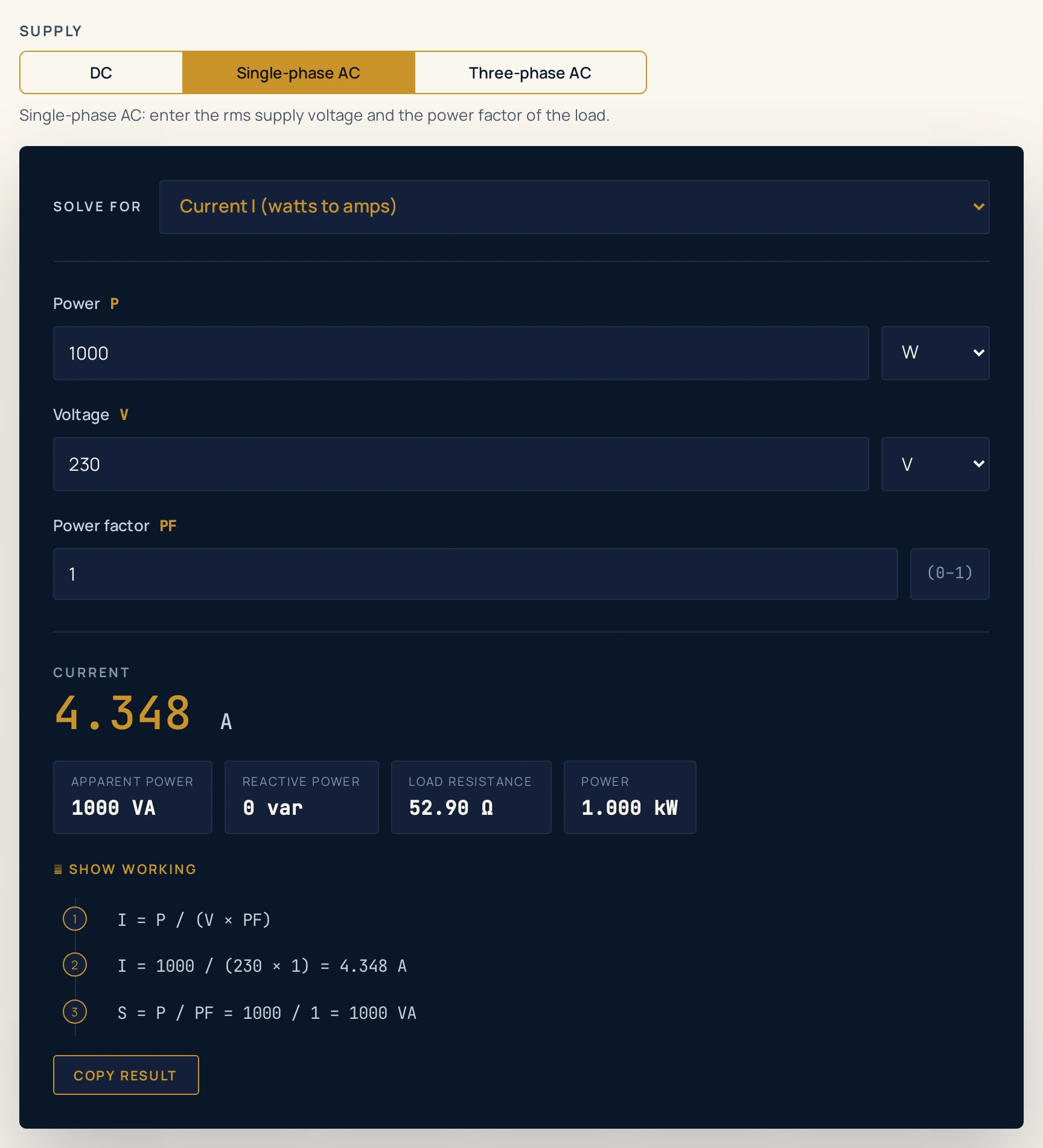
Single-phase AC: enter the rms supply voltage and the power factor of the load.
Load a real case
Each button chooses the supply type, writes the watts, volts and power factor into the boxes, and puts the tool back on solving for current if you had changed it. The line underneath then quotes the current the calculator itself displays, not a stored answer.
Pick a case above, or type your own numbers.
What Is the Watts to Amps Calculator?
The watts to amps calculator is a free online tool built on I = P / V for direct current, I = P / (V · PF) for single-phase AC and I = P / (sqrt(3) · V · PF) for balanced three-phase AC, where V is the line-to-line voltage. Pick the supply, enter the power, the voltage and the power factor, and it returns the current with the apparent power and every step of the working; switch Solve for to turn amps back into watts or to find the voltage needed.
| Symbol | Quantity | Default unit | Also accepts | Example value |
|---|---|---|---|---|
| P | Power | W | kW | 1000 |
| V | Voltage | V | kV | 230 |
| PF | Power factor | — | — | 1 |
| I | Current | A | mA | 4.348 |
How to use the watts to amps calculator
- Pick the supply. Press DC, Single-phase AC or Three-phase AC above the boxes. DC hides the power factor box, because the idea has no meaning for a steady current, and three-phase renames the voltage box Line-to-line voltage. If you are unsure which button your supply needs, the guide to AC and DC current separates the mains flow that reverses direction many times a second from the one-way flow of a battery.
- Enter the power. Type the load's power in W or kW, the figure on its rating label. For a motor, enter the electrical input power: the kW on a motor nameplate is the shaft output, and the input is that divided by the efficiency from the data sheet.
- Enter the voltage. On single-phase this is the rms supply voltage, such as 230 V (UK/Europe nominal) or 120 V (North America nominal). On three-phase it is the voltage between two lines, such as 400 V or 480 V.
- Enter the power factor. Use 1 for a kettle, a heater or a filament lamp, and the nameplate figure for a motor. Anything above 1, or 0 and below, is refused.
- Read the result and the extras. The headline is the current. On AC the extras give the Apparent power in VA and the Reactive power in var; Load resistance appears on DC and on single-phase at a power factor of 1, Phase voltage on three-phase, and Power in kW on every supply.
- Solve the other way. The Solve for menu turns the tool into an amps to watts converter (Power) or finds the voltage a given power and current imply (Voltage). Open Show working to see the formula for the supply you picked, with your numbers in it.
The headline figure trims trailing zeros, so a 1500 W heater on 120 V shows 12.5 A while the working line, which always carries four significant figures, ends in 12.50 A. They are the same number. The same happens with the headlamp, which shows 5 A in the headline and 5.000 A in the working.
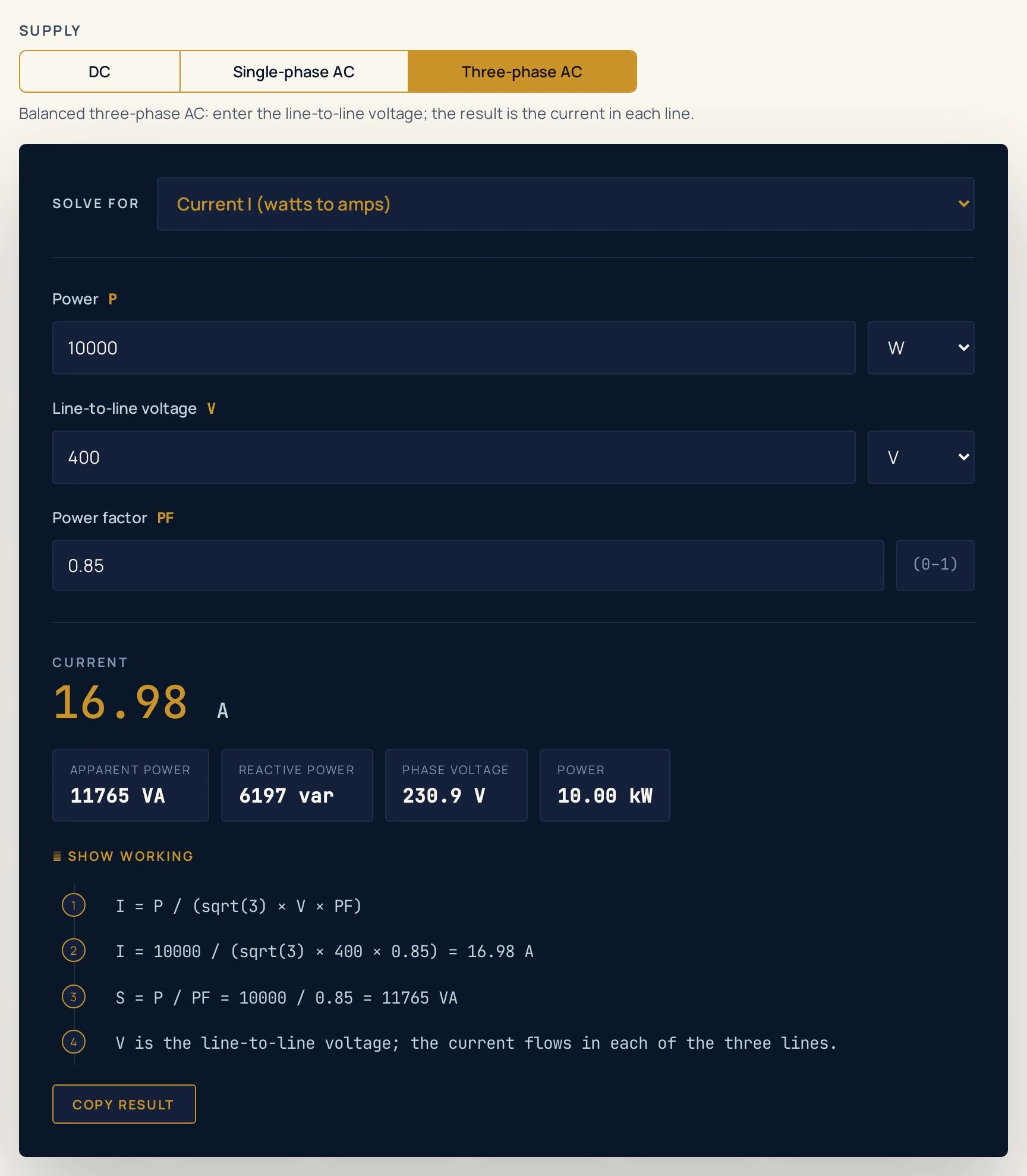
Three slips account for most wrong answers. On three-phase, typing the phase voltage of 230 V instead of the line-to-line 400 V turns the motor preset's 16.98 A into 29.53 A. Leaving the power factor at 1 for a motor under-reads the current, and typing 2000 with kW selected, when watts were meant, asks for 2000 kW and returns 8696 A.
Worked example: change one thing at a time
Start from the kettle and move as little as possible per row, except at row 7, which jumps to a new load. Every figure in the table is the string the calculator itself displays for those inputs, so if the table and the tool ever disagree, the tool is right. A dash means the calculator shows no such extra for that supply.
| Step | Supply | Power entered | Voltage entered | Power factor | Current, amps | Apparent power | Reactive power | Load resistance |
|---|---|---|---|---|---|---|---|---|
| Start: kettle on UK/EU mains | Single-phase | 2000 W | 230 V | 1 | 8.696 | 2000 VA | 0 var | 26.45 Ω |
| Voltage to 120 V | Single-phase | 2000 W | 120 V | 1 | 16.67 | 2000 VA | 0 var | 7.200 Ω |
| Power to 1500 W | Single-phase | 1500 W | 120 V | 1 | 12.5 | 1500 VA | 0 var | 9.600 Ω |
| Back to 230 V at 1000 W | Single-phase | 1000 W | 230 V | 1 | 4.348 | 1000 VA | 0 var | 52.90 Ω |
| Power factor to 0.8 | Single-phase | 1000 W | 230 V | 0.8 | 5.435 | 1250 VA | 750.0 var | — |
| Power to 750 W | Single-phase | 750 W | 230 V | 0.8 | 4.076 | 937.5 VA | 562.5 var | — |
| A workshop load at 400 V | Single-phase | 10 kW | 400 V | 0.85 | 29.41 | 11765 VA | 6197 var | — |
| Switch to three-phase | Three-phase | 10 kW | 400 V | 0.85 | 16.98 | 11765 VA | 6197 var | — |
| Power factor to 1 | Three-phase | 10 kW | 400 V | 1 | 14.43 | 10000 VA | 0 var | — |
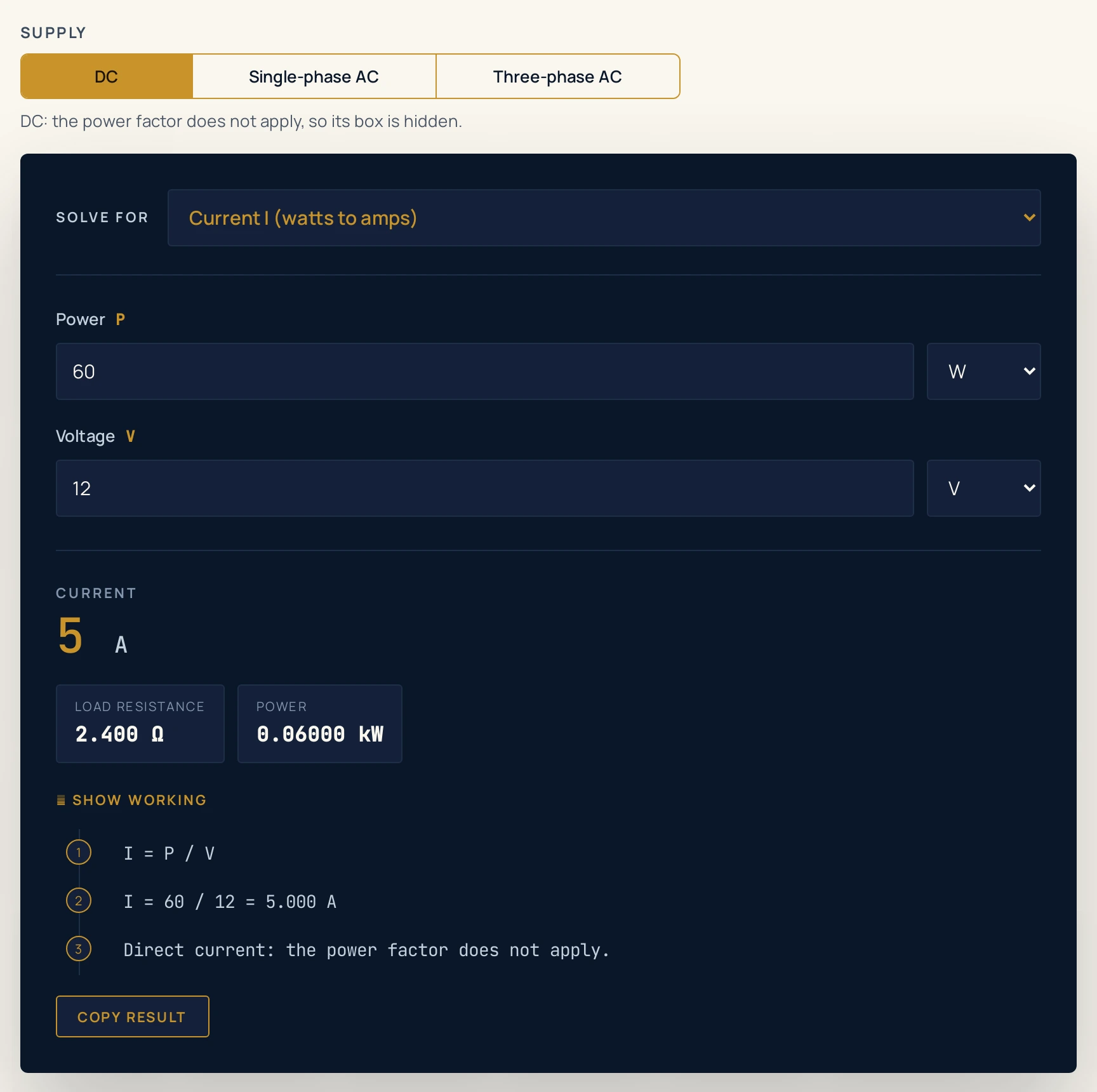
| Switch to DC: a 12 V headlamp | DC | 60 W | 12 V | — | 5 | — | — | 2.400 Ω |
Rows 1 to 3 hold the watts and change the voltage, then the watts; for the voltage half of that, the watts to amps simulator puts one load's current at 12, 120, 230 and 400 V side by side as a bar chart. Keeping 2000 W in the power box while the voltage box drops from 230 V to 120 V multiplies the current by 230/120 = 1.917, to 16.67 A, and that describes a second kettle whose element was designed for 120 V. The resistance extra shows it, falling from 26.45 Ω to 7.200 Ω, and the item Two kettles, not one further down gives what the first kettle would really do on 120 V.
Rows 4 to 6 show what the power factor does. At 1000 W and 230 V, lowering it from 1 to 0.8 lifts the current by 1/0.8 = 1.25, from 4.348 A to 5.435 A, while the watts stay put and the apparent power rises to 1250 VA. The resistance extra disappears, because below a power factor of 1 the load is no longer a plain resistor.
Rows 7 to 9 are the motor preset reached one change at a time. Treating 10 kW at 400 V as single-phase gives 29.41 A; pressing Three-phase AC divides that by sqrt(3) = 1.732, to 16.98 A in each line, and the phase voltage extra reads 230.9 V. Raising the power factor to 1 brings it to 14.43 A, smaller by the factor 1/0.85 = 1.176.
Row 10 is the headlamp on DC. The power factor box is hidden, the extras shrink to the load resistance and the power, and 60 W on 12 V comes out at 5 A, ten times the 0.5 A that the same 60 W needs on 120 V.
Formula and symbol reference
The calculator uses three forms of one idea: I = P / V for DC, I = P / (V × PF) for single-phase AC and I = P / (sqrt(3) × V × PF) for balanced three-phase AC. The extras come from S = P / PF, Q = S × sqrt(1 - PF²) and R = V / I; the reverse modes rearrange the same equations, P = V × I × PF and V = P / (I × PF), with sqrt(3) added on three-phase. The R = V / I extra is Ohm's law, offered only where the load behaves as a plain resistor.
| Symbol | Meaning | SI unit | Typical range |
|---|---|---|---|
| P | Real (active) power of the load, in watts: the electrical input, never a motor's shaft output | watt, W | 60 W for a car headlamp, 1500 W for a space heater, 2000 W for a kettle, 10 kW for a workshop motor's electrical input. |
| V | The voltage the load is connected to: its rms value on AC, measured between two lines on three-phase | volt, V | 12 V DC; 120 V (North America nominal) and 230 V (UK/Europe nominal) single-phase; 400 V and 480 V line-to-line three-phase. |
| I | The headline result in amps; on three-phase, what each line carries | ampere, A | 0.5 A for a 60 W lamp on 120 V, 8.696 A for a kettle on 230 V, 16.98 A per line for the motor taking 10 kW of electrical input. |
| PF | Watts over volt-amperes for the load; hidden and ignored on DC | none (a ratio) | 1 for heaters, kettles and filament lamps; 0.8 and 0.85 in this page's motor examples. The tool accepts any value above 0 up to 1. |
| S | Apparent power, P / PF: what the supply has to carry | volt-ampere, VA | Equal to P at a power factor of 1; 937.5 VA for 750 W at 0.8; 11765 VA for 10 kW at 0.85. |
| Q | Reactive power, S × sqrt(1 - PF²): the part that flows back and forth without doing work | volt-ampere reactive, var | 0 var at a power factor of 1; 562.5 var for 750 W at 0.8; 6197 var for 10 kW at 0.85. |
| R | Load resistance, V / I: shown for DC and for single-phase at a power factor of 1 | ohm, Ω | 2.400 Ω for the 12 V headlamp, 7.200 Ω for a 2000 W kettle built for 120 V, 26.45 Ω for one built for 230 V. |
| sqrt(3) | The three-phase factor linking line-to-line voltage, phase voltage and line current | none | 1.732051. Phase voltage = V / sqrt(3), so 400 V line-to-line is 230.9 V line-to-neutral. |
The physics: why the supply type changes the current
A volt is a joule per coulomb, and an amp of electric current is a coulomb per second, so volts times amps is joules per second, which is watts. That is the whole of the DC case, and it is why the calculator refuses to answer without a voltage: the same power can arrive as many coulombs at a low voltage or a few at a high one.
On AC the supply has to carry the Apparent power extra, not just the watts. When voltage and current fall out of step, as they do in a motor, part of the current surges back and forth doing no net work, and the Reactive power extra measures that part, while the number in the power factor box is simply watts over volt-amperes. Dividing by it is what makes the current rise when the power factor falls.
A three-phase supply shares the load between three live conductors whose voltages are staggered evenly through each cycle. The voltage between two lines is sqrt(3) times the voltage from each line to neutral, so the calculator divides by sqrt(3) as well and reports the current in each line, with the line-to-neutral figure as the Phase voltage extra.
Where the conversion breaks down
The arithmetic is exact. What goes wrong is the number typed into the power box, the power factor assumed for the load, or the supply the formula takes for granted.
- A rating is not a measurement
- The watts on a label are what the appliance is rated for, and the current the tool returns is the current at that rating. Real draw moves around it: a thermostat switches a heater on and off, and a motor running light takes far less than its full-load figure.
- Symptom: a clamp meter reading well below the calculated current on a lightly loaded machine.
- A motor's kW is its output
- Motor nameplates rate the mechanical power at the shaft, and the motor takes more than that from the supply. What belongs in the power box is the electrical input, shaft kW over efficiency; that efficiency belongs to the particular motor, so take it from its data sheet and verify before use rather than guessing one.
- The first moment after switch-on
- The result is the current once the load has settled into steady running. For a moment after switch-on, a motor that has not yet spun up or a lamp whose filament is still cold takes far more, and nothing in the boxes can show that surge.
- Resistance that changes with temperature
- The Load resistance extra is V / I at the rated power, which for a lamp is the hot filament. A multimeter on the cold lamp reads lower, because a metal filament's electrical resistance rises as it heats.
- Loads that distort the current
- Switch-mode power supplies, chargers and LED drivers draw current in short pulses rather than a smooth sine wave. The formula still holds if the power factor you enter is the true one, which includes that distortion, but a figure that describes only the phase shift under-reads the current.
- Unbalanced three-phase
- The three-phase formula assumes the same current in all three lines. If the phases are loaded unequally, work each one as a single-phase load on the phase voltage the three-phase extra reports, 230.9 V for a 400 V supply, and expect a different current in each line.
- Two kettles, not one
- The two kettle presets describe a 2000 W kettle built for each voltage. Plug the 26.45 Ω element of a 230 V kettle into 120 V and, if its resistance stayed constant, it would draw 4.537 A and give only 544.4 W. The watts on a label hold only at the voltage the appliance was built for, which the watts to amps guide follows through as a fixed-resistance problem.
None of this is installation advice. Cable sizes, fuses and circuit breakers are chosen under local wiring regulations, by a qualified electrician, and the current this tool returns is only the starting point of that work.
Where it is actually used
- Three-phase workshop machines
- Press Single-phase AC with the motor preset loaded and the headline climbs from 16.98 A to 29.41 A, the same 10 kW of electrical input squeezed through one pair of conductors. That factor of sqrt(3) less current per conductor is part of why larger machines are wired for three-phase.
- Generators and UPS units rated in VA
- The VA figure on a backup supply caps the current it can deliver, and a separate watt figure, where one is given, caps the power. Run each load through the tool, add up the Apparent power extras and compare the total with the VA figure; simple addition errs on the safe side.
- 12 V battery and solar systems
- Low voltage means high current for the same power. The headlamp preset needs 5 A at 12 V, and on DC a 1000 W load would need 83.33 A, which is why low-voltage systems use heavy cables and keep their loads small.
- Extension leads and adaptors
- A lead or adaptor is rated for a maximum current, and the rating printed on the lead is the figure to compare against. Add the watts of everything plugged into it, enter the total, and set the result beside that printed rating.
- Reading a rating label
- Most appliances print their watts and their supply voltage, but not their current. For a heater, kettle or other resistive appliance, type the two figures into the boxes with a power factor of 1 and the headline is the current at full power.
- Checking a circuit with Ohm's law
- On DC, or single-phase at a power factor of 1, the resistance extra gives you the load as a plain resistor, so that figure can go straight into the Ohm's law calculator as a check. The 12 V headlamp behaves as 2.400 Ω, and 12 V across 2.400 Ω gives back the same 5 A.
Where to go next
For the reasoning behind the three formulas, with worked problems that go step by step, read the guide Watts to Amps: Conversion and Formula, and for the relation the resistance extra rests on, the article on Ohm's law. Take the load resistance to the Ohm's law calculator, or the same watts to the electricity cost calculator to see what the load costs to run. Or browse the library of physics simulations.
Frequently asked questions
Why won't the calculator give a current until the voltage box is filled?
Because a wattage on its own fixes only the product of voltage and current, and endless pairs of the two multiply to the same figure. Clear the voltage box and the result area asks for it instead of guessing; type 230 against the default 1000 W and it answers 4.348 A, then type 120 and it answers 8.333 A. Those are two different appliances, each designed around the supply it runs on.
Which formula does the calculator use for DC, single-phase and three-phase?
DC uses I = P / V, and single-phase AC uses I = P / (V × PF), with V the rms supply voltage. With Three-phase AC pressed it switches to I = P / (sqrt(3) × V × PF), reading the voltage box as line-to-line and reporting the current carried by each line. For three-phase, enter the line-to-line figure, such as 400 V or 480 V, not the phase voltage; the tool shows the phase voltage as an extra.
What is power factor and where do I find it?
Power factor is the ratio of real power in watts to apparent power in volt-amperes, a number above 0 and at most 1. It is 1 for resistive loads such as heaters, kettles and filament lamps, and below 1 for motors and other inductive loads, whose nameplates usually state it. If you cannot find it, the current you get with 1 entered is the smallest the load could draw, not the actual figure.
Which figure should I compare with a VA rating?
The Apparent power extra, which the calculator shows on both AC supplies. It matches the watts only while the power factor box holds 1, and grows as that number falls: 750 W at 230 V with a power factor of 0.8 reads 937.5 VA. Many generators and UPS units state a VA figure and a watt figure, so hold the extra against the first and the power you typed against the second.
How do I convert amps to watts?
Change Solve for to Power and enter the current, the voltage and the power factor. On a single-phase supply at a power factor of 1, 13 A at 230 V gives 2990 W and 15 A at 120 V gives 1800 W. On three-phase the tool multiplies by sqrt(3) as well, so 16.98 A at 400 V and a power factor of 0.85 comes back as 9999 W, the rounded current costing one watt.
Why is a motor's nameplate kW not its electrical input power?
A motor rating in kW describes the mechanical power it delivers at the shaft, and some of the energy it takes in is lost as heat inside it. To fill the power box, divide the shaft kW by the efficiency printed on the motor data sheet. Nothing on the page guesses an efficiency, which is why the three-phase preset is labelled as 10 kW of electrical input.
What does the page's default 1000 W case show?
A 1000 W resistive load on 230 V single-phase at a power factor of 1, which the headline turns into 4.348 A. Because nothing is out of step, the apparent power extra matches the 1000 W, the reactive power reads 0 var and the load resistance extra gives 52.90 ohms. Overwrite any box to start your own case, and the working under Show working follows your numbers.
References & formula source
- Halliday, Resnick & Walker — Fundamentals of Physics, the chapters on current and resistance (power in electric circuits) and on alternating current (power factor).
- Young & Freedman — University Physics, the chapters "Current, Resistance and Electromotive Force" and "Alternating Current".
- BIPM — The International System of Units (SI brochure): the definitions of the ampere, the volt and the watt.
- Further reading: Electric power — Wikipedia