A magnetic field is a region of space around a magnet or moving electric charge in which a magnetic force acts on other moving charges, electric currents and magnetic materials. Its strength is measured in tesla (T), and the force on a charge q moving at speed v is given by F = qvB sin θ.
Stick a note to your fridge and you have just used one. Swipe your phone onto a wireless charger, watch a compass needle settle towards north, slide into an MRI scanner — every one of these leans on the same invisible thing.
You cannot see it, yet it steers the electrons painting your screen, spins the motor in your washing machine, and wraps the whole planet in a protective shell. Understanding the magnetic field is really understanding how moving electricity and magnetism turn out to be two faces of one force.
What Is a Magnetic Field?
Think of the space around a bar magnet as “loaded”. Bring a second magnet, a compass, or a moving charge into that space and it feels a push or a twist; take it far away and the effect fades. That loaded region is the magnetic field.
More precisely, a magnetic field is a vector field — every point in space has both a strength and a direction. Physicists give it the symbol B and call it the magnetic flux density. Its direction at any point is the way the north-seeking end of a tiny compass would point if you placed it there.
Two things create these fields, and they are secretly the same thing: moving electric charge (a current in a wire) and permanent magnets (where the “current” is the spin of electrons inside the material). A stationary charge makes only an electric field. Set it moving, and a magnetic field appears.
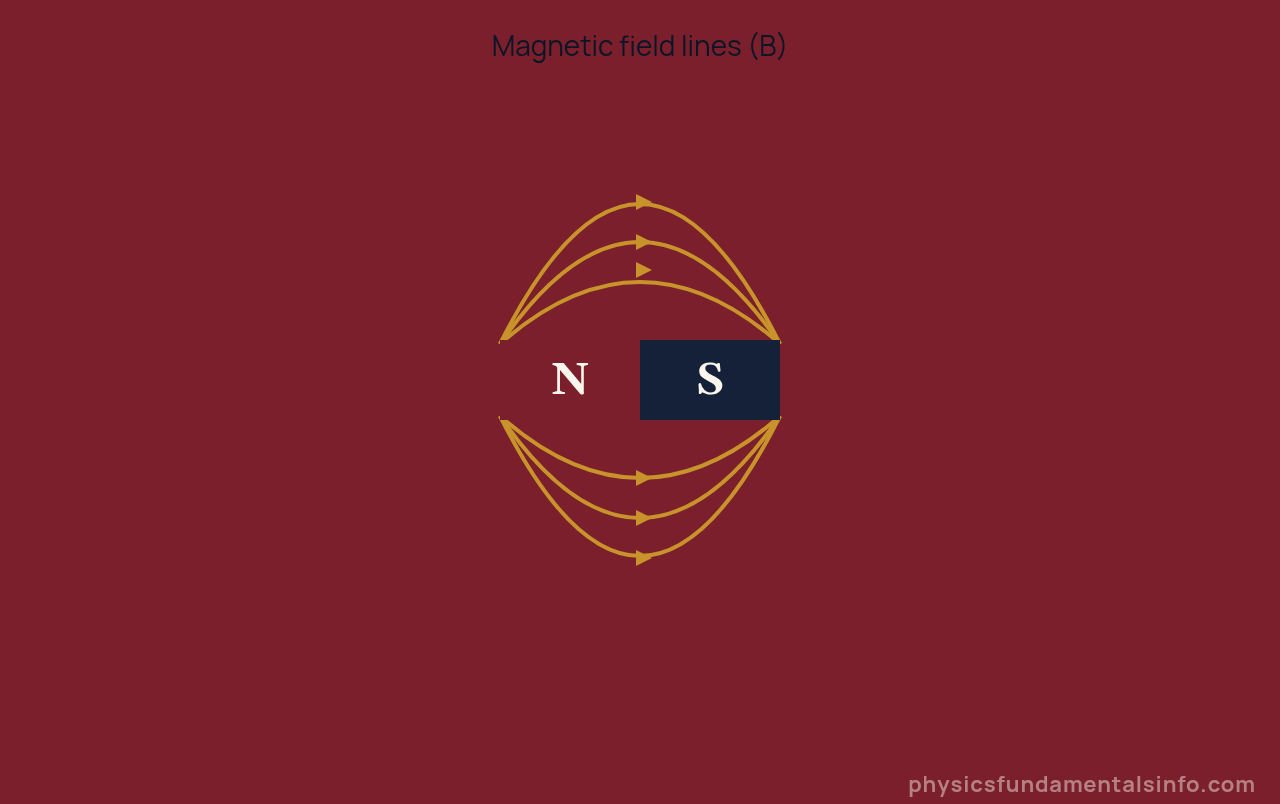
Figure 1: Field lines leave the north pole and enter the south pole, always forming closed loops. The arrows show the direction of B.
Magnetic field lines: a useful picture, not a real string
We draw magnetic fields as lines for a reason. The density of the lines shows the field’s strength — packed tightly near the poles, spread out far away — and the arrows show its direction. Where the lines crowd together, the field is strong.
But a quick warning you will need later: those lines are a model, not physical wires. The field is smooth and continuous everywhere between them. And unlike electric field lines, magnetic field lines never start or stop — they always close into loops, because there are no isolated magnetic “charges”.
The Magnetic Force Formula: F = qvB sin θ
How do we measure something invisible? We measure the force it produces. The strength of a magnetic field is defined by the force it exerts on a moving charge, and that gives us the central equation of magnetism.
Here every symbol carries an SI unit, so let’s pin them all down:
- F — the magnetic force on the charge, in newtons (N).
- q — the size of the moving charge, in coulombs (C).
- v — the charge’s speed, in metres per second (m/s).
- B — the magnetic flux density (field strength), in tesla (T).
- θ — the angle between the velocity v and the field B (dimensionless).
The sin θ term matters. A charge that races along the field lines (θ = 0°) feels no force at all, because sin 0° = 0. A charge that cuts straight across the field (θ = 90°) feels the maximum force, and the formula simplifies to the version most people remember:
How the magnetic force changes with angle
It is worth seeing that angle dependence laid out in full, because the two extremes are exactly where students lose marks.
| Angle θ between v and B | sin θ | Magnetic force F | Path of the charge |
|---|---|---|---|
| 0° — moving along the field | 0 | 0 (no force at all) | Straight line, undeflected |
| 30° | 0.50 | 0.50 qvB | Wide, stretched-out helix |
| 45° | 0.71 | 0.71 qvB | Helix |
| 60° | 0.87 | 0.87 qvB | Tighter helix |
| 90° — cutting across the field | 1 | qvB (maximum) | Perfect circle, radius r = mv/(qB) |
| 180° — moving against the field | 0 | 0 (no force at all) | Straight line, undeflected |
In practice a real particle rarely arrives at exactly 0° or 90°. Any angle in between splits the velocity into a component along B, which feels nothing and carries the particle steadily forward, and a component across it, which curls the particle round.
Add those two motions together and you get a helix — the path of a stretched spring. It is why charged particles from the Sun spiral down Earth’s field lines instead of falling straight in.
Strictly, the force is a vector product, F = q v × B, which is why the magnetic field B is formally defined through this Lorentz force law (see Georgia State University’s HyperPhysics reference). Once you have the numbers, you can work out the force on any moving charge instantly with our Magnetic Force Calculator.
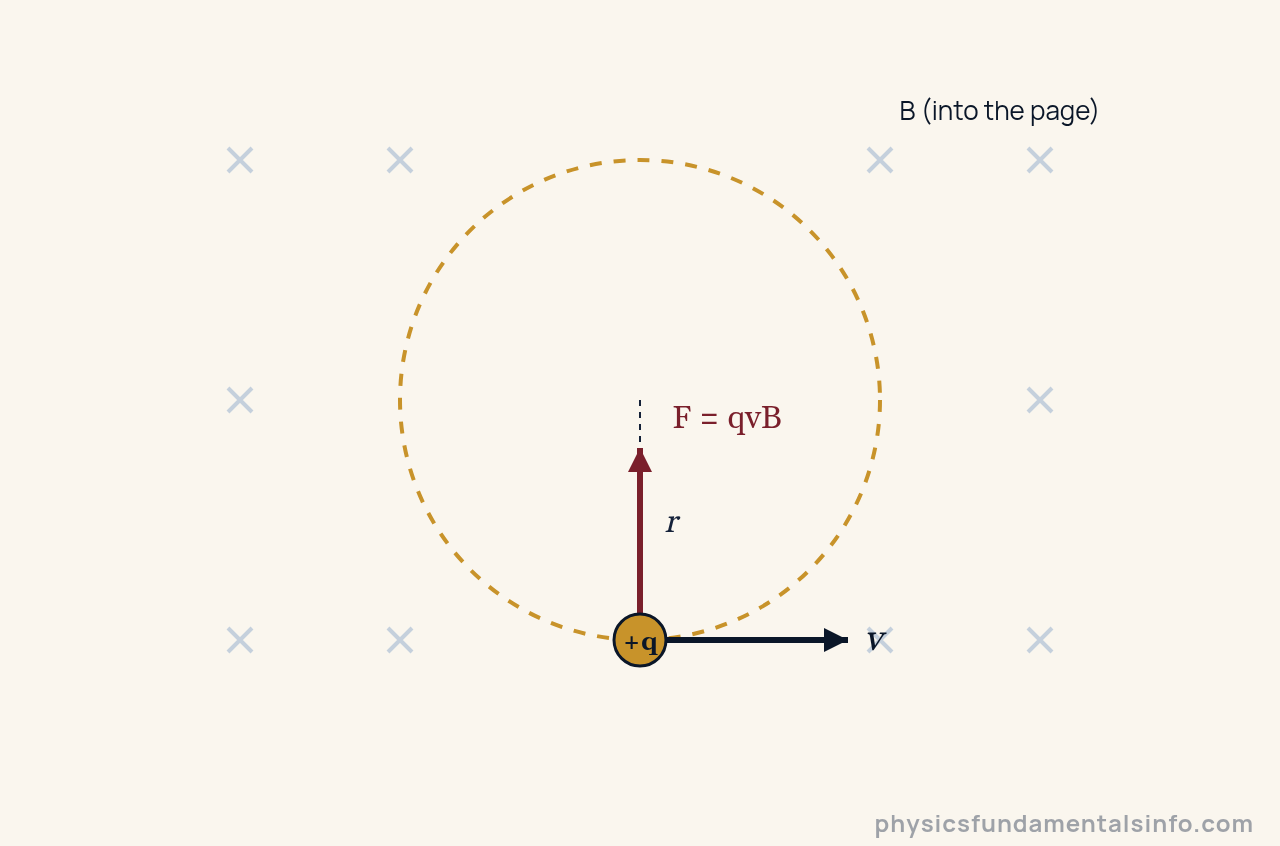
Figure 2: A positive charge moving right (v) through a field into the page (B) feels a force F = qvB at right angles to its motion. The sideways push bends it into a circle of radius r = mv/qB without ever changing its speed.
What Is the SI Unit of a Magnetic Field?
The SI unit of magnetic field is the tesla (T), named after Nikola Tesla. Rearranging F = qvB shows exactly what a tesla is built from: one tesla is the field that pushes a 1-coulomb charge with a force of 1 newton when that charge moves at 1 metre per second across the field.
So 1 T = 1 N / (A·m), which also equals one weber per square metre (Wb/m2). The tesla is a big unit. Everyday fields are tiny by comparison, so you will often meet smaller units: the microtesla (1 μT = 10−6 T) and the gauss, where 1 tesla = 10,000 gauss.
The table below puts some real fields side by side. Notice the enormous range — from the faint field that steers a compass to the unimaginable fields of a dying star.
| Source of the field | Typical magnetic flux density (B) |
|---|---|
| Earth’s field at the surface | 25–65 μT (about 0.25–0.65 gauss) |
| Small refrigerator magnet | ~5 mT (0.005 T) |
| Sunspot | 0.1–0.4 T |
| Strong neodymium magnet (at the surface) | ~0.5–1.3 T |
| Hospital MRI scanner | 1.5–3 T |
| Strongest continuous laboratory magnets | ~45 T |
| Magnetar (a type of neutron star) | up to ~1011 T |
How Magnetic Fields Are Produced
Every magnetic field traces back to one origin: electric charge in motion. That single idea explains both the electromagnet in a scrapyard crane and the bar magnet on your desk.
The link was discovered almost by accident. In 1820 the Danish scientist Hans Christian Ørsted noticed that a compass needle jumped whenever he switched on a nearby electric current — the same current that obeys Ohm’s law. A current makes a magnetic field. That was the birth of electromagnetism.

Currents, wires and electromagnets
A long straight wire carrying a current I is wrapped in circular field lines, with the field strength falling off as you move away. Coil that wire into many turns — a solenoid — and the loops reinforce one another to make a strong, uniform field down the middle.
Here n is the number of turns per metre, I is the current in amperes, and μ0 is the permeability of free space, μ0 ≈ 4π × 10−7 T·m/A (about 1.257 × 10⁻⁶ T·m/A). Push more current through, or wind more turns, and the field grows — which is exactly how an electromagnet’s strength is dialled up.
Permanent magnets and electron spin
So what about a fridge magnet, where nothing seems to be flowing? Zoom in and the “current” is still there. Each electron behaves like a minuscule loop of current thanks to its spin, giving it a tiny magnetic field of its own.
In most materials these atomic magnets point every which way and cancel out. In iron, nickel and cobalt they line up across whole regions called domains. When the domains align, their fields add together — and you get a permanent magnet you can hold in your hand.
How a Magnetic Field Bends a Moving Charge
Here is the strangest, most important feature of the magnetic force: it always pushes sideways. Look again at Figure 2. The force F is perpendicular to the velocity v, never along it. So the force can change a charge’s direction, but never its speed.
A constant sideways push on a moving object produces circular motion. The magnetic force on a charge moving across a uniform field provides exactly the centripetal force needed to hold it in a circle. Setting the magnetic force equal to the centripetal force, qvB = mv2/r, and rearranging gives the radius:
Two beautiful consequences fall out of this. A faster particle simply traces a bigger circle, and a stronger field winds it into a tighter one. Even better, the time for one full loop, T = 2πm/(qB), does not depend on the speed at all — the principle behind the cyclotron particle accelerator.
The right-hand rule
Which way does the force point? Use your right hand. Point your fingers in the direction the positive charge is moving (v), curl them towards the field (B), and your thumb points along the force (F). For a negative charge such as an electron, the force is simply the other way.
Real-World Examples of Magnetic Fields
Magnetic fields are not a textbook abstraction — they run the modern world. Here are seven places the physics above is doing real work.
1. Electric motors
A motor sends current through a coil sitting in a magnetic field. The field pushes sideways on that current (the F = BIL effect), spinning the coil. Almost every fan, pump, drill and electric car traces back to this one trick.
2. MRI scanners
A hospital MRI surrounds you with a field of 1.5–3 T — tens of thousands of times Earth’s. That huge, steady field nudges the protons in your body into alignment so radio waves can map your soft tissue in stunning detail.
3. Compasses and navigation
A compass needle is a small magnet free to swing into line with Earth’s own field. Sailors used this for a thousand years before anyone knew why. Earth’s field also carves out a protective bubble called the magnetosphere, described by NASA.
4. Loudspeakers and headphones
Inside every speaker, a coil carrying the music signal sits in a permanent magnet’s field. As the current rises and falls, the magnetic force shoves the coil — and the cone glued to it — back and forth, pushing the air that becomes sound.
5. Maglev trains
Magnetic levitation trains float a few centimetres above the track on powerful electromagnets. With no wheels touching the rail, there is almost no friction, letting them glide at well over 400 km/h.
6. Particle accelerators and mass spectrometers
Because a field bends charges along r = mv/qB, it is the perfect steering tool. Accelerators use magnets to whip particles around enormous rings, while a mass spectrometer uses the same bending to sort molecules by mass — heavier ions swing on wider arcs.
7. The aurora
The northern and southern lights are charged particles from the Sun, funnelled by Earth’s magnetic field down towards the poles. There they crash into the upper atmosphere and make it glow — a magnetic field painting the sky.
Common Misconceptions About Magnetic Fields
A few stubborn myths trip up almost every student. Clearing them up is the fastest way to really understand the topic.
Myth 1: “A magnetic field speeds charges up.”
It cannot. The magnetic force is always perpendicular to the velocity, so no part of it points along the motion. That means it does zero work: the particle’s speed and kinetic energy stay exactly the same. A magnetic field steers, it never accelerates in the everyday sense of “speeds up”.
Myth 2: “A stationary charge feels a magnetic force.”
Look at F = qvB. If the speed v is zero, the force is zero. A charge sitting still in a magnetic field feels nothing magnetic at all — only moving charges and currents respond to a field.
Myth 3: “The field and the force are the same thing.”
They are not. The field B is a property of the space itself, there whether or not anything is in it. The force F is the push that field delivers to a charge that happens to be moving through it. One is the cause; the other is the effect.
Myth 4: “Earth’s geographic North Pole is a magnetic north pole.”
It is actually a magnetic south pole. A compass needle’s north-seeking end is pulled towards it, and since opposite poles attract, the pole sitting up there must behave as a magnetic south. The names are a historical accident worth remembering.
How Magnetic Fields Relate to Electricity, Light & Circular Motion
The magnetic field never works alone. Its closest relative is the electric field, the field that surrounds any charge and is described by Coulomb’s law. The two are so intertwined that physicists treat them as one electromagnetic field. The table below shows how they differ.
| Property | Electric field (E) | Magnetic field (B) |
|---|---|---|
| Source | Electric charges (still or moving) | Moving charges, currents and magnetic poles |
| Acts on | Any charge, moving or not | Only moving charges and currents |
| Direction of force | Along the field | Perpendicular to both v and B |
| Does it do work? | Yes — can change speed | No — changes direction only |
| SI unit | volt per metre (V/m) | tesla (T) |
| Field lines | Start and end on charges (open) | Always closed loops |
The partnership runs deeper still. A changing magnetic field creates an electric field, and a changing electric field creates a magnetic field. James Clerk Maxwell showed that these two fields can keep regenerating each other and sail off through empty space as a wave.
That wave is light. Radio, microwaves, X-rays and visible light are all electromagnetic waves — linked electric and magnetic ripples — racing along at the speed of light, c = 299,792,458 m/s. The humble magnetic field on your fridge is, quite literally, one half of light.
Worked Problems
Show Solution
Solution:
Step 1: Use the magnetic force law F = qvB sin θ. The motion is perpendicular to the field, so θ = 90° and sin θ = 1.
Step 2: Substitute the values: F = (1.6 × 10⁻¹⁹ C)(3.0 × 10⁶ m/s)(0.40 T)(1).
Step 3: Multiply: F = 1.92 × 10⁻¹³ N.
Answer: F ≈ 1.9 × 10⁻¹³ N, directed at right angles to both v and B.
Show Solution
Solution:
Step 1: Apply F = qvB sin θ with θ = 30°, so sin θ = 0.50.
Step 2: Substitute: F = (1.6 × 10⁻¹⁹)(5.0 × 10⁶)(0.20)(0.50) N.
Step 3: Multiply: F = 8.0 × 10⁻¹⁴ N.
Answer: F = 8.0 × 10⁻¹⁴ N. The negative charge flips the direction of the force, not its size.
Show Solution
Solution:
Step 1: With θ = 90°, F = qvB. Rearrange for B: B = F / (qv).
Step 2: Substitute: B = (4.8 × 10⁻³ N) / [(2.0 × 10⁻⁶ C)(400 m/s)] = (4.8 × 10⁻³) / (8.0 × 10⁻⁴).
Step 3: Divide: B = 6.0 T.
Answer: B = 6.0 T — a very strong field, stronger than a hospital MRI.
Show Solution
Solution:
Step 1: The magnetic force supplies the centripetal force, qvB = mv2/r, which rearranges to r = mv / (qB).
Step 2: Substitute: r = (9.11 × 10−31 × 2.0 × 107) / (1.6 × 10−19 × 0.010) = (1.82 × 10⁻²³) / (1.6 × 10⁻²¹).
Step 3: Divide: r = 1.1 × 10⁻² m.
Answer: r ≈ 0.011 m, or about 1.1 cm.
Show Solution
Solution:
Step 1: For a current-carrying wire, F = BIL sin θ. Here θ = 90°, so F = BIL.
Step 2: Substitute: F = (0.60 T)(3.0 A)(0.25 m).
Step 3: Multiply: F = 0.45 N.
Answer: F = 0.45 N. This sideways push on a current-carrying wire is exactly how an electric motor turns.
Show Solution
Solution:
Step 1: From qvB = mv2/r the radius is r = mv/(qB). The period is T = 2πr/v = 2π(mv/qB)/v = 2πm/(qB). The speed v cancels, so T is independent of v.
Step 2: Substitute: T = 2π(1.67 × 10⁻²⁷) / [(1.6 × 10⁻¹⁹)(0.50)] = (1.05 × 10⁻²⁶) / (8.0 × 10⁻²⁰).
Step 3: Divide: T = 1.3 × 10⁻⁷ s.
Answer: T ≈ 1.3 × 10⁻⁷ s (about 0.13 microseconds). Faster protons just trace bigger circles in the same time — the basis of the cyclotron.
Show Solution
Solution:
Step 1: The particle is undeflected when the electric force equals the magnetic force: qE = qvB. The charge q cancels, giving v = E / B.
Step 2: Substitute: v = (3.0 × 10⁵ V/m) / (0.15 T).
Step 3: Divide: v = 2.0 × 10⁶ m/s.
Answer: v = 2.0 × 10⁶ m/s. Only particles at this exact speed pass straight through; faster or slower ones are deflected.