The right-hand rule answers the question a magnitude cannot: not how big the magnetic force is, but which way it points. For a charge moving through a magnetic field that force is F = q v × B, a cross product, so it is at right angles to both the velocity and the field. This free calculator takes a signed charge and the three components of v and B and returns the force as a vector — its size, its three components and its direction in words, on fixed axes: +x right across the screen, +y up it, +z out of the page towards you.
Load a real case
Every button writes a complete set of figures into all seven boxes, so the answer changes the moment you press it. The line underneath quotes back whatever the widget then works out, so nothing in it is stored text. Two of the buttons are deliberately cases with no answer, because a force of zero has no direction and that is worth seeing.
Pick a case above, or type your own figures.
What Is the Right-Hand Rule Calculator?
The right-hand rule calculator is a free online tool for the direction of the magnetic force on a moving charge: F = q v × B, the cross product of the velocity with the magnetic field, multiplied by the signed charge. Type a charge and the three components of v and B and it returns the size of the force in newtons, the three force components, the angle between v and B, a check that the force does no work, and the answer most problems actually ask for: the direction, as one of six phrases when the force lands on an axis and as a unit vector when it lands between them.
The axes are fixed and stated before any direction word is used, because nothing here means anything without them: +x is right across the screen, +y is up it, and +z points out of the page towards the reader. That makes the set right-handed, so x × y = z. A magnetic field drawn as crosses on a diagram is going into the page and is entered as a negative Bz; assume the opposite sense and every answer comes out reversed, which is the commonest way this topic is got wrong.
This is the direction half of a pair. The magnetic force calculator on this site solves F = q v B sin(θ), a size from an angle, and its charge box rejects anything that is not strictly positive — so it cannot be asked about an electron and it has no way to report a direction. Here the charge carries its sign through the whole calculation, which is why the same velocity and the same field push a proton down and an electron up with forces of identical size. Use that page when a problem asks how many newtons; use this one when it gives you two directions and asks for the third.
Two things on this page are deliberate and worth knowing. The force is computed from the cross product and never from q v B sin(θ), because in double-precision arithmetic the sine of 180 degrees is 1.2246e-16 rather than 0, so the sine form returns about 2.35452e-29 N for a charge moving exactly against the field where the cross product returns an exact 0. And when the force really is zero — a charge of zero, a velocity of zero, a field of zero, or a velocity parallel or antiparallel to the field — the calculator names which cause applied instead of printing an axis, because a zero vector has no direction. This page does the first of the three right-hand rules; the grip rule for the field around a wire and the coil rule for which end of a solenoid is north are not computed here.
| Symbol | Quantity | Default unit | Also accepts | Example value |
|---|---|---|---|---|
| q | Signed charge | C | mC, µC, nC, e | 1.602176634e-19 |
| vx | Velocity to the right | m/s | km/s, cm/s | 3e6 |
| vy | Velocity up the screen | m/s | km/s, cm/s | 0 |
| vz | Velocity out of the page | m/s | km/s, cm/s | 0 |
| Bx | Field to the right | T | mT, µT, G | 0 |
| By | Field up the screen | T | mT, µT, G | 0 |
| Bz | Field out of the page | T | mT, µT, G | 0.4 |
How to use the right-hand rule calculator
- Fix the axes before you type anything. This page uses one convention throughout:
+xis right across the screen,+yis up it, and+zpoints out of the page towards you. So a field into the page is a negative Bz. Assume the other sense forzand every answer comes out backwards. - Type the charge, with its sign. The box opens on
1.602176634e-19C, the charge on a proton, and exponential entry like1.6e-19or3e6is accepted everywhere on this page. A minus sign gives you an electron or any other negative charge. The menu also offers mC, µC, nC and e, so you can simply type1and choose e. - Type the three velocity components. Boxes take m/s, km/s or cm/s. A box you leave empty reads as zero, so a charge moving straight to the right needs only
vx. - Type the three field components. Boxes take T, mT, µT or G.
Bzis the one pointing out of the page, so a 0.4 T field into the page is-0.4there. - Read the direction chip first. It is the chip you came for. When the force lands on an axis it prints one of six phrases — right (+x), left (-x), up (+y), down (-y), out of the page (+z), into the page (-z) — and when it lands between them it prints the unit vector to three decimal places instead.
- Read the headline and the three components. The headline is the size of the force in newtons to four significant figures;
Fx,FyandFzgive the components to six. Read them against the direction chip: a force whose only non-zero component is a negativeFyis exactly what down (-y) means. - Use the angle chip to see how much force survives. At 90 degrees the whole of the field counts; at 0 or 180 degrees none of it does. Adding a velocity component along the field changes the angle without changing the force at all, which is the quickest way to see that only the perpendicular part matters.
- Treat the last chip as a free check. It multiplies the force by the velocity, and the answer must be zero, because a cross product is at right angles to both of its factors. That is the honest reason a magnetic field bends a charge without ever speeding it up.
- Expect an explanation rather than a number when the force is zero. A zero vector has no direction, so the calculator names which of five causes applied — a charge of zero, a velocity of zero, a field of zero, a velocity parallel to the field, or a velocity antiparallel to it — instead of printing a meaningless axis or angle.
- Open Show working. The steps restate the axis convention, list your figures in SI, expand the cross product one component at a time, multiply by the charge, take the size, normalise for the direction, work out the angle and finish with both checks.
Two neighbouring tools come close to this question without answering it. The magnetic field simulator does name a sense — it reports a charge already circling in a uniform field as turning anticlockwise or clockwise, and flips that on the sign of the charge — but its field is fixed into the page and its velocity is a speed on a slider, so it cannot be asked which way the force points for a v and a B of your own. This page resolves the direction of F = q v × B for any pair you name: the six axis directions, the off-axis case where it prints a unit vector rather than a word, and the zero cases, where it refuses and says which cause applied.
The other neighbour is the magnetic force calculator, which solves F = q·v·B·sin(θ): a size from an angle. It is a magnitude tool by construction and rejects a charge that is not strictly positive, so it cannot be asked about an electron and has no way to name a direction. Here the two vectors go in and a vector comes out, so the sign of the charge survives the whole calculation and the answer is a direction.
That calculator and this one are a pair rather than duplicates, and it is worth knowing which to open. Use that one when a problem gives you a speed, a field and an angle and asks how many newtons. Use this one when a problem gives you two directions and asks for the third.
For what a magnetic field is, how it bends a charge onto a circle and the whole of the F = q·v·B·sin(θ) arithmetic, read the magnetic field guide, which gives you how big. This page gives you which way. For the rule itself in all three of its forms, including the grip rule for a wire and the coil rule for a solenoid, read the guide to the right-hand rule.
Three mistakes account for most wrong answers here. The first is the z sign: a field drawn as crosses on a diagram is going into the page and must be typed as a negative Bz. The second is dropping the minus sign on an electron, which does not shrink the force but reverses it; the third is reaching for the left hand for a negative charge instead of using the right hand and then flipping the answer.
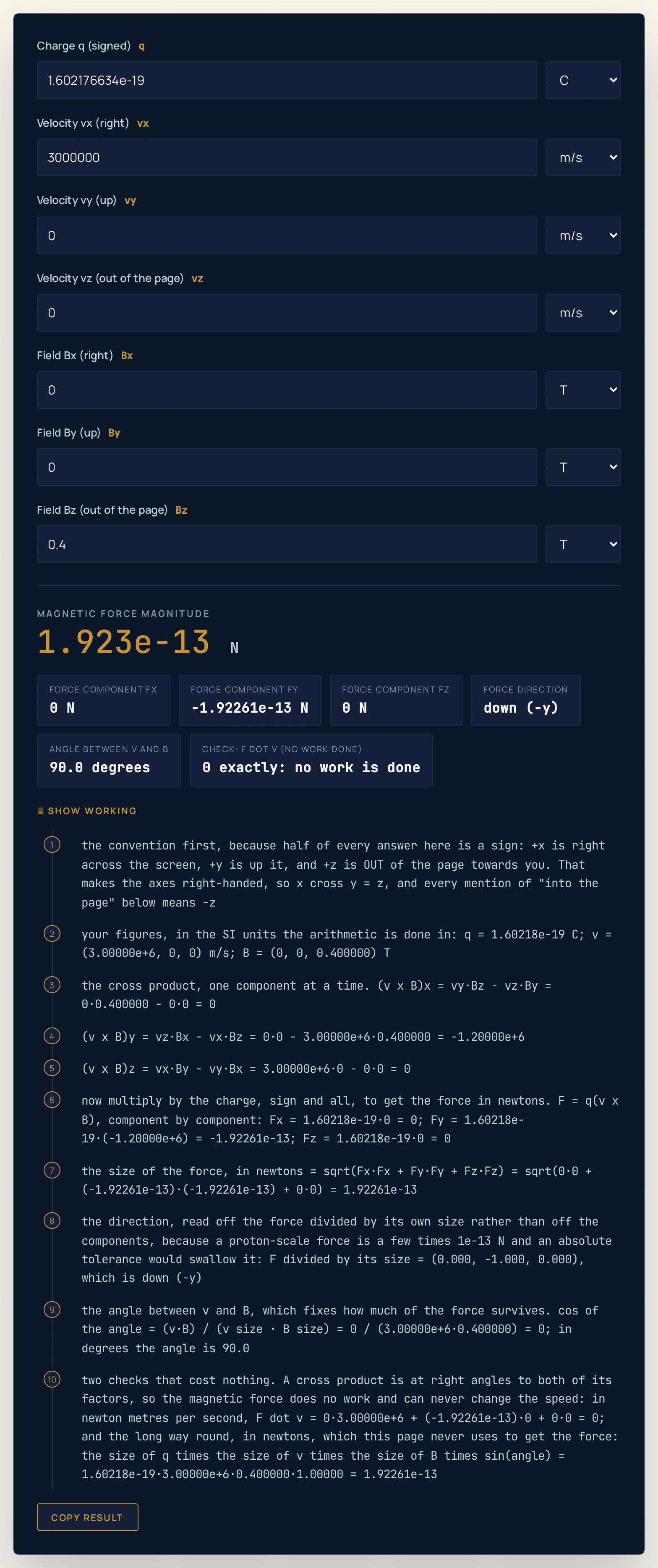
down (-y); the working underneath expands the cross product one component at a time.Worked example: change one thing at a time
The table starts at the defaults and moves one thing at a time: the sign of the charge, then where the field points, then whether the velocity lies along it, then the size of everything, then the entries the calculator declines. Every Headline, component, direction and angle cell was read out of the running widget rather than worked out by hand. Where a cell and the tool ever part company, believe the tool.
| Step | What you type | Headline / N | Fx, Fy, Fz / N | Force direction | Angle |
|---|---|---|---|---|---|
| The page as it opens: a proton to the right, field out of the page | q = 1.602176634e-19 C, v = (3e6, 0, 0) m/s, B = (0, 0, 0.4) T | 1.923e-13 | 0, -1.92261e-13, 0 | down (-y) | 90.0 degrees |
| Only the sign of the charge changed: an electron | q = -1.602176634e-19 C, same v and B | 1.923e-13 | 0, 1.92261e-13, 0 | up (+y) | 90.0 degrees |
| Only the field moved: 0.4 T up the screen instead | B = (0, 0.4, 0) T, same q and v | 1.923e-13 | 0, 0, 1.92261e-13 | out of the page (+z) | 90.0 degrees |
| Only the field reversed: 0.4 T into the page | B = (0, 0, -0.4) T, same q and v | 1.923e-13 | 0, 1.92261e-13, 0 | up (+y) | 90.0 degrees |
| The velocity turned along the field | v = (3e6, 0, 0) m/s, B = (0.4, 0, 0) T | no answer | — | — | — |
| The velocity turned against the field | v = (3e6, 0, 0) m/s, B = (-0.4, 0, 0) T | no answer | — | — | — |
| A velocity component added along the field | v = (3e6, 0, 3e6) m/s, B = (0, 0, 0.4) T | 1.923e-13 | 0, -1.92261e-13, 0 | down (-y) | 45.0 degrees |
| A one-coulomb test charge: 2 m/s up, 1.5 T to the right | q = 1 C, v = (0, 2, 0) m/s, B = (1.5, 0, 0) T | 3 | 0, 0, -3.00000 | into the page (-z) | 90.0 degrees |
| Neither vector on an axis | q = 2e-6 C, v = (3e5, 4e5, 0) m/s, B = (0, 0, 0.2) T | 0.2 | 0.160000, -0.120000, 0 | unit vector (0.800, -0.600, 0.000) | 90.0 degrees |
| A field tilted out of the plane of the page | B = (0, 0.2, 0.34641016151377546) T, same q and v | 1.923e-13 | 0, -1.66503e-13, 9.61306e-14 | unit vector (0.000, -0.866, 0.500) | 90.0 degrees |
| The charge set to zero | q = 0 C, same v and B | no answer | — | — | — |
| The velocity set to zero | v = (0, 0, 0) m/s, same q and B | no answer | — | — | — |
Rows 1 and 2 are the whole point of the page in two lines. The same velocity and the same field push a proton down and an electron up, and the size of the force is identical at 1.923e-13 N. The hand did not change; the sign of the charge did.
Rows 3 and 4 move the field instead. Turning it up the screen throws the force out of the plane of the page altogether, to out of the page (+z); reversing it from out of the page to into the page flips the force from down to up. Those two rows are the reason this page states its z convention four times.
Rows 5 and 6 are declined, and they are declined for a physical reason rather than an arithmetic one. With the velocity along the field the angle is 0 degrees, and against it 180 degrees; the cross product is the zero vector either way, and a zero vector has no direction to report. The calculator says which of the two applied instead of printing an axis.
Row 7 is the most instructive row in the table. Adding 3e6 m/s of velocity straight along the field changes the angle from 90.0 to 45.0 degrees and leaves the force completely unchanged, components and all. Only the part of the velocity across the field does anything at all; the part along it is wasted motion.
Rows 8 to 10 leave the subatomic scale behind. A one-coulomb charge at 2 m/s across a 1.5 T field feels 3 N, which you can check in your head. Rows 9 and 10 put the vectors between the axes, and the direction chip stops printing a word and prints the unit vector instead — (0.800, -0.600, 0.000) and (0.000, -0.866, 0.500).
Rows 11 and 12 are the other two zero cases. A charge of zero feels nothing however fast it goes, and a charge standing still feels nothing however strong the field. Both are refused with the cause named, which is more use than a printed zero would be.
Formula and symbol reference
One relation does all the work: F = q v × B. The cross product is what makes it a direction problem, and it expands into three components: (v × B)x = vyBz − vzBy, (v × B)y = vzBx − vxBz and (v × B)z = vxBy − vyBx. Multiply all three by the signed charge and you have the force.
The axes are right-handed, which is the only thing the hand in the name is really recording: x × y = z, y × z = x and z × x = y. On this page that means +x right, +y up and +z out of the page towards you. Reverse that last one and every single answer reverses with it.
The textbook size, F = q·v·B·sin(θ), is printed in the working as a cross-check and is never used to produce the answer. It gives no direction, and it cannot give an exact zero: in double-precision arithmetic the sine of 180 degrees is 1.2246e-16 rather than 0, so for a charge moving exactly against the field it returns about 2.35452e-29 N where the cross product returns an exact 0.
| Symbol | Meaning | SI unit | Values used on this page |
|---|---|---|---|
| q | The charge, carrying its own sign. A minus sign does not make the answer smaller, it turns the force round | coulomb (C) | Boxes take C, mC, µC, nC or e: 1.602176634 × 10⁻¹⁹ C is the default proton, the same figure with a minus sign is an electron, 1 C is the test-charge row. |
| vx, vy, vz | The velocity components on the fixed axes: x to the right, y up the screen, z out of the page towards you | metre per second (m/s) | Boxes take m/s, km/s or cm/s: (3 × 10⁶, 0, 0) is the default, (0, 2, 0) the test-charge row, (3 × 10⁵, 4 × 10⁵, 0) the off-axis row. |
| Bx, By, Bz | The field components on the same axes. A field into the page is a negative Bz, and that sign is half of every answer | tesla (T) | Boxes take T, mT, µT or G: (0, 0, 0.4) is the default, (0, 0, -0.4) the same field into the page, 4000 G the same field again. |
| F | The magnetic force, a vector. Reported as a size, three components and a direction, never as a size alone | newton (N) | A result, never an input: 1.923 × 10⁻¹³ N on the default proton, 3 N on the test charge, 0.2 N on the off-axis row. |
| v × B | The cross product itself, shown component by component in the working. This is where the direction comes from | tesla metre per second | A working value: (0, -1.20000e+6, 0) for the defaults, exactly as the working prints it, which becomes the force once multiplied by q. |
| θ | The angle between v and B. It sets how much of the force survives, and at 0 or 180 degrees none of it does | degree | A chip, never an input: 90.0 degrees for the defaults, 45.0 degrees once a velocity component is added along the field, 180.0 degrees in the refused antiparallel row. |
The physics: why a cross product needs a hand
Two vectors can be combined in two ways, and the difference is the whole of this topic. A dot product gives a number, and the order does not matter. A cross product gives a vector perpendicular to both, and the order does matter: v × B and B × v point opposite ways.
That leaves one genuine ambiguity. A plane has two perpendicular directions, one each side, and the algebra alone cannot say which of them to call positive. The right hand is the convention that settles it, and that is all it is: point your fingers along v, curl them towards B, and your thumb points along v × B.
So the hand is bookkeeping rather than a fact about hands. Done consistently in a left-handed coordinate system the left hand would serve just as well. Fleming's left-hand rule is not a rival result either — it is the same physics arranged for the motor case with the fingers assigned differently, and it gives the same answers.
The sign of the charge is the other half. q sits outside the cross product in F = q v × B, so a negative charge simply reverses the vector the hand gave you. The usual mistake is to switch hands for an electron; the fix is to use the right hand as normal and then flip the result, which is exactly what typing a negative charge here does.
Every row of the table below is this calculator run on one charge and one speed, with only the field direction changed: a charge of one elementary charge, 1.602176634e-19 C, moving to the right at 3e6 m/s through a 0.4 T field along the named axis. The negative column is the same run with a minus sign in front of the charge. That is where the 1.923e-13 N in the last column comes from, in every row that has one.
| Field direction | Force on a positive charge | Force on a negative charge | Size / N |
|---|---|---|---|
| right (+x) | no force at all | no force at all | 0 |
| left (-x) | no force at all | no force at all | 0 |
| up (+y) | out of the page (+z) | into the page (-z) | 1.923e-13 |
| down (-y) | into the page (-z) | out of the page (+z) | 1.923e-13 |
| out of the page (+z) | down (-y) | up (+y) | 1.923e-13 |
| into the page (-z) | up (+y) | down (-y) | 1.923e-13 |
Read the first two columns against each other and the structure appears. The two field directions that lie along the velocity give no force at all, and the other four give forces of the same size pointing four different ways. Every cell in the negative column is the opposite of the cell beside it, exactly.
That pattern of zeros generalises. Across all six velocity directions and all six field directions there are 36 pairs, and 12 of them give no force: three axes, two senses of the velocity and two senses of the field. It is a third of the table, not a sixth, because the velocity and the field each have two senses to choose from.
The perpendicularity is not decoration either. Because the force is always at right angles to the velocity, it can change the direction of motion but never the speed, so a charge in a steady field travels at constant speed on a curved path. That is why the magnetic field in the magnetic field guide bends a charge onto a circle without doing any work on it, and you can watch the same circle form in the magnetic field simulator.
One naming caution before the limits. Crossing two vectors is not adding them, and the two operations answer different questions: if what you actually need is a resultant rather than a perpendicular, the vector addition calculator adds two vectors in a plane and returns theirs. Cross products also turn up well away from magnetism — torque is one — and the hand means the same thing every time.
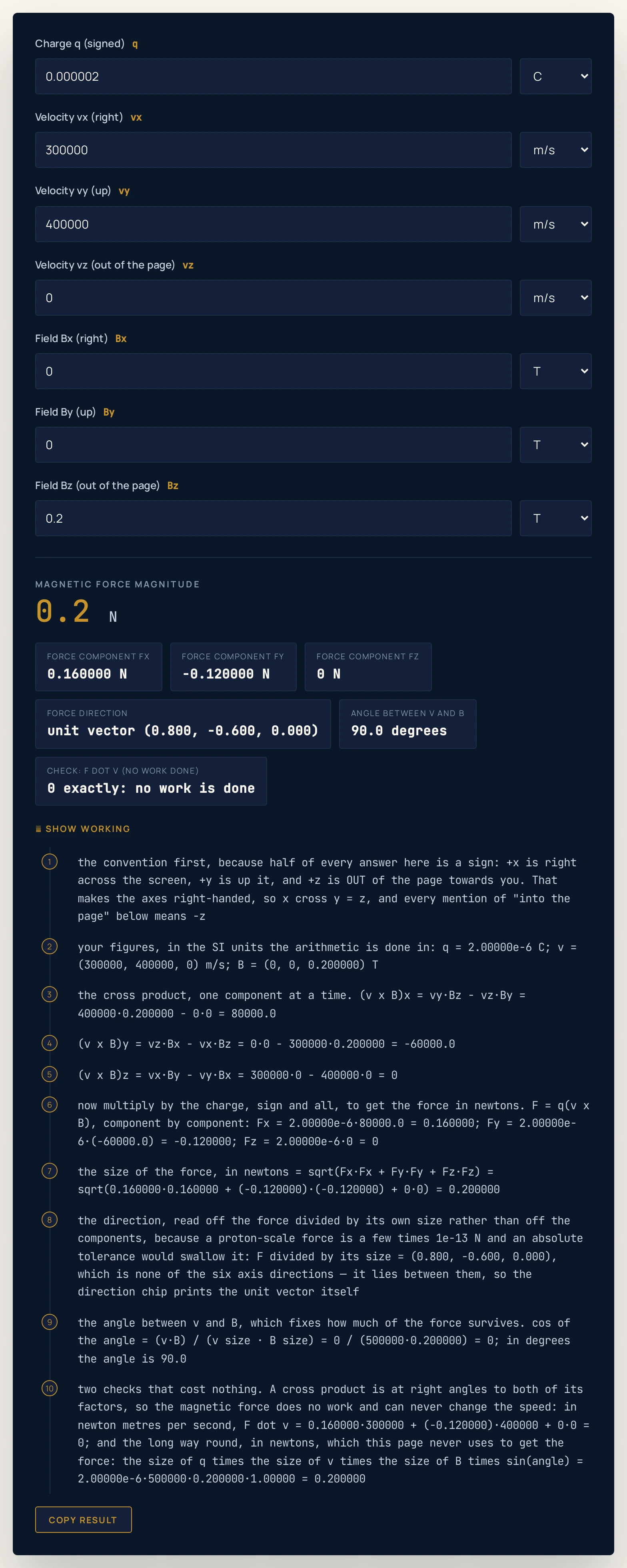
(0.800, -0.600, 0.000) instead of a phrase — and the components beside it are the figures to work from.Where the right-hand rule calculator breaks down
The arithmetic here is a handful of multiplications and subtractions, and the cross product has no awkward domain to fall out of. What fails is the model around it: one charge, one uniform field, no relativity, and only the first of the three right-hand rules.
- A zero force has no direction, and that is not a bug to be worked round
- When the charge, the velocity or the field is zero, or when the velocity lies exactly along the field or exactly against it, the force is the zero vector. There is no axis to print and no angle to quote, so the calculator says which of those five causes applied instead. The test is a tolerance against the largest the force could be — one part in a thousand million of the size of
qtimes the speed times the field — and never a comparison with zero, because the sine form leaves floating-point dust behind that an equality test would mistake for a real force. - The field has to be uniform, and a real field is not
- One field vector goes in, so the answer is the force at one instant at one point. A real field varies from place to place, which is why a charge in a real magnet follows a path this page cannot draw: the force changes as the charge moves. For a uniform field it is exact, and over a small enough region most fields are uniform enough.
- No electric field, so this is not the full Lorentz force
- The complete force on a charge is
F = q(E + v × B), and only the magnetic half is computed here. If there is an electric field in your problem as well, its contributionqEhas to be added as a separate vector, and unlike the magnetic part it is parallel to the field and does do work. There is no electric-field input on this page. - Classical speeds only
- The expression is used here exactly as written, with no relativistic correction. The default 3 × 10⁶ m/s is about one per cent of the speed of light, where that is a negligible difference. Push the speed towards the speed of light and the force is still
q v × B, but relating it to the resulting acceleration needs the relativistic momentum rather thanma, which this page does not do. - Only the first of the three right-hand rules
- This page does the force on a moving charge. It does not compute the grip rule, which gives the direction of the field circling a current-carrying wire from
B = µ0I / 2πr, and it does not compute the coil rule, which tells you which end of a solenoid is north. For the field inside a long solenoid,B = µ0nI, use the magnetic field calculator; all three rules are the same cross product, but only one of them is the arithmetic on this page. - A size on its own is a different question, and a different tool
- If you have a speed, a field and an angle between them and you want newtons, you do not need a vector calculator at all. That is
F = q·v·B·sin(θ)and it belongs to the magnetic force calculator, which also rearranges for the charge, the speed or the field. This page deliberately leaves that job alone, and prints the sine form only as a check on its own answer. - The unit vector is a reading to three decimal places, not an exact direction
- When the force does not land on an axis the direction chip prints the normalised force to three decimal places, so
(0.800, -0.600, 0.000)is a rounding of the real direction rather than the direction itself. The components are given to six significant figures for that reason: if you need the direction precisely, take it from them. A component printed as0.000may be a genuine zero or merely a small one, and the component chips will tell you which. - A single charge, with nothing else in the problem
- No second charge, no current in a nearby wire, no induced field, no force between the two. The moving charge here is a test particle that does not disturb anything. A charge moving through a field also produces a field of its own, and that mutual business is a different calculation entirely.
Where the right-hand rule is actually used
- Working out which way a beam bends
- This is the everyday use. An electron beam crossing a field is deflected at right angles to both, and the direction decides whether a spot lands above or below the axis. Type the beam velocity and the field and read the direction chip, remembering the minus sign on the charge of an electron — it is the difference between up and down.
- Reading a motor as a right-hand rule made of metal
- Replace
q vbyI Land the same rule gives the force on a current-carrying wire,F = I L × B, with the same hand and the same geometry. A wire 0.25 m long carrying 3 A to the right in a 0.6 T field into the page feels 0.45 N upwards, which you can reproduce on this page by typing a charge of 1 C, a velocity of 0.75 m/s to the right and a field of-0.6T inBz, becauseI Lis 0.75 in SI units either way. That is how every brushed motor turns. - Deciding the sign of a Hall voltage
- Current through a strip in a transverse field pushes the carriers to one edge, and which edge depends on the sign of the carriers. That is the measurement that showed some semiconductors carry positive charge, and it is a direction question with a direction answer. Run the carrier velocity and the field through this page twice, once with each sign of charge, and the two answers are the two edges.
- Checking that an answer can be right at all
- The commonest practical use of a tool like this is auditing a figure you already have. If a solution claims a magnetic force with a component along the velocity, it is wrong before you check any arithmetic, because the last chip on this page is always zero. The same test catches a force that is claimed to have changed a charge's speed.
- Finding the radius a charge will circle on
- Once you know the force is perpendicular, the rest is circular motion: the magnetic force supplies the centripetal force, so the radius is
mv / qBand the speed never changes. This page gives the force and its direction at one instant; the magnetic field guide carries the radius, the period and the worked magnitudes. - Getting the other two rules right by the same method
- The grip rule and the coil rule are the same cross product with different vectors in it, so a reader who can see why the force comes out perpendicular here can see why the field circles a wire there. The arithmetic for those two is not on this page; the method is.
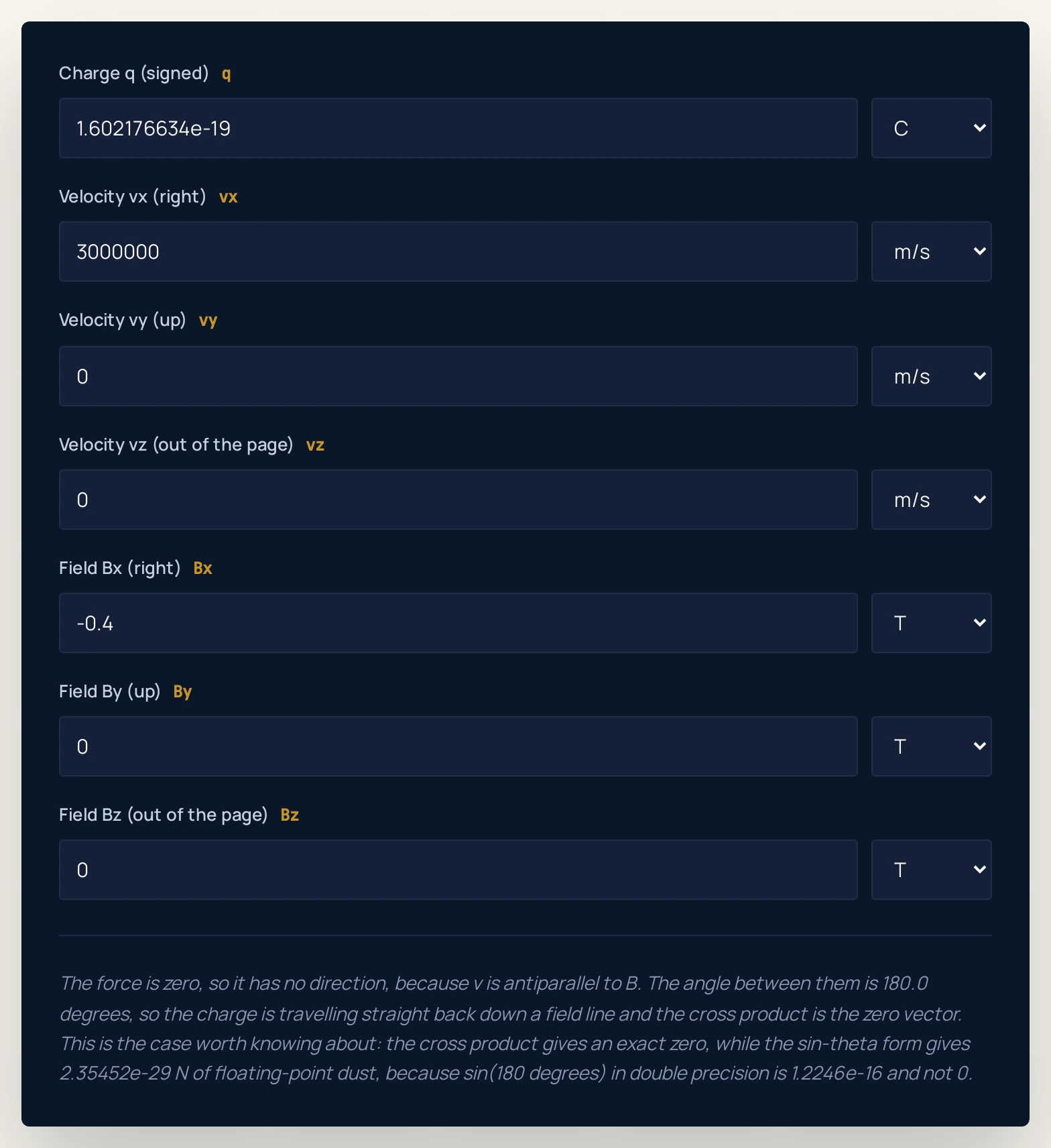
q v B sin(θ) would return 2.35452e-29 N of floating-point dust.Where to go next
For the rule in all three of its forms, the six-by-six direction table and eight worked problems, read the guide to the right-hand rule, which this tool is the arithmetic half of. The magnetic field guide is the companion piece: it gives the size of the force, the radius of the circle and the period, where this page gives the direction.
Four tools are worth a bookmark beside this one. The magnetic force calculator gives the size from an angle; the magnetic field calculator does the field inside a solenoid; the vector addition calculator adds two vectors in a plane rather than crossing them; and the torque calculator gives the size of the other cross product you meet every week, from r·F·sin(θ). The full physics lab library and the calculator index are open too.
Frequently asked questions
What does the right-hand rule calculator work out?
It works out the magnetic force on a moving charge as a vector, F = q times v cross B. You give it a signed charge and the three components of the velocity and of the magnetic field, and it returns the size of the force in newtons, the three force components, the direction in words when the force lies along an axis, the angle between the velocity and the field, and a check that the force is at right angles to the motion. It is the direction half of the topic: the magnitude on its own belongs to the magnetic force calculator.
Which way do the axes point in this calculator?
Plus x is right across the screen, plus y is up the screen, and plus z points out of the page towards you. Those three make a right-handed set, so x cross y gives z. A magnetic field into the page is therefore a negative Bz, and a field out of the page is a positive Bz. Every page in this set uses the same convention, because assuming the opposite sense for z reverses every answer.
How do you use the right-hand rule for an electron or any negative charge?
Use exactly the same hand and then reverse the answer, because the charge carries its own sign in F = q v cross B. The usual mistake is to try to use the left hand for a negative charge. Work out the direction of v cross B with the right hand as normal, then flip it. In this calculator you simply type a negative charge and it does the flip for you: the same velocity and field that push a proton down push an electron up.
Why the right hand and not the left?
Because the cross product is defined that way, together with the sign conventions for charge and for conventional current. It is a bookkeeping convention rather than a fact about hands: done consistently in a left-handed coordinate system, the left hand would serve. Fleming's left-hand rule is not a rival result either. It is a different mnemonic for the same physics, set up for the motor case with the fingers assigned differently, and it gives the same answer.
What happens when the velocity and the magnetic field point the same way?
The force is exactly zero and has no direction, because the cross product of two parallel vectors is the zero vector. The same is true when they point in exactly opposite directions. The calculator refuses to print an axis or an angle for that case and says which cause applied instead, since a zero vector genuinely has no direction to report. A charge released along a field line simply carries straight on.
Why does the calculator use the cross product instead of q v B sin of the angle?
Because the sine form cannot give an exact zero. In double-precision arithmetic the sine of 180 degrees is 1.2246e-16 rather than 0, so for a charge moving exactly against the field the sine form returns about 2.35452e-29 newtons where the cross product returns an exact zero. The sine form also gives only a size and never a direction. This page computes the force from the cross product and prints the sine form beside it as a cross-check that is allowed to disagree out loud.
Does the magnetic force do any work on the charge?
No, never, and the last chip on the page is the proof. A cross product is at right angles to both of the vectors that made it, so the force is always perpendicular to the velocity, and a force perpendicular to the motion does no work. That is why a magnetic field can bend a charge onto a circular path while leaving its speed untouched, and why the kinetic energy of a charge moving in a steady magnetic field never changes.
Does the right-hand rule work for a current-carrying wire as well as a moving charge?
Yes, and it is the same rule with the same hand. For a straight wire the force is F = I times L cross B, where L is a vector along the wire in the direction of the conventional current. Replacing q times v by I times L changes none of the geometry, so the thumb, fingers and palm mean what they always meant. A wire 0.25 metres long carrying 3 amperes to the right in a 0.6 tesla field into the page feels 0.45 newtons upwards.
Is there more than one right-hand rule?
There are three common ones and they are all the same cross product in different clothes. This calculator handles the first: the force on a moving charge. The second is the grip rule, which gives the direction of the field circling a current-carrying wire. The third tells you which end of a coil is its north pole. The interactive trainer covers all three, each in the form that rule actually takes: the force for any of six velocity directions crossed with six field directions, the field around a wire for a current along any of the six, and the north end of a coil from the sense of its current. This page handles the general case, where the vectors lie at any angle rather than along an axis.
References & formula source
- The force on a moving charge is computed on this page from the cross product F = q (v x B), expanded component by component, and never from q v B sin(theta). The two agree in exact arithmetic and part company in floating point: the sine of 180 degrees in double precision is 1.2246e-16 rather than 0, so for a charge moving exactly antiparallel to the field the sine form returns 2.35452e-29 N where the cross product returns an exact 0. The sine form is printed in the working as a cross-check and is allowed to disagree out loud.
- The axis convention is fixed and the same on every page of this set: +x is right across the screen, +y is up it, +z points out of the page towards the reader. That makes the set right-handed, so x cross y = z, y cross z = x and z cross x = y. A field into the page is a negative Bz. Nothing on this page means anything without that convention, which is why it is stated in the formula band, in the definition, in the first line of the working and in the symbol table.
- Every figure quoted in the prose, in the worked table and in the figure captions is a string this calculator printed for the inputs named beside it. The charge on the proton, 1.602176634e-19 C, is the defined elementary charge of the SI. Nothing here is a measurement made on this site, and no figure has been carried in from another page without being recomputed here first.
- Halliday, Resnick and Walker, Fundamentals of Physics, chapters "Magnetic Fields" and "Magnetic Fields Due to Currents".
- Young and Freedman, University Physics with Modern Physics, chapters "Magnetic Field and Magnetic Forces" and "Sources of Magnetic Field".
- The right hand is a convention rather than a fact about hands. It follows from the definition of the cross product together with the sign conventions for charge and for conventional current; done consistently in a left-handed coordinate system, the left hand would serve. Fleming's left-hand rule is a different mnemonic for the same physics, arranged for the motor case, and nothing on this page suggests either of them is wrong.
- This calculator does the first of the three right-hand rules, the force on a moving charge. The grip rule for the field around a straight wire, B = mu-zero I / 2 pi r, and the coil rule for which end of a solenoid is north, B = mu-zero n I, are not computed here: they belong to the interactive trainer and to the guide.
- Further reading: Right-hand rule — Wikipedia