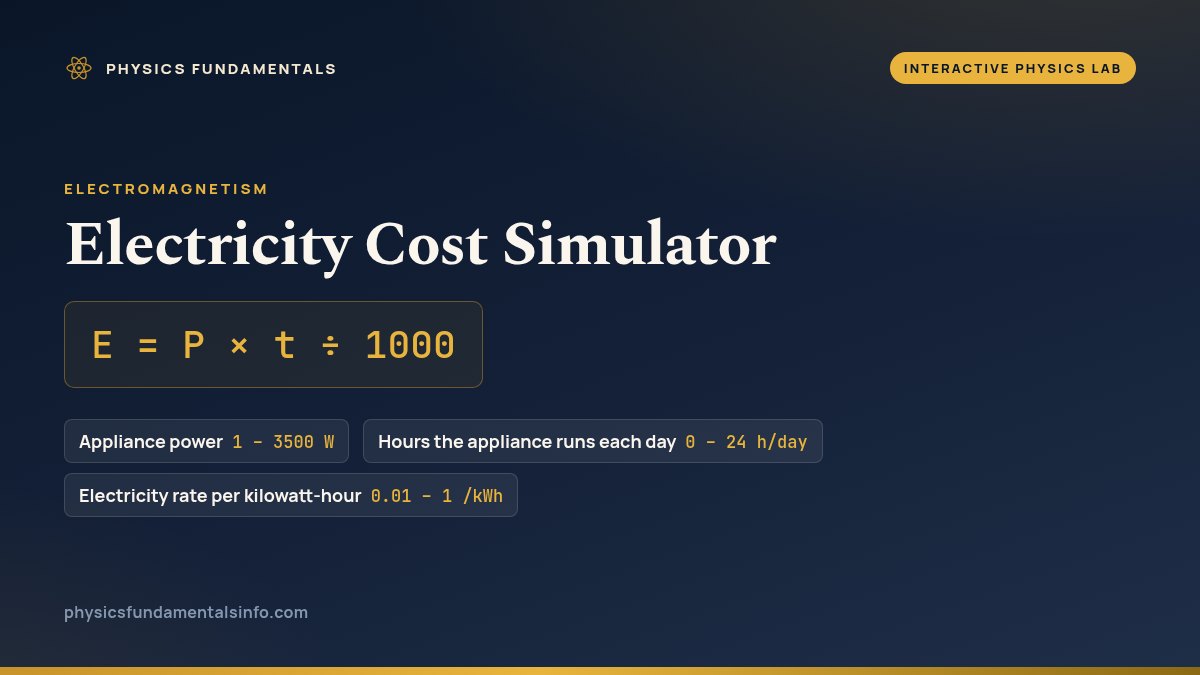
An appliance costs what its energy costs, and energy is power multiplied by time: E = P × t ÷ 1000 in kilowatt-hours, then cost = E × r. Drag the wattage, the hours per day and your own rate per kWh, then fast-forward a day and watch the meter count it up.
What an Appliance Costs to Run
Energy is power multiplied by time, and your supplier sells it by the kilowatt-hour. Set the wattage, the hours it runs each day and the rate you pay, then fast-forward a day and watch the meter count it up. A small load left on all day can easily beat a big one used in short bursts.
What Is the Electricity Cost Simulator?
The electricity cost simulator is a free interactive physics lab that runs in your browser — nothing to install and no sign-up. Drag wattage, daily hours and your tariff to watch kWh and running cost update live. Cost = kWh times rate. It reports energy per day, cost per day, cost per month 30 × daily, cost per year 365 × daily and hours to use 1 kWh as you drag the sliders.
| Control | Range | Step |
|---|---|---|
| Appliance power | 1 – 3500 W | 1 |
| Hours the appliance runs each day | 0 – 24 h/day | 0.25 |
| Electricity rate per kilowatt-hour | 0.01 – 1 /kWh | 0.01 |
How to Use the Electricity Cost Simulator
Three sliders drive everything. Power runs from 1 W to 3500 W: the figure on the appliance's rating plate, the rate at which it draws energy while it works. Run time spans 0 to 24 hours a day in quarter-hour steps, and is the part you actually control. Rate covers 0.01 to 1.00 per kilowatt-hour — put in the unit price from your own bill and every figure comes back in your own currency, because the lab never names one. Press Run the day: the shaded block on the day bar is the stretch the appliance is on, the disc spins while it draws, and the register counts up to the day's total.
Watch what the two left-hand sliders do differently to the yearly figure. Wattage and hours multiply the daily energy in exactly the same proportion — double either and the day doubles — but the hours slider has far more room to move. Wattage is fixed the moment you buy the thing; hours are a habit. Going from a quarter of an hour to eight hours is a thirty-two-fold jump you can make by accident, while the same jump in wattage would mean a different appliance. It is why 100 W left on around the clock outspends 3500 W used for half an hour.
Underneath, the lab solves E = P × t ÷ 1000 for the daily energy — the thousand is just watts becoming kilowatts — then cost = E × r. The month and year readouts are that daily cost times a flat 30 and 365, with no standing charge, so they answer what running this thing costs rather than what your bill will say. The fifth readout, hours to use 1 kWh, is 1000 ÷ P and depends on nothing but the wattage. For your own numbers over a real billing period, the electricity cost calculator shows every step.
One misconception this lab exists to break: a kilowatt is not a kilowatt-hour. A kilowatt is a rate, like a speed; a kilowatt-hour is an amount, like a distance. A 1000 W heater never uses "a kilowatt" — it uses one kilowatt-hour for every hour you leave it on, and none at all when it is off. Suppliers bill the amount, never the rate, which is why the hours slider matters as much as the wattage. If power as energy per second is still slippery, read power in physics; for where a wattage comes from in the first place, that is Ohm's law.
Frequently asked questions
What does the wattage slider actually change?
It sets how fast the appliance draws energy, not how much it uses. Watts are a rate. Move the slider and two things happen at once: the energy figure rises in direct proportion, because energy is power multiplied by time, and the hours-to-use-1-kWh figure falls, because a hungrier appliance gets through a kilowatt-hour sooner. Nothing about the hours slider changes. Most household ratings sit between 5 W for a standby light and 3000 W for a kettle or an immersion heater.
Why does a small always-on load beat a big short-burst one?
Because time is doing the work. Set the sliders to 3500 W for half an hour a day and the lab reports 1.75 kWh. Now set 100 W for the full 24 hours and it reports 2.4 kWh, from an appliance drawing thirty-five times less power. The short burst never gets long enough to accumulate. This is why a forgotten set-top box or an old fridge can quietly outspend a kettle you notice yourself using.
Does the simulator include standing charges?
No, and that is deliberate. The lab shows only the energy portion of a bill, which is the part that responds to how you use an appliance. A standing charge is a fixed daily fee for being connected at all, and it does not change whether an appliance runs for one hour or twenty. Add it separately if you are reconciling against a real bill. For the same reason the month here is a flat 30 days and the year a flat 365, not a real billing period.
How do I find my own rate per kWh?
It is on your electricity bill, usually called the unit rate or the price per kilowatt-hour, printed next to the standing charge. Type that number into the rate slider and every cost the lab shows comes back in your own currency, because the lab never names one. If your tariff has day and night rates, run the simulator twice, once with each figure, and use whichever matches the time the appliance actually runs.
Why is my appliance's real use lower than the slider suggests?
Because the number on a rating label is usually the maximum, and many appliances only draw it in bursts. A fridge is rated for its compressor but the compressor cycles on and off, so its average draw over a day is far below the plate figure. A washing machine spends most of a cycle tumbling at low power and only a few minutes heating water at full rating. To model those honestly, keep the wattage at the plate value and cut the hours slider down to the equivalent hours at full power rather than the hours the appliance is switched on.
References & formula source
- BIPM — The International System of Units (SI Brochure, 9th ed.): the watt, the joule, and the kilowatt-hour as a non-SI unit accepted for use with the SI.
- Young & Freedman — University Physics with Modern Physics, §25.5 (Energy and Power in Electric Circuits).
- US Energy Information Administration — Electricity explained: measuring electricity, and typical appliance energy use.
- Further reading: Kilowatt-hour — Wikipedia