Electricity cost: the running cost of an appliance is the energy it uses, in kilowatt-hours (kWh), multiplied by your electricity rate — cost = kW × hours × days × rate. This free calculator turns any appliance’s wattage and usage into a cost, in your own currency, with every step shown.
What Is the Electricity Cost Calculator?
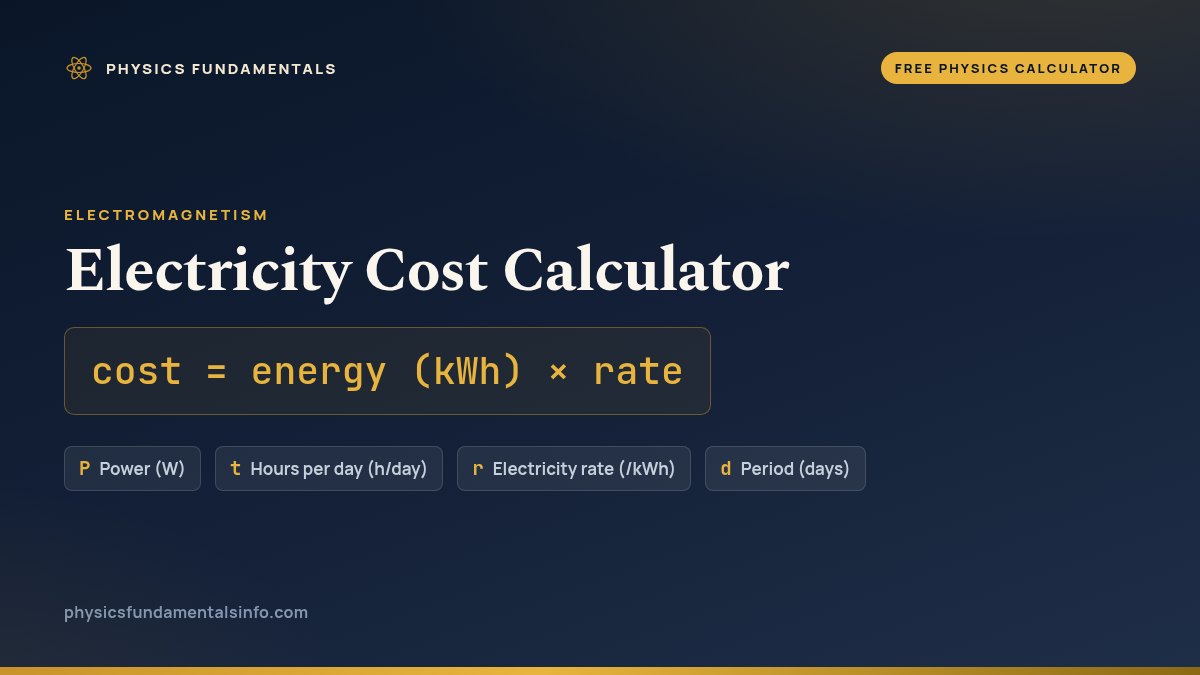
The electricity cost calculator is a free online tool built on the formula cost = energy (kWh) × rate. Enter the values you already know, in whichever units suit you, and it solves for running cost of an appliance and shows every step of the substitution. Electricity Cost is running cost of an appliance from wattage, hours and rate.
| Symbol | Quantity | Default unit | Also accepts | Example value |
|---|---|---|---|---|
| P | Power | W | kW | 1000 |
| t | Hours per day | h/day | — | 5 |
| r | Electricity rate | /kWh | — | 0.3 |
| d | Period | days | — | 30 |
How to calculate electricity cost
The cost of running an electrical appliance comes down to two things: how much energy it uses and how much you pay per unit of that energy. Energy suppliers bill in kilowatt-hours (kWh), so the whole calculation is built around that unit. One kilowatt-hour is the energy a 1000-watt appliance uses in one hour.
Start with the appliance’s power, printed on its rating label in watts (W) or kilowatts (kW). Convert it to kilowatts by dividing watts by 1000 — a 2000 W oven is 2 kW. Then work out the energy: multiply the power in kilowatts by the number of hours per day it runs and by the number of days in your billing period. That gives the energy in kWh: energy = kW × hours × days.
Finally, multiply the energy by your electricity rate — the per-kWh price on your bill — to get the cost: cost = energy × rate. The rate and the resulting cost are currency-agnostic here, so enter the price in whatever currency you pay and read the answer back in the same currency. The calculator also breaks out the energy used and the per-day cost, which is handy for comparing two appliances or deciding whether something is worth switching off.
A few practical notes. Use the hours the appliance is actually drawing power, not just the time it is plugged in — a fridge cycles on and off, and many devices idle in standby. This estimate covers the appliance’s usage cost only; most bills add a fixed daily standing charge and taxes on top. For the electrical relationships behind power, see the Ohm’s law calculator, or look up power in the physics glossary.
Worked example
Suppose a 1500 W (1.5 kW) space heater runs 5 hours a day for 30 days, and you pay 0.30 per kWh. The energy used is 1.5 kW × 5 h × 30 days = 225 kWh. The cost is 225 kWh × 0.30 = 67.5 in your currency — about 2.25 per day. Halving the daily run-time to 2.5 hours would halve both figures, to roughly 112.5 kWh and a cost of 33.75.
Why it matters
Knowing the true running cost of each appliance turns a vague monthly bill into clear, comparable numbers. It shows which devices dominate your usage, what standby power really costs over a year, and whether an efficient replacement pays for itself — the foundation of any sensible energy-saving decision.
Frequently asked questions
How do I calculate the cost of running an appliance?
Convert the appliance’s power to kilowatts (divide watts by 1000), multiply by the hours per day and the number of days to get the energy used in kilowatt-hours (kWh), then multiply by your electricity rate. In short: cost = (power in kW) × hours × days × rate.
What is a kilowatt-hour (kWh)?
A kilowatt-hour is the energy used by a 1000-watt (1 kW) appliance running for one hour. It is the unit energy suppliers bill you in. A 2 kW heater on for 3 hours uses 2 × 3 = 6 kWh; a 100 W bulb left on for 10 hours uses 0.1 × 10 = 1 kWh.
How do I convert watts to kilowatts?
Divide the number of watts by 1000. A 1500 W kettle is 1.5 kW, a 60 W bulb is 0.06 kW. This calculator does the conversion for you — just pick watts or kilowatts from the unit menu.
What electricity rate should I enter?
Use the per-kWh unit price on your electricity bill (sometimes called the unit rate). It varies by country, supplier and tariff, so check your latest bill rather than relying on a typical figure. Enter it in your own currency — the cost result comes back in that same currency.
Does the calculator include standing charges?
No. It estimates only the energy (usage) cost of the appliance itself. Many tariffs also add a fixed daily standing charge and taxes that are independent of how much you use, so your total bill will be higher than this single-appliance figure.
References & formula source
- Halliday, Resnick & Walker — Fundamentals of Physics, Chapter 26–27 (Current and Electrical Energy).
- Young & Freedman — University Physics with Modern Physics, §25.5 (Energy and Power in Electric Circuits).
- NIST — Guide for the Use of the International System of Units (SI): the joule, watt and kilowatt-hour.
- Further reading: Kilowatt-hour — Wikipedia