Potential energy is the energy stored in an object because of its position, shape, or configuration, ready to be released as motion or another form of energy. For an object of mass m at height h, gravitational potential energy equals mgh, where g is the gravitational field strength. Its SI unit is the joule (J).
Lift a book over your head and hold it perfectly still. Nothing is moving, no engine is running — yet something has changed. You have loaded that book with energy, and the floor will find out the instant you let go.
That waiting, stored energy is potential energy. It hides in a drawn bow, in water trapped behind a dam, in the food on your plate, even in the charge sitting on your phone battery. None of it does anything visible — until it is released.
What Is Potential Energy?
Potential energy is the energy an object stores because of where it is or how it is arranged, rather than because it is moving. Stretch a spring, raise a mass, push two magnets together: each time you do work, and that work is banked as energy the system can pay back later.
It is one of the two great families of mechanical energy — the other being kinetic energy, the energy of motion. For the wider map of how all the forms fit together, see our guide to energy in physics.
The word potential is the clue. The energy is latent, not active. A boulder resting on a clifftop isn’t doing a thing — but it holds the potential to do a great deal the moment it tips over the edge.
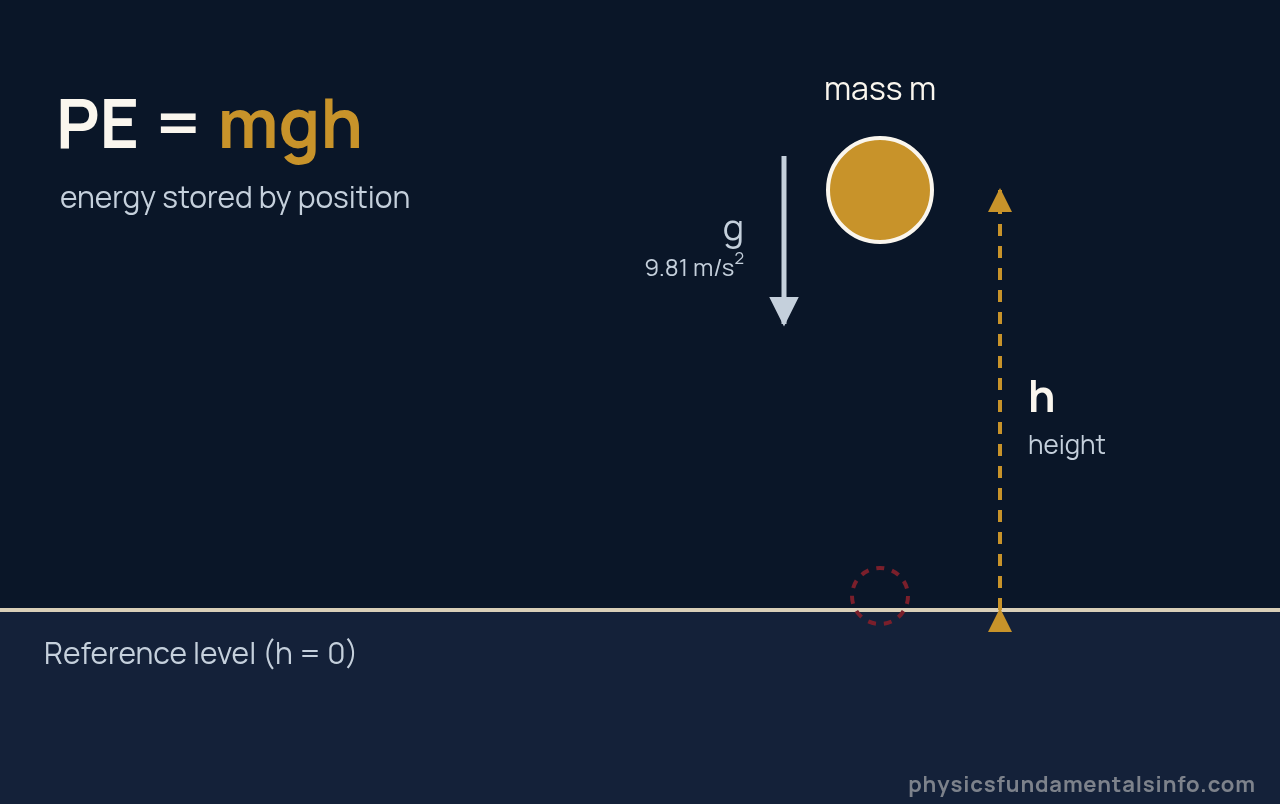
Gravitational potential energy depends on mass, gravity, and height above a chosen reference level.
The Potential Energy Formula
There isn’t one single formula for potential energy, because energy can be stored in different ways. But three formulas cover almost everything you will meet, and the first is the one most people mean by “the PE formula”.
Gravitational potential energy: PE = mgh
Near the Earth’s surface, the gravitational potential energy of a raised object is the product of just three quantities:
Each symbol, with its SI unit:
- PE — gravitational potential energy, measured in joules (J).
- m — the object’s mass, in kilograms (kg).
- g — the gravitational field strength, about 9.81 m/s2 near Earth’s surface (equivalently 9.81 N/kg).
- h — the height above your chosen reference level, in metres (m).
Elastic potential energy: Ep = ½kx2
Squash or stretch a spring and you store energy in it. The further you push, the more you store — and because the resisting force grows as you go, the energy rises with the square of the displacement.
- Ep — elastic potential energy, in joules (J).
- k — the spring constant, or stiffness, in newtons per metre (N/m).
- x — the extension or compression from the natural length, in metres (m).
This formula comes straight from Hooke’s law, which tells us the restoring force of a spring is proportional to how far it is stretched.
Far from Earth: U = −GMm/r
The tidy PE = mgh only works while gravity is roughly constant — that is, near the surface. Travel out towards orbit and beyond, and you need the full expression:
- U — the gravitational potential energy of the two-mass system, in joules (J).
- G — the gravitational constant, 6.674 × 10⁻¹¹ N·m2/kg2 (NIST CODATA value).
- M, m — the two masses, in kilograms (kg).
- r — the distance between their centres, in metres (m).
The minus sign looks strange, but it simply sets the zero of energy at infinite separation. We will unpack that in the misconceptions below.
Types of Potential Energy
Because energy can be banked in several ways, “potential energy” is really an umbrella term. Here are the five forms you are most likely to meet.
Gravitational
Energy stored by lifting a mass against gravity — the dam, the diver on the high board, the apple before it falls. This is the PE = mgh form near the ground.
Elastic (strain)
Energy stored when a material is stretched, compressed, or bent: a drawn bow, a wound clock spring, a trampoline mat at full sag.
Electric (electrostatic)
Energy stored in the arrangement of charged particles. Pull unlike charges apart or push like charges together and you store electric potential energy — the principle behind a charged capacitor, and a direct cousin of Coulomb’s law.
Chemical
Energy locked in the bonds between atoms. Petrol, food, and a battery all hold chemical potential energy, released as heat, motion, or electricity during a reaction.
Nuclear
Energy stored in the nucleus of an atom, released in fission or fusion. It is what powers nuclear reactors — and the Sun.
| Type | Typical formula | Energy is stored in… | Everyday example |
|---|---|---|---|
| Gravitational | PE = mgh (or U = −GMm/r) | an object’s height in a gravitational field | water held behind a dam |
| Elastic | Ep = ½kx2 | a stretched or compressed material | a drawn bow or trampoline |
| Electric | U = kq1q2 / r | the arrangement of charges | a charged capacitor |
| Chemical | no single formula | bonds between atoms | food, petrol, a battery |
| Nuclear | E = Δmc2 (binding energy) | the nucleus of an atom | uranium fuel, the Sun |
How Potential Energy Works
Where does the stored energy actually come from? From work. Whenever you push against a force that wants to pull something back — gravity pulling a mass down, a spring trying to snap shut — the work you do is converted into potential energy.
Lift a mass m straight up at steady speed and the force you apply equals its weight, mg. Work is force times distance, so raising it through a height h takes work mg × h = mgh. That is exactly the energy now stored — which is why PE = mgh.
It always needs a reference level
Here is a subtlety worth pinning down early. Potential energy is never an absolute number — it is always measured from somewhere. The book is 1.5 m above the desk, but 4 m above the floor, and 30 m above the street.
So you choose a reference level (often the ground) and call its energy zero. Only the change in potential energy between two points has physical meaning, and that change is the same whichever zero you pick.
Energy that converts and conserves
Release the stored energy and it has to go somewhere. As the book falls, its potential energy turns into kinetic energy: the lower it gets, the faster it moves. Add the two together and — if we ignore air resistance — the total never changes.
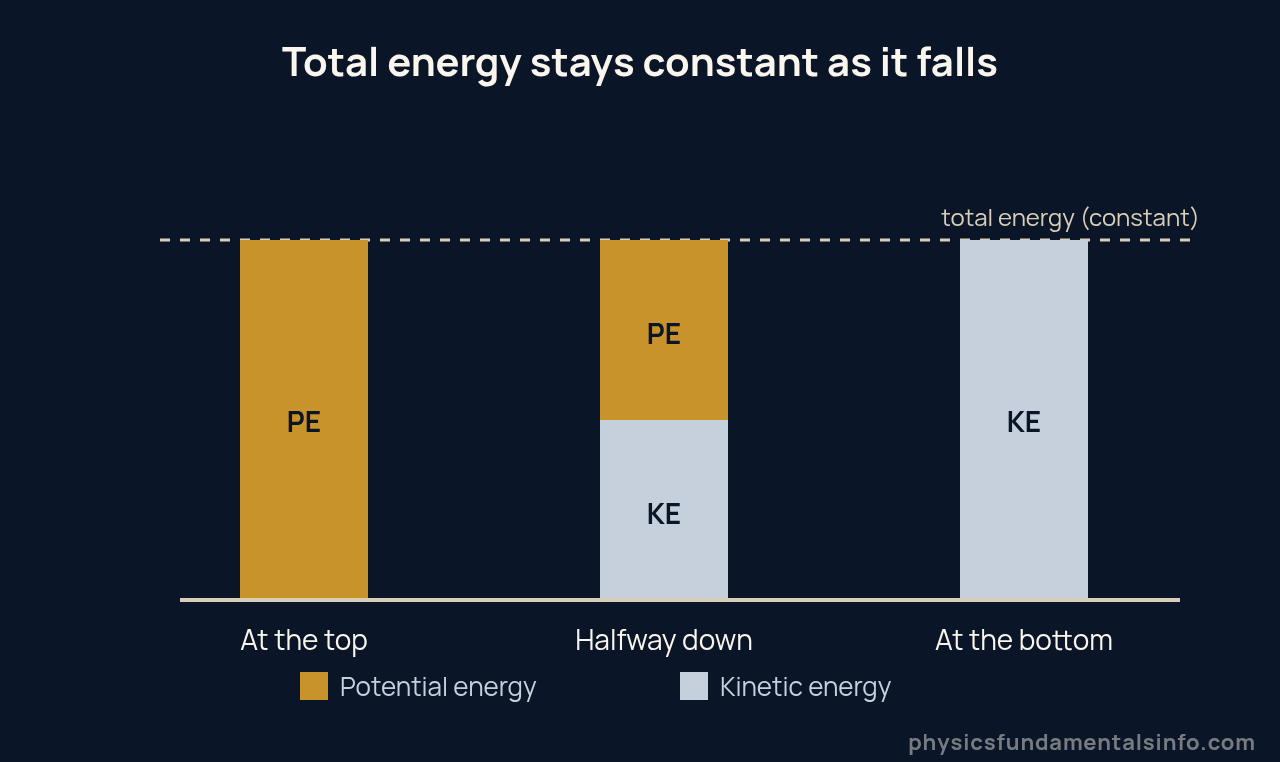
As an object falls, potential energy converts into kinetic energy while the total mechanical energy stays the same (ignoring air resistance).
One more idea ties this together neatly: a force always points “downhill” in energy. Mathematically, force is the negative slope of potential energy (F = −dU/dx) — which is just a precise way of saying things naturally move towards lower potential energy, like that boulder rolling off the cliff.
Real-World Examples of Potential Energy
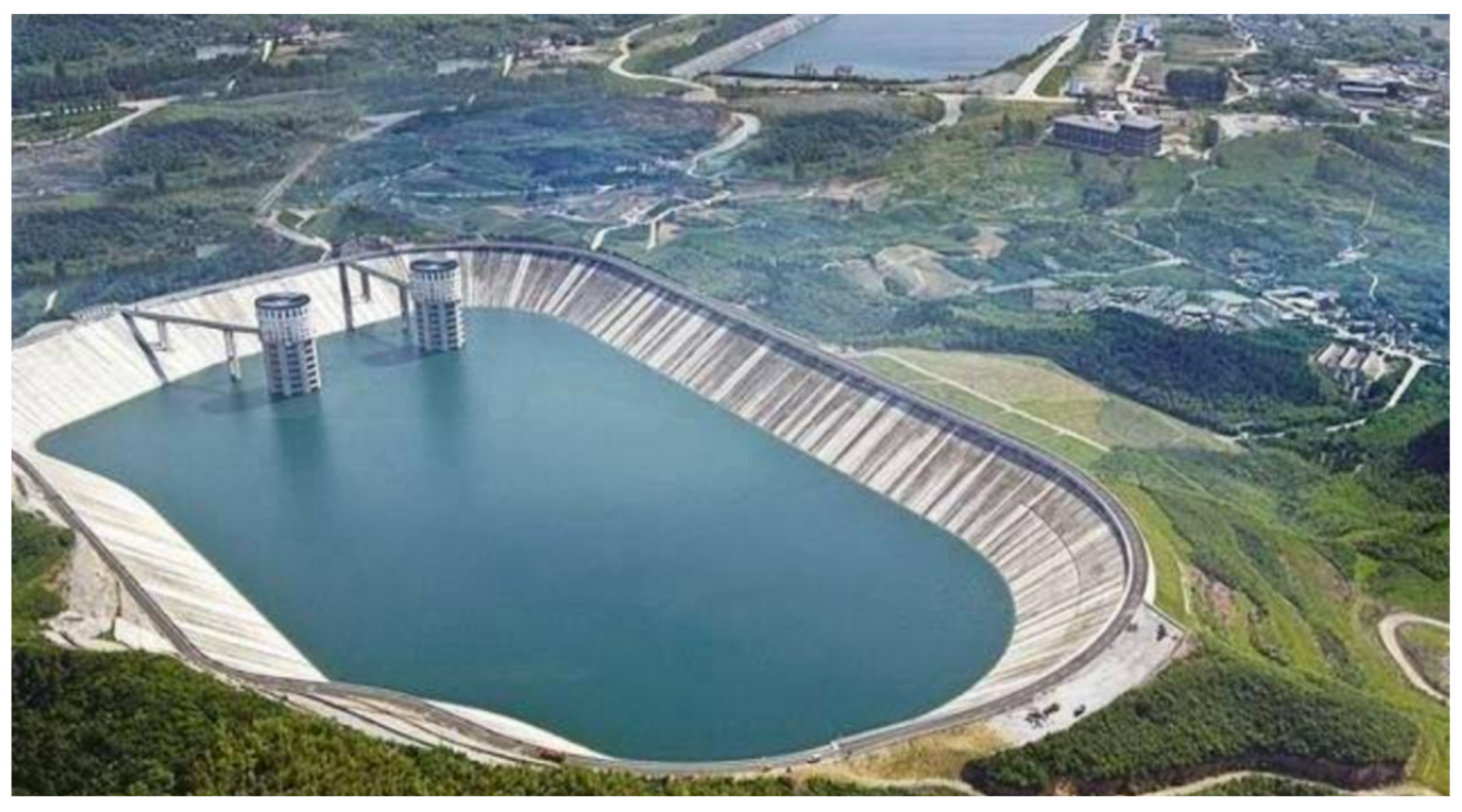
1. Water behind a dam. A reservoir holds enormous gravitational potential energy simply by sitting high up. Let it fall through turbines and that energy becomes electricity — the basis of every hydroelectric plant.
2. A drawn bow. Pull the string back and the limbs store elastic potential energy. Release, and it flings into the arrow’s kinetic energy in a fraction of a second.
3. A roller coaster at the crest. The first big climb does nothing but load the car with gravitational potential energy. Every thrilling drop afterwards is that energy being spent as speed.
4. A pendulum clock. At the top of each swing the bob is momentarily still — all potential energy. At the bottom it is fastest — all kinetic. The endless trade keeps the clock ticking.
5. A charged phone battery. Charging stores chemical potential energy; using the phone releases it as electrical energy. Same idea, different storehouse.
Common Misconceptions About Potential Energy
Myth: potential energy belongs to a single object. It is really a property of a system. Gravitational potential energy belongs to the object–Earth pair, and electric potential energy to a set of charges. We say “the book’s PE” only as a convenient shorthand.
Myth: there is an absolute zero of potential energy. The zero is a choice, not a fact of nature. Put it at the floor, the desk, or sea level — your numbers shift, but every change in PE stays identical, and only changes affect the physics.
Myth: PE = mgh works everywhere, even in deep space. It holds only where g is roughly constant — close to the surface. Far out, gravity weakens with distance and you must switch to U = −GMm/r, which is why that formula carries its negative sign.
Myth: heavier objects fall faster because they store more energy. A heavier object does store more PE and arrives with more kinetic energy — but not more speed. Mass cancels in mgh = ½mv2, leaving v = √(2gh). On the airless Moon, a hammer and a feather hit the ground together.
How Potential Energy Relates to Kinetic Energy, Work, and Conservation of Energy
Potential energy never lives alone. Add it to kinetic energy and you get an object’s mechanical energy. When only conservative forces (like gravity) act, that total is conserved:
This is what makes energy methods so powerful. Instead of tracking forces moment by moment, you compare energy at the start and the end. A pendulum and a mass on a spring show it beautifully — both forever swap PE and KE, as we explore in simple harmonic motion.
Work is the bridge between them. The work done against gravity becomes stored PE; releasing it does work that becomes kinetic energy. Energy is simply passed along the chain, never created or destroyed.
| Feature | Kinetic energy | Potential energy |
|---|---|---|
| Depends on | motion (speed) | position or configuration |
| Typical formula | KE = ½mv2 | PE = mgh |
| Is zero when | the object is at rest | it sits at the chosen reference level |
| Quantity type | scalar, in joules (J) | scalar, in joules (J) |
| Together they form | mechanical energy (KE + PE) | |
Worked Problems
Show Solution
Solution:
Step 1: Use the gravitational PE formula, PE = mgh.
Step 2: Substitute with units: PE = (2.0 kg)(9.81 m/s2)(1.8 m).
Step 3: Multiply: PE = 35.3 J.
Answer: PE ≈ 35 J (2 significant figures).
Show Solution
Solution:
Step 1: Rearrange PE = mgh to make h the subject: h = PE / (mg).
Step 2: Substitute: h = 24.5 J / [(0.50 kg)(9.8 m/s2)] = 24.5 / 4.9.
Step 3: Divide: h = 5.0 m.
Answer: h = 5.0 m.
Show Solution
Solution:
Step 1: Use the elastic PE formula, Ep = ½kx2.
Step 2: Substitute: Ep = ½ × (200 N/m) × (0.15 m)2.
Step 3: Evaluate: ½ × 200 × 0.0225 = 2.25 J.
Answer: Ep = 2.25 J.
Show Solution
Solution:
Step 1: All the potential energy becomes kinetic energy: mgh = ½mv2.
Step 2: Mass cancels, giving v = √(2gh) = √(2 × 9.81 × 5.0).
Step 3: Evaluate: v = √98.1 = 9.9 m/s.
Answer: v ≈ 9.9 m/s (and KE at the ground ≈ 9.8 J).
Show Solution
Solution:
Step 1: The PE at the top all converts to KE at the bottom: KE = mgh.
Step 2: Substitute: KE = (1500 kg)(9.81 m/s2)(45 m) = 662 175 J.
Step 3: For speed, use ½mv2 = mgh, so v = √(2gh) = √(2 × 9.81 × 45) = √882.9.
Answer: KE ≈ 6.6 × 10⁵ J and v ≈ 29.7 m/s.
Show Solution
Solution:
Step 1: Use ΔPE = mgΔh, where Δh is the change in height.
Step 2: Find Δh = 1500 − 200 = 1300 m, then substitute: ΔPE = (60 kg)(9.81 m/s2)(1300 m).
Step 3: Multiply: ΔPE = 765 180 J.
Answer: ΔPE ≈ 7.7 × 10⁵ J (about 765 kJ).
Show Solution
Solution:
Step 1: Far from the surface use U = −GMm/r, with r = R + altitude.
Step 2: Find r = 6.371 × 10⁶ + 0.400 × 106 = 6.771 × 10⁶ m, then substitute: U = −(6.674 × 10−11 × 5.972 × 1024 × 1000) / (6.771 × 10⁶).
Step 3: Evaluate the top (3.986 × 10¹⁷) and divide: U = −5.89 × 10¹⁰ J.
Answer: U ≈ −5.9 × 10¹⁰ J — the negative sign means energy must be supplied to move the satellite infinitely far away.