Electric potential is the work per unit charge needed to bring a test charge in from infinitely far away, and around a single point charge it is V = k·Q / r. This free electric potential calculator takes a charge and a distance and returns that potential in volts, or reads the same relation backwards to give you the charge or the distance instead. The charge may be negative, and the potential then comes out negative too — which is the whole difference between a potential and a field strength.
Load a real charge
Every button types a consistent set of figures into all three boxes, so whichever quantity the Solve for menu is pointing at, the other two already agree with it. The line underneath quotes back whatever the widget works out from that, so nothing in it is stored text.
Pick a charge above, or type your own numbers.
What Is the Electric Potential Calculator?
The electric potential calculator is a free online tool for the potential a single point charge produces at a distance from it: V = k·Q / r, with k = 8.9875 × 10⁹ N·m2/C2. Type a charge and a distance and it returns the potential in volts, millivolts or kilovolts; point the Solve for menu at the charge or at the distance instead and it rearranges to Q = V·r / k or r = k·Q / V. Beside the answer it prints the sign of the potential and why it has that sign, the charge in coulombs and nanocoulombs, the field strength at the same point, the potential divided by that field, and what the potential would be at twice the distance.
The charge may be negative, and that is what makes this page additive rather than a repeat of the electric field calculator. That tool solves E = k·Q / r2 and rejects a negative charge in every one of its three modes, because a field strength there is a magnitude. Electric potential is a scalar with a sign: a negative charge lowers the potential everywhere around it, so the answer comes out below zero and is printed that way. That is also why the potentials of several charges at one point can be added as ordinary signed numbers, with no angles and no components, where the fields would have to be added as vectors.
Two things on the page are conventions rather than results, and it says so. The zero of potential sits infinitely far from the charge; only differences in potential move energy about, so that zero is a choice, and it is the choice that makes V = k·Q / r come out with no constant added. And the Coulomb constant is rounded, and measured rather than defined: the 2019 SI redefinition released the magnetic constant, so CODATA 2022 gives 8.9875517862 × 10⁹ where the older SI had fixed the constant by definition at 8.9875517873681764 × 10⁹. This page uses 8.9875 × 10⁹ to agree digit for digit with the electric field calculator, and the Coulomb law calculator on this site uses 8.988 × 10⁹. All three agree once rounded to four significant figures and differ in the digit after that.
Solving for the distance is the one mode that can have no answer. Because k is positive and a distance is positive, V = k·Q / r always carries the sign of Q, so a positive charge cannot produce a negative potential at any distance whatsoever and the calculator declines rather than returning a negative distance. A potential of exactly zero is declined for the same reason from the other side: a single charge reaches zero only infinitely far away. A distance of zero is refused in every mode, because the potential of an idealised point charge is undefined there rather than merely large.
| Symbol | Quantity | Default unit | Also accepts | Example value |
|---|---|---|---|---|
| V | Potential | V | mV, kV | 8.9875 |
| Q | Charge | nC | C, mC, µC | 1 |
| r | Distance | m | cm, mm | 1 |
How to use the electric potential calculator
- Choose the unknown. The Solve for menu opens on Potential, and the other two choices are Charge and Distance. Whichever you pick vanishes from the boxes below and the remaining two become your inputs.
- Type the charge, with its sign. This box takes C, mC, µC or nC and opens on 1 nC. A minus sign is not merely tolerated here: it is the point of the page, and a negative charge returns a negative potential rather than a magnitude.
- Type the distance. The distance box takes m, cm or mm and opens on 1 m. It must be above zero, because it is the only denominator in the calculation.
- Type the potential when you are solving backwards. The potential box takes V, mV or kV and opens on 8.9875 V, which is exactly what 1 nC produces at 1 m. It accepts a negative figure, and the two backwards modes read it.
- Read the answer. The headline carries four significant figures while it stays a plain decimal and becomes a three-figure exponential outside that range. It appears in whatever unit that quantity’s own menu is set to. The box you are solving for is hidden, so to change the answer’s unit, set it while that quantity is still an input and then point Solve for back at it.
- Read the seven chips. They give the potential with its sign, what that sign means, the charge in coulombs and nanocoulombs, the distance, the field strength at the same point, the potential divided by that field, and the potential at twice the distance.
- Use the ratio chip as a check. For a point charge, the potential divided by the field strength is the distance itself, exactly, at every distance. If that chip disagrees with the distance you typed, one of your two figures is in the wrong unit.
- Open Show working. The steps restate the relation, list your figures in SI, run the rearrangement and check it forwards. In Solve for Distance they state the sign condition before dividing by anything, because that is the one mode that can fail on physics rather than on arithmetic.
This page exists because nothing on the site could turn a charge and a distance into a voltage. The electric field calculator looks close enough to cover it and does not: it solves E = k·Q / r2, one power of r steeper, and every one of its three modes rejects a negative charge outright because it is a magnitude tool by construction. Here the sign survives the whole calculation, which is what makes the two pages different rather than duplicates.
For what the quantity means, why it is measured from zero at infinity and how two charges’ potentials add, read the guide to electric potential, which this tool is the arithmetic half of. The tool answers “how many volts?”; the guide answers “why volts, and measured from where?”
Two mistakes account for most wrong answers. The first is leaving the charge menu on nanocoulombs while typing a figure meant as microcoulombs, which moves the answer by a factor of a thousand — the Charge chip prints both units for exactly that reason. The second is dropping the minus sign, which does not make the answer smaller; it makes it the wrong side of zero.
Worked example: change one thing at a time
The table starts at the defaults and moves one thing at a time: the distance, then the sign of the charge, then the charge to zero, then the unit the figure is typed in, then which quantity is the unknown, and finally the entries the calculator declines. Every Headline, Potential chip and Field chip cell was read out of the running widget rather than worked out by hand, so where a cell and the tool ever part company, believe the tool.
| Step | Solving for | What you type | Headline answer | Potential chip | Field chip |
|---|---|---|---|---|---|
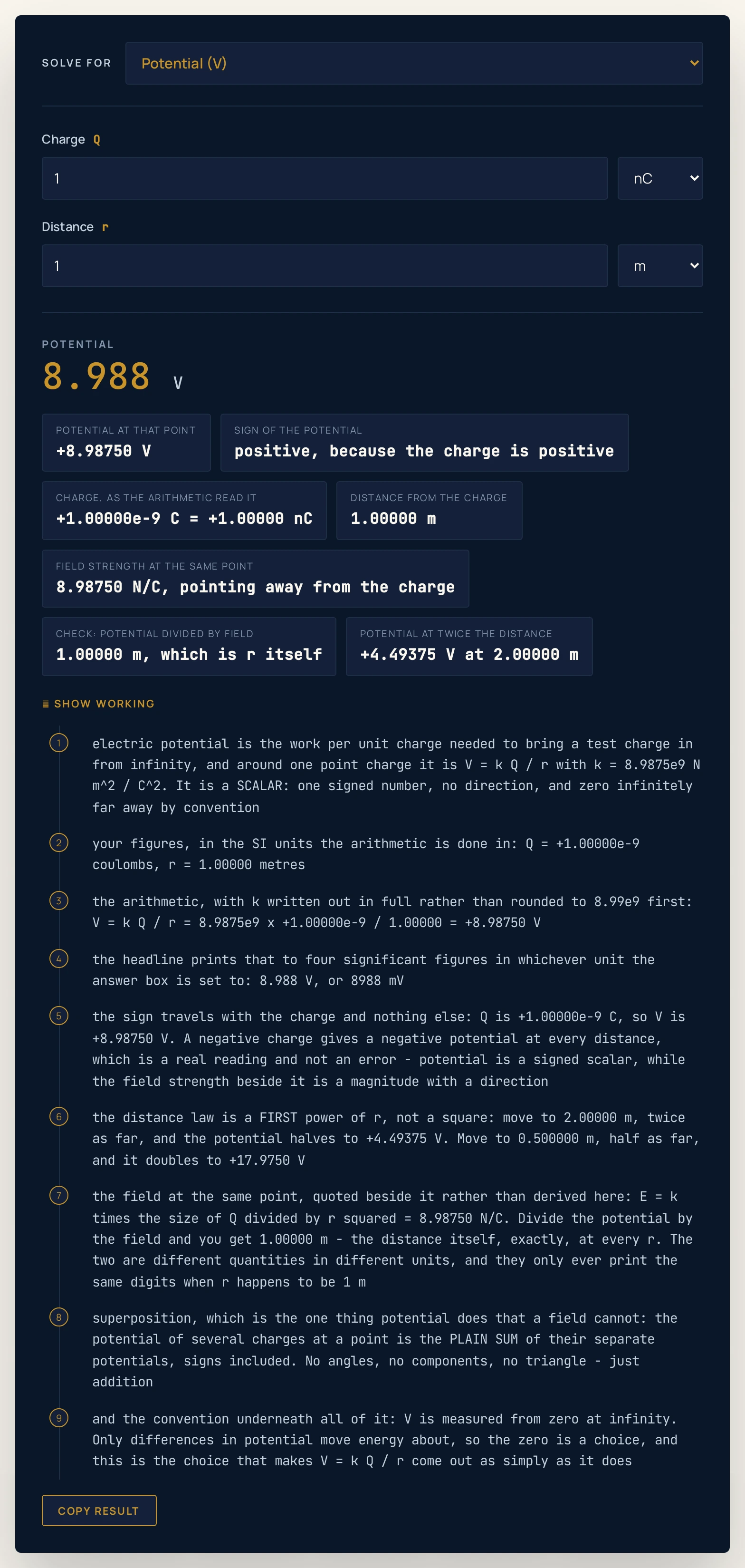
| The page as it opens | Potential | 1 nC at 1 m | 8.988 V | +8.98750 V | 8.98750 N/C, pointing away from the charge |
| Twice as far away | Potential | 1 nC at 2 m | 4.494 V | +4.49375 V | 2.24688 N/C, pointing away from the charge |
| Ten times closer | Potential | 1 nC at 0.1 m | 89.88 V | +89.8750 V | 898.750 N/C, pointing away from the charge |
| The same charge, made negative | Potential | -1 nC at 1 m | -8.988 V | -8.98750 V | 8.98750 N/C, pointing towards the charge |
| A bigger negative charge, closer in | Potential | -5 nC at 0.5 m | -89.88 V | -89.8750 V | 179.750 N/C, pointing towards the charge |
| Its mirror image | Potential | 5 nC at 0.5 m | 89.88 V | +89.8750 V | 179.750 N/C, pointing away from the charge |
| No charge at all | Potential | 0 nC at 1 m | 0 V | 0 V | 0 N/C, no field at all: the charge is zero |
| The same figure typed in centimetres | Potential | 1 nC at 100 cm | 8.988 V | +8.98750 V | 8.98750 N/C, pointing away from the charge |
| A distance of zero is declined | Potential | 1 nC at 0 m | no answer | — | — |
| A negative distance is declined | Potential | 1 nC at -1 m | no answer | — | — |
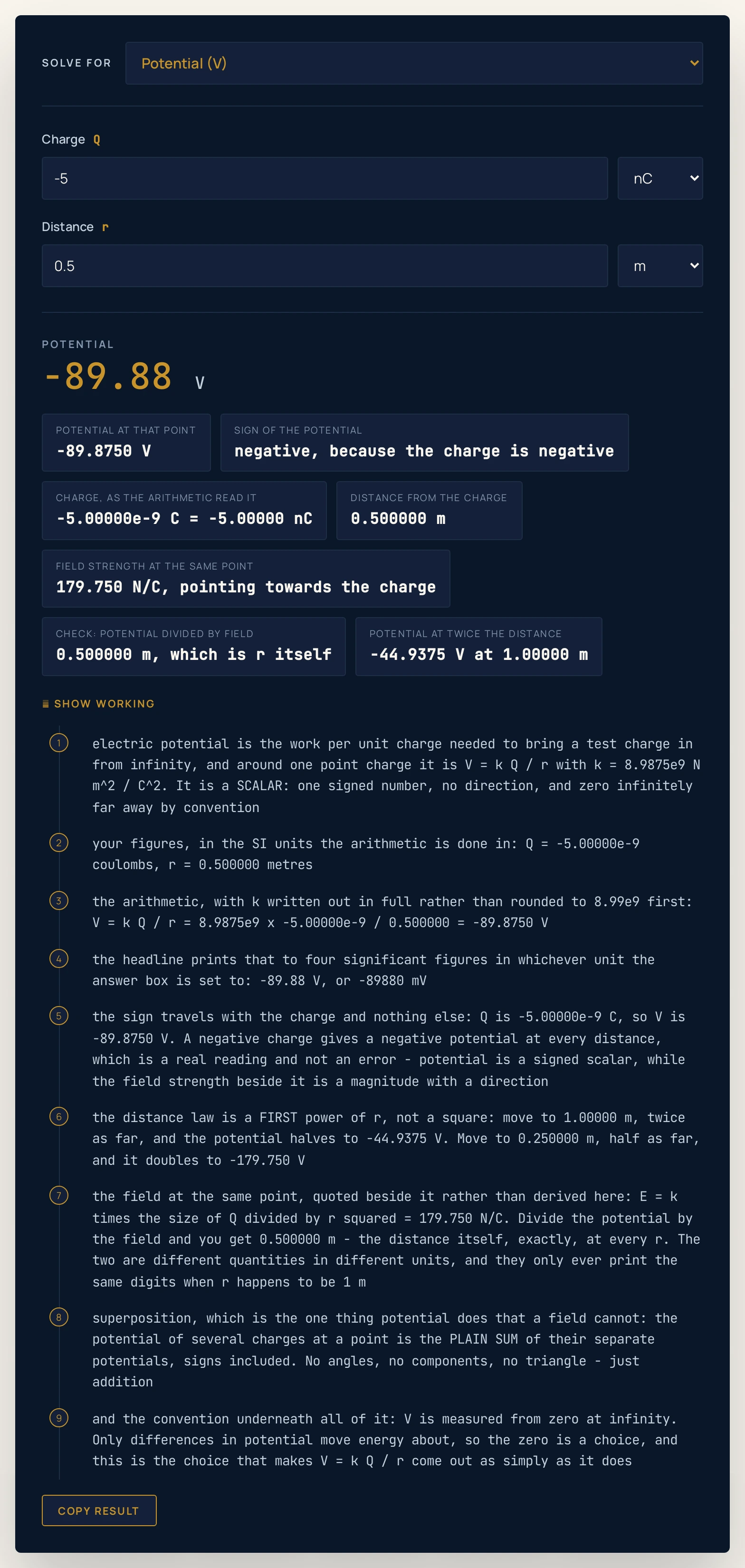
| What charge gives 100 V at half a metre? | Charge | 100 V at 0.5 m | 5.563 nC | +100.000 V | 200.000 N/C, pointing away from the charge |
| The same question, negative | Charge | -100 V at 0.5 m | -5.563 nC | -100.000 V | 200.000 N/C, pointing towards the charge |
| A potential of zero needs no charge | Charge | 0 V at 0.5 m | 0 nC | 0 V | 0 N/C, no field at all: the charge is zero |
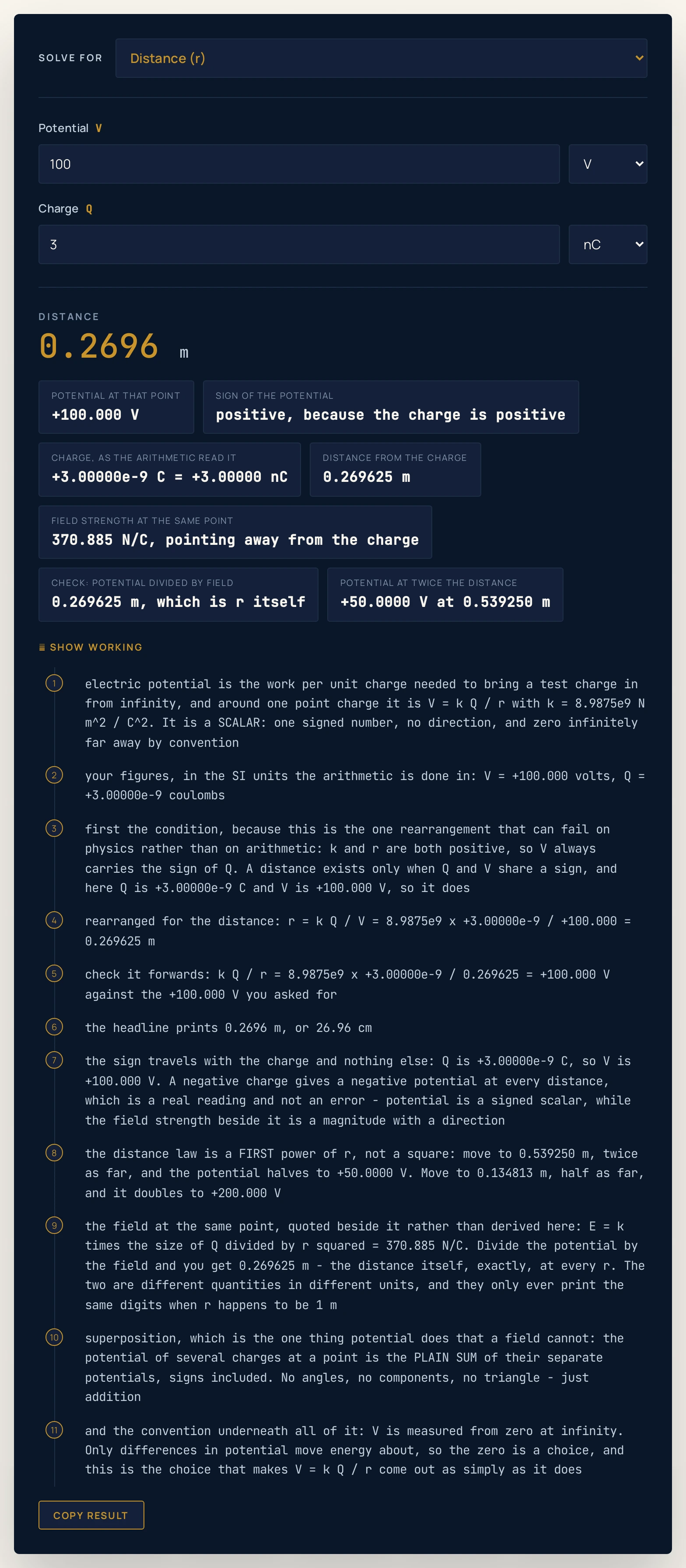
| How far out is 100 V from 3 nC? | Distance | 100 V from 3 nC | 0.2696 m | +100.000 V | 370.885 N/C, pointing away from the charge |
| The same question, both signs flipped | Distance | -100 V from -3 nC | 0.2696 m | -100.000 V | 370.885 N/C, pointing towards the charge |
| Signs that disagree are declined | Distance | -100 V from +3 nC | no answer | — | — |
| A potential of zero is declined | Distance | 0 V from 3 nC | no answer | — | — |
Rows 1 to 3 are the distance law on its own. Doubling the distance halves the potential and quarters the field beside it; going ten times closer multiplies the potential by ten and the field by a hundred. Those two columns moving at different rates is the clearest demonstration on the page that the potential is not the field.
Rows 4 to 6 are the sign, and they are why this page exists. Making the charge negative flips the potential to the other side of zero while the field strength beside it does not change at all — only its direction word does. Rows 5 and 6 are the same size of charge at the same distance, one of each sign: +89.8750 V and −89.8750 V, a pair that would add to exactly zero at a point halfway between the two charges.
Row 7 is the empty case and it is answered rather than declined. A charge of zero produces a potential of zero, which is a perfectly good reading, so the calculator prints 0 V instead of refusing. Row 8 is the unit menu: 100 cm is 1 m, so it reproduces row 1 exactly.
Rows 9 and 10 sit outside the domain. A distance of zero divides the one denominator this page has, and a negative distance is not a place; both are declined rather than answered with a very large number.
Rows 11 to 13 read the relation backwards to a charge, and they are where a guard written in the wrong place would have shown itself: the distance box is still on screen in that mode, but the potential box is the one doing the work. A potential of zero honestly needs no charge at all.
Rows 14 to 17 solve for the distance, and the last two are the physics guard rather than an arithmetic one. Flipping both signs at once leaves the distance unchanged at 0.2696 m, because the two minus signs cancel in k·Q / V. Flipping only one leaves no distance to find at all.
Formula and symbol reference
One relation does all the work. The potential a point charge Q produces at a distance r from it is the Coulomb constant times the charge, divided by the distance: V = k·Q / r. Rearranged for the other two quantities that is Q = V·r / k and r = k·Q / V, and the calculator does all three from one menu.
The constant is k = 1 / (4 π ε0), and this page uses 8.9875 × 10⁹ N·m2/C2. That is the same rounding the electric field calculator on this site uses, deliberately, so the two tools agree digit for digit on the same charge at the same distance. The working prints it in full at every step and never rounds it to 8.99 × 10⁹ before multiplying by it.
Two properties of the formula are worth more than the formula itself. The potential is a scalar, so the potentials of several charges at one point add as ordinary signed numbers, with no angles anywhere. And it falls off as the first power of the distance, not the square, which is why the potential and the field strength around the same charge move at different rates as you walk away from it.
| Symbol | Meaning | SI unit | Values used on this page |
|---|---|---|---|
| V | Electric potential at a point: the work per unit charge needed to bring a test charge there from infinity. A signed scalar, not a vector | volt (V), which is one joule per coulomb | Boxes take V, mV or kV: 8.9875 V is 1 nC at 1 m, −89.875 V is −5 nC at 0.5 m. |
| Q | The charge producing the potential. May be positive, negative or zero, and its sign becomes the sign of V | coulomb (C); nanocoulombs on this page | Boxes take C, mC, µC or nC: 1 nC is the default, −5 nC the negative preset, 5.563 nC what 100 V at 0.5 m needs. |
| r | Distance from the charge to the point you are asking about. The only denominator in the calculation, so it must be above zero | metre (m) | Boxes take m, cm or mm: 1 m is the default, 0.5 m the preset pair, 0.269625 m where 3 nC reaches 100 V. |
| k | The Coulomb constant, 1 over 4 π ε0. Exact in principle; rounded in practice, and this page and the electric field calculator round it the same way | newton metre squared per coulomb squared | A constant: 8.9875 × 10⁹ N·m2/C2, the same value the electric field calculator uses. |
| E | Electric field strength at the same point, shown for comparison only. A vector magnitude, and it falls off as the square of the distance where V falls off as the first power | newton per coulomb (N/C), the same as a volt per metre | A chip, never an input: 8.9875 N/C beside 8.9875 V at 1 m, 2.24688 N/C beside 4.49375 V at 2 m. |
The physics: one signed number you can add up
The potential at a point is a single number with a sign and no direction. That sounds like a simplification and it is the opposite: it is the reason potential is the quantity physicists reach for first, because a scalar can be added with arithmetic while a vector needs geometry.
The sign is not decoration. A positive charge raises the potential everywhere around it and a negative charge lowers it everywhere around it, so a negative potential means it takes work to remove a positive test charge to infinity rather than to bring it in. Around a single charge the sign never changes with distance — only the size does — which is exactly why solving for a distance from a potential of the opposite sign has no answer.
Now the comparison that gives this page its point, and it is one line of arithmetic rather than a section. The field strength at the same place is E = k·Q / r2, one power of r steeper, so walking twice as far from a charge halves the potential and quarters the field. Divide one by the other and you get the distance back, exactly, at every distance.
The field itself — its direction, its lines, its inverse-square law — belongs to the electric field guide and to its own calculator, and none of it is worked out here. This page borrows one number from it and no more.
| Distance / m | Potential chip / V | Field chip / N per C | Ratio chip / m |
|---|---|---|---|
| 0.1 | +89.8750 | 898.750 | 0.100000 |
| 0.25 | +35.9500 | 143.800 | 0.250000 |
| 0.5 | +17.9750 | 35.9500 | 0.500000 |
| 1 | +8.98750 | 8.98750 | 1.00000 |
| 2 | +4.49375 | 2.24688 | 2.00000 |
| 4 | +2.24688 | 0.561719 | 4.00000 |
Read the middle two columns against each other rather than down. From 1 m to 2 m the potential goes from 8.98750 to 4.49375, a factor of two, while the field goes from 8.98750 to 2.24688, a factor of four.
The row at 1 m is the best hook on the page and also its best trap: those two numbers are equal because the distance happens to be one metre, not because the quantities are the same. They are in different units, and one row further down they no longer match.
The last column is the same statement as a single figure, and it is worth keeping as a habit. Potential divided by field strength is the distance, so if a calculation hands you a potential and a field that do not divide to the distance you started from, one of them is wrong — usually by a factor of ten, and usually a unit.
The payoff is superposition. Because the potential is a scalar, the potential several charges produce at a point is the plain sum of what each produces on its own, signs and all: a +5 nC charge half a metre one way gives +89.8750 V, a −5 nC charge half a metre the other way gives −89.8750 V, and halfway between them the total is exactly zero. The field at that same point is emphatically not zero, which is the single most useful thing a student can be shown about the difference between the two quantities.
One naming caution before the limits. The volt also arrives by a completely different route, as energy per unit charge moved between two points, V = W / Q; that is the circuit quantity, it is what a voltmeter reads, and it belongs to the potential difference guide. Same unit, same underlying idea, different question: this page asks what the potential is at a place, not what the difference is between two places.
Where the electric potential calculator breaks down
The arithmetic here is exact to the last digit a double can hold. What fails is a point charge being taken literally, a rounded constant being taken as exact, a scalar being read as though it had a direction, and an absolute potential being read as though it were a measurement.
- A point charge has no size, and nothing real is one
- The formula is exact for a charge concentrated at a mathematical point, and outside a uniformly charged sphere it is exact too, with
rmeasured from the centre. Inside a uniformly charged spherical shell, or any conductor, it is simply wrong: the potential stops rising and levels off at the surface value rather than running away. So the answer is trustworthy at distances comfortably larger than the object, and meaningless at distances smaller than it. - Zero distance is undefined, not large
- At
r = 0the formula divides by zero, and the honest answer is that the potential of an idealised point charge is undefined there rather than infinite in any useful sense. The calculator declines the entry instead of printing a huge number. A negative distance is declined for the plainer reason that it is not a place. - Solving for a distance fails when the signs disagree
- This is the one guard on the page that is physics rather than arithmetic. Because
kis positive and a distance is positive,V = k·Q / ralways carries the sign ofQ: a positive charge cannot produce a negative potential at any distance whatsoever. Ask for one and there is no answer to give, so the calculator declines rather than returning a negative distance. A potential of exactly zero is declined for a related reason: a single charge reaches zero only infinitely far away. - The constant is rounded, and not everywhere the same way
- The Coulomb constant
1/(4 π ε0)has been a measured quantity rather than a defined one since the 2019 SI redefinition: CODATA 2022 gives 8.9875517862 × 10⁹, uncertain by 14 in the final two digits, and 8.9875517873681764 × 10⁹ is what it was by definition before then. This page rounds it to8.9875 × 109to match the electric field calculator, while the Coulomb’s law calculator on this site rounds it to8.988 × 109. All three agree once rounded to four significant figures and part company in the digit after that: at 1 nC and 1 m, this page returns 8.9875 V, the measured constant would return 8.9876 V and the Coulomb’s law page returns 8.9880 V. Do not carry a figure from one of those pages into the other and expect the last digit to survive. - Vacuum only — no medium, no dielectric
- Everything here assumes the charge sits in empty space. Put it in water, oil or any other dielectric and the potential is divided by the relative permittivity of that medium, and for water that divisor is large enough to change the answer completely. There is no permittivity input on this page, so a reading taken in a medium needs dividing before it means anything.
- One charge, and nothing else anywhere
- The model is a single isolated charge with no neighbours, no earthed surfaces and no conductors nearby. A real conductor rearranges its own charge the moment another one approaches, which changes the potential everywhere; a nearby earthed plate pins the potential to zero at its surface. For more than one charge you add the separate potentials by hand, which is easy precisely because they are scalars.
- The zero is a convention, so an absolute potential is not a measurement
- Potential is measured here from zero at infinity, and that choice is what makes
V = k·Q / rcome out with no constant added. Nothing measurable changes if you shift every potential by the same amount, and no instrument reads an absolute potential, because a voltmeter reads the difference between the two points its leads touch. Treat the headline as a value in this convention rather than as something a voltmeter could confirm. - Static charges only
- The formula describes a charge sitting still. Set it moving at a steady speed and it radiates nothing whatsoever — radiation needs acceleration — but the electrostatic expression stops applying all the same, because a moving source has to be handled with the relativistic potentials instead. Let it accelerate and it radiates as well, and only then does the potential at a distant point lag behind where the charge is now. Nothing here models a current, a changing field or a wave.
- The field chip is a comparison, not a field calculator
- The field strength beside the answer is there to be read against the potential, and it is a magnitude with a direction word rather than a vector. If the field is what you actually want — its components, its behaviour between two charges, its lines — the electric field calculator is the tool for it, and this page deliberately leaves that job alone.
Where electric potential is actually used
- Adding up what several charges do at one point
- This is the everyday use, and it is why the quantity exists. Work out the potential each charge produces on its own, then add the numbers with their signs. Two equal and opposite charges half a metre either side of a point give
+89.8750 Vand−89.8750 V, which is exactly zero between them — a result you can get in your head, where the corresponding field sum needs directions. - Finding the energy a charge picks up or gives up
- Multiply a potential by a charge and you have an energy, which is how the volt earns its place in atomic physics: an electron moved through one volt gains one electronvolt. Run this calculator to get the potential at a point, then hand that figure to the volt to eV calculator to turn it into an energy. That second step is a different relation and a different page.
- Working out how close something can get
- Turn the menu to Distance and the tool answers the question in reverse: at what distance does this charge reach that potential? It is the shape of the calculation behind a breakdown radius, a closest approach or a spacing chosen to keep a potential below a limit. A charge of 3 nC reaches 100 V at 0.2696 m, and closer than that it exceeds it.
- Seeing the vector picture the scalar hides
- The potential tells you the height of the landscape; the field tells you the slope. Once the arithmetic here makes sense, watching the field arrows move is the other half of the same picture, and the electric field simulator is where to do it. Potential is the easier quantity to compute and the field is the easier one to picture, which is why physicists keep both.
- Charging a conductor to a chosen voltage
- An isolated conducting sphere sits at the potential its own charge produces at its surface, so
V = k·Q / rwithrthe radius gives the voltage it floats at, and rearranging gives the charge needed to reach a voltage. That ratio of charge to voltage is capacitance, and the capacitance calculator is the tool that treats it as a quantity in its own right. - Checking somebody else’s number
- The commonest practical use of a tool like this is auditing a figure you have been handed. Divide the quoted potential by the quoted field strength: if the answer is not the distance, one of the two is wrong, and the working prints that ratio on every mode for exactly that reason. It catches a factor-of-ten slip instantly and a dropped minus sign immediately after.
Where to go next
For what electric potential is, why the zero sits at infinity, how the potentials of two charges add and where one of the potential and the field is zero while the other is not, read the guide to electric potential, which this tool is the arithmetic half of. The potential difference guide covers the same unit arrived at from a circuit, and Coulomb's law is where the constant in this formula comes from.
Three tools are worth a bookmark beside this one. The electric field calculator is the vector sibling; the Coulomb’s law calculator gives the force between two charges rather than the potential of one; and the potential difference calculator handles the circuit quantity. The full physics lab library and the calculator index are open too.
Frequently asked questions
What does the electric potential calculator work out?
It works out the electric potential a single point charge produces at a distance from it, using V = kQ/r with k = 8.9875e9 N m^2/C^2. Type the charge and the distance and it returns the potential in volts; or point the Solve for menu at the charge or the distance and it rearranges instead. Beside the answer it gives the sign of the potential, the field strength at the same point, the ratio of the two and the potential at twice the distance.
Can electric potential be negative?
Yes, and that is the single most useful thing to understand about it. The potential carries the sign of the charge that produces it, so a negative charge gives a negative potential at every distance from it. This is not a smaller potential or a potential pointing the other way: it is a number below zero, and it means work would have to be done to pull a positive test charge back out to infinity rather than to bring it in. Type a minus sign in the charge box and the calculator will show it.
What is the difference between electric potential and electric field?
Electric potential is a scalar measured in volts and electric field strength is a vector measured in newtons per coulomb, and around a point charge they fall off differently: the potential goes as 1/r while the field goes as 1/r squared. Double the distance and the potential halves while the field quarters. Their ratio is the distance itself, which is the check this calculator prints. The other consequence is arithmetic: two potentials add as plain signed numbers, while two fields have to be added as vectors.
Is electric potential a scalar or a vector?
A scalar. It has a size and a sign but no direction, which is exactly why it is easier to work with than the field. To find the potential several charges produce at a point you add their separate potentials as ordinary signed numbers, with no angles and no components anywhere in the calculation.
What is the formula for electric potential?
V = kQ/r for a single point charge, where Q is the charge in coulombs, r is the distance from it in metres, and k is the Coulomb constant, 8.9875e9 N m^2/C^2. Rearranged, Q = Vr/k and r = kQ/V. This calculator does all three, and the third of them only has an answer when the charge and the potential share a sign.
Why is electric potential taken as zero at infinity?
Because only differences in potential do anything physical, the zero point is a free choice, and infinity is the choice that makes the arithmetic simplest. Setting V = 0 infinitely far from an isolated charge is what makes V = kQ/r come out with no constant added to it. A different choice would shift every potential by the same amount and change no energy, no force and no measurement.
What happens to the potential at zero distance?
Nothing that the calculator will print. A point charge is an idealisation with no size, so V = kQ/r grows without limit as you approach it and is undefined at r = 0 rather than merely large. The calculator declines that entry instead of returning a huge number. Real charges are spread over some volume, and inside a charged conductor the potential stops rising and levels off, which is one of the places this model stops describing reality.
Why does solving for the distance sometimes give no answer?
Because a distance only exists when the charge and the potential share a sign. k is positive and a distance is positive, so V = kQ/r always carries the sign of Q: a positive charge simply cannot produce a negative potential anywhere, at any distance. Ask for one and there is no answer to give. A potential of exactly zero has no answer either, because a single charge only reaches zero infinitely far away.
How is this different from the potential difference calculator?
This page starts from a charge and a distance and works out the potential at a point in space. The potential difference calculator starts from an energy and a charge and works out the voltage between two points, which is the circuit quantity. They are the same unit and the same underlying idea but different inputs and different questions, and neither can answer the other one.
References & formula source
- k = 8.9875e9 N m^2/C^2 is the value the live Electric Field calculator on this site already uses, and it is used here so that V = kQ/r and E = kQ/r squared agree digit for digit on the same charge and the same distance. The Coulomb constant 1/(4 pi eps0) is not a defined number any more: the 2019 SI redefinition fixed e, h, the Boltzmann constant and the Avogadro constant and released the magnetic constant, so k is measured now, and CODATA 2022 puts it at 8.9875517862e9 with an uncertainty of 14 in the final two digits. The tidy 8.9875517873681764e9 is the value k held by definition before that change, back when the magnetic constant was the one fixed outright. This site rounds the constant to 8.9875e9 here and to 8.988e9 on the Coulomb law calculator, and those two roundings and the measured value all agree to four significant figures and part company in the digit after that: at 1 nC and 1 m this page gives 8.9875 V and the Coulomb law page gives 8.9880 V.
- Every published figure on this page is either a string this calculator printed for the inputs named beside it, or a constant the page states above. Nothing here is a measurement made on this site, and no figure has been carried in from another page without being recomputed here first.
- V = kQ/r describes ONE point charge in a vacuum with nothing else nearby. It is an idealisation: a real charge has a size, a real laboratory has a bench and a wall, and a real conductor rearranges its own charge the moment another one comes near. The calculator is the arithmetic of the model, not a description of an apparatus.
- The potential is measured from zero at infinity throughout. That is a convention rather than a fact about the world, and a different zero shifts every potential by the same amount without changing any energy, force or measurement.
- The definition of the volt through V = W/Q, the potential difference between two points, and everything about circuits belongs to our potential difference guide and is not derived here. It is named once, as the other way of arriving at the same unit.
- E = kQ/r squared appears on this page as one chip and one ratio, quoted beside the potential because the comparison is the point. The field itself, its direction, its field lines and its inverse-square behaviour belong to our electric field guide and to the electric field calculator, and none of it is derived here.
- Further reading: Electric potential — Wikipedia