Sound waves are longitudinal pressure waves that travel by squeezing and stretching the particles of a medium — a gas, liquid or solid. Each particle vibrates back and forth about a fixed point, passing energy to its neighbour, so the pattern moves outward while the matter stays put. Speed equals frequency times wavelength.
Clap your hands. Somewhere across the room, a fraction of a second later, someone’s eardrum flexes inward by less than the width of an atom — and they turn around. Nothing crossed the gap except a squeeze.
That squeeze is the whole story. Sound is not a substance that flies through the air; it is a disturbance that the air passes along, molecule to molecule, like a rumour. Understand that one sentence and every other fact about sound — why it is faster in steel, why space is silent, why thunder lags lightning — falls out of it.
What Are Sound Waves?
A sound wave is a travelling pattern of pressure changes in a material. Something vibrates — a vocal cord, a guitar string, a speaker cone — and it pushes on the material touching it, creating a region of slightly higher pressure that spreads outward.
Picture a slinky lying on a table. Jerk one end along its length and you see a bunched-up coil race to the far end while every individual coil just shuffles forward and back. Sound in air is that, in three dimensions.
The precise definition: a sound wave is a mechanical, longitudinal wave consisting of alternating compressions and rarefactions propagating through an elastic medium. Break that into its three load-bearing words:
- Mechanical — it needs matter to travel through. No medium, no sound.
- Longitudinal — the particles oscillate along the direction the wave moves, not across it.
- Elastic — the medium must push back when squeezed, or the disturbance dies instead of moving on.
That last word is the one students skip, and it quietly explains the entire speed table further down this page.
How Do Sound Waves Travel Through a Medium?
Sound waves travel by each particle in the medium colliding with its neighbour, passing the disturbance forward while returning to its own starting position. Nothing is transported across the room except energy and the pattern itself.
Here is the sequence, one step at a time:
- The source vibrates and pushes forward, crowding the particles just in front of it. That crowded region is a compression — pressure slightly above normal.
- Those crowded particles push their neighbours forward, and the compression moves on. Meanwhile the source pulls back, leaving a thinned-out region behind it: a rarefaction, pressure slightly below normal.
- Each particle, having been shoved forward, is pulled back by the pressure difference — it overshoots, and oscillates about a fixed average position.
- Compression, rarefaction, compression, rarefaction: the alternating pattern marches outward at a speed fixed entirely by the medium.
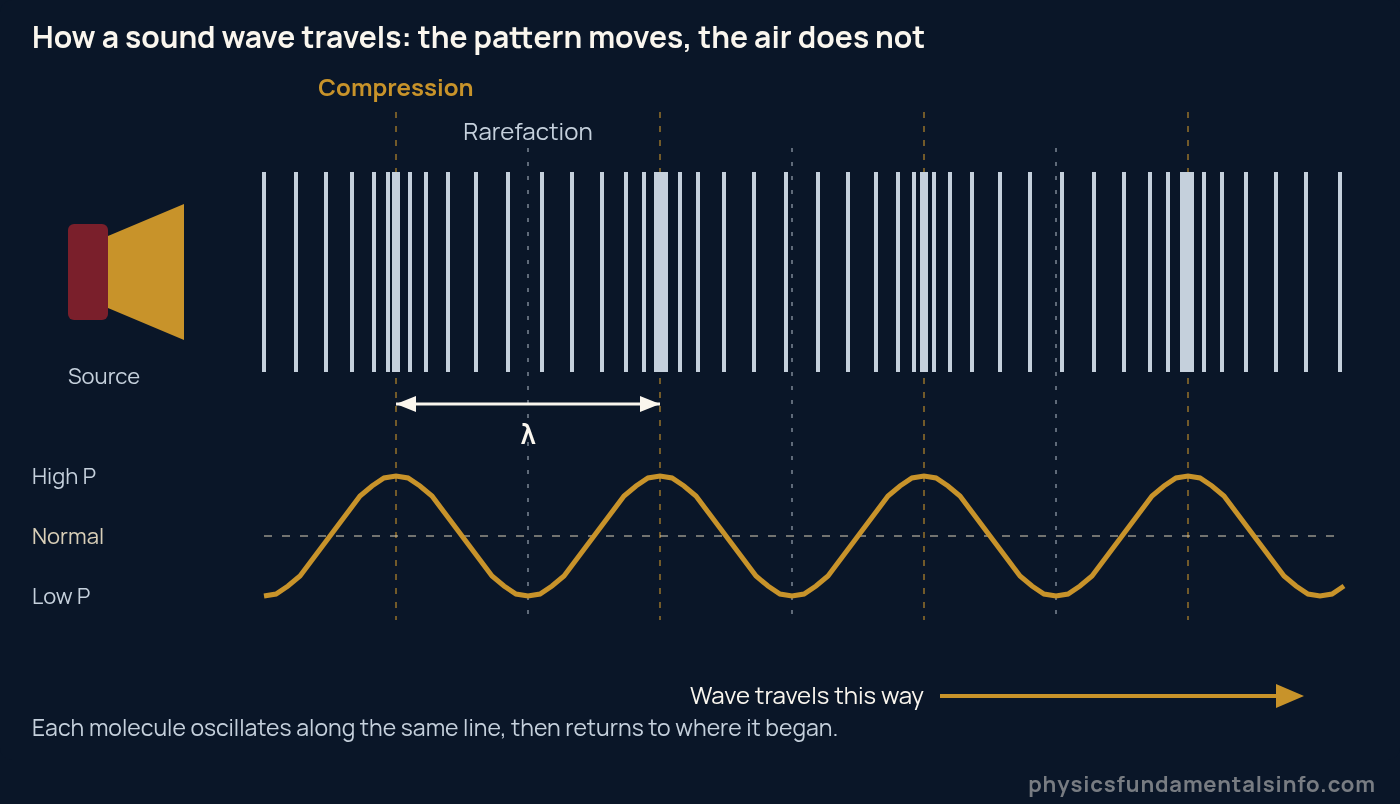
Sound waves in air: crowded lines are compressions, spread-out lines are rarefactions. The gold curve is the pressure at each point — and one full cycle of it is the wavelength λ.
Notice how the pressure curve peaks exactly where the lines bunch together. That is the key mental link: the smooth curve you draw in an exam is the crowd pattern, plotted properly. It is not a picture of anything wiggling sideways.
Sound is therefore a longitudinal wave, in contrast with light or a wave on a rope, where the oscillation runs perpendicular to the travel direction. If that distinction is still slippery, our guide to transverse and longitudinal waves sets the two side by side with seven worked examples.
Drag the sliders below and watch both wave types run at once — the transverse trace wiggles across the page while the longitudinal one bunches and thins along it.
The Sound Wave Formula
The single equation that governs every sound wave links its speed, its frequency and its wavelength:
- v — wave speed, in metres per second (m/s). Set by the medium.
- f — frequency, in hertz (Hz, equivalent to 1/s). Set by the source.
- λ — wavelength, in metres (m). Whatever the first two force it to be.
Frequency is also the reciprocal of the period, so if a problem gives you the time for one full oscillation instead:
- T — period, the time for one complete cycle, in seconds (s).
- f — frequency, in hertz (Hz).
Read the arrow of causation correctly and the formula stops being a triangle to memorise. The source dictates f, the medium dictates v, and the wavelength λ is then forced to equal v/f — it has no say in the matter.
You can check any of the three quantities against the other two with our Wave Speed Calculator, which is handy for sanity-checking a wavelength before you commit it to an answer sheet.
A quick magnitude check that catches errors instantly: at 343 m/s in room-temperature air, a 20 Hz rumble has a wavelength of about 17 m — longer than a house — while a 20 kHz hiss is only 1.7 cm across. Bass fills a room; treble does not. If your answer says otherwise, you have inverted the formula. For more on where f itself comes from, see our breakdown of the frequency formula.
How Fast Do Sound Waves Travel?
Sound travels at about 343 m/s in dry air at 20 °C, roughly 1,480 m/s in fresh water and around 5,900 m/s in steel. Speed is a property of the material, not of the sound.
Most people expect dense materials to be slow — they feel heavy and sluggish. Sound does the opposite, and the reason is that two competing properties are at work.
- B — bulk modulus, the medium’s resistance to being compressed, in pascals (Pa).
- ρ — density, in kilograms per cubic metre (kg/m3).
- v — speed of sound, in metres per second (m/s).
Stiffness sits on top of the fraction and density sits underneath. Steel is about 8 times denser than water, which should slow it down — but it is roughly 80 times harder to compress, and stiffness wins the fight by a wide margin. For a thin solid rod, the same logic runs with Young’s modulus E in place of B, giving v = sqrt(E / ρ).

Stiffer materials carry sound waves faster, despite being denser. Steel outruns air by more than 17 times.
| Medium | State | Speed (m/s) | Compared with air |
|---|---|---|---|
| Vacuum | None | No propagation | Silent |
| Air at 0 °C | Gas | 331 | 0.97 times |
| Air at 20 °C | Gas | 343 | 1 time (reference) |
| Helium at 20 °C | Gas | 1,007 | 2.9 times |
| Fresh water at 20 °C | Liquid | 1,482 | 4.3 times |
| Soft body tissue | Liquid-like | about 1,540 | 4.5 times |
| Oak, along the grain | Solid | about 3,850 | 11 times |
| Steel | Solid | 5,941 | 17 times |
One honest caveat that textbooks often bury: the steel figure is the bulk value for an extended solid. Along a thin rail or rod the effective speed drops to roughly 5,000 m/s, because the metal is free to bulge sideways as the wave passes. Quote whichever value your syllabus uses, and say which.
Why Warm Air Carries Sound Faster
Heat the air and its molecules move faster, so they collide sooner and hand the disturbance on more quickly. For dry air, a linear approximation is accurate to within about 0.2 m/s across everyday temperatures:
- T — air temperature, in degrees Celsius (°C).
- v — speed of sound in dry air, in metres per second (m/s).
So a freezing winter morning at -5 °C gives 328 m/s, while a 35 °C afternoon gives 353 m/s. That 25 m/s spread is why outdoor sound-timing measurements need the thermometer reading recorded alongside them. The broader picture of how any wave changes pace on crossing a boundary is covered in our guide to wave speed in different media.
Why Can Sound Waves Not Travel Through a Vacuum?
Sound waves cannot travel through a vacuum because there are no particles to compress, so there is nothing to pass the disturbance along. Take away the medium and the wave has nothing to be a wave of.
This is the sharpest dividing line in wave physics. Light is an electromagnetic wave — an oscillating field that carries itself and needs no help. Sound is mechanical, and mechanical waves are entirely parasitic on matter.
The famous bell-jar demonstration makes it visible: an electric bell inside a sealed jar rings loudly, and as the pump draws the air out the sound fades to nothing while the hammer is still plainly seen striking. Nothing about the bell changed. The road out of it was removed.
Space is a near-vacuum, which is why the explosions in films are a comfortable lie. Where space is not empty, though, sound returns: NASA’s Chandra X-ray Observatory has traced genuine pressure waves rippling through the hot gas of the Perseus galaxy cluster, a note some 57 octaves below middle C. Sparse gas is still a medium.
Real-World Examples of Sound Waves
Five everyday cases, each showing a different part of the physics at work.
1. Thunder Arriving After Lightning
Light covers a kilometre in about three microseconds; sound takes almost three seconds. Count the gap between flash and bang, divide by three, and you have the distance in kilometres — a direct, pocket-sized application of distance = speed × time.
2. Hearing a Train Through the Rail
Press your ear to a steel rail and the train’s rumble arrives seconds before it does through the air, because steel carries sound roughly seventeen times faster. Track workers historically used exactly this trick as an early-warning system — though modern safety rules rightly keep everyone well clear of live track.
3. Whale Song Crossing an Ocean Basin
Water is far stiffer than air, and low-frequency sound loses very little energy per kilometre travelled. NOAA notes that a natural sound channel forms where sound speed dips with depth, so waves refract back toward it — and, as its explainer on how far sound travels in the ocean describes, the channelling lets signals cross thousands of miles.
4. Medical Ultrasound
A probe emits sound waves at a few megahertz — far above hearing — into tissue where they travel at about 1,540 m/s. The scanner times the echoes off each internal boundary and converts those delays into an image. Higher frequency means shorter wavelength, and shorter wavelength means finer detail.
5. A Guitar String and the Air Around It
Here two wave types meet in one object. The string carries a transverse standing wave, vibrating across its length; the body and air convert that motion into a longitudinal pressure wave you can actually hear. Pluck harder and the sound gets louder, not higher — amplitude and frequency are independent controls.

Common Misconceptions About Sound Waves
Misconception 1: Sound carries air across the room
It does not. Each air molecule oscillates about a fixed average position and ends up where it started; only the pressure pattern advances. If sound genuinely transported air, a loud concert would generate a gale — and the front row would be blown over rather than deafened.
Misconception 2: Sound travels slower in solids because they are dense
Density does slow sound down, but stiffness speeds it up far more, and in solids stiffness wins decisively. This is the single most common slip in classroom tests: students see v = sqrt(B / ρ), notice ρ on the bottom, and forget to check what B is doing on the top.
Misconception 3: Louder sounds travel faster
Loudness is amplitude — how far the molecules swing and how much the pressure varies. It carries more energy, so it stays audible further away, but every sound in the same air moves at the same speed. Turning the volume up does not shorten the delay.
Misconception 4: Higher-pitched sounds arrive first
They do not, and here is the elegant proof: air is effectively non-dispersive for audible sound, so all frequencies travel at one speed. If they did not, a distant orchestra would reach you as an unravelled smear, treble first — and the far side of a stadium would hear a completely different chord from the near side.
How Sound Waves Relate to Pitch, Loudness and Other Wave Behaviour
Sound waves obey every rule that governs waves in general, which means most of what you learn here transfers directly. Three connections do the most work in exams.
Pitch is frequency; loudness is amplitude. These are independent — you can change either without touching the other. Loudness in practice is measured on a logarithmic scale, because human hearing spans a factor of about a trillion in intensity; our guide to the decibel formula shows how that compression works.
Motion shifts the frequency you receive. When a source moves toward you, each successive compression is emitted a little closer, so the wavefronts bunch and the pitch rises. That is the Doppler effect — and it is why a passing siren drops in pitch at the exact instant it goes by, not gradually.
Sound spreads round obstacles far more than light does. You can hear someone through an open doorway without seeing them because audible wavelengths are metres to centimetres — comparable to everyday objects, so the waves bend around them. Light’s wavelengths are hundreds of nanometres, so it barely bends at all. Our explainer on diffraction in physics covers the size-matching rule behind this.
Worked Problems
Show Solution
Solution:
Step 1: Use the wave equation v = f λ, rearranged for wavelength: λ = v / f.
Step 2: Substitute with units: λ = 343 m/s divided by 512 Hz.
Step 3: Solve: λ = 0.6699 m.
Answer: λ = 0.670 m (3 s.f.)
Show Solution
Solution:
Step 1: Frequency is the reciprocal of the period: f = 1 / T.
Step 2: Substitute with units: f = 1 divided by 2.50 × 10⁻³ s = 400 Hz.
Step 3: Now apply λ = v / f = 343 m/s divided by 400 Hz = 0.8575 m.
Answer: f = 400 Hz and λ = 0.858 m (3 s.f.)
Show Solution
Solution:
Step 1: Find the speed of sound at this temperature using v = 331.3 + 0.606 T.
Step 2: Substitute with units: v = 331.3 + 0.606 × 25 = 331.3 + 15.15 = 346.45 m/s.
Step 3: Apply distance = speed × time: d = 346.45 m/s × 4.5 s = 1559 m.
Step 4: Check the assumption. Light covers 1559 m in about 5 × 10⁻⁶ s, which is negligible against 4.5 s, so treating the flash as instantaneous is valid.
Answer: d = 1.6 km (2 s.f.)
Show Solution
Solution:
Step 1: Frequency is set by the source, and a boundary cannot create or destroy cycles. So f = 250 Hz in both media.
Step 2: In air, λ = v / f = 343 m/s divided by 250 Hz = 1.372 m.
Step 3: In water, λ = v / f = 1482 m/s divided by 250 Hz = 5.928 m.
Step 4: Sanity check. The wavelength ratio 5.928 / 1.372 = 4.32, which matches the speed ratio 1482 / 343 = 4.32.
Answer: f stays at 250 Hz; λ = 1.37 m in air and 5.93 m in water (3 s.f.)
Show Solution
Solution:
Step 1: For a fluid, v = sqrt(B / ρ).
Step 2: Substitute with units: v = sqrt(2.20 × 10⁹ Pa divided by 998 kg/m3) = sqrt(2.204 × 10⁶ m2/s2).
Step 3: Solve: v = 1484.7 m/s.
Step 4: Compare with the measured value of 1482 m/s. The agreement is within about 0.2%, which confirms the model.
Answer: v = 1.48 × 10³ m/s (3 s.f.)
Show Solution
Solution:
Step 1: Convert the frequency: 3.50 MHz = 3.50 × 10⁶ Hz.
Step 2: Apply λ = v / f = 1540 m/s divided by 3.50 × 10⁶ Hz.
Step 3: Solve: λ = 4.40 × 10⁻⁴ m = 0.440 mm.
Step 4: Interpret. A scanner cannot resolve detail much finer than about one wavelength, so 0.44 mm sets the practical limit at this frequency. Raising the frequency sharpens the image but reduces penetration depth.
Answer: λ = 0.440 mm (3 s.f.)
Show Solution
Solution:
Step 1: Both paths use time = distance / speed, with d = 1.20 × 10³ m.
Step 2: Through steel: t = 1200 m divided by 5941 m/s = 0.2020 s.
Step 3: Through air: t = 1200 m divided by 343 m/s = 3.4985 s.
Step 4: Subtract: Δt = 3.4985 s – 0.2020 s = 3.2965 s.
Answer: Δt = 3.30 s (3 s.f.)