The standing waves simulator is a free interactive lab built around a card that will not move. Set a length and a medium, then climb the mode number and watch the drawing gain a loop each time while Fundamental frequency holds one string; move the wave speed instead and the picture does not change at all. Switch what the two ends are and the fundamental halves exactly, with every even rung of the ladder gone. No amplitude, no period and no energy is printed anywhere on this page.
Standing Waves: Nodes, Antinodes and Harmonics
One string, or one air column, with a single mode drawn on it. Only the wavelengths that fit a whole number of half-waves between the ends survive, so L = nλ/2 and only a whole-number ladder of frequencies sounds.
Load a real standing wave
The first seven buttons are the lab’s own presets, pressed by id and nothing else. The last four press one of those and then move a slider or two, which is what anyone does half a minute in. They are arranged as pairs, because that is what makes them a lesson rather than a list: each pair changes exactly one thing, and the readings that stay byte-identical across it are the point.
Take them in order. One and two change only the mode number; one and three change only the boundary; four and five are the same air column open and then stopped; six and seven are the same metre of length in water and then in steel. The last four reach the half-open octave on the opening string, the longer string, the kilohertz rung and the bottom of the speed slider.
Pick a published state above, or drag the three sliders yourself.
What Is the Standing Waves Simulator?
The standing waves simulator is a free interactive physics lab that runs in your browser, with nothing to install and no sign-up. It draws one string or air column in side view, laid out horizontally with a single mode on it, and marks each end according to what that end is: a hatched clamp where the medium is held still, a dashed open mouth where it is free to move. The mode is drawn as a faint mirrored pair of curves with the live pattern swinging between them.
Three sliders drive it. Length L runs 0.100 to 5.000 m in steps of 0.005, Wave speed v runs 10 to 6000 m/s in whole metres per second, and Mode number n is a whole number from 1 to 8 with no values in between, because a fraction of a half wave does not fit between two ends. Three buttons set the boundary — Fixed at both ends, Free at both ends and One end fixed, one free — seven presets load a published state, and Pause and Reset finish the panel.
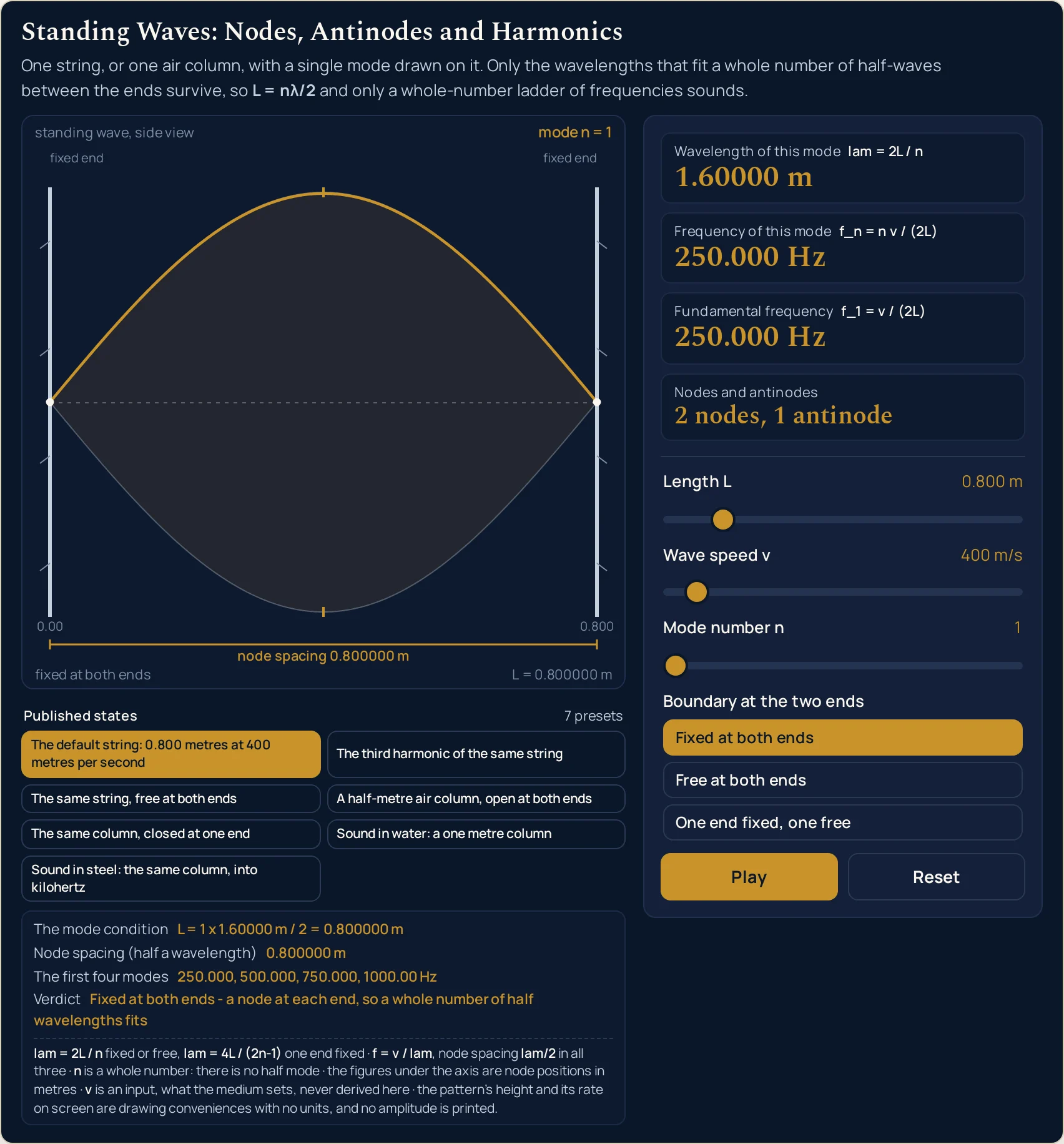
Eight readings answer. Four cards give Wavelength of this mode, Frequency of this mode, Fundamental frequency and Nodes and antinodes, each over the relation it comes from; a compact strip beneath them adds The mode condition, Node spacing (half a wavelength), The first four modes and a Verdict. On the state the lab opens in they read 1.60000 m, 250.000 Hz, 250.000 Hz, 2 nodes, 1 antinode, L = 1 x 1.60000 m / 2 = 0.800000 m and 250.000, 500.000, 750.000, 1000.00 Hz.
Each control answers to a different set of those readings, which is what the panel is arranged to show. Climb the mode number and the drawing gains a loop while the fundamental and the ladder hold their strings exactly. Move the wave speed and every frequency changes while the wavelength, the spacing and both counts stay byte-identical. Move the length and everything but the counts follows.
The boundary is the control that moves all six. Free at both ends against Fixed at both ends is the surprise: the same wavelength, the same frequency, the same fundamental and the same spacing, with only the counts swapping from 2 nodes, 1 antinode to 1 node, 2 antinodes. One end fixed, one free is the one that moves the numbers — a half-metre air column sounds 343.000 Hz open at both ends and 171.500 Hz stopped at one, an exact octave lower, and its ladder keeps only the odd rungs.
Every node is a dot on the axis with its position in metres printed beneath it and every antinode is a gold tick at the envelope peak, so the marks can be counted against the card rather than taken on trust. One half-wavelength gap is bracketed and labelled: between the first two nodes wherever two or more are drawn, between the two antinodes when the free boundary in mode 1 leaves only one node, and dropped entirely in the half-open mode-1 case, where no such pair exists on the drawing.
What the panel will not do, it says. The wave speed is an input and is never derived from a medium here; the readings stop where the geometry stops, so no amplitude, period or energy appears anywhere on it. The envelope height and the animation rate carry no units. Pushed into its corner the arithmetic reaches 240.000 kHz, which is a test fixture rather than a physical case, and the verdict then stops naming the boundary and reports the mode as ultrasound, using the roughly 20 Hz to 20,000 Hz band this site already publishes.
| Control | Range | Step, default and what it moves |
|---|---|---|
| Length L | 0.100 to 5.000 m | step 0.005; opens at 0.800; moves every reading except the node and antinode counts |
| Wave speed v | 10 to 6000 m/s | step 1; opens at 400; moves the three frequency readings and nothing else |
| Mode number n | 1 to 8, whole | step 1; opens at 1; moves everything except the fundamental and the ladder |
| Boundary | 3 buttons, one active | Fixed at both ends is the default; free swaps only the counts, half-open halves the fundamental |
| Buttons | 7 presets, Pause, Reset | one press each; a preset writes all three sliders and the boundary together |
How to use the standing waves simulator
- Read the four cards before you touch anything. They are already answering: Wavelength of this mode 1.60000 m, Frequency of this mode 250.000 Hz, Fundamental frequency 250.000 Hz and Nodes and antinodes 2 nodes, 1 antinode. The first three carry the relation they come from on their own label, and that label changes when the boundary does.
- Count the marks on the drawing against that last card. A node is a dot on the axis with its position in metres printed beneath it; an antinode is a gold tick at the peak of the faint envelope. At the opening state there are two dots, one at each end, and one tick in the middle, which is what 2 nodes, 1 antinode means in the picture.
- Now move Mode number n alone and watch which card refuses. Climb it to
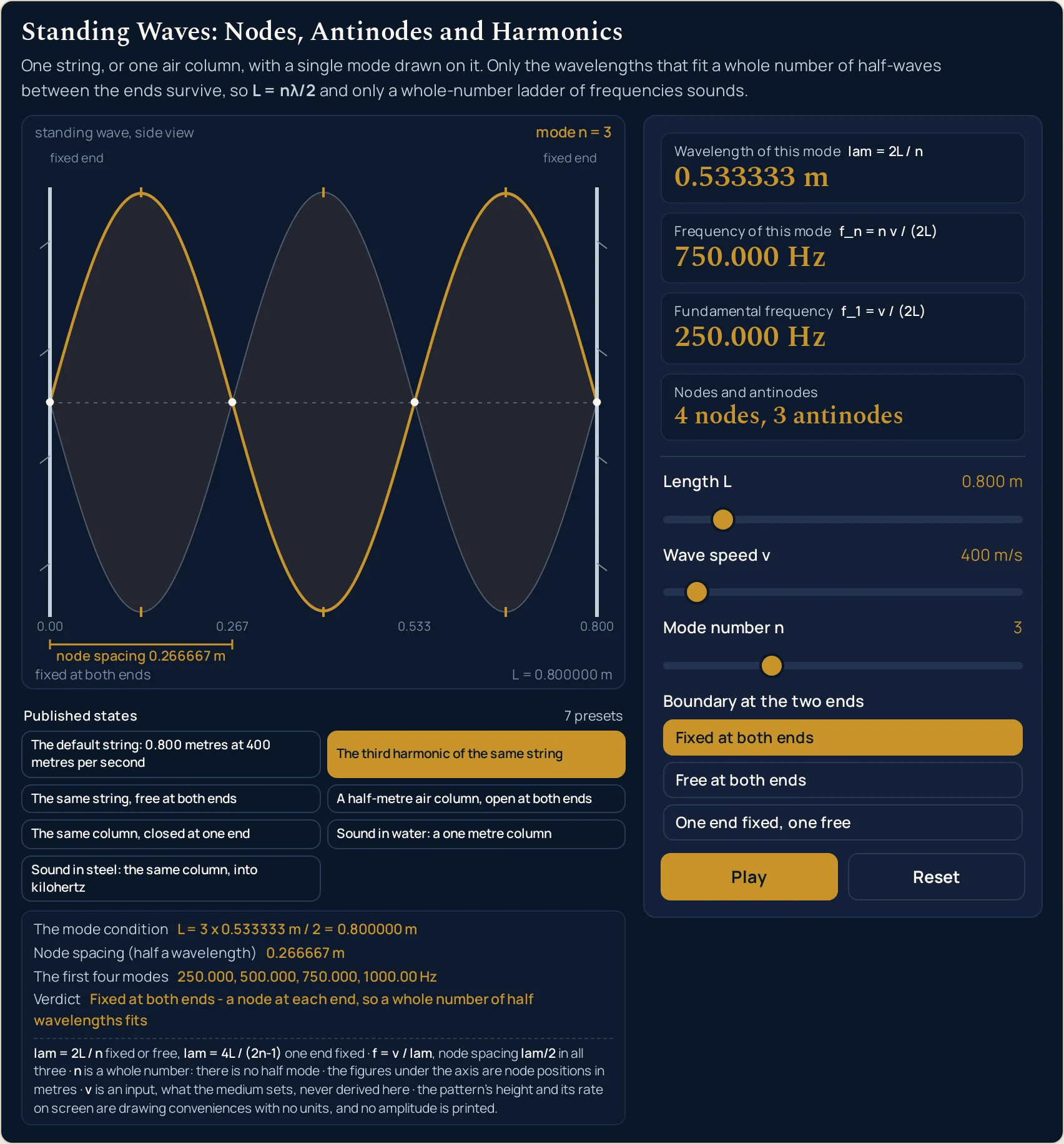
3and the drawing gains loops, the wavelength card falls to 0.533333 m and the frequency card rises to 750.000 Hz — while Fundamental frequency and The first four modes keep the strings they already had. That one slider is the whole argument of the page. - The mode number steps in whole numbers, and it has to. There is no mode 2.7 on the slider because a fraction of a half wave does not fit between two ends; the read-back prints a bare integer, and The mode condition row writes out the whole number it used. The standing waves and harmonics guide is where that condition is set out in prose, with the node positions and the worked problems.
- Now move Wave speed v alone and watch the picture ignore you. Every frequency on the panel changes and not one shape does: same wavelength, same dots, same ticks, same bracketed span. The medium decides how fast the pattern runs through its cycle, and nothing else about it.
- Switch Boundary at the two ends and watch all six readings follow. Free at both ends is the surprising one: against Fixed at both ends it gives the same wavelength, the same frequency, the same fundamental and the same spacing, and only the counts differ. One end fixed, one free is the one that moves the numbers, halving the fundamental and deleting every even rung.
- Watch what the bracketed span claims in each boundary. Wherever two or more nodes are drawn it brackets the first two and labels them with Node spacing. Free at both ends in mode 1 draws only one node, so it brackets the two antinodes instead and the label says antinode spacing over the same figure. The half-open case in mode 1 has no such pair, so the span is dropped.
- Read the compact strip as a decomposition, not as more evidence. The mode condition shows the geometry with its whole number in it, Node spacing (half a wavelength) restates half of the first card on purpose and its label says so, The first four modes is the bottom of the ladder in one unit, and Verdict is one line about the state you are in.
- Use Pause when you want to look rather than watch. It stops the single animation loop and leaves a clean static frame, which is the right state for counting dots and reading the span. The button then reads Play; press it again to restart. Nothing on the panel is moving while the pattern swings, so no reading changes either way.
- Reset is the way back when too many controls have moved to remember. It returns all three sliders and the boundary to their opening values, zeroes the pattern phase and leaves the loop playing. Touching any slider by hand drops the preset highlight, so no button can claim a state the cards do not show.
Dragging is the right way to see which card answers to which control, and a poor way to hit an exact figure. When you already have two of the three quantities and want the third typed out, the standing waves calculator solves the same relation for whichever one is missing, with unit menus on every box and the stopped-pipe instruction written out.
Worked example: change one thing at a time
Nothing in the tables below was worked out here. Each row is a state the lab was put into on this page and then read back from, cell by cell, so every string in them is the panel’s own. The first table prints the four cards for five published states: the first three isolate one control each, and the last two are each one half of a pair that the pairs table below completes.
| What was pressed | Mode number | Wavelength of this mode | Frequency of this mode | Fundamental frequency | Nodes and antinodes |
|---|---|---|---|---|---|
| The default string: 0.800 metres at 400 metres per second | 1 | 1.60000 m | 250.000 Hz | 250.000 Hz | 2 nodes, 1 antinode |
| The third harmonic of the same string | 3 | 0.533333 m | 750.000 Hz | 250.000 Hz | 4 nodes, 3 antinodes |
| The same string, free at both ends | 1 | 1.60000 m | 250.000 Hz | 250.000 Hz | 1 node, 2 antinodes |
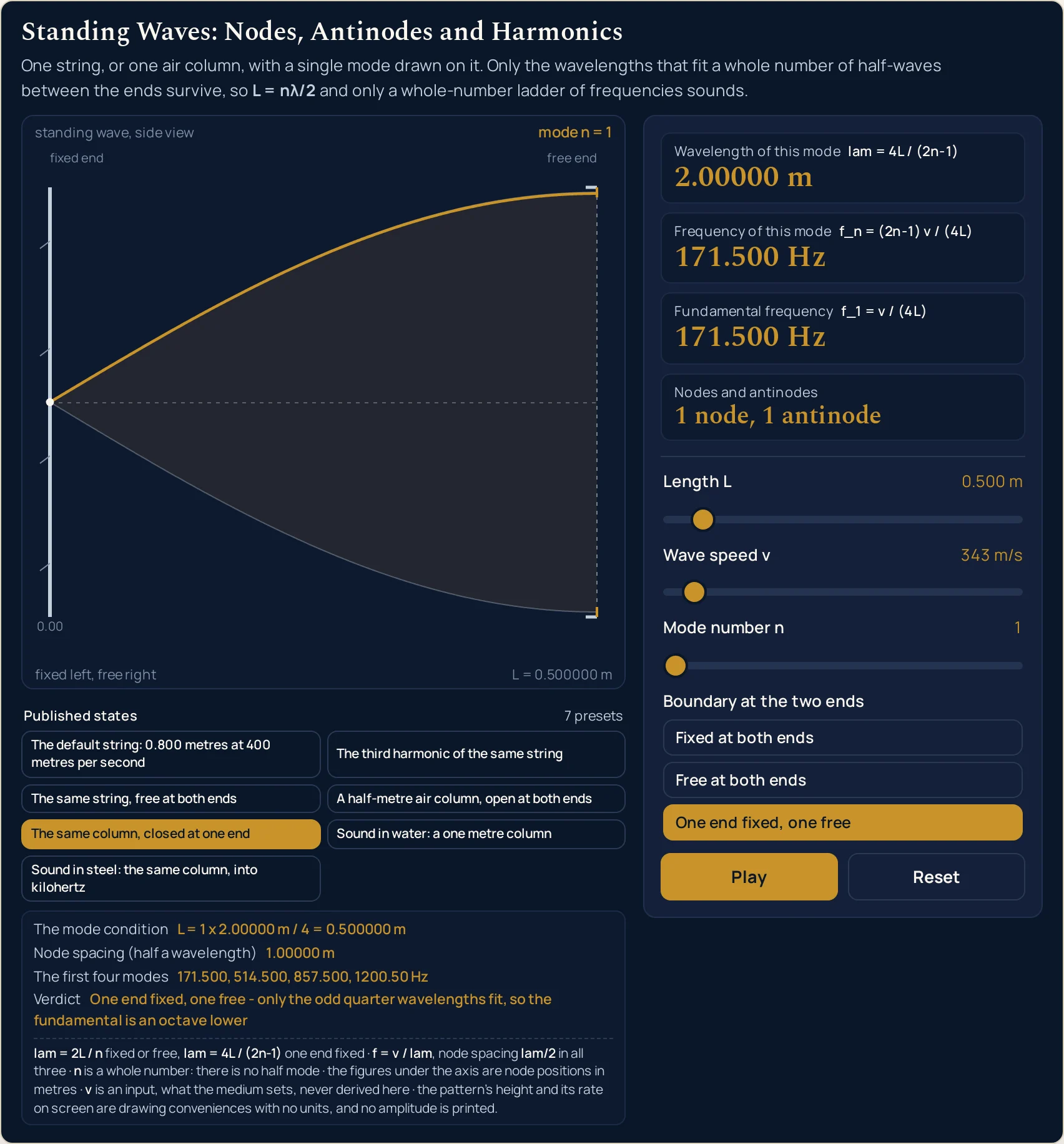
| The same column, closed at one end | 1 | 2.00000 m | 171.500 Hz | 171.500 Hz | 1 node, 1 antinode |
| Sound in steel: the same column, into kilohertz | 1 | 2.00000 m | 2.98000 kHz | 2.98000 kHz | 1 node, 2 antinodes |
Rows one and two share every control but the mode number, and that is the argument. Same length, same medium, same ends — and the fundamental column holds 250.000 Hz on both rows while the frequency beside it goes from 250.000 Hz to 750.000 Hz. Climbing the ladder does not move the ladder.
Rows one and three are the pair worth pressing yourself. Only the boundary changed, and three of the four reading columns are byte-identical down the two rows: the same wavelength, the same frequency, the same fundamental. Only the counts swap, from 2 nodes, 1 antinode to 1 node, 2 antinodes. Two pictures that look nothing alike, one set of numbers.
Row four is the one that moves the numbers rather than the picture. With one end stopped the pitch is 171.500 Hz and the wavelength has doubled to 2.00000 m; the 343.000 Hz the same column gives open at both ends is a row in the table below rather than this one. Compare row five with the water column in that second table and only the medium changes, which the wavelength column does not notice: 2.00000 m in water and 2.00000 m in steel, while the pitch crosses the kilohertz seam to 2.98000 kHz.
The strip, for the same five states
The four cards answer what; the strip underneath them shows the geometry those answers came out of. Read the mode condition column down the first two rows and the length on the right-hand side never changes — only the number of half waves packed into it does. The ladder column is where the stopped column gives itself away.
| What was pressed | The mode condition | The first four modes | Verdict |
|---|---|---|---|
| The default string: 0.800 metres at 400 metres per second | L = 1 x 1.60000 m / 2 = 0.800000 m | 250.000, 500.000, 750.000, 1000.00 Hz | Fixed at both ends - a node at each end, so a whole number of half wavelengths fits |
| The third harmonic of the same string | L = 3 x 0.533333 m / 2 = 0.800000 m | 250.000, 500.000, 750.000, 1000.00 Hz | Fixed at both ends - a node at each end, so a whole number of half wavelengths fits |
| The same string, free at both ends | L = 1 x 1.60000 m / 2 = 0.800000 m | 250.000, 500.000, 750.000, 1000.00 Hz | Free at both ends - an antinode at each end: the same frequencies, the mirror-image pattern |
| The same column, closed at one end | L = 1 x 2.00000 m / 4 = 0.500000 m | 171.500, 514.500, 857.500, 1200.50 Hz | One end fixed, one free - only the odd quarter wavelengths fit, so the fundamental is an octave lower |
| Sound in steel: the same column, into kilohertz | L = 1 x 2.00000 m / 2 = 1.00000 m | 2.98000, 5.96000, 8.94000, 11.9200 kHz | Free at both ends - an antinode at each end: the same frequencies, the mirror-image pattern |
The fourth row is the only one whose ladder skips. Its rungs are 171.500, 514.500, 857.500, 1200.50 Hz, and the 343.000 Hz that the same column sounds with both ends open is not among them. The even-numbered rungs of a stopped column are not faint; the boundary never admits them at all. Note the / 4 in that row’s condition where the others carry / 2.
The whole ladder is printed in one unit, and that is a decision rather than an oversight. The opening row reads 250.000, 500.000, 750.000, 1000.00 Hz rather than switching its last member to kilohertz, because the row exists to show the 1 : 2 : 3 : 4 and a unit change half way along would hide it. The steel row is in kilohertz throughout for the same reason.
The two pairs the table above leaves half-finished
Two of the five rows are each one half of a pair, so here are both halves. The first two rows are the same half-metre air column, open and then stopped; the last two are the same metre of length carrying sound in water and then in steel. The node spacing column is the one to watch in the second pair, with one caveat: every row here is mode 1 with at least one end free, so not one of them draws two nodes — the column is printing half a wavelength, which the drawing brackets between the two antinodes in the open rows and drops altogether in the stopped one.
| What was pressed | Wavelength of this mode | Frequency of this mode | Node spacing | Nodes and antinodes |
|---|---|---|---|---|
| A half-metre air column, open at both ends | 1.00000 m | 343.000 Hz | 0.500000 m | 1 node, 2 antinodes |
| The same column, closed at one end | 2.00000 m | 171.500 Hz | 1.00000 m | 1 node, 1 antinode |
| Sound in water: a one metre column | 2.00000 m | 741.000 Hz | 1.00000 m | 1 node, 2 antinodes |
| Sound in steel: the same column, into kilohertz | 2.00000 m | 2.98000 kHz | 1.00000 m | 1 node, 2 antinodes |
The octave is exact on the panel, not approximately exact. Press the two air-column buttons in turn and the pitch goes from 343.000 Hz to 171.500 Hz, which is a halving with nothing left over. Stopping one end turns it into a node, which forces a quarter of a wavelength into the length where half of one fitted before.
The medium pair is the one that proves the shape is none of its business. Water and steel differ by about a factor of four in speed, and the wavelength card, the node spacing and both counts are byte-identical across the two rows while the pitch goes from 741.000 Hz to 2.98000 kHz. Half a wavelength is the quickest wavelength measurement available, but only where two still points are drawn to measure between — and none of these four rows draws two: the open rows bracket the two antinodes instead, and the stopped row brackets nothing. The wavelength formula and units guide is where such a measured gap becomes a number you can use.
Formula and symbol reference
The lab prints its relations on itself, in a fixed line under the strip. With both ends alike the wavelength of mode n is lam = 2L / n; with one end fixed and one free it is lam = 4L / (2n-1). In both cases the frequency is f = v / lam, and the node spacing is lam / 2.
One route computes every frequency on this panel, and that is worth knowing before you read the cards. The wavelength is worked out first and the frequency is the speed divided by it, so the half-open case has no second formula to disagree with the both-ends case about. The n in f_n = n v / (2L) therefore lives inside the wavelength step, which is also why the speed cannot reach the wavelength at all.
Three buttons, several objects each. Fixed at both ends is a clamped string, held still at each end; Free at both ends is an open pipe, or — taken longitudinally — a bar with both of its ends free; One end fixed, one free is a pipe closed at one end. The buttons name the ends rather than the object because one boundary genuinely covers all of those at once. The symbol you may have met for a wavelength is written lam everywhere on the panel, so that no uppercased label can mangle it.
Where the wave speed itself comes from is a different question and a different page. That is a property of the material and not of the mode, this panel takes it as given, and for a string it is set by quantities that appear nowhere here — the guide to wave speed in different media is where that belongs. No period is printed here, so anyone arriving with one needs a single division before this panel can take it: the frequency formula guide is where that conversion is set out.
Ten rows follow and only three of them are things you drag. Four are cards, three are rows of the compact strip, and none of the seven has a control of its own. For the sliders the right-hand column gives the end stops and the step; for everything else it gives the strings the lab prints and the span it prints them over.
| Symbol | Meaning | SI unit | In this lab |
|---|---|---|---|
| L | The span the pattern has to fit into, taken end to end along the string or the air column. The first slider, and the only control that moves every reading except the counts | metre | 0.100 to 5.000 m, in steps of 0.005; it opens at 0.800 m, and the other published positions are 0.500 m, 1.000 m, 1.200 m, 0.150 m and 5.000 m. Counted by stepping the slider rather than read off a card: that is 981 reachable positions, and the mode frequency is strictly decreasing across all of them in every boundary. |
| v | How fast a wave travels through the material. The second slider, which the panel takes as given: this number belongs to the medium and not to the mode, and nothing here works it out | metre per second | 10 to 6000 m/s, in steps of 1; it opens at 400 m/s, and the presets also reach 343 m/s, 1482 m/s and 5960 m/s. Swept end to end, and not a card reading either: 5991 reachable positions, with the frequency strictly increasing across all of them and the wavelength byte-identical throughout. |
| n | Mode number, also called the harmonic number. The third slider, and a whole number by construction: there is no half mode to draw | dimensionless | 1 to 8, in steps of 1; it opens at 1 and the read-back prints a bare integer. Eight positions, and the only control that moves the counts. |
| lam_n | Wavelength of this mode, the first card. The length and the mode number fix it between them and the medium cannot touch it | metre | six significant figures with the trailing zeros kept: 1.60000 m at the opening state, 0.533333 m in the third harmonic, 3.20000 m with one end freed. From the limits the sliders allow, not from a card: the reachable span is 0.0250000 m to 20.0000 m, every value of it comfortably in metres, so the card has no unit ladder and therefore no rounding seam. |
| f_n | Frequency of this mode, the second card. The one card that answers to all three sliders and to the boundary as well | hertz | six significant figures, in hertz below 1000 and kilohertz at and above it: 250.000 Hz, 171.500 Hz, 500.000 Hz, 4.00000 kHz, 2.98000 kHz. The rung is chosen on the rounded figure rather than the raw one, so nothing is rounded twice. |
| f_1 | Fundamental frequency, the third card: mode 1 of the same length and the same medium, whichever mode you are looking at | hertz | six significant figures on the same ladder: 250.000 Hz for the opening string and still 250.000 Hz in its third harmonic, 125.000 Hz with one end freed, 100.000 Hz on the 1.200 m string, 2.00000 kHz on the short one. It answers to the length, the medium and the boundary, and never to the mode number. |
| Nodes and antinodes | The fourth card, counted from the boundary and the mode number alone. Each word goes singular on its own when its count is 1 | a count | the two words are counted independently: 2 nodes, 1 antinode fixed at both ends in mode 1, 1 node, 2 antinodes free at both ends in the same mode, 1 node, 1 antinode with one end fixed and one free, and 6 nodes, 5 antinodes in mode 5. Neither the length nor the medium moves this card at all. |
| Node spacing | Half the wavelength of this mode, in all three boundaries: a strip row, and a decomposition of the first card rather than a second piece of evidence. Where the drawing carries two or more nodes that is the gap between neighbouring ones; where mode 1 leaves a single node the strip prints the figure anyway, and the drawing either brackets the two antinodes instead or drops the span | metre | six significant figures: 0.800000 m at the opening state, 0.266667 m in the third harmonic, 0.240000 m on the 1.200 m string at mode 5 and 0.0750000 m on the short string at mode 2 — four states that draw two or more nodes, so each of those figures is a gap you can bracket on the axis. The label on the row names it as half a wavelength, so the overlap with the wavelength card is stated rather than hidden. |
| The mode condition | The strip row that writes the condition out with the whole number it actually used in it, so the geometry is visible rather than asserted | metre on both sides | the coefficient is the mode number over 2 fixed or free, and the odd number 2n-1 over 4 with one end free: L = 1 x 1.60000 m / 2 = 0.800000 m, L = 3 x 0.533333 m / 2 = 0.800000 m, L = 1 x 2.00000 m / 4 = 0.500000 m. The right-hand side is the length you set, every time. |
| The first four modes | The strip row that prints the bottom four rungs of the ladder at once, in ONE unit for the whole row | hertz or kilohertz | one unit per row, chosen from the fundamental: 250.000, 500.000, 750.000, 1000.00 Hz rather than a row that switches to kilohertz half way along and hides the 1 : 2 : 3 : 4. With one end freed the same row reads 125.000, 375.000, 625.000, 875.000 Hz — the odd multiples only. |
If you read one row twice, make it Node spacing. It is the only entry that is openly half of another reading, and its label says which half, so the panel is not quietly offering the wavelength twice and calling it two measurements.
The physics: why only certain frequencies fit
Only the wavelengths that fit a whole number of half waves between the two ends survive, so only a whole-number ladder of frequencies sounds and nothing in between does. That is the condition the first strip row writes out, and the right-hand side of it is always the length you set. Everything else on the panel is a consequence of it.
The mechanism is a reflection: the wave that runs out comes back, and the outgoing and returning waves add all along the length. That is one clause and no more on this page, because the general case is a subject of its own. Each particle of the medium, meanwhile, runs simple harmonic motion about the place it sits at rest, while the pattern as a whole goes nowhere.
Four readings on this panel answer to four different things, and the controls are arranged so you can see it one change at a time. From the test runs rather than from a card: the dependency grid was checked at a tolerance of zero on every non-mover, over 720 speed pairs, 756 mode pairs, 720 length pairs and 288 fixed-against-free pairs, so these are byte-identical strings rather than figures that agree to six digits.
The medium moves the three frequency readings and nothing else. The mode number moves everything except the fundamental and the ladder. The length moves everything except the counts. And the boundary moves all six, which is why switching it is the one action on the panel that can surprise you twice in a row.
The relation tying a speed to a frequency and a wavelength is the travelling-wave guide’s subject, not this page’s: here the speed is typed in and the wavelength is read off, and no travelling wave is drawn. The wave generator lab is the contrast worth pressing — there a crest really does move along the medium, and there are no fixed nodes anywhere on it.
Where standing waves break down
Every position these three sliders can reach is answered, and answered to the full precision of a double. The arithmetic is not where this page can let you down; the physics at the edges of it is — an end that does not really reflect, a medium that changes along the way, and a question about loudness or ringing that no mode condition can take.
- Three boundary buttons, and not one of them is an endless medium
- A wave running along a medium with no end never settles into a pattern; what builds one is the return off a boundary. One boundary gets you a pattern but not a ladder, because the condition the first strip row writes out needs a length between two ends. Both ends of the drawing are always marked for that reason, and the boundary buttons never offer a state with only one.
- The panel has no card for how loud, how hard or how long
- The mode condition says which wavelengths fit. What starts a mode off, how hard it answers and how long it rings on once you stop are three questions it does not touch, and no card here answers any of them. Nor does it reach the size of the swing, which is the amplitude guide’s subject and stays there.
- A medium that varies along its length breaks the one-speed assumption
- One slider sets one speed, and the drawing applies it from end to end. Where the medium itself varies — a string that thickens, a column warmer at one end than the other — there is no single wavelength for the panel to draw and no clean ladder for it to print, and nothing on screen would warn you. The length you give it has to be one the medium is uniform over.
- The first four modes row is an idealisation, and stiffness is what it leaves out
- Anything that resists being bent, as a real string does, carries its short-wavelength modes a little above the exact multiples the ladder row prints, so what you are reading is the idealisation. How far above is a question this panel cannot be asked: no figure for it on any particular instrument is published on this site, and none is invented here — verify before use.
- Where the drawing puts the antinode tick, a real pipe does not
- Look at where the gold tick sits in the last figure on this page: hard on the mouth of the pipe. In a real open pipe it sits a little outside, which makes the pipe behave as though it were slightly longer and drops its pitch below what this panel returns for the length you measured. Same rule as the row above — the size of that shift is not published on this site, so no number for it appears here; verify before use.
- The relation is arithmetic, so some reachable states are exact and absurd
- Nothing in the relation asks whether the mode is audible, or whether a real medium would carry it at that speed. Pushed to its corner the slider product reaches
240.000 kHz— a test fixture rather than a physical case, and quoted here only as the arithmetic ceiling of the three sliders. The verdict refuses to leave that unremarked: past the printed limits it stops naming the boundary and says the mode is ultrasound, or infrasound at the other end, using the roughly 20 Hz to 20,000 Hz band the guide to how sound waves travel sets out. - The pattern’s height on screen is a drawing convenience and means nothing
- The envelope is drawn tall enough to read and no taller, and the rate the live curve swings at is slowed so that it can be watched. Neither carries units, neither has a readout, and the fixed line under the panel says so rather than leaving it as a silent gap. Read the dots, the ticks and the cards; do not read the height.
- The bracketed span is not always measuring between two nodes
- It is wherever the drawing has two or more node dots, which is most states. Free at both ends in mode 1 puts a single node in the middle, so the span is taken between the two antinodes instead and its label says antinode spacing over the same figure. One end fixed and one free in mode 1 has no half-wavelength pair on the drawing at all, so the span is dropped rather than drawn as a measurement the picture cannot support.
- Two engines agree readout for readout, and Safari was never run at all
- From running the lab in two browsers rather than from a card: the published states were put side by side in Chrome and in Firefox, 19 assertions passed and none failed. There is a hole in that, and it is Safari: the WebKit build on this machine is installed but cannot be launched without administrator rights, so Safari was never exercised and nothing here is evidence about it.
Where standing waves are actually used
- Finding out what a length will sound at before you cut it
- This is the question most people arrive with, and it is two slider moves. Set the length, set the medium, leave the mode number at
1, and Fundamental frequency is the pitch that length will give: 250.000 Hz for the opening string, 100.000 Hz for the 1.200 m one. Shortening the vibrating part is the only thing a finger on a fretboard does. - Telling the harmonics of one string apart without retuning it
- Press the first two buttons in turn. The pitch goes from 250.000 Hz to 750.000 Hz, three loops appear where there was one, and the fundamental card does not budge. That is what a player means by touching a harmonic: the same string, the same tuning, a different rung of the same ladder.
- Two presses on the air-column buttons drop the pitch by an octave
- Press A half-metre air column, open at both ends and then The same column, closed at one end: 343.000 Hz becomes 171.500 Hz and the ladder loses every even rung. That is why a stopped pipe of a given length sounds an octave below an open one, and why its tone is a different thing rather than the same tone lower. The 343 m/s those two presets use is the speed of sound in air this site publishes.
- Telling the material apart from the geometry with two preset buttons
- Press the water column and then the steel one. The wavelength card, the spacing and both counts hold their strings while the pitch goes from 741.000 Hz to 2.98000 kHz. Anyone who has to decide whether a measured pitch is telling them about the geometry or about the material has that separation in front of them in two presses.
- Getting a wavelength out of a gap you can actually measure
- The still points on a real vibrating object are the easiest thing on it to find, and the gap between two of them is half a wavelength in every boundary this panel offers. Read Node spacing against the dots on the drawing, double it, and that is the wavelength: 0.266667 m of spacing on the third harmonic of the opening string, against a 0.533333 m wavelength card.
- Reading the verdict row when the arithmetic runs past hearing
- Because the relation is arithmetic it reaches past hearing in both directions, and the verdict row says which side you are on using the band this site publishes. Pull the length up and the speed down and it reads that the mode is infrasound at 0.500000 Hz; push the other way and it reaches the ultrasound band that sonar and medical imaging work in. The decibel calculator is the tool for how loud rather than how high.
- What else a length will hold, four rungs at a time on the strip
- Anything with two ends and one speed along it has a mode condition of this shape, which is why the panel prints the bottom four rungs rather than only the one you asked for. Microwave and radio cavities are sized by exactly this arithmetic, and are named here and no further. Not every resonator is a length between two ends, though: the Helmholtz resonator calculator handles the cavity-and-neck sort, which this panel cannot draw and should not be asked to.
Where to go next
A panel can show you which readings a control is allowed to move, and that is the end of what a panel is for. Standing Waves and Harmonics is where the subject itself is written out: what a standing wave is, where the nodes sit, the harmonic ladder in full, the worked problems and the misconceptions. The calculator that takes those figures typed heads the list of related tools below.
Three things this panel leans on but never explains have pages of their own. A wave that actually goes somewhere, and how its speed, pitch and wavelength are tied together, is the transverse and longitudinal waves guide. The motion of one particle rather than the whole pattern is the simple harmonic motion guide. Why the second slider reads what it reads for a given material is the guide to wave speed in different media.
Further out, the wavelength formula and units guide takes the wavelength by itself, the amplitude guide is the height this panel refuses to print, the guide to how sound waves travel is where the audible band in the verdict comes from, and the speed of sound guide covers the 343 m/s that the two air-column buttons sit at.
One lab on this site looks startlingly like this one, and the resemblance is real. The infinite-well lab solves the same eigenvalue problem — only whole numbers of half waves fit between two walls, with the nodes marked — for a different subject: its readings are about a probability density rather than a pitch, and it prints no wavelength and no frequency. It is already published and is not changing, and that is the whole of the claim.
Beyond that there is the simulation library to work through, an index of calculators for when typing beats dragging, and the blog for everything written out at length.
Frequently asked questions
Why does the fundamental frequency card not move when I drag the mode number?
Because the fundamental is mode 1 of the length and the medium you have set, and climbing the ladder changes neither of those. Drag the mode slider from 1 to 3 and the card holds 250.000 Hz while the frequency beside it goes to 750.000 Hz. The ladder does not shift when you climb it, and the first-four-modes row holds its string for the same reason.
Why does the picture not change at all when I move the wave speed slider?
Because the wavelength is fixed by the length and the mode number, and the speed appears in neither. Press the water column and then the steel one: the wavelength card reads 2.00000 m in both, the counts stay at 1 node, 2 antinodes, and only the frequencies move, from 741.000 Hz to 2.98000 kHz. The medium sets the pitch, not the shape.
Why does the bracketed span under the axis sometimes say antinode spacing?
Because the drawing refuses to bracket a pair it is not showing. Free at both ends in mode 1 puts only one node on the axis, so the span is taken between the two antinodes instead and the label says so, over the same figure. One end fixed and one free in mode 1 has no half-wavelength pair at all, so the span is dropped rather than drawn.
Why are the boundary buttons named after the ends rather than after a string or a pipe?
Because one boundary covers several objects. Fixed at both ends is a clamped string; free at both ends is a pipe that is open at both ends, or a bar vibrating longitudinally with both of its ends free; one end fixed and one free is a pipe closed at one end. Naming the ends is the only honest label for a control that serves all of them at once.
Why is the mode number slider stepped in whole numbers with no values in between?
Because a fraction of a half wave does not fit between two ends, so there is no mode 2.7 to draw. The slider steps by 1 from 1 to 8, the read-back prints a bare integer, and the mode condition row shows the whole number it used. A smooth slider here would be inviting you to set a state the physics has no room for.
How tall is the pattern meant to be, and where is the amplitude readout?
There is none, deliberately. The envelope height on the canvas is a drawing convenience with no units, and the fixed line under the panel says so. The mode condition fixes which wavelengths fit and is silent about how far the medium swings, so printing a height here would be an answer this relation cannot give.
What is the Verdict row for when it is just naming the boundary back to me?
Two of its five strings are not about the boundary at all. If the printed frequency reaches 20000 it reads that the mode is ultrasound, and below 20 it reads that the mode is infrasound, using the audible limits this site already publishes. Both thresholds are decided on the six-figure printed figure rather than the raw value, so the string and the caveat never disagree.
Does pressing Pause change any of the readings?
No. Pause stops the single animation loop and leaves a clean static frame, which is the right state for reading the node dots and the bracketed span. Every card, the mode condition, the spacing, the ladder and the verdict are computed from the three sliders and the boundary, so none of them is moving while the pattern swings. Press Play to start it again.
Why does the drawing show a dot at each end in one boundary and not in the others?
Because the ends are what the boundary is. A fixed end cannot move, so it is drawn as a hatched clamp with a node dot on it; a free end is drawn as an open mouth with a gold antinode tick. Fixed at both ends therefore has a dot at each end, free at both ends a tick at each end, and the half-open case one of each.
References & formula source
- Every figure on this panel comes out of three slider positions, one boundary button and four closed forms, and nothing is fitted or measured. The lab prints the relations on itself, in a fixed line under the strip: the wavelength is twice the length over the mode number when both ends are alike and four times the length over the odd number 2n-1 when one end is free, the frequency is the wave speed divided by that wavelength, and the node spacing is half the wavelength in all three cases.
- There is ONE code path for the frequency on this panel, and that is deliberate rather than incidental. The wavelength is worked out first and the frequency is the wave speed divided by it, in every boundary, so the half-open case cannot disagree with the both-ends case about a figure they share. The mode number therefore sits inside the wavelength step, and the wave speed has no way of reaching the wavelength at all.
- The wave speed is an INPUT on this page and is never derived. No value for the wave speed on any particular string is published on this site, so none is invented here; the three speeds the presets use are the ones this site already publishes for a medium, 343 metres per second in air, 1482 in water and 5960 in steel, and each lands exactly on a slider step rather than near one.
- The audible-range caveat in the verdict row uses only the two limits this site already publishes, roughly 20 hertz to 20,000 hertz for a healthy young ear. Both thresholds are tested on the six-figure printed frequency rather than on the raw value, in both directions, so a mode printing 20000 does fire the ultrasound string and one printing 20.0000 does not fire the infrasound one. The threshold follows the string the reader can see.
- Two of the limits on this page have a mechanism and no number, and that is a stated gap rather than an omission. A real string resists bending as well as stretching, so its exact whole-number ladder is an idealisation, and the displacement antinode of a real open end sits slightly beyond the physical opening. No figure for the size of either effect on any particular instrument or pipe is published on this site, so no figure for either appears here. Verify before use.
- A mode condition is a geometry, and geometry is the whole of what this panel reports: which wavelengths fit between two ends, and nothing whatever about the excitation that would put energy into one of them. So no tension, linear density, energy, loudness, damping time or resonance curve is computed anywhere here, and no card carries one. The silence is the relation's rather than the panel's.
- The bracketed span on the drawing is the one caption that could overstate what the picture shows, so it is written three ways. Wherever two or more nodes are drawn it brackets the first two nodes. Free at both ends in mode 1 draws only one node, so it brackets the two antinodes instead and the label says antinode spacing over the same figure. One end fixed and one free in mode 1 has no half-wavelength pair on the drawing, so the span is dropped rather than drawn.
- Two engines were compared readout by readout rather than assumed to agree: the browser-by-browser check run for this page put the published states side by side in Chrome and in Firefox and every reading matched, 19 assertions passed and 0 failed. There is a hole in that, and it is Safari - the WebKit build on this machine will not start without system access it has not been given, so Safari was never exercised here and nothing on this page is evidence about it.
- Every readout figure quoted on this page is a string this simulation printed for the button or the slider position named beside it, read back out of the running lab in a browser rather than worked out by hand. Each is computed from the exact value and rounded once, so re-deriving one printed figure from another will not always reproduce the sixth digit; the few figures here that came from running many states rather than from a card say so in their own sentences. Where a figure here and the lab part company, believe the lab, and verify anything you rely on before using it.
- Further reading: Standing wave — Wikipedia