The speed of sound in a gas depends on just three things — how springy the gas is (γ), how hot it is (T) and how heavy its molecules are (M) — combined as v = sqrt(γRT/M). This free calculator solves for the speed, the temperature or the molar mass, in any unit, and shows every step of the working.
What Is the Speed of Sound Calculator?
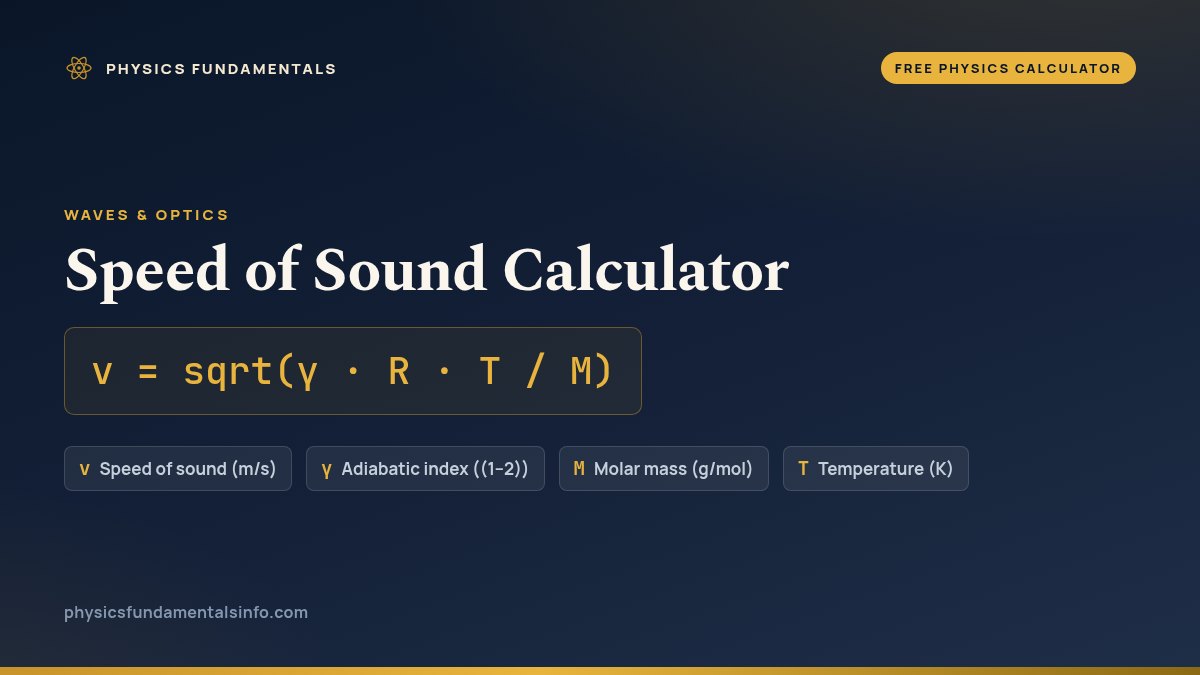
The speed of sound calculator is a free online tool built on the formula v = sqrt(γ · R · T / M). Enter the values you already know, in whichever units suit you, and it solves for speed of sound, temperature or molar mass and shows every step of the substitution. Speed of Sound Calculator is how fast sound travels through a gas, from its temperature, adiabatic index and molar mass.
| Symbol | Quantity | Default unit | Also accepts | Example value |
|---|---|---|---|---|
| v | Speed of sound | m/s | km/h, mph, ft/s | 343.2 |
| γ | Adiabatic index | (1–2) | — | 1.4 |
| M | Molar mass | g/mol | kg/mol | 28.9645 |
| T | Temperature | K | °C, °F | 293.15 |
How to calculate the speed of sound
Sound is a pressure wave, and how fast it runs depends entirely on the medium carrying it. For a gas, the speed is set by three properties: the adiabatic index γ, which measures how much the gas heats when squeezed; the absolute temperature T, which sets how fast the molecules are already moving; and the molar mass M, which sets how much inertia each molecule brings. Combine them as v = sqrt(γRT/M), where R is the universal gas constant, 8.314462618 J/(mol·K).
There are three steps. First, choose what you want from the Solve for menu — the speed, the temperature that would produce a measured speed, or the molar mass of an unidentified gas. Second, enter what you know: the adiabatic index and molar mass (both have preset menus for the common gases) and the temperature in kelvin, °C or °F. Third, read the answer in metres per second, with Mach 1 in km/h and mph alongside, and the worked steps underneath.
Two traps are worth naming. The temperature must be absolute, so 20 °C is 293.15 K, not 20 — the calculator converts for you, but hand calculations often miss it. And the molar mass must be in kilograms per mole inside the formula, so the familiar 28.9645 g/mol for air becomes 0.0289645 kg/mol; again the calculator handles the conversion, but it is the single most common source of an answer that is out by a factor of about 32.
Notice what is not in the formula: pressure. Compressing a gas raises its pressure and its density together, and in v = sqrt(γRT/M) those two effects cancel exactly, so the speed is unchanged. Sound does not travel faster at sea level than on a mountain because of the pressure — it travels faster because the air down there is usually warmer. To see that play out as a race between two pulses, open the speed of sound simulator; to work from a frequency and wavelength instead, use the wave speed calculator.
Worked example
Take dry air at room temperature: γ = 1.40, M = 28.9645 g/mol (0.0289645 kg/mol), and T = 20 °C, which is 293.15 K. Substituting gives v = sqrt(1.40 × 8.3145 × 293.15 / 0.0289645) ≈ 343.2 m/s — about 1236 km/h, or 768 mph. Cool the same air to 0 °C (273.15 K) and the speed drops to 331.3 m/s; chill it to the −56.5 °C of cruising altitude and it falls to 295.1 m/s, which is why airliners reach a given Mach number at a lower true airspeed up high.
Now swap the gas rather than the temperature. Helium at the same 20 °C has γ = 1.667 and M = 4.0026 g/mol, giving v ≈ 1008 m/s — nearly three times faster, and the reason a lungful of helium raises the pitch of the resonances in your vocal tract. Carbon dioxide goes the other way: heavier molecules and a lower γ give only 259 m/s at 0 °C. Across the whole −80 °C to +60 °C range of everyday air the speed shifts by barely 20%, while changing the gas can move it by a factor of three.
Why it matters
The speed of sound sets the Mach number that governs aircraft and rocket design, fixes the pitch of every wind instrument and organ pipe, calibrates ultrasonic flow meters and sonar, and underpins the acoustic thermometry used to measure temperature in furnaces and in the ocean. Because it depends on temperature and composition alone, measuring it is also a practical way to work backwards to either one.
Frequently asked questions
Do I enter Celsius or Kelvin?
Either — the calculator accepts K, °C and °F and converts to absolute kelvin before applying the formula. Internally the temperature must be absolute, because v depends on the square root of T and the scale has to start at absolute zero. If you do the arithmetic by hand, convert first with K = °C + 273.15.
Why is there no pressure input?
Because pressure genuinely does not change the speed of sound in an ideal gas. Squeezing a gas raises its pressure and its density in the same proportion, and in v = sqrt(γRT/M) the two effects cancel exactly. Only the temperature, the adiabatic index and the molar mass matter, which is why this calculator has no pressure field at all.
What γ and M should I use for air?
Use γ = 1.40 and M = 28.9645 g/mol for dry air, which are the calculator defaults. Air is mostly diatomic nitrogen and oxygen, so its adiabatic index is close to the diatomic value of 1.4. Both are available from the preset menus, along with helium, argon, carbon dioxide, nitrogen and oxygen.
Why does helium come out nearly three times faster?
Because speed falls as one over the square root of molar mass, and helium is about seven times lighter than air. Helium is also monatomic, so γ rises from 1.40 to 1.667. Together these give sqrt(1.667/1.40 × 28.9645/4.0026) ≈ 2.94, so sound travels at about 1008 m/s in helium at 20 °C against 343 m/s in air.
How do I turn this into a Mach number?
The speed the calculator returns is Mach 1 for that gas and temperature — it is shown in km/h and mph beneath the answer. To get the Mach number of a moving object, divide its speed by this value. Because the speed of sound falls with temperature, the same true airspeed is a higher Mach number high in the atmosphere, where it is cold.
What is the adiabatic index?
The adiabatic index γ (also called the heat capacity ratio) is the ratio of a gas’s heat capacity at constant pressure to that at constant volume. It is 1.667 for monatomic gases such as helium and argon, about 1.40 for diatomic gases such as nitrogen, oxygen and air, and about 1.30 for carbon dioxide. It appears because sound compressions are fast enough to be adiabatic rather than isothermal.
References & formula source
- Halliday, Resnick & Walker — Fundamentals of Physics, chapter on waves and sound (speed of sound in a gas).
- Young & Freedman — University Physics with Modern Physics, chapter on sound and hearing.
- Kinsler, Frey, Coppens & Sanders — Fundamentals of Acoustics, chapter on sound propagation in fluids.
- Further reading: Speed of sound — Wikipedia