A standing wave is the pattern a wave makes when it is trapped between two ends, and the trap is fussy: only the wavelengths that fit a whole number of half waves into the length survive, so L = n lam / 2. That one condition is why a string or an air column sounds at a whole-number ladder of frequencies, f = n v / (2L), with nothing in between. This free standing waves calculator solves that relation for the mode frequency, the wave speed or the length, and prints the wavelength of the mode, the fundamental, the node and antinode counts and the first four modes beside the answer. The wave speed comes from you, not from a tension, a density or a temperature.
Load a real standing wave
Every button writes all four boxes in their default units, so whichever quantity the Solve for menu is pointing at, the remaining three already agree with it. The line underneath quotes back whatever the widget works out from that, so nothing in it is stored text.
Pick a string or a column above, or type your own numbers.
What Is the Standing Waves Calculator?
The standing waves calculator is a free online tool for the condition that decides which notes a string or an air column can make at all. Between two ends, half wavelengths fit only in whole numbers, so the wavelength of mode n is 2L/n and its frequency is n v / (2L). Give the tool any two of the mode frequency, the wave speed and the length, together with the mode number, and it returns the third in whichever of the unit menus that box was set to.
The mode number is the one box that never leaves the form, because it is an input in every mode and is never one of the three unknowns. It is a whole number from 1 to 8 and it has to be: a fraction of a half wave does not fit between the ends, so there is no mode 2.7. A typed 2.7 is rounded to 3 and anything above 8 is held at 8, and the working names the number it actually used rather than mangling it in silence.
Four readings sit beside the answer. The first is the wavelength this mode is forced to have, which the two ends and the mode number fix between them and which the medium cannot touch. The second is the fundamental frequency, mode 1 of the same length and speed, which stays exactly where it is while you climb the mode number. The third counts the nodes and the antinodes, and the fourth prints the first four modes in one unit so the whole-number ladder stays visible instead of the row switching units half way along.
All four are worked out from the complete state with the solved value substituted back, which is what makes them the same four readings whichever quantity you asked for. That matters most in the length mode: with Solve for pointed at the length there is no length among the inputs, so the wavelength can only come from the answer.
The relation covers a string fixed at both ends and a pipe open at both ends alike. A pipe closed at one end sounds at (2m-1) v / (4 Lc), and the way to reach that here is exact rather than approximate: enter twice the pipe length and use only the odd mode numbers 1, 3, 5 and 7, because (2m-1) v / (4 Lc) is identically n v / (2 x 2Lc) with n = 2m-1. A half-metre closed pipe therefore goes in as 1.000 m and returns an answer exactly an octave below the same pipe with both ends open.
Four kinds of entry are declined rather than answered. A zero or negative length and a zero or negative wave speed have no mode behind them; a zero frequency in the length mode would need an infinitely long string and a negative one a negative length; and a mode number below 1 is not a mode. In each case the page says so in words instead of printing an infinity or a NaN.
What the page does not do, it says. The wave speed is an input here and is never derived from a tension, a linear density, a temperature or a refractive index. Nothing here prints an amplitude, a period or an energy, and nothing computes a loudness, a resonance curve, a damping time or any interference arithmetic: the mode condition is a geometry, so it says which modes fit and is silent about how one is set going, how strongly it responds or how long it rings.
| Symbol | Quantity | Default unit | Also accepts | Example value |
|---|---|---|---|---|
| f | Frequency of this mode | Hz | kHz, MHz | 250 |
| v | Wave speed in the medium | m/s | cm/s, km/h, ft/s | 400 |
| L | Length of the string or column | m | cm, mm, in | 0.800 |
| n | Mode number (harmonic number) | — | whole numbers 1 to 8 | 1 |
How to use the standing waves calculator
- Choose the unknown. The Solve for menu opens on Frequency of this mode, and the other two choices are Wave speed in the medium and Length of the string or column. Any two of the three, plus the mode number, fix the third.
- Type the length. It takes m, cm, mm or in and opens on 0.800 m. Measure the vibrating part between the two ends, not the whole string on the reel.
- Type the wave speed. It takes m/s, cm/s, km/h or ft/s and opens on 400 m/s. This page takes the speed as given rather than deriving it from anything.
- Type the mode number. A whole number from 1 to 8, an input in every mode, so it never leaves the form. A typed 2.7 is rounded to 3 and anything above 8 is held at 8, and the working names the number it used.
- Read the answer. The headline always carries four significant figures, with trailing zeros dropped, in the unit that box was showing — switching to scientific notation outside the range 0.0001 to 10,000,000. Set the unit while the quantity is still an input and then point Solve for back at it.
- Read the wavelength chip first. It is
2L/n, and at the defaults it reads1.60000 m. Change only the wave speed and it does not budge, because the ends set the shape and the medium only sets the pitch. - Read the fundamental chip. At the defaults it reads
250.000 Hz, and atn = 3it still reads250.000 Hzwhile the headline climbs to 750 Hz. Climbing the ladder does not change the ladder. - Read the counts chip. At the defaults it reads
2 nodes, 1 antinode; atn = 3it reads4 nodes, 3 antinodes. Those are the counts for a string fixed at both ends or a pipe open at both ends. - Read the ladder chip. It prints the first four modes in one unit so the pattern stays readable:
250.000, 500.000, 750.000, 1000.00 Hzat the defaults. Change the mode number and this chip does not move either. - Open Show working. The steps form the wavelength, rearrange the relation, and then give the ladder, the fundamental, the node spacing, the instruction for a pipe closed at one end and your figures in every unit the boxes offer.
This page exists for the one step that turns a length into a pitch: the mode condition. The standing waves and harmonics guide is the prose half of it, with the node positions, the worked problems and the misconceptions set out in full. Where the wave speed in the box comes from is a different question and a different page: the guide to wave speed in different media is what sets it for a string or a column, and nothing on this calculator derives it.
Three mistakes account for most wrong answers here. The first is using the mode number of the harmonic you can hear while measuring the length of the whole string; the second is entering a closed pipe's own length instead of twice it, which comes out an octave too high. The third is reading the fundamental chip as the answer when the headline is the mode you asked for — at n = 1 they agree, and at every other mode number they do not.
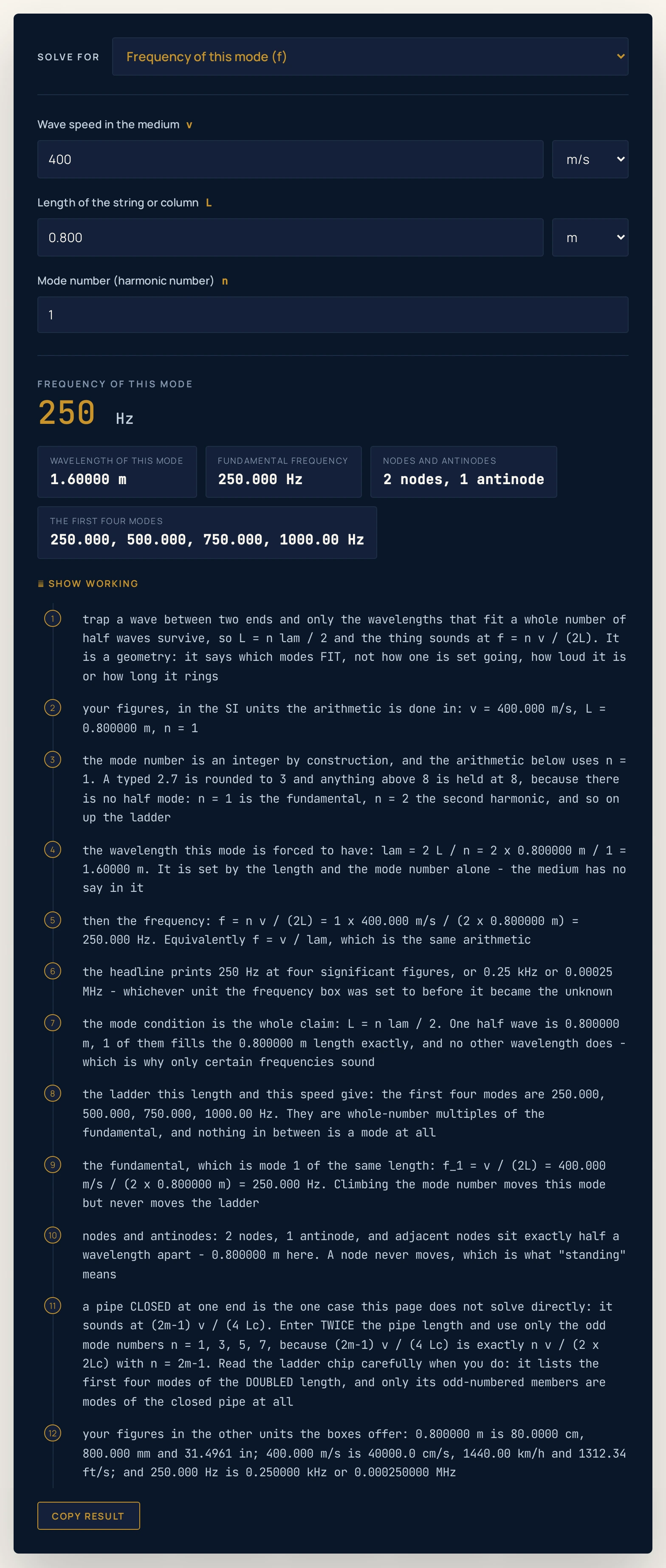
250 Hz. The wavelength chip is the one to watch: every frequency on the page is built on that 1.60000 m, and it is the figure the medium cannot touch.Worked example: change one thing at a time
The table starts at the defaults, moves the unknown through all three quantities, then changes only the mode number, only the wave speed and only the length, walks every unit menu, runs the closed-pipe trick, and finally reaches the entries the calculator declines. Rows 1 to 3 are one string solved three ways. Every answer and chip cell was read out of the running widget rather than worked out by hand, so where a cell and the tool ever part company, believe the tool.
| Step | Solving for | What you type | Headline answer | Wavelength of this mode | Fundamental frequency | Nodes and antinodes | The first four modes |
|---|---|---|---|---|---|---|---|
| The page as it opens | Frequency of this mode | 0.800 m at 400 m/s, mode 1 | 250 Hz | 1.60000 m | 250.000 Hz | 2 nodes, 1 antinode | 250.000, 500.000, 750.000, 1000.00 Hz |
| The same state, solved for the speed | Wave speed in the medium | 250 Hz on 0.800 m, mode 1 | 400 m/s | 1.60000 m | 250.000 Hz | 2 nodes, 1 antinode | 250.000, 500.000, 750.000, 1000.00 Hz |
| The same state, solved for the length | Length of the string or column | 250 Hz at 400 m/s, mode 1 | 0.8 m | 1.60000 m | 250.000 Hz | 2 nodes, 1 antinode | 250.000, 500.000, 750.000, 1000.00 Hz |
| Only the mode number: the third harmonic | Frequency of this mode | mode 3 instead of mode 1 | 750 Hz | 0.533333 m | 250.000 Hz | 4 nodes, 3 antinodes | 250.000, 500.000, 750.000, 1000.00 Hz |
| Only the mode number: the eighth | Frequency of this mode | mode 8 instead of mode 1 | 2000 Hz | 0.200000 m | 250.000 Hz | 9 nodes, 8 antinodes | 250.000, 500.000, 750.000, 1000.00 Hz |
| A typed 2.7 is rounded to 3 | Frequency of this mode | mode 2.7 instead of mode 3 | 750 Hz | 0.533333 m | 250.000 Hz | 4 nodes, 3 antinodes | 250.000, 500.000, 750.000, 1000.00 Hz |
| A typed 12 is held at 8 | Frequency of this mode | mode 12 instead of mode 8 | 2000 Hz | 0.200000 m | 250.000 Hz | 9 nodes, 8 antinodes | 250.000, 500.000, 750.000, 1000.00 Hz |
| Only the length: twice as long | Frequency of this mode | 1.600 m instead of 0.800 m | 125 Hz | 3.20000 m | 125.000 Hz | 2 nodes, 1 antinode | 125.000, 250.000, 375.000, 500.000 Hz |
| Only the length: half as long | Frequency of this mode | 0.400 m instead of 0.800 m | 500 Hz | 0.800000 m | 500.000 Hz | 2 nodes, 1 antinode | 500.000, 1000.00, 1500.00, 2000.00 Hz |
| A half-metre air column, open at both ends | Frequency of this mode | 0.500 m at 343 m/s, mode 1 | 343 Hz | 1.00000 m | 343.000 Hz | 2 nodes, 1 antinode | 343.000, 686.000, 1029.00, 1372.00 Hz |
| The same column closed at one end, entered as twice its length | Frequency of this mode | 1.000 m at 343 m/s, mode 1 | 171.5 Hz | 2.00000 m | 171.500 Hz | 2 nodes, 1 antinode | 171.500, 343.000, 514.500, 686.000 Hz |
| The closed column second mode: the odd numbers only | Frequency of this mode | 1.000 m at 343 m/s, mode 3 | 514.5 Hz | 0.666667 m | 171.500 Hz | 4 nodes, 3 antinodes | 171.500, 343.000, 514.500, 686.000 Hz |
| Sound in water | Frequency of this mode | 1.000 m at 1482 m/s, mode 1 | 741 Hz | 2.00000 m | 741.000 Hz | 2 nodes, 1 antinode | 741.000, 1482.00, 2223.00, 2964.00 Hz |
| Sound in steel: only the speed changed | Frequency of this mode | 1.000 m at 5960 m/s, mode 1 | 2980 Hz | 2.00000 m | 2.98000 kHz | 2 nodes, 1 antinode | 2.98000, 5.96000, 8.94000, 11.9200 kHz |
| Five antinodes on a longer string | Frequency of this mode | 1.200 m at 240 m/s, mode 5 | 500 Hz | 0.480000 m | 100.000 Hz | 6 nodes, 5 antinodes | 100.000, 200.000, 300.000, 400.000 Hz |
| The frequency box set to kHz | Frequency of this mode | the same string, frequency box in kHz | 0.25 kHz | 1.60000 m | 250.000 Hz | 2 nodes, 1 antinode | 250.000, 500.000, 750.000, 1000.00 Hz |
| The frequency box set to MHz | Frequency of this mode | the same string, frequency box in MHz | 0.00025 MHz | 1.60000 m | 250.000 Hz | 2 nodes, 1 antinode | 250.000, 500.000, 750.000, 1000.00 Hz |
| The length typed in centimetres | Frequency of this mode | 80 cm instead of 0.800 m | 250 Hz | 1.60000 m | 250.000 Hz | 2 nodes, 1 antinode | 250.000, 500.000, 750.000, 1000.00 Hz |
| The length typed in millimetres | Frequency of this mode | 800 mm instead of 0.800 m | 250 Hz | 1.60000 m | 250.000 Hz | 2 nodes, 1 antinode | 250.000, 500.000, 750.000, 1000.00 Hz |
| The length typed in inches | Frequency of this mode | 31.4960629921 in instead of 0.800 m | 250 Hz | 1.60000 m | 250.000 Hz | 2 nodes, 1 antinode | 250.000, 500.000, 750.000, 1000.00 Hz |
| The speed typed in cm/s | Frequency of this mode | 40000 cm/s instead of 400 m/s | 250 Hz | 1.60000 m | 250.000 Hz | 2 nodes, 1 antinode | 250.000, 500.000, 750.000, 1000.00 Hz |
| The speed typed in km/h | Frequency of this mode | 1440 km/h instead of 400 m/s | 250 Hz | 1.60000 m | 250.000 Hz | 2 nodes, 1 antinode | 250.000, 500.000, 750.000, 1000.00 Hz |
| The speed typed in ft/s | Frequency of this mode | 1312.33595801 ft/s instead of 400 m/s | 250 Hz | 1.60000 m | 250.000 Hz | 2 nodes, 1 antinode | 250.000, 500.000, 750.000, 1000.00 Hz |
| Tune a length to concert A | Length of the string or column | 440 Hz at 320 m/s, mode 1 | 0.3636 m | 0.727273 m | 440.000 Hz | 2 nodes, 1 antinode | 440.000, 880.000, 1320.00, 1760.00 Hz |
| Back-solve a speed from a measured second harmonic | Wave speed in the medium | 300 Hz on 0.900 m, mode 2 | 270 m/s | 0.900000 m | 150.000 Hz | 3 nodes, 2 antinodes | 150.000, 300.000, 450.000, 600.000 Hz |
| A zero length is declined | Frequency of this mode | 0 m | no answer | - | - | - | - |
| A negative length is declined | Frequency of this mode | -0.800 m | no answer | - | - | - | - |
| A zero speed is declined | Frequency of this mode | 0 m/s | no answer | - | - | - | - |
| A zero frequency is declined in the length mode | Length of the string or column | 0 Hz at 400 m/s | no answer | - | - | - | - |
| A negative frequency is declined in the length mode | Length of the string or column | -250 Hz at 400 m/s | no answer | - | - | - | - |
| A mode number below 1 is declined | Frequency of this mode | mode 0 | no answer | - | - | - | - |
Rows 1 to 3 are one string with the Solve for menu in each of its three positions, and all four chips are identical down all three because the chips describe the state rather than the mode. That is not free: they are worked out from the answer substituted back into the state, so the mode in which the length is the unknown still has a length to take a wavelength of. The residual is exactly zero in all three directions, because no rounding enters this relation anywhere.
Rows 4 to 7 climb the mode number and nothing else. The headline and the wavelength move, the counts move, and the fundamental and ladder chips do not budge from 250.000 Hz and 250.000, 500.000, 750.000, 1000.00 Hz. Rows 6 and 7 are the integer clamp: a typed 2.7 returns the same 750 Hz as mode 3, and a typed 12 the same 2000 Hz as mode 8.
Rows 8 and 9 move the length alone. Double it and the pitch halves to 125 Hz; halve it and the pitch doubles to 500 Hz, with the whole ladder moving with it. This is the one control that moves every figure on the page.
Rows 10 to 12 all print the fixed-at-both-ends counts: in rows 11 and 12 the Nodes and antinodes column counts the doubled length rather than the pipe, and in row 10 it stands in for an open pipe, whose counts are 1 node, 2 antinodes. The counts chip is the both-ends case, below, translates both. A 0.500 m column open at both ends sounds 343 Hz; the same column closed at one end goes in as 1.000 m and sounds 171.5 Hz, exactly an octave lower. Row 12 takes its next real mode with n = 3 and gets 514.5 Hz — and the 343.000 Hz sitting in that ladder chip is not a mode of the closed pipe.
Rows 13 to 15 change only the medium, or only the mode on a longer string. Water and steel on the same 1.000 m column return the identical 2.00000 m wavelength and the identical counts, while the pitch goes from 741 Hz to 2980 Hz — and the fundamental chip crosses the Hz-to-kHz seam to read 2.98000 kHz. Row 15 is a 1.200 m string in its fifth mode, sounding 500 Hz on a 100.000 Hz fundamental.
Rows 16 to 23 change nothing but the units, and every one of them returns the same string. One frequency reads 250 Hz, 0.25 kHz and 0.00025 MHz; the length typed as 80 cm, 800 mm or 31.4960629921 in is the same 0.800 m; and the speed typed as 40000 cm/s, 1440 km/h or 1312.33595801 ft/s is the same 400 m/s. Those are the round trips through the multipliers people most often invert.
Rows 24 and 25 are the two back-solves worth doing. A string sounding concert A at 440 Hz in a medium carrying 320 m/s must be 0.3636 m long; and a 0.900 m length whose second harmonic is 300 Hz is carrying waves at 270 m/s on a 150.000 Hz fundamental. Note how the fundamental chip in row 25 is half the frequency you typed, because you typed a second harmonic.
Rows 26 to 31 sit outside the domain and are declined there rather than answered. A zero or negative length has no mode behind it, a zero speed carries no wave, a zero frequency in the length mode would need an infinitely long string, a negative frequency a negative length, and a mode number below 1 is not a mode. In each case the widget says so in words instead of printing an infinity.
Formula and symbol reference
One condition does all the work here. A wave trapped between two ends is reflected back on itself, and the returning wave only reinforces the outgoing one when a whole number of half wavelengths fits the length: L = n lam / 2. Rearranged, that gives the wavelength of mode n as lam = 2L/n, and nothing else is allowed.
The frequency follows at once, because a wave of that wavelength running at the medium's speed completes v / lam cycles a second: f = n v / (2L). Rearranged the other two ways that is v = 2Lf/n and L = n v / (2f), and those are the three positions of the Solve for menu. Setting n to 1 gives the fundamental, f_1 = v / (2L), and every other mode is a whole-number multiple of it.
The wave speed is the medium's, not the mode's, and this page never derives it — the wave speed calculator is the tool that relates a speed to a frequency and a wavelength directly, and the speed of sound calculator is where the 343 m/s in air comes from. For a reader who arrives with a period rather than a frequency, the frequency formula guide is the conversion. Every particle on the pattern is meanwhile doing simple harmonic motion about its own rest position, which is a separate story told on its own page.
The page solves the both-ends case, and says so out loud. f = n v / (2L) covers a string fixed at both ends and a pipe open at both ends alike. A pipe closed at one end sounds at (2m-1) v / (4 Lc): to get that from this calculator, enter twice the pipe's length and use only the odd mode numbers — n = 1, 3, 5, 7 — because (2m-1) v / (4 Lc) is exactly n v / (2 x 2Lc) with n = 2m-1. That is an identity, not an approximation, and the lab draws the picture with its third boundary button.
One chip needs reading carefully when you use that trick. With a 0.500 m closed pipe entered as 1.000 m the ladder chip prints 171.500, 343.000, 514.500, 686.000 Hz, because those are the first four modes of the doubled length. Only the odd-numbered members of that row are modes of the closed pipe — 171.500 and 514.500 Hz — and 343.000 Hz is not one of its modes at all. The even harmonics of a closed pipe are not quiet; they do not exist.
| Symbol | Meaning | SI unit | Values used on this page |
|---|---|---|---|
| f | Frequency of the chosen mode — how many times a second the whole pattern completes a cycle. The quantity the page opens solving for | hertz | Boxes take Hz, kHz or MHz: 250 Hz is the default, which is 0.250000 kHz and 0.000250000 MHz. |
| v | The speed at which a disturbance runs along whatever lies between the ends. This page asks you for it and never works it out: no tension, linear density or temperature is read anywhere here | metre per second | Boxes take m/s, cm/s, km/h or ft/s: 400 m/s is the default, with 343 m/s in air, 1482 m/s in water and 5960 m/s in steel. |
| L | The distance from one end to the other of the part that actually vibrates: the free span of a string, or the sounding length of an air column. For a pipe closed at one end, enter twice its length | metre | Boxes take m, cm, mm or in: 0.800 m is the default, which is 80.0000 cm, 800.000 mm and 31.4961 in. |
| n | Mode number, also called the harmonic number. A whole number from 1 to 8, an input in every mode and never one of the three solve targets | dimensionless | No unit menu: 1 is the default and the fundamental, 2 the second harmonic, 8 the top of the range this page offers. |
| lam_n | Wavelength of mode n, which the two ends and the mode number fix between them. A chip rather than a box, because a length and a mode number are what a reader has | metre | A chip: 1.60000 m at the defaults, 0.533333 m at n = 3, 0.480000 m for a 1.200 m string at n = 5. |
| f_1 | Fundamental frequency, the frequency of mode 1 for the same length and speed. Independent of which mode you are looking at | hertz | A chip: 250.000 Hz at the defaults and still 250.000 Hz at n = 3; 100.000 Hz for a 1.200 m string at 240 m/s. |
The physics: why only certain frequencies fit
The ends are the whole story. A fixed end cannot move, so the pattern must have a node there; an open end is free to move as much as it likes, so the pattern has an antinode there. Either way the length is pinned to a whole number of half wavelengths, and a wavelength that does not satisfy that condition cancels itself out on the return trip instead of building up.
The mechanism is two waves running in opposite directions and adding — the outgoing wave and its own reflection — which is why a standing wave needs a boundary and never forms on an endless string. The pattern itself does not travel: the nodes never move, and no net energy is carried along the length, which is what separates it from the travelling waves of the transverse and longitudinal waves guide. That guide is also where the relation between a speed, a frequency and a wavelength is set out properly.
Four quantities on this page respond to four different things, and the chips are arranged so you can see it in one change at a time. Move the length and everything moves. Move the mode number and the headline and the wavelength move while the fundamental and the ladder stand still. Move the wave speed and every frequency moves while the wavelength and the counts do not change at all.
That last one is worth loading rather than reading. A one metre column open at both ends has a fundamental wavelength of 2.00000 m in water and 2.00000 m in steel — byte for byte the same chip — while its pitch goes from 741.000 Hz to 2.98000 kHz. Same shape, same nodes, same spacing; a four-times-faster medium only raises the pitch. The travelling wave lab is the contrast: there the pattern moves and there are no fixed nodes at all.
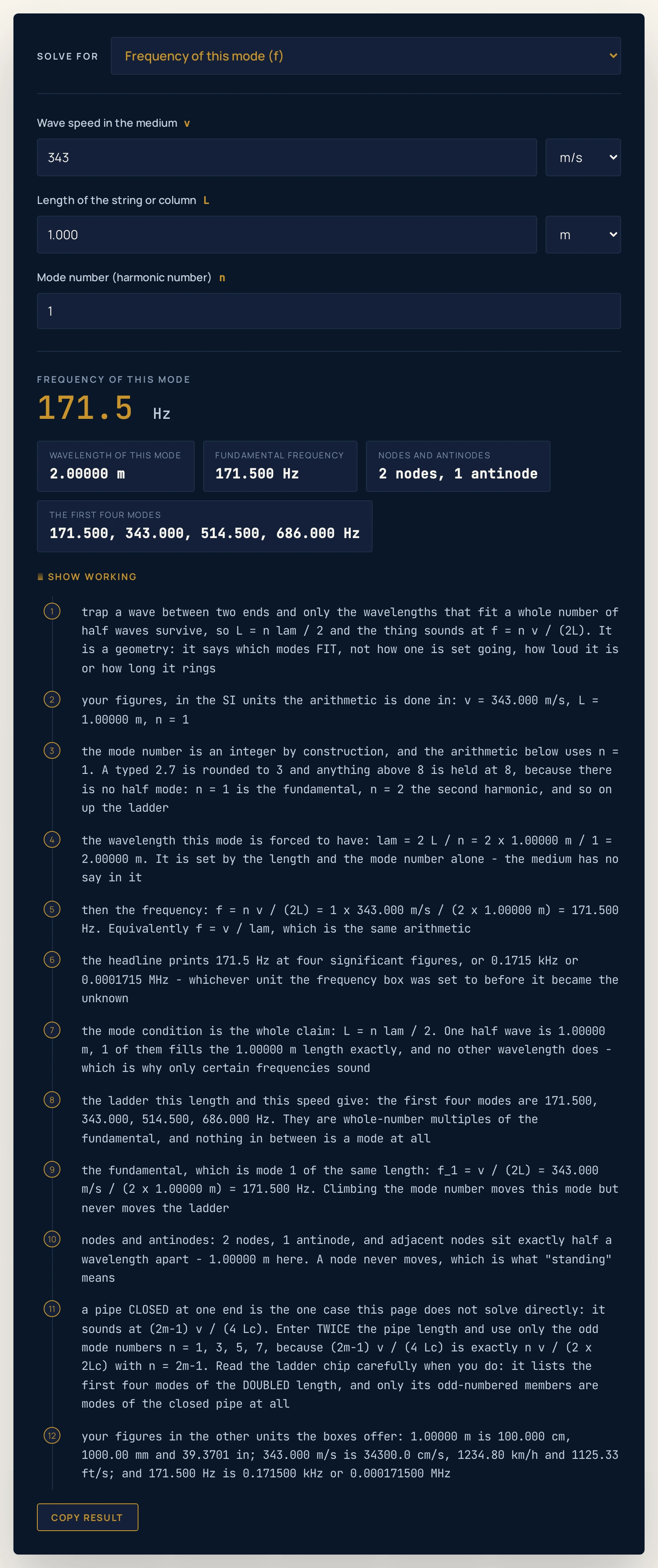
1.000 m at n = 1 and returns 171.5 Hz — exactly an octave below the 343 Hz the same pipe sounds when both ends are open.Where the standing wave formula breaks down
The arithmetic here is exact to the last digit a double can hold. What still goes wrong is physical: a boundary the boxes assume and the real object does not have, a wave speed that is not the same all along the length, and a loudness question put to a condition that only sorts shapes.
- Nothing you can type describes a medium with no end
- A wave that never meets a boundary never forms a standing pattern, because it is the return from one that builds the pattern up — a long cable with an absorbing termination is exactly that case, and nothing on this page applies to it. One boundary does better than none: the reflection off a single end gives a real pattern with its nodes half a wavelength apart, which is what a cable shorted at one end shows. What it does not give is a ladder of modes, because the length box wants the distance between two ends and there is no second one to measure to.
- Four boxes describe a shape, and none of them describes a push
L = n lam / 2says which modes fit. It says nothing about how a mode is set going, how strongly it responds, how loud it is or how long it rings on after you stop driving it. Those are separate questions with separate physics, and nothing on this page answers any of them — which is also why no amplitude appears anywhere, a point the amplitude guide takes up properly.- The speed box holds one number, and it has to be true everywhere
- A string of varying thickness, a wound string over part of its length, or an air column whose temperature changes along it has no single wavelength and therefore no clean ladder. Pick a stretch over which the medium really is the same throughout, or treat the answer as an estimate and verify before use.
- The ladder chip prints exact multiples that a real string will not quite hold
- Bending stiffness is the part this model drops: a real string pushes back against being bent, not just against being stretched, and that stiffening lifts its short-wavelength modes a little above the whole-number multiples the ladder chip prints. Quantifying the shift takes a measurement, and this site carries none for it, on any instrument, so no figure is quoted here. Expect the ladder to be very good low down and progressively less exact high up.
- A pipe sounds as though it were a little longer than the length you type
- The displacement antinode of an open pipe sits slightly beyond the physical opening, so a real pipe's fundamental is a little lower than
v / (2L)orv / (4 Lc)predicts. The mechanism is honest; the size of the correction depends on the bore and is not published on this site, so no figure for it appears here. Treat a pipe answer as slightly sharp of reality. - Every state this relation reaches is arithmetically right, including the inaudible ones
- Nothing in
f = n v / (2L)knows whether anything can hear the mode or whether the medium could carry it. A short length at a high speed and a high mode number returns a frequency far above the roughly 20 Hz to 20,000 Hz a healthy young ear covers, as the guide to how sound waves travel sets out, and a long slow one returns a frequency far below it. Both are arithmetically right and worth a second look. - The counts chip is the both-ends case
- The
n + 1nodes andnantinodes it prints are those of a string fixed at both ends; a pipe open at both ends has exactly the same wavelength, frequency, fundamental and spacing with the counts the other way round. A pipe closed at one end needs its own mode number recovered from the typed one asm = (n + 1) / 2, because the doubled-length trick typesn = 2m-1for the pipe's own m-th mode, and that mode has m nodes and m antinodes:n = 1is1 node, 1 antinoderather than the2 nodes, 1 antinodeon the chip,n = 3is two of each,n = 5three of each andn = 7four of each. The frequencies hold at every mode number for the two both-ends cases and at the odd mode numbers only for a closed pipe, and the lab's third boundary button prints the closed-pipe counts directly. - A hyphen or a refusal is an answer, not a fault
- A zero or negative length, a zero or negative wave speed, a zero or negative frequency in the length mode and a mode number below 1 are all declined in words rather than answered with an infinity or a NaN. A zero frequency would need an infinitely long string and a negative one a negative length, so neither is published.
- The calculator measures nothing — you supply the numbers
- Two quantities and a mode number go in, one condition is rearranged, and the answer describes the string or column you described. The preset names are shorthand for the four figures behind them and are not claims about any particular instrument or installation.
Where the standing wave formula is actually used
- Tuning a string to a pitch
- Point Solve for at the length and the question inverts: a pitch you want and the speed the medium gives you return the length that sounds it. At 320 m/s a string must be
0.363636 mlong to sound 440 Hz in its fundamental — and because a longer length sounds lower, building it long gives a flat note rather than a sharp one. - Getting a wave speed out of a pitch you can measure
- Point Solve for at the wave speed and a measured frequency on a known length gives the speed in the medium. A 0.900 m length whose second harmonic is 300 Hz is carrying waves at
270.000 m/s. Get the mode number wrong in that measurement and the speed is wrong by exactly that factor, which is the one real trap in this direction. - Wind instruments, and the doubled length box that drops the octave
- Load the half-metre air column preset and then the closed at one end preset:
343 Hzagainst171.5 Hz, exactly a factor of two. A pipe closed at one end fits only a quarter of a wavelength in its fundamental rather than a half, so it sounds an octave below an open pipe of the same length — and its even harmonics do not merely go quiet, they do not exist. - Changing the speed box alone, with the length left exactly as it was
- Load the water preset against the steel preset: the same 1.000 m column, the same
2.00000 mwavelength, and741.000 Hzagainst2.98000 kHz. That is how one piece of apparatus can be used to compare two media, and it is why the wavelength chip and the frequency chip are printed separately. - When the headline answer lands outside the audible band
- Because the relation is arithmetic, it reaches well past hearing in both directions, and the audible band this site publishes is roughly 20 Hz to 20,000 Hz. Pushing the length down and the speed and mode number up walks a mode straight into the ultrasound range, which is the region sonar and medical imaging work in; pulling the other way reaches infrasound. The decibel calculator is the one for how loud rather than how high.
- Why the ladder chip prints four modes when you asked for one
- Any resonator with two ends has a mode condition of this shape, which is why the first four modes are printed rather than just the one you asked for. The Helmholtz resonator calculator is the different case — a cavity and a neck rather than a length — and the two are worth comparing before assuming a bottle behaves like a pipe.
- Recognising the same mathematics somewhere else entirely
- The condition that only whole numbers of half waves fit between two walls is not unique to sound. The infinite-well lab plots exactly the same eigenvalue problem for a quantum particle, with the nodes marked, which is why the pictures look so alike. Its subject is a probability density rather than a pitch, and it prints no wavelength or frequency, but the shapes are the same shapes.
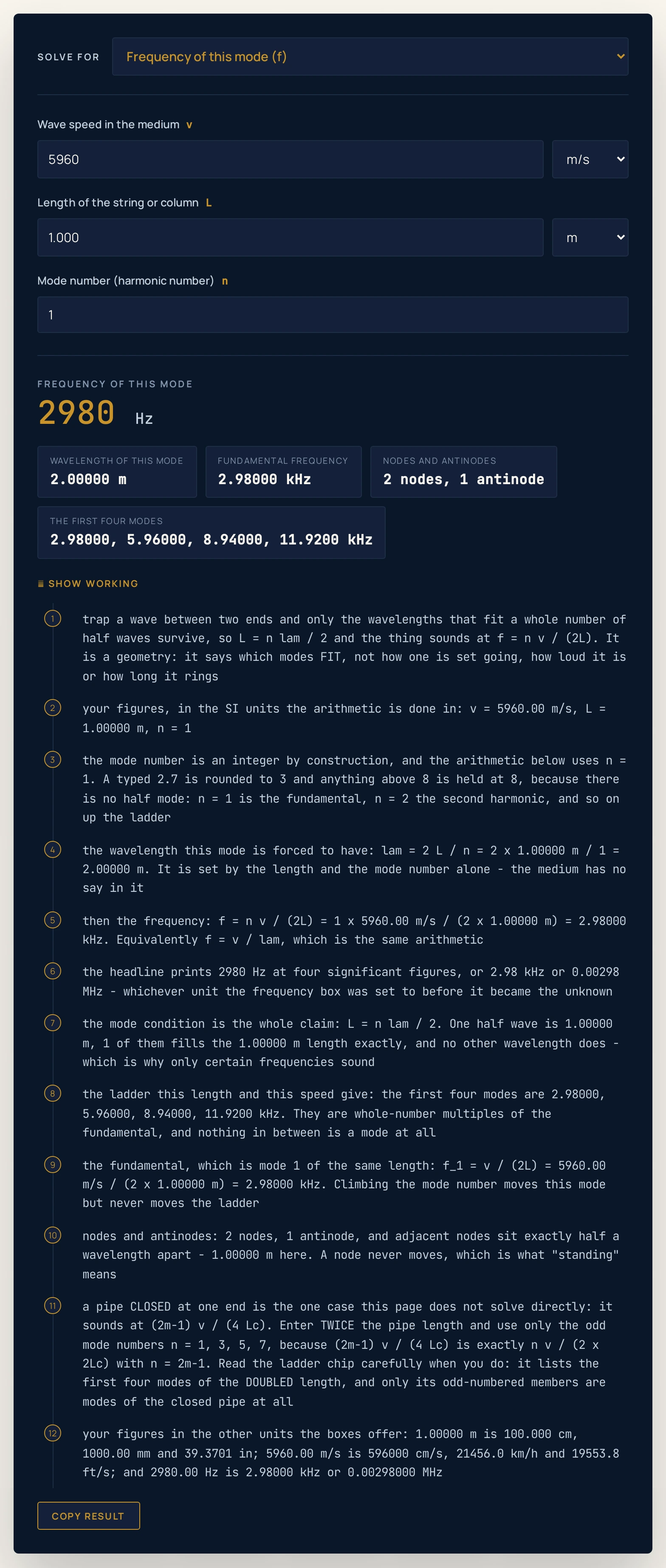
2.00000 m, while the pitch has gone from 741.000 Hz to 2.98000 kHz.Where to go next
For what a standing wave is, where the nodes sit, the harmonic ladder, the worked problems and the misconceptions, read the standing waves and harmonics guide, which this tool is the arithmetic half of. The transverse and longitudinal waves guide is where a travelling wave and the relation between speed, frequency and wavelength belong, the simple harmonic motion guide is what each particle on the pattern is doing, and the guide to wave speed in different media is what sets the speed this page takes as given.
Four more posts pick up what this page deliberately leaves out. The wavelength formula and units guide is the wavelength on its own, the frequency formula guide is the period-to-frequency conversion, the amplitude guide is where the height of a vibration belongs, and the guide to how sound waves travel is where the audible range comes from. The speed of sound guide is the 343 m/s the air-column presets use.
Four tools sit next to this one. The wave speed calculator relates a speed, a frequency and a wavelength directly; the speed of sound calculator supplies a speed for a gas; the Helmholtz resonator calculator is a cavity rather than a length; and the simple harmonic motion calculator is the oscillation each particle performs. The decibel calculator answers how loud instead of how high.
The travelling wave lab, the transverse and longitudinal lab, the lab for a wave crossing into a new medium and the simple harmonic motion lab are the neighbouring simulations, and the infinite-well lab is the same eigenvalue problem on a different subject. The full physics lab library and calculator index are open too.
Frequently asked questions
What does the standing waves calculator work out?
It solves f = n v / (2L) for any one of three quantities: the frequency of a chosen mode, the wave speed in the medium, or the length of the string or air column. Beside the answer it prints the wavelength of that mode, the fundamental frequency, the number of nodes and antinodes, and the first four modes of the same length and speed.
Which of the three boxes should I point Solve for at?
Point it at the frequency when you know the length and the wave speed, which is the forward question. Point it at the wave speed when you have measured a pitch on a length you know and want the speed behind it. Point it at the length when you know the pitch you want and the speed the medium gives you, which is the tuning question.
Why must the mode number be a whole number?
The mode number multiplies a count of half wavelengths, and two ends will not hold a fraction of one. That is all L = n lam / 2 says, so mode 2.7 is not a state anything can be in. The box rounds a typed 2.7 to 3 and holds anything above 8 at 8, and the working prints the number it actually used.
How do I use this calculator for a pipe closed at one end?
A pipe closed at one end sounds at (2m-1) v / (4 Lc), so enter TWICE the pipe length and use only the odd mode numbers 1, 3, 5 and 7. That is exact rather than approximate: (2m-1) v / (4 Lc) is exactly n v / (2 x 2Lc) with n = 2m-1. A 0.500 m closed pipe therefore goes in as 1.000 m and returns 171.500 Hz, an octave below the same pipe open at both ends.
Why does the fundamental chip not move when I change the mode number?
Only the length and the speed go into that chip, and the mode number is not one of them: it is always mode 1 that is reported there. Climbing the mode number moves the headline and the wavelength chip but leaves the fundamental and the first-four-modes chip exactly where they were. Climbing the ladder does not change the ladder.
Why does changing the wave speed leave the wavelength chip alone?
Because the wavelength is fixed by the two ends and the mode number, not by the medium. Two lengths divided by the mode number is all that goes into it, so a faster medium gives the same shape at a higher pitch rather than a different shape. A one metre column open at both ends has a 2.00000 m fundamental wavelength in water and in steel alike, while its pitch rises from 741.000 Hz to 2.98000 kHz.
Which unit does the headline answer come out in?
Whichever unit that box was showing before it became the unknown. The engine converts every input to SI, does the arithmetic there, and converts the answer back, so the units you choose never change the physics. Set the unit while the quantity is still an input, then point Solve for at it.
Why will it not give me a length when the frequency is zero?
Because a zero frequency would need an infinitely long string, which is not an answer. The page declines it rather than printing an infinity, and it declines a negative frequency for the same kind of reason: a negative length has no meaning. A zero or negative wave speed and a mode number below 1 are declined wherever they are inputs.
Does this calculator work out the tension or the loudness?
No, and both omissions are deliberate. The wave speed is an input here and nothing on this page derives it from a tension or a linear density, because that is a different relation on a different page. Nothing here prints an amplitude, a period or an energy either: the mode condition is a geometry, so it says which modes fit and is silent about how one is set going, how loud it is or how long it rings.
References & formula source
- The relation this page solves is the boundary condition for a one-dimensional standing wave: a whole number of half wavelengths has to fit the span between the ends, L = n lam / 2, so the wavelength of mode n is 2L/n and its frequency is n v / (2L). It is stated here rather than derived, and it holds for a string fixed at both ends and for a pipe open at both ends alike.
- The node and antinode counts printed beside the answer are those of the both-ends case: a string fixed at both ends has n + 1 nodes and n antinodes in mode n. A pipe open at both ends has the mirror-image pattern - the same wavelength, the same frequency and the same fundamental, with the counts the other way round. A pipe closed at one end needs its own mode number recovered from the typed one as m = (n + 1) / 2, because the doubled-length trick types n = 2m-1 for the m-th mode of the pipe itself, and that mode has m nodes and m antinodes: n = 1 is one node and one antinode, n = 3 is two of each, n = 5 is three of each and n = 7 is four of each. The node spacing is half a wavelength in every one of those cases, and the frequencies hold at every mode number for the two both-ends cases and at the odd mode numbers only for a closed pipe.
- For a pipe closed at one end the modes are (2m-1) v / (4 Lc), the odd quarter wavelengths only. This page reaches that case exactly by taking twice the pipe length with the odd mode numbers, because (2m-1) v / (4 Lc) is identically n v / (2 x 2Lc) with n = 2m-1; the even harmonics of such a pipe are not quiet, they do not exist. An independent reference asserts that identity over twenty length and mode pairs.
- The wave speed is an INPUT on this page and is never computed. It is a property of the medium, and nothing here derives it from a tension, a linear density, a temperature, a pressure or a refractive index. The three speeds named in the prose and presets - 343 m/s for sound in air at 20 C, 1482 m/s in water and 5960 m/s in steel - are the values this site already publishes for those media, reused so that neighbouring tools agree rather than carrying two sets of numbers for the same material.
- The audible range quoted in the prose, roughly 20 Hz to 20,000 Hz for a healthy young ear, is the figure this site already publishes. It is a property of hearing and not of the formula: f = n v / (2L) is arithmetic and will happily return a frequency nothing can hear, which is why extreme inputs are worth a second look rather than a refusal.
- The ideal whole-number ladder assumes a perfectly flexible medium whose wave speed is the same along the whole length. A real string has bending stiffness and a real open end is not exactly an antinode, so the exact series is an idealisation; both are consequences of what the model leaves out rather than measurements, and no figure for either is published on this site or invented here. Verify anything you mean to rely on.
- One relation is solved here and nothing adjacent to it: no tension, no linear density, no resonance curve, no damping time and no interference or superposition arithmetic appears anywhere. Those belong to other pages, and this one links to them rather than repeating them.
- Every figure quoted in the prose and tables above is either a string this calculator printed for the inputs named beside it, a wave speed or hearing limit this site already publishes, or a ratio checked against an independent reference written before this page existed and sharing no code with it, which runs 1,684 checks with 0 failures. Where a cell and the running widget ever part company, believe the widget.
- Further reading: Standing wave — Wikipedia