Helmholtz resonator: a cavity of air with an open neck that resonates at one frequency, like blowing across a bottle. Its frequency is f = (c/2 pi) sqrt(A/(V L)). This free calculator solves for the frequency, the cavity volume, the neck area or the neck length, with every step shown.
What Is the Helmholtz Resonator Calculator?
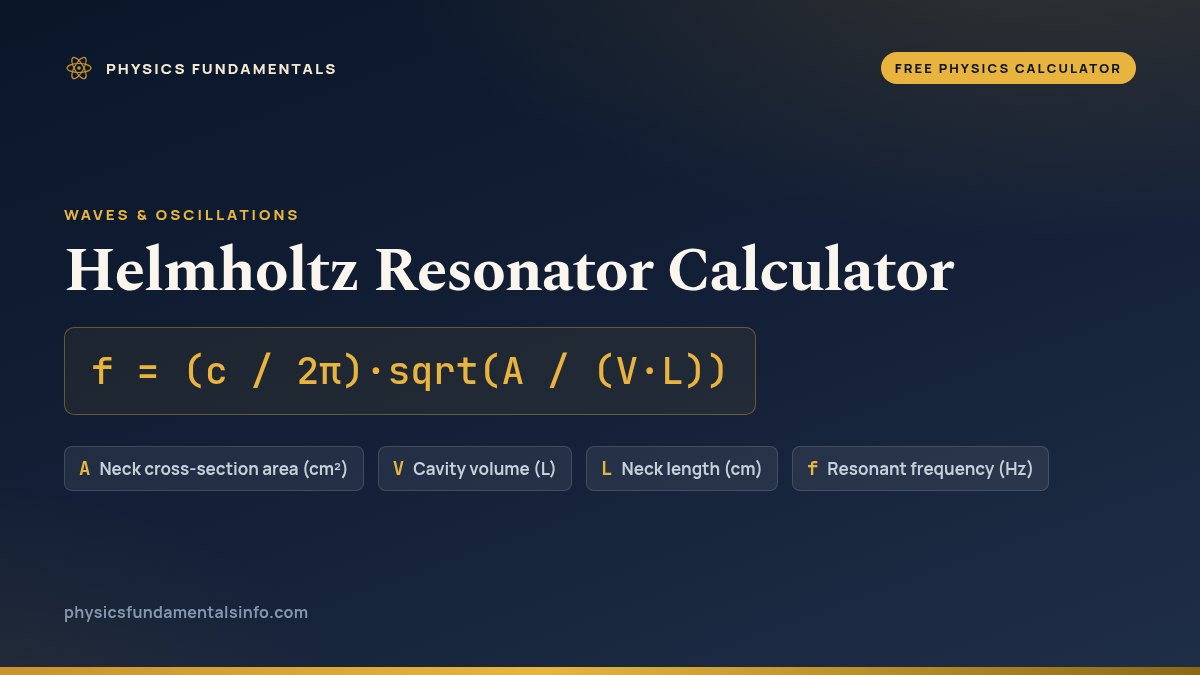
The helmholtz resonator calculator is a free online tool built on the formula f = (c / 2π)·sqrt(A / (V·L)). Enter the values you already know, in whichever units suit you, and it solves for resonant frequency, volume, neck area or length and shows every step of the substitution. Helmholtz Resonator is the resonant frequency of an air cavity with a neck — a bottle, a port, a muffler.
| Symbol | Quantity | Default unit | Also accepts | Example value |
|---|---|---|---|---|
| A | Neck cross-section area | cm² | mm², m² | 1 |
| V | Cavity volume | L | cm³, mL, m³ | 1 |
| L | Neck length | cm | mm, m | 5 |
| f | Resonant frequency | Hz | kHz | — |
How to calculate the Helmholtz frequency
A Helmholtz resonator works because the air in the neck acts as a mass and the air in the cavity acts as a spring. That mass-on-a-spring bounces at one natural frequency, giving f = (c/2 pi) sqrt(A/(V·L)), where c is the speed of sound (343 m/s in air at 20 °C), A the neck cross-section area, V the cavity volume and L the neck length. The result is a frequency in hertz.
To use the formula, enter three of the four quantities and read off the fourth. Select what you want in the Solve for menu — frequency, volume, neck area or neck length — then type the values you know in any listed unit. The calculator converts areas to square metres, volumes to cubic metres and lengths to metres before it computes, then shows the formula, your numbers substituted in, and the answer with units. Because the same air spring governs any mass-and-restoring-force oscillation, it helps to compare it with a simple harmonic motion calculator, and the speed of sound c itself follows from the wave speed calculator.
The frequency depends only weakly on each input — it scales as the square root — so a resonator is fairly forgiving to build, but you still need consistent units. Keep areas, volumes and lengths in SI, or use this calculator’s unit menus, which handle the conversions for you.
Worked example
Take a bottle with a neck area A = 1 cm² (1×10⁻⁴ m²), a neck length L = 5 cm and a cavity volume V = 1 L (1×10⁻³ m³). Substituting into the formula gives f = (343/2 pi) sqrt(1×10⁻⁴ / (1×10-3 × 0.05)), which works out to about 77 Hz — a low hum, matching the note you hear when you blow across the mouth of a bottle.
Why it matters
Helmholtz resonance explains bass-reflex speaker ports, the tuning of car cabins and instrument bodies, engine intake and exhaust muffler design, and the panel absorbers used to control room acoustics. Emptying a bottle raises V, and because f is proportional to 1/sqrt(V), the note drops — which is why a draining bottle glugs lower and lower. In real life a neck behaves slightly longer than its physical length because the air just outside also moves; this end correction lowers the true frequency a little below the ideal value. The same oscillator thinking applies to any timekeeping swing, as the pendulum period calculator shows, and the terms here are defined in the physics glossary.
Frequently asked questions
What is a Helmholtz resonator?
A Helmholtz resonator is an air cavity with a narrow open neck that resonates at a single low frequency; a bottle you blow across is the classic example.
What is the formula for the resonant frequency?
The resonant frequency is f = (c/2 pi) sqrt(A/(V L)), with c the speed of sound, A the neck area, V the cavity volume and L the neck length.
Why does an emptier bottle sound lower?
A larger air volume V makes the spring softer, and since f is proportional to 1/sqrt(V), the frequency drops.
What speed of sound should I use?
Use about 343 m/s for air at 20 C; it rises with temperature, so a warmer cavity resonates a little higher.
What is the end correction?
The moving air plug extends a little beyond the neck, so the effective length is slightly longer than the physical neck, lowering the frequency slightly.
References & formula source
- Kinsler, Frey, Coppens & Sanders — Fundamentals of Acoustics, Chapter 10 (Cavity and Helmholtz resonators).
- Halliday, Resnick & Walker — Fundamentals of Physics, Chapter 17 (Waves and Sound).
- Young & Freedman — University Physics with Modern Physics, §16 (Sound and Hearing).
- Further reading: Helmholtz resonance — Wikipedia