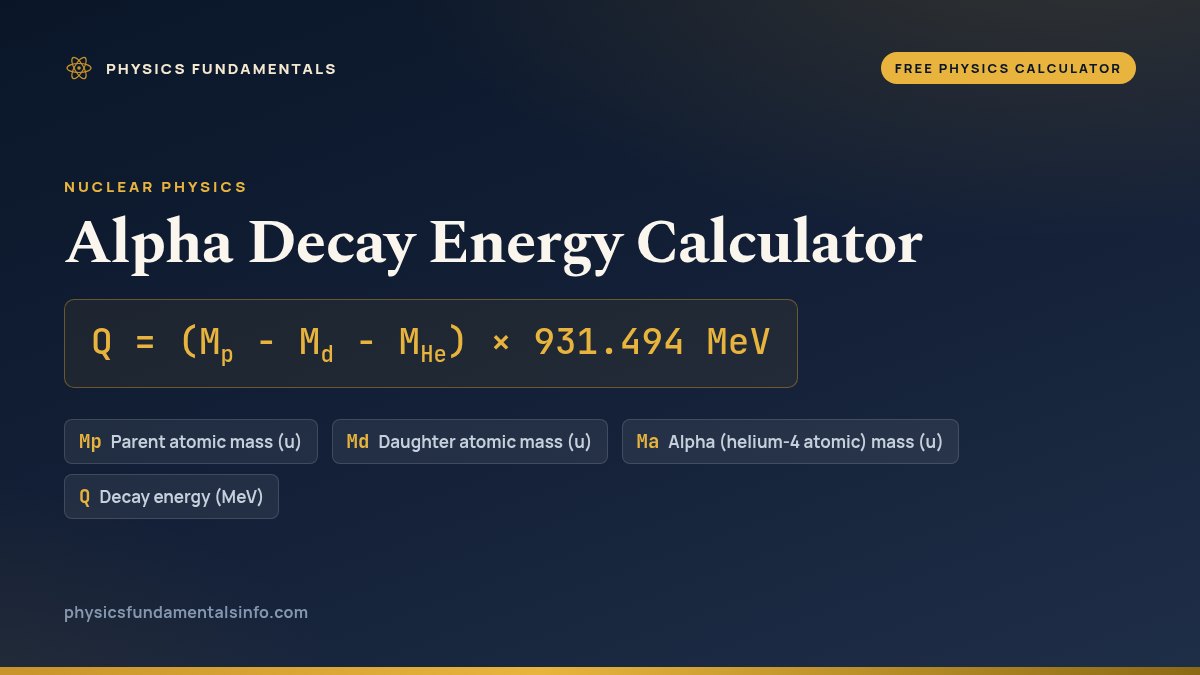
Alpha decay energy: when a heavy nucleus throws out an alpha particle — a helium-4 nucleus of two protons and two neutrons — the energy released is the mass that disappears, Q = (Mp - Md - MHe) × 931.494 MeV, worked out from the neutral atomic masses of the parent and the daughter. This free alpha decay energy calculator returns Q in MeV or keV, splits it between the alpha particle and the recoiling daughter, and says whether the decay is energetically allowed.
Load a real alpha emitter
Each button puts the tool back on the decay energy and fills the three boxes with one real measured mass triple. Whatever the widget then works out is read back into the line underneath, so nothing there is stored text.
Pick a case above, or type your own masses.
What Is the Alpha Decay Energy Calculator?
The alpha decay energy calculator is a free online tool built on the formula Q = (Mp - Md - MHe) × 931.494 MeV. Enter the neutral atomic masses of the parent and the daughter in unified atomic mass units and it returns the decay energy Q in MeV or keV, splits it into the alpha particle's kinetic energy and the daughter's recoil, and says whether the decay is energetically allowed. It solves the same relation backwards too, so a known Q and one mass give the other.
| Symbol | Quantity | Default unit | Also accepts | Example value |
|---|---|---|---|---|
| Mp | Parent atomic mass | u | — | 238.050786936 |
| Md | Daughter atomic mass | u | — | 234.043599801 |
| Ma | Alpha (helium-4 atomic) mass | u | — | 4.002603254 |
| Q | Decay energy | MeV | keV | 4.27 |
How to use the alpha decay energy calculator
- Choose what to solve for. The menu opens on the decay energy Q. Switch it to the parent atomic mass or the daughter atomic mass and the engine rearranges the same relation, hides that box and asks for the other three — putting every box back to its default as it does so, which is why the masses have to be typed again or a preset pressed again after a switch.
- Enter the two atomic masses. Both go in u, the unified atomic mass unit. Use neutral atomic masses, not bare nuclear masses, and type as many decimals as your table gives you.
- Leave the alpha mass box alone. It holds the helium-4 atomic mass, 4.002603254 u. That is a measured constant rather than a variable, so it is never the quantity being solved for.
- Read Q, then read the verdict. The headline is the decay energy, in MeV or keV. Verdict says whether the decay is energetically allowed, and a negative Q comes back as an answer rather than an error.
- Read the split and open Show working. Alpha kinetic energy and Daughter recoil divide Q in inverse proportion to the masses, Share carried by the alpha gives that division as a percentage, and the working substitutes your own figures step by step.
Alpha decay is one of three radiations that come out of unstable nuclei, and the other two change the bookkeeping quite differently; the guide to alpha, beta and gamma radiation sets the three side by side. If the nuclide you are looking at emits an electron or a positron rather than a helium nucleus, the arithmetic has the same shape but a different correction, and the beta decay energy calculator is the page that handles it. Nothing on this page can tell the two apart for you: it converts whatever mass difference you type.
Three slips account for most wrong answers here. The first is typing the parent and the daughter into each other's boxes, which turns the sign of Q over and brings back the forbidden verdict. The second is rounding the masses to four or five decimals, which throws away more than the answer is worth, and the third is reading the headline as a mass: it is four significant figures, so a parent mass comes back as a bare 226 u rather than the nine decimals the working line carries.
Worked example: change one thing at a time
The table below walks away from the opening case one entry at a time, then asks the same question backwards and in a different unit. Every cell was copied out of the running widget rather than worked out by hand, so where a cell and the tool ever part company, believe the tool. A dash marks the box the engine hides because it is the one being solved for, and the alpha mass box holds 4.002603254 u in every row.
| Step | Solve for | Parent mass, u | Daughter mass, u | Result | Mass lost | Alpha kinetic energy | Daughter recoil |
|---|---|---|---|---|---|---|---|
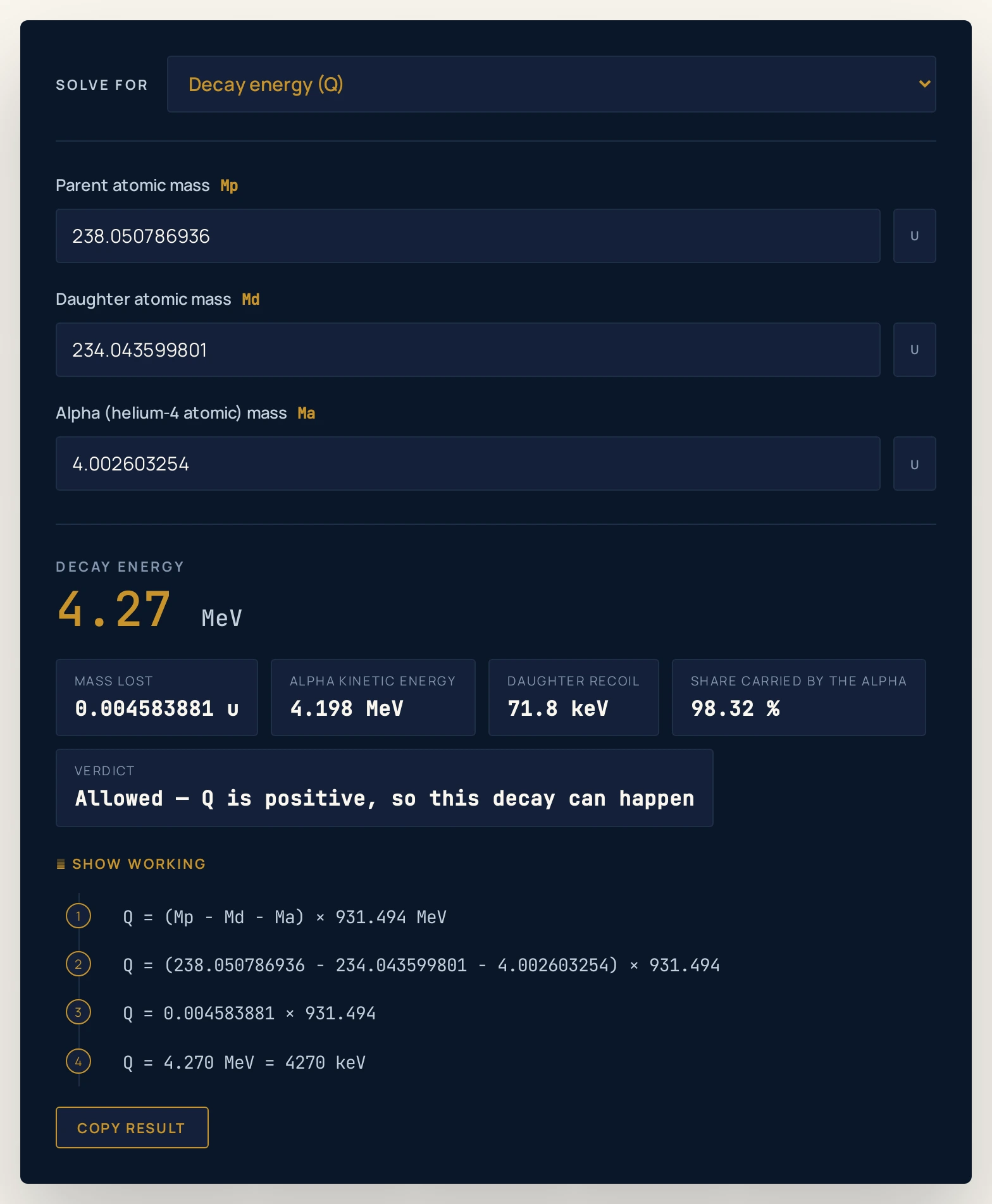
| Start: uranium-238 to thorium-234 (the defaults) | Decay energy | 238.050786936 | 234.043599801 | 4.27 MeV | 0.004583881 u | 4.198 MeV | 71.8 keV |
| Both masses moved to radium-226 and radon-222 | Decay energy | 226.025408186 | 222.017576017 | 4.871 MeV | 0.005228915 u | 4.784 MeV | 86.3 keV |
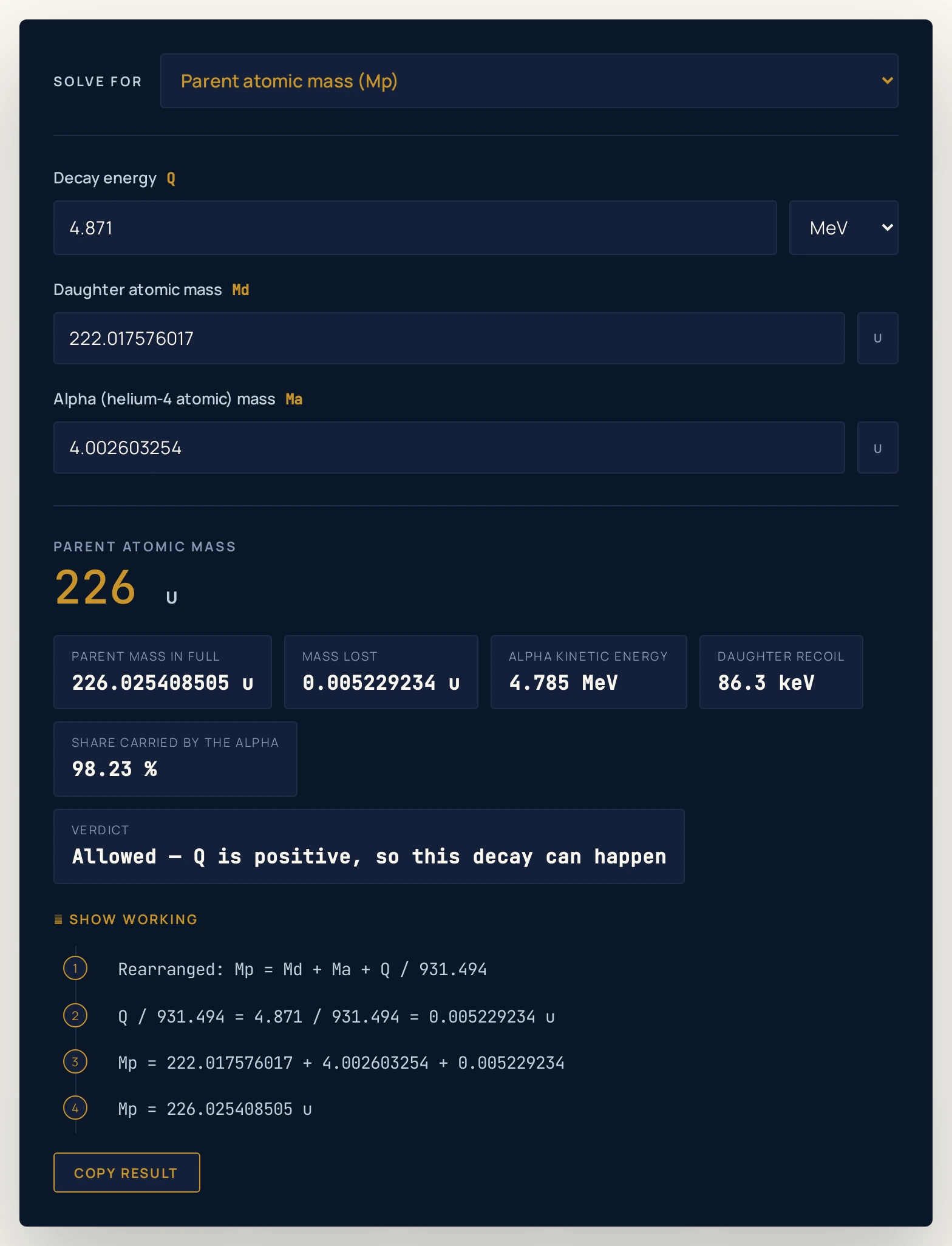
| Solving for the parent mass instead, radon-222 retyped in the daughter box and Q typed as 4.871 MeV | Parent atomic mass | — | 222.017576017 | 226 u | 0.005229234 u | 4.785 MeV | 86.3 keV |
| Solving for the daughter mass, radium-226 retyped in the parent box and the same Q | Daughter atomic mass | 226.025408186 | — | 222 u | 0.005229234 u | 4.785 MeV | 86.3 keV |
| Back on the decay energy with the box left on keV, both radium masses retyped | Decay energy | 226.025408186 | 222.017576017 | 4871 keV | 0.005228915 u | 4.784 MeV | 86.3 keV |
| Americium-241 to neptunium-237, the smoke-alarm nuclide | Decay energy | 241.056827343 | 237.04817164 | 5.638 MeV | 0.006052449 u | 5.544 MeV | 93.6 keV |
| Polonium-212 to lead-208, the most energetic case here | Decay energy | 211.988867982 | 207.976652005 | 8.954 MeV | 0.009612723 u | 8.785 MeV | 169.1 keV |
| Polonium-210 to lead-206, the largest share left behind | Decay energy | 209.982873686 | 205.97446521 | 5.408 MeV | 0.005805222 u | 5.304 MeV | 103.1 keV |
| The uranium-238 pair typed the wrong way round | Decay energy | 234.043599801 | 238.050786936 | -7461 MeV | -8.009790389 u | none — no alpha is emitted | none — no alpha is emitted |
Rows 1 and 2 move both masses together, because a parent and a daughter are not independent entries: they are the two ends of one decay. Radium-226 loses a fraction more mass than uranium-238 does, 0.005228915 u against 0.004583881 u, and the extra fourteen per cent of missing mass is the whole of the difference between 4.27 MeV and 4.871 MeV.
Rows 3 and 4 turn the question round and recover the masses the first two rows started from; note that changing the solve target clears every box, so the radium figures have to go back in. The headline is only four figures, so read 226 u and 222 u from the Parent mass in full and Daughter mass in full extras instead, where they come back as 226.025408505 u and 222.017575698 u. Both land within four ten-millionths of a unified mass unit of the measured values, and the gap is entirely the 4.871 MeV that had to be typed in rounded.
The 4.785 MeV in rows 3 and 4 is that same rounded figure coming back out. Those two rows read 4.785 MeV of alpha kinetic energy and 0.005229234 u of mass lost because their Q was typed as 4.871 MeV, where rows 2 and 5 read 4.784 MeV and 0.005228915 u worked out from the radium masses themselves. The two alpha energies differ by less than the keV that third decimal can resolve and fall either side of a rounding step, so they are one decay reported twice rather than two answers.
Row 5 shows the unit menu carrying through where the numbers do not. Leave the decay-energy box on keV while the tool is rearranged, switch back to solving for Q and retype the two radium masses, and the case now answers 4871 keV instead of 4.871 MeV. Rows 6 to 8 load three more real pairs, and row 8 is worth a second look: polonium-210 has the lightest daughter of the five, so its alpha comes away with the smallest share of Q anywhere on this page, 98.09 per cent.
Row 9 is the mistake to recognise. With the two masses in each other's boxes the mass lost is negative, Q comes back as -7461 MeV, and the verdict reads energetically forbidden instead of throwing an error. That is deliberate: a negative Q is a real answer about a real nuclide, and the guide to beta decay shows the same test being used to rule a decay mode out.
Formula and symbol reference
The calculator uses one relation in three arrangements: Q = (Mp - Md - MHe) × 931.494, Mp = Md + MHe + Q/931.494 and Md = Mp - MHe - Q/931.494. The extras come from Mp - Md - MHe in u, from Q·Md/(Md + MHe), from Q·MHe/(Md + MHe) and from the sign of Q. Nothing else is computed, and the only constant on the page is the 931.494 MeV that one unified mass unit is worth.
| Symbol | Meaning | Unit | Values used on this page |
|---|---|---|---|
| Mp | The atomic mass of the parent atom, the nucleus that is about to decay together with its electrons | unified atomic mass unit, u | 238.050786936 for uranium-238, 226.025408186 for radium-226, 241.056827343 for americium-241, 211.988867982 for polonium-212. |
| Md | The atomic mass of the daughter atom left behind, with four fewer nucleons and two fewer protons | unified atomic mass unit, u | 234.043599801 for thorium-234, 222.017576017 for radon-222, 237.04817164 for neptunium-237, 207.976652005 for lead-208. |
| MHe | The atomic mass of helium-4. An alpha particle is a helium-4 nucleus, and the two electrons the neutral atom carries are the two the daughter no longer needs | unified atomic mass unit, u | 4.002603254, a measured constant. It is the third box and it is the same in every case on this page. |
| Q | The decay energy: the mass that disappears, converted to energy. Positive means the decay is energetically open, negative means it is shut | megaelectronvolt, MeV | Boxes take MeV or keV: 4.27 MeV for uranium-238, 4.871 MeV for radium-226, 8.954 MeV for polonium-212, or the same 4.871 MeV read back as 4871 keV. |
| Talpha | The kinetic energy the alpha particle leaves with, which is Q less the daughter recoil and is what an alpha detector measures | megaelectronvolt, MeV | 4.198 MeV for uranium-238, 4.784 MeV for radium-226, 5.544 MeV for americium-241, 8.785 MeV for polonium-212. |
| Trecoil | The kinetic energy the daughter nucleus keeps, because momentum has to balance. Small, but never zero | kiloelectronvolt, keV | 71.8 for uranium-238, 86.3 for radium-226, 103.1 for polonium-210, 169.1 for polonium-212. |
The physics: where the energy comes from
An alpha particle is a helium-4 nucleus, and helium-4 is one of the most tightly bound objects in nature for its size. A heavy nucleus that lets one go therefore ends up lighter than it was by more than the four nucleons would weigh on their own, and that missing mass is Q. The same nucleus spitting out four separate nucleons would have to be given energy rather than releasing it, which is why alpha decay happens and four-nucleon evaporation does not.
The formula takes neutral atomic masses because the electrons cancel. A parent atom of proton number Z carries Z electrons; the daughter carries Z minus two, and the neutral helium-4 atom on the other side brings exactly those two back. Nuclear data tables publish atomic masses for this reason, and the tool's answer reproduces the tabulated alpha Q values of the five cases above to better than 0.002 keV.
Once the decay has happened, momentum decides how Q is shared. The alpha and the daughter leave with equal and opposite momenta, so the kinetic energy goes in inverse proportion to their masses and the heavy daughter is left with a small but real recoil. Across the five preset cases the alpha takes between 98.09 and 98.34 per cent, so the daughter keeps 71.8 to 169.1 keV — enough to strip the daughter atom of electrons and knock it out of whatever it was bound to, which is why the recoil matters far more than its share of Q suggests.
What Q cannot tell you is when. A positive Q only says the door is open; the alpha still has to tunnel out through an electrical barrier taller than its own energy, and that is a quantum-mechanical process this page does not model in any way. Bismuth-209 has a Q of 3.137 MeV and decays entirely by alpha emission, yet its half-life is 2.01e19 years — so for the timing you need a measured half-life and the half-life calculator, not a mass difference.
The five cases the buttons load make the point from the other side. They span 4.27 to 8.954 MeV, a factor of just over two in energy, and their measured half-lives run from billions of years down to a fraction of a microsecond. The full guide to alpha decay works through why so small a change in energy buys so enormous a change in lifetime.

Where the alpha decay energy calculator breaks down
Subtracting three numbers can hardly go wrong. What fails is the pair of masses you hand it, the precision they were rounded to, or the belief that a positive answer settles anything about how long the nuclide will last.
- A positive Q does not make a decay observable
- The alpha has to tunnel out through a barrier taller than its own energy, and that process spans more than twenty decades of half-life across the nuclides on this page. Bismuth-209 has a positive Q of 3.137 MeV and a half-life of 2.01e19 years; both statements are true at once.
- Nothing on this page computes a barrier height, a nuclear radius or a tunnelling probability, and none is quoted anywhere on it.
- Changing only one of the two masses
- The parent and the daughter describe the two ends of one decay, so moving one and not the other describes nothing. Leave uranium-238 in the parent box and put radon-222 in the daughter box and the tool answers 11210 MeV, which is arithmetic rather than physics.
- Nuclear masses instead of atomic masses
- The formula relies on the electrons cancelling between the three neutral atoms. Feed it bare nuclear masses and the electron terms no longer balance, and the answer is wrong by far more than the quantity being measured.
- Rounded masses in, rounded answer out
- Uranium-238 loses 0.004583881 u out of 238, which is about one part in 52,000. Round either mass to four or five decimals and the rounding is comparable to the mass difference itself, so the answer becomes meaningless long before it becomes obviously wrong.
- Changing the solve target empties the boxes
- The shared engine rebuilds the input rows whenever Solve for moves, and each one comes back at its default. The unit menus keep their setting, but the masses do not, so anything you had typed must be typed again or reloaded from a preset button.
- The headline is four significant figures
- That is exactly right for a Q value and far too coarse for a mass. Solving for a mass returns a headline such as 226 u, and the nine decimals are in the Parent mass in full extra and the last line of the working instead.
- Trailing zeros go with it, so the 4.270 MeV the working line prints reaches the headline as 4.27 MeV. Both are the same figure rounded to the same nearest keV.
- One alpha energy, when a real source gives several
- The tool splits the full Q, which is what you get when the daughter is left in its ground state. A real emitter often leaves the daughter excited, so the measured alpha energies form a group at or below the figure here and the balance comes off later as gamma radiation.
- Alpha emission is rarely the only channel
- Uranium-238 is listed as 100 per cent alpha with a spontaneous-fission branch of 0.0000545 per cent, and radium-226 emits a carbon-14 nucleus in 0.0000000032 per cent of its decays. This page knows nothing about the competing channels; it answers only for the alpha.
- The measurement, not the arithmetic, sets the precision
- The quoted uncertainties on these Q values run from 0.06 to 2.12 keV. Q and the alpha energy are therefore printed to the nearest keV and the recoil to 0.1 keV, and no page here claims better.
Where alpha decay energy is actually used
- Deciding whether a decay mode is open at all
- The sign of Q is the first question asked of any candidate decay, and it is a pure mass-table lookup. A negative answer closes the channel outright, which is exactly how alpha emission is ruled out for the great majority of light nuclides.
- Alpha spectroscopy
- An alpha detector measures the alpha's kinetic energy, not Q, and the two differ by the recoil. Because that energy is sharp and characteristic, comparing a measured peak with the Alpha kinetic energy figure identifies which emitter a sample contains.
- Ionisation smoke alarms
- The americium-241 preset is the emitter used in this kind of detector, where alpha particles ionise the air in a small gap and smoke entering the gap changes the current. Its alphas do that ionising with at most the 5.544 MeV the preset returns, which is a ground-state ceiling rather than a line an alpha detector would resolve.
- Radioisotope heat and power sources
- The kinetic energy in the Alpha kinetic energy extra is absorbed within a very short distance and turns into heat, which is what radioisotope thermoelectric generators and heater units run on. How much heat depends on the activity as well as the energy, and nothing on this page computes an activity.
- Radon and its decay products
- The radium-226 preset produces radon-222, a gas that can accumulate indoors, and the hazard is really its short-lived alpha-emitting descendants. The recoil matters here as well: a daughter born with 86.3 keV of recoil leaves ionised and lands somewhere new.
- Bookkeeping a decay chain
- Each alpha step takes four from the mass number and two from the proton number, and the daughter of one step is the parent of the next. Uranium-238 through thorium-234 is the first step of the chain that eventually stops at lead; the guide to half-life covers how fast a chain like that comes into balance, and the half-life simulator shows a population thinning out.
- Checking a tabulated Q against the masses
- Published Q values and published atomic masses are separate evaluated quantities, so recomputing one from the other is a standard consistency check. For the five cases above the two agree to better than 0.002 keV.
Where to go next
For what is actually leaving the nucleus, why the half-lives vary so wildly and seven worked problems, read Alpha Decay Explained, and for the three radiations set side by side, Radioactivity: Alpha, Beta and Gamma. Take an electron or a positron emitter to the beta decay energy calculator, a timing question to the half-life calculator, and the electrons these atomic masses include to the Bohr model calculator. The whole physics lab library is open if you would rather watch a quantity move than type it.
Frequently asked questions
What units should the masses be in?
Unified atomic mass units, written u, amu or Da, where one u is one twelfth of the mass of a neutral carbon-12 atom and is worth 931.494 MeV/c². Alpha decay destroys only a few thousandths of a u out of more than two hundred, so the answer hangs on a difference between two large and nearly equal numbers. Enter both masses to at least six decimal places, and to nine if your table gives them, or the rounding will be larger than the quantity you are trying to find.
Do I use atomic masses or nuclear masses?
Atomic masses, which is what the nuclear data tables publish. The electrons cancel exactly in alpha decay: the parent atom carries Z of them, the daughter carries two fewer, and the neutral helium-4 atom on the other side of the equation brings those two back. That is why the formula is written with neutral atomic masses and needs no separate electron term, so entering bare nuclear masses would force you to add the electron masses and their binding energies back by hand.
What does a negative Q mean?
It means the decay is energetically forbidden, and the calculator reports it as a verdict rather than an error. A negative Q says the daughter atom plus a helium-4 atom would weigh more than the parent, so the decay would have to create energy out of nothing. That is a perfectly meaningful physical answer, it is how you show that a nuclide is stable against alpha emission, and it is also what appears when the parent and daughter masses have been typed into each other's boxes.
Why does the alpha not carry all of the energy?
Because momentum has to balance as well as energy: the alpha and the daughter nucleus fly apart with equal and opposite momenta, so the energy divides in inverse proportion to their masses and the heavier daughter keeps a small share. Across the five cases loaded by the buttons on this page the alpha takes between 98.09 and 98.34 per cent of Q, leaving the daughter between 71.8 and 169.1 keV of recoil. Any statement that the alpha carries the energy released is wrong by that much.
Does a positive Q mean the decay will actually happen?
No: a positive Q is necessary and nowhere near sufficient, because the alpha still has to escape through an electrical barrier taller than its own energy, which it can only do by quantum tunnelling. Bismuth-209 makes the point: its Q is 3.137 MeV and it decays entirely by alpha emission, yet its half-life is 2.01e19 years, a billion times the age of the Earth. Nothing on this page computes a barrier or a tunnelling probability, and no half-life can be worked out from a mass difference alone.
Why is the answer only four figures when I typed nine?
The headline is rounded to four significant figures by the shared calculator engine. For a decay energy between 4 and 9 MeV that is three decimals of a MeV, which is exactly the precision these measurements support and no finer. For a mass it is far too coarse, so when you solve for the parent or the daughter mass read the Parent mass in full or Daughter mass in full extra, or the last line of Show working, both of which carry nine decimals.
Where do the default masses come from?
They are the measured atomic masses of uranium-238 and thorium-234, the most familiar alpha decay there is, taken from the IAEA Nuclear Data Services ground-state table together with every other mass quoted on this page. The buttons above load four more real pairs from the same table. The quoted uncertainties on these atomic masses run from 1.19 to 2.09 micro-u, and on the resulting Q values from 0.06 to 2.12 keV, which is why nothing here is printed finer than the nearest keV.
References & formula source
- IAEA Nuclear Data Services — the evaluated ground-state table of nuclides (atomic masses, alpha Q values, half-lives, spin-parities and branching ratios). Fetched 2026-09-14; it is the source of every nuclear figure on this page.
- Krane — Introductory Nuclear Physics, the chapter on alpha decay (Q-value definitions in terms of atomic masses, and the recoil split).
- Halliday, Resnick & Walker — Fundamentals of Physics, the nuclear physics chapter (decay processes and disintegration energy).
- Young & Freedman — University Physics, the nuclear physics chapter (nuclear stability and radioactivity).
- Further reading: Alpha decay — Wikipedia