A - 4, Z - 2Q = (Mp - Md - MHe) × 931.494 MeV
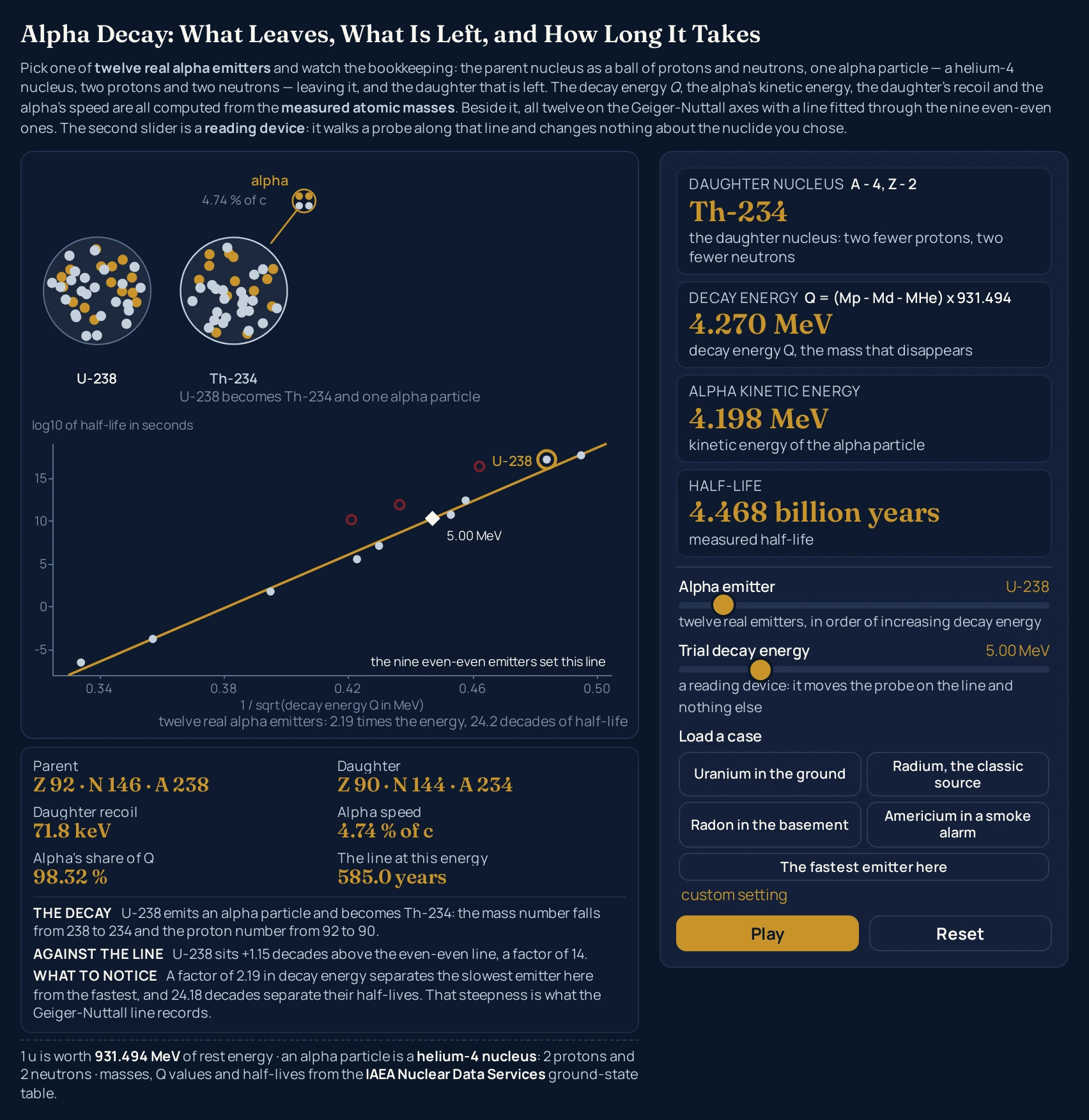
The alpha decay simulator is an interactive lab for the bookkeeping of alpha emission: choose one of twelve real emitters and it names the daughter, counts its protons and neutrons, and prints the decay energy Q, the alpha particle's kinetic energy, the daughter's recoil and the alpha's speed — every one of them from the measured atomic masses the lab carries. Beside the decay it plots all twelve on Geiger-Nuttall axes with a straight line fitted through the nine even-even ones, and a second slider walks a probe along that line. Every figure below was read off the running simulation.
Alpha Decay: What Leaves, What Is Left, and How Long It Takes
Pick one of twelve real alpha emitters and watch the bookkeeping: the parent nucleus as a ball of protons and neutrons, one alpha particle — a helium-4 nucleus, two protons and two neutrons — leaving it, and the daughter that is left. The decay energy Q, the alpha's kinetic energy, the daughter's recoil and the alpha's speed are all computed from the measured atomic masses. Beside it, all twelve on the Geiger-Nuttall axes with a line fitted through the nine even-even ones. The second slider is a reading device: it walks a probe along that line and changes nothing about the nuclide you chose.
ParentZ 92 · N 146 · A 238
DaughterZ 90 · N 144 · A 234
Daughter recoil71.8 keV
Alpha speed4.74 % of c
Alpha's share of Q
The line at this energy585.0 years
The decayU-238 emits an alpha particle and becomes Th-234: the mass number falls from 238 to 234 and the proton number from 92 to 90.
Against the lineU-238 sits +1.15 decades above the even-even line, a factor of 14.
What to noticeA factor of 2.19 in decay energy separates the slowest emitter here from the fastest, and 24.18 decades separate their half-lives. That steepness is what the Geiger-Nuttall line records.
1 u is worth 931.494 MeV of rest energy · an alpha particle is a helium-4 nucleus: 2 protons and 2 neutrons · masses, Q values and half-lives from the IAEA Nuclear Data Services ground-state table.
Daughter nucleus A - 4, Z - 2
Th-234
the daughter nucleus: two fewer protons, two fewer neutrons
Decay energy Q = (Mp - Md - MHe) x 931.494
4.270 MeV
decay energy Q, the mass that disappears
Alpha kinetic energy
4.198 MeV
kinetic energy of the alpha particle
Half-life
4.468 billion years
measured half-life
Alpha emitterU-238
twelve real emitters, in order of increasing decay energy
Trial decay energy5.00 MeV
a reading device: it moves the probe on the line and nothing else
Load a case
custom setting
Load a real alpha emitter
The first five buttons press the lab's own case buttons, which write both sliders at once and name the case on the line beneath them. The last three write the sliders directly, so that line stays at custom setting — which is exactly what the eighth one is for, since it reproduces the first button's setting without the name.
Pick a case above, or drag the two sliders yourself.

What Is the Alpha Decay Simulator?
The alpha decay simulator is a free interactive physics lab that runs in your browser — nothing to install and no sign-up. Pick one of twelve real alpha emitters, thorium-232 through to polonium-212, and it names the daughter, prints the decay energy Q and the alpha particle's kinetic energy to three decimals of a MeV, the daughter's recoil to 0.1 keV, the alpha's speed to two decimals of a percentage of light speed, and the measured half-life. A second slider, 4.00 to 9.00 MeV in 0.01 MeV steps, walks a probe along the Geiger-Nuttall line fitted to the plotted points; it is a reading device and changes nothing about the nuclide you chose.
| Control | Range | Step |
|---|---|---|
| Alpha emitter | 1 to 12, Th-232 up to Po-212 | 1 |
| Trial alpha energy | 4.00 to 9.00 MeV | 0.01 MeV |
| Load a case | five real emitters | button |
| Pause and Reset | the animation and the defaults | button |
How to use the alpha decay simulator
- Load a case, or start from Reset. The five buttons under Load a case — Uranium in the ground, Radium, the classic source, Radon in the basement, Americium in a smoke alarm and The fastest emitter here — write both sliders together and print a name such as “The americium in a smoke alarm” on the case line. Move either slider and that line reverts to “custom setting”. Reset returns to U-238 at a trial energy of 5.00 MeV.
- Choose the emitter. Alpha emitter steps through twelve real nuclides, 1 to 12 in order of increasing decay energy Q, from Th-232 at one end to Po-212 at the other. It redraws the nucleus, moves the gold ring on the plot, and rewrites every card and stat except The line at this energy, which belongs to the other slider.
- Read the four cards. Daughter nucleus names what is left, Decay energy gives Q to three decimals of a MeV, Alpha kinetic energy gives the part that leaves with the alpha to the same three decimals, and Half-life gives the measured lifetime in words. Nothing finer than the nearest keV is offered, because the measurements do not support it.
- Read the six stats underneath. Parent and Daughter print Z, N and A for both nuclei, Daughter recoil gives the keV the heavy fragment keeps, Alpha speed gives the percentage of light speed, and Alpha's share of Q gives the split as a percentage. The line at this energy belongs to the second slider, not to this one.
- Walk the trial energy along the line. Trial decay energy runs from 4.00 to 9.00 MeV in steps of 0.01, and moves the cream diamond on the plot together with The line at this energy. It changes nothing whatever about the nuclide, which is what two independent sliders are here to let you prove.
- Read the three sentence lines. The decay restates the current event in words, Against the line gives the selected emitter's distance from the fit in decades and as a factor, and What to notice changes as you cross the landmarks — an odd nucleon, the steep end of the plot, or a trial energy a full MeV away from the emitter's own. Pause rests the jiggle without moving a number, and the button then reads Play.
Worked example: change one thing at a time
Every row below follows on from the one above it and changes exactly one thing. Each cell is a string the running lab printed at those control positions, harvested in this order; where a cell and the lab ever disagree, the lab is right.
| What was changed | Trial energy | Daughter | Decay energy | Alpha energy | Daughter recoil | Measured half-life | The line at this energy |
|---|---|---|---|---|---|---|---|
| Start: the state Reset leaves | 5.00 MeV | Th-234 | 4.270 MeV | 4.198 MeV | 71.8 keV | 4.468 billion years | 585.0 years |
| Trial energy down to 4.27, uranium-238’s own decay energy | 4.27 MeV | Th-234 | 4.270 MeV | 4.198 MeV | 71.8 keV | 4.468 billion years | 314.4 million years |
| Press The fastest emitter here | 8.95 MeV | Pb-208 | 8.954 MeV | 8.785 MeV | 169.1 keV | 294.3 nanoseconds | 43.68 nanoseconds |
| Emitter slider to U-235, trial energy untouched | 8.95 MeV | Th-231 | 4.678 MeV | 4.598 MeV | 79.7 keV | 704 million years | 43.68 nanoseconds |
| Press Reset | 5.00 MeV | Th-234 | 4.270 MeV | 4.198 MeV | 71.8 keV | 4.468 billion years | 585.0 years |
Row 2 is the reason this lab has two sliders. Dragging the trial energy down to 4.27 MeV — uranium-238's own decay energy, to the two decimals the slider offers — leaves all five columns that belong to the emitter byte for byte where they were, and moves both of the columns it owns itself: Trial energy, from “5.00 MeV” to “4.27 MeV”, and The line at this energy, from “585.0 years” to “314.4 million years”. That is the fitted line's opinion of a 4.27 MeV alpha emitter. The nuclide standing at that energy actually lives 4.468 billion years, and Against the line has been printing the gap all along: “U-238 sits +1.15 decades above the even-even line, a factor of 14.”
Row 3 shows what a factor of two in energy is worth. The fastest emitter here writes both sliders, so the emitter becomes polonium-212 and the trial energy jumps to 8.95 MeV. Decay energy goes from 4.270 to 8.954 MeV, just over double, and the half-life from 4.468 billion years to 294.3 nanoseconds; the recoil more than doubles as well, 71.8 keV to 169.1 keV. What to notice widens the comparison to the two ends of the set, where 8.954 MeV against thorium-232's 4.082 MeV is worth 24.18 decades of half-life.
Row 4 is the same invariant read backwards. Sliding the emitter to U-235 with the trial energy left alone rewrites the daughter, Q, the alpha energy, the recoil and the half-life, while Trial energy and The line at this energy do not stir from 8.95 MeV and 43.68 nanoseconds. Uranium-235 releases 4.678 MeV, barely more than uranium-238's 4.270, yet it lives 704 million years; What to notice explains that as an odd neutron number and puts the cost at about 5200 times the line's figure. The half-lives behind all of this are measurements, and the guide to half-life covers what one actually means.
Formula and symbol reference
The lab does three sums and one fit. It subtracts the daughter and helium-4 atomic masses from the parent's and turns what is left into Q; it divides Q between the alpha and the daughter in inverse proportion to their masses; it turns the alpha's share into a speed. Then, once at load time, it least-squares a straight line through the nine even-even points on the chart and reads that line wherever the probe is standing.
| Symbol | Meaning | SI unit | In this lab |
|---|---|---|---|
| A | Mass number of the parent, the count of protons and neutrons in it. The daughter always carries four fewer | none (a count) | 210 for polonium-210 up to 241 for americium-241, printed on the Parent stat as “Z 92 · N 146 · A 238” and on Daughter as “Z 90 · N 144 · A 234”. |
| Z | Proton number of the parent, which fixes the element. Two fewer makes the daughter a different element | none (a count) | 84 for the three polonium parents to 95 for americium-241. The daughter’s Z is always exactly two less, which is the second half of the A - 4, Z - 2 line on the first card. |
| N | Neutron number of the parent. Two of these leave with the alpha as well | none (a count) | 126 to 146 across the twelve; the daughter’s N is two less in every case. Whether Z or N is odd is what decides the hindered branch of the What to notice line. |
| Mp | Atomic mass of the parent — the neutral atom, electrons included, which is the form nuclear data tables publish | kilogram, kg (tabulated in u) | 209.982873686 u for polonium-210 up to 241.056827343 u for americium-241. The lab carries all twelve and prints none of them: only what the subtraction leaves reaches a card. |
| Md | Atomic mass of the daughter, on the same neutral-atom convention. The two surplus electrons are what makes the convention work | kilogram, kg (tabulated in u) | 205.974465210 u for lead-206 up to 237.048171640 u for neptunium-237. Daughter nucleus names which one it is; the mass behind the name stays off the screen. |
| MHe | Atomic mass of a neutral helium-4 atom — the third term of the Q sum, and not the bare alpha particle | kilogram, kg (tabulated in u) | One fixed number, 4.002603254 u. The alpha particle is that atom less its two electrons, 4.001506094 u, and the 0.001097 u between them is worth 1.022 MeV — about a quarter of a typical Q here, so the two are not interchangeable. |
| Q | Decay energy: the rest energy of the mass that disappears, worked out from the measured atomic masses the lab carries | joule, J (shown in MeV) | “4.082 MeV” for thorium-232 to “8.954 MeV” for polonium-212, always three decimals. That is a factor of 2.19 across the whole set. |
| Talpha | Kinetic energy of the alpha particle, the part of Q that leaves with it and the figure an alpha detector sees | joule, J (shown in MeV) | “4.011 MeV” to “8.785 MeV”, three decimals, on the Alpha kinetic energy card. It is never equal to Q. |
| Trecoil | Kinetic energy the daughter nucleus keeps, because the two fragments leave back to back | joule, J (shown in keV) | “70.4 keV” for thorium-232 to “169.1 keV” for polonium-212, one decimal. It rises with Q and falls as the daughter gets heavier, and the second effect can beat the first: polonium-210 keeps “103.1 keV” out of 5.408 MeV, while americium-241 has the larger Q of the two and still keeps only “93.6 keV” out of 5.638 MeV, because its daughter is thirty-one mass units heavier. |
| v/c | Speed of the alpha as a fraction of the speed of light, worked out relativistically | none (a ratio, shown as a percentage) | “4.64 % of c” to “6.85 % of c”, two decimals. The flight line on the canvas is drawn in proportion to it, so the fastest alpha visibly outruns the slowest. |
| Talpha/Q | The share of the decay energy the alpha carries away, on the Alpha’s share of Q stat | none (a percentage) | “98.09 %” for polonium-210 to “98.34 %” for americium-241, two decimals. Close to 98 % everywhere here, but not a constant: it falls as the mass number falls. |
| t1/2 | The measured half-life carried with each emitter. Nothing in this lab computes it | second, s (shown in words) | “294.3 nanoseconds” to “14.0 billion years”, which is the 24.18 decades the What to notice line quotes. |
| Qtrial | The trial decay energy the second slider sets, and the only thing the probe diamond depends on | joule, J (shown in MeV) | 4.00 to 9.00 MeV in steps of 0.01, printed as “5.00 MeV” after Reset. The step is fine enough to stand on every emitter’s own Q rounded to two decimals. |
| m | Slope of the fitted Geiger-Nuttall line, least-squared at load time from the nine even-even emitters on the chart | per square root of MeV | 156.05121. It is fitted from the plotted table rather than stored, and it never changes as you drag either slider. |
| b | Intercept of the same fitted line, in decades of half-life | none (a logarithm) | -59.52193, with R2 = 0.99353 over those nine points. The line at this energy is this line evaluated at the trial energy, and reads from “101.1 billion years” at 4.00 MeV to “31.27 nanoseconds” at 9.00 MeV. |
A few of those rows deserve a second look. Q and Talpha are printed to three decimals of a MeV and the recoil to one decimal of a keV because the measured uncertainty on a Q value in this set falls between 0.06 and 2.12 keV, so a fourth decimal would be invention. The slope and intercept carry five decimals only because that is what the fit returns, and the line is worth nothing outside the twelve points it was drawn from. The three mass rows are the lab's own, and the alpha decay energy calculator is where you can edit them, or run the sum backwards to a mass you do not have.
The physics: why the alpha gets out at all
An alpha particle is a helium-4 nucleus: two protons and two neutrons, and the lab draws it as exactly that, four dots with a gold outline. Four nucleons in that particular arrangement are bound unusually hard, so a heavy nucleus that assembles and releases one ends up lighter by more than those four nucleons weigh loose. Decay energy is the rest energy of that missing mass, and the card carries the sum it came from on its own label.
The masses behind that sum are neutral-atom masses, not bare nuclear ones, which is why the helium-4 atomic mass appears rather than the alpha's. Two electrons are surplus to the daughter's requirements and two come with the neutral helium atom, so the electron count balances on both sides and never has to be written down. That is the convention nuclear data tables publish in, and it lets the lab recompute each of its twelve Q values from the stored masses and land within 0.0014 keV of the tabulated one.
Q is not, however, what the alpha gets. The two fragments leave back to back, so the lighter one takes the larger share of the energy and the daughter is left with a real recoil: Daughter recoil reads between “70.4 keV” and “169.1 keV” across the twelve. Alpha's share of Q puts that in proportion, from “98.09 %” up to “98.34 %” — close to 98 % everywhere in this set, but drifting with the mass number rather than fixed. Any account of alpha decay that hands the alpha all of Q is wrong by that much.
None of this says the decay will be quick, or will happen at all on any timescale you would notice. The daughter and the alpha repel each other electrically, and on the way out the alpha meets a barrier higher than the energy it has; it crosses only because quantum mechanics allows it to, and that crossing is exorbitantly sensitive to how much energy it brings. Nothing in this lab models the barrier, and no height, radius or escape probability is printed anywhere on the page. What the lab does instead is show you the consequence: the full guide to alpha decay sets out the mechanism in prose.
That consequence is the plot. Each emitter is placed at one over the square root of its decay energy, horizontally, against the base-ten logarithm of its half-life in seconds, vertically, and on those axes the twelve fall close to a straight line. The lab least-squares that line through the nine even-even emitters at load time and gets a slope of 156.05121, an intercept of -59.52193 and an R2 of 0.99353. Where the band is wide enough to carry it, the caption under the plot names the span the twelve cover: 2.19 times the energy end to end, and 24.2 decades of half-life.
The three hollow rings are the emitters with an odd proton or neutron number, and they sit clearly above the line: +3.26, +3.72 and +3.93 decades, against a spread of -0.96 to +1.15 for the nine that were fitted. The panel calls that hindrance, puts a factor on it — 1800 for plutonium-239, 5200 for uranium-235, 8600 for americium-241 — and blames the alpha having to carry angular momentum away. The separation is clean: the worst even-even point is out by a factor of 14, the best odd-nucleon point by 1800. Alpha is one of three radiations, and alpha, beta and gamma set side by side compares the other two.

Where alpha decay breaks down
The lab solves its own model exactly, so nothing on screen ever fails. Every limit below is a limit of that model, of the measurements behind it, or of the drawing, and each item says what the lab does about it.
- A positive decay energy is not a promise that anything happens
- Every one of the twelve emitters here has a positive Q and a measured half-life to go with it, which makes the two look like partners. They are not. Bismuth-209 is the counter-example: its Q is 3.137 MeV, alpha emission is its only channel, and its measured half-life is 2.01e19 years — billions of times the age of the Earth.
- No barrier height, nuclear radius or tunnelling probability was computed for this lab, and none is printed on this page or drawn on the canvas.
- The straight line is a fit to twelve points, not a law of nature
- Nine even-even emitters were least-squared to get it and three odd-nucleon ones were deliberately left out. The line at this energy therefore answers a question about those nine, and any nuclide you have in mind that is not on this chart is outside what the fit knows.
- The trial slider stops at 4.00 and 9.00 MeV on purpose: the fitted data runs from 4.0816 to 8.9542 MeV, so the line is never extrapolated by more than a whisker.
- Odd nucleons cost three to four decades and the fit cannot see it coming
- Uranium-235, plutonium-239 and americium-241 all live far longer than their alpha energies suggest, and the only warning is the parity of Z or N. Feed the fitted line an energy and it will answer as though every emitter were even-even, which is why the panel prints the residual for the selected nuclide beside it rather than leaving you to compare by eye.
- Alpha emission is almost never the only channel
- The data the lab was built from lists a spontaneous-fission branch of 0.0000545 per cent for uranium-238, 1.1e-9 per cent for thorium-232 and 3.6e-10 per cent for americium-241. The carbon-14 branch in the same file belongs to radium-226, emitter 5 on the slider, at 3.2e-9 per cent, and thorium-230 sheds a neon-24 nucleus in 5.8e-11 per cent of its decays. The lab shows the alpha channel and says nothing about the rest.
- One tidy flight, where a real source emits in every direction
- The canvas draws a single alpha leaving along one straight line, at one speed, into an empty page. A real source fires into the whole solid angle at once, and its alphas stop within a very short distance of wherever they started. No range, dose or activity figure appears anywhere here, because nothing in this build computed one.
- The nucleon dots are a drawing rule, not a census
- The parent is drawn with about one dot per six nucleons — 40 dots, 15 of them gold, for uranium-238's 92 protons and 146 neutrons — and the daughter gets exactly four fewer, two of each colour, so the picture carries
A - 4, Z - 2by itself. The real counts are on the Parent and Daughter stats. The dots never change number while the animation runs. - Both circles are on one radius scale, and that is the point
- Losing four nucleons out of two hundred and something barely changes a nuclear radius, so the daughter is drawn only just smaller than the parent. It would be easy to exaggerate the difference and quite wrong. The pair is rescaled to fill the band for each emitter, though, so compare the two circles with each other and not with the circles at another setting. If you want to watch a nucleus change its element without changing its mass number at all, that is the other charged radiation and the beta decay simulator.
- What the drawing leaves out when there is no room
- Every string on the canvas is measured before it is drawn, then shortened or dropped rather than overprinted, and what survives depends on the width of its own band rather than the width of your screen. The caption under the plot sheds its opening clause first, “twelve real alpha emitters: 2.19 times the energy, 24.2 decades of half-life” becoming “2.19 times the energy, 24.2 decades of half-life”, and in the narrowest bands it goes altogether, taking the in-plot label down to “the nine even-even emitters” with it. The caption under the nuclei follows last, “U-238 becomes Th-234 and one alpha particle” becoming “U-238 becomes Th-234”. Both tick ladders came through complete at every width measured.
- The word “alpha” beside the flight line is dropped whenever the line is too long for the label to sit clear of it, which is why the americium-241 and polonium-212 shots on this page do not carry it. The speed along the line is drawn either way.
- The panel rounds, so do not derive one reading from another
- Three decimals on the two energies, one on the recoil, two on the speed and the share. Divide the printed “4.198 MeV” by the printed “4.270 MeV” and you get 98.31 %, while Alpha's share of Q reads “98.32 %”, because the lab took that ratio before either operand was rounded. Every quantity has its own card for this reason.
Where alpha decay is actually used
- The smoke alarm on your ceiling
- Press Americium in a smoke alarm. An ionisation detector holds a tiny americium-241 source facing a small air gap; its alphas ionise the air, a current flows across the gap, and smoke drifting in disrupts that current. Alpha kinetic energy reads 5.544 MeV for this emitter, which is what the split gives when the daughter is left in its ground state, so the alphas a real source sends out carry that much at most. The 432.6 years on the Half-life card is why it outlasts the device.
- Radon indoors, and the daughters that matter more than it does
- Press Radon in the basement and then look at what the case produces: radon-222 lasts 3.8235 days and leaves polonium-218, itself an alpha emitter. A gas can be breathed in and breathed out again; its solid, short-lived descendants are the ones that stay. The 100.8 keV of recoil is part of that story, because a daughter born with that much energy leaves ionised and lands somewhere new.
- Heat and power where nothing can be refuelled
- The energy on the Alpha kinetic energy card is deposited within a very short distance of the source, which makes it heat. Radioisotope thermoelectric generators and small heater units run on exactly that, and they are chosen for half-life as much as for energy — a source that is gone in a month is no use to a mission that lasts decades. How much heat also depends on how much material there is, which this lab does not model.
- Identifying an emitter from its alpha energy
- Alpha energies are sharp and characteristic, which is what makes alpha spectroscopy work: measure the energy of the alphas coming off an unknown sample and compare. The figure to compare with is the one on the Alpha kinetic energy card, not Decay energy, and the gap between them is the recoil the daughter took.
- Dating rocks by what has accumulated
- Uranium and thorium decay chains run through several of the emitters on this slider, and their measured half-lives are what turn an isotope ratio into an age. Helium dating counts the alphas themselves, trapped in a mineral as helium gas. Both rest on the Half-life card being a measurement rather than something the lab worked out, and the half-life simulator runs a sample of nuclei down against its own clock.
- Deciding how much is left, and when
- Once the half-life is known, the remaining question is arithmetic rather than nuclear physics: how much of a source survives a given time, and how strongly it is still emitting. That is what the half-life calculator answers, and it takes the figure on this lab's Half-life card as its input.

Where to go next
The full account — what alpha decay is, why the alpha rather than four loose nucleons, how the energy splits, and seven worked problems — is in Alpha Decay Explained. For a pair of atomic masses the lab does not carry, the alpha decay energy calculator takes any parent and daughter you type and returns Q, the alpha's kinetic energy and the recoil, including the negative Q that says a decay is shut.
Next door, Radioactivity: Alpha, Beta and Gamma puts the three radiations side by side, the guide to beta decay takes the one that changes Z without touching A, and gamma rays covers what an excited daughter emits afterwards. Their labs are the beta decay simulator and the half-life simulator, the carbon dating simulator puts a half-life to work as a clock, and the rest are in the library of physics simulations.
Frequently asked questions
Does moving the trial decay energy slider change the nuclide?
No, and proving that is what the second slider is for. Sweep it across the whole 4.00 to 9.00 MeV range and Daughter nucleus, Decay energy, Alpha kinetic energy, Half-life, Parent, Daughter, Daughter recoil, Alpha speed and Alpha's share of Q stay exactly as they were. Only the trial figure, The line at this energy and the cream diamond on the plot move with it.
Why does the line read 314.4 million years when uranium-238 lives 4.468 billion?
Because the line is a fit through nine points, not a lookup table. Press Uranium in the ground and the probe stands on 4.27 MeV, which is uranium-238's own decay energy, and the fitted line reads 314.4 million years there. The Against the line sentence prints the discrepancy as it stands: +1.15 decades above the even-even line, a factor of 14.
Why does the Pause button read Play?
Because the button is named for what pressing it will do next. While the nucleons are jiggling it reads Pause; press it and the label becomes Play, aria-pressed turns false and the animation loop rests. Nothing this lab reports depends on time, so every readout and both nucleon counts come back byte for byte identical when you start it again.
What are the hollow rings on the plot?
They mark the three odd-nucleon emitters: uranium-235, plutonium-239 and americium-241. The nine filled dots are the even-even emitters the straight line was least-squared through. Each hollow ring sits well above that line, by +3.26 to +3.93 decades as the panel prints them, while the nine fitted points stay between -0.96 and +1.15 decades of it.
Why is the daughter circle almost the same size as the parent?
Because both circles are drawn to one radius scale, and shedding four nucleons out of 210 to 241 barely moves a nuclear radius. That is the honest picture, and it is the point: alpha decay chips a small corner off a large nucleus. The dot counts do the bookkeeping instead, 40 dots with 15 gold for uranium-238 against 36 with 13 for thorium-234.
Why does Daughter recoil read 71.8 keV when 4.270 minus 4.198 is 72.0?
Because the two cards are rounded for display and the recoil is worked out from the unrounded values. Decay energy and Alpha kinetic energy are shown to three decimals of a MeV, the recoil to 0.1 keV, and subtracting one printed card from another is not the sum the lab performed. Read the recoil card rather than deriving it.
What does custom setting mean under the case buttons?
It means no named case is loaded. Each case button writes both sliders at once and prints its own name on that line: Uranium in the ground, Radium, the classic source, Radon in the basement, The americium in a smoke alarm, or The fastest emitter here. Touch either slider afterwards, or press Reset, and the line falls back to custom setting.
Can the lab work out a half-life from a decay energy?
No. Half-life is a measured quantity here, carried with each of the twelve emitters and never computed. The line at this energy reports only what the fitted straight line says at the trial energy, and that line was least-squared through the nine even-even points drawn on the chart. Outside those twelve emitters it predicts nothing at all.
References & formula source
- IAEA Nuclear Data Services — the evaluated ground-state table of nuclides. Fetched 2026-09-14; every atomic mass, Q value, half-life, spin-parity and branching ratio this lab holds was cut from it, and nothing nuclear here is typed from memory.
- Krane — Introductory Nuclear Physics, the chapter on alpha decay: Q values from atomic masses, the recoil split, barrier penetration and the systematics the Geiger-Nuttall line summarises.
- Halliday, Resnick and Walker — Fundamentals of Physics, the nuclear physics chapter, for decay processes and disintegration energy.
- Young and Freedman — University Physics, the nuclear physics chapter, for nuclear stability and radioactivity.
- The straight line on the plot is a least-squares fit to the nine even-even emitters drawn on this chart and to nothing else; it is a summary of twelve measurements, not a prediction for any other nuclide. Verify against a current data table before use.
- Further reading: Alpha decay — Wikipedia