A circular orbit is gravity supplying exactly the centripetal force the circle needs — and when you write that balance down, the mass of the orbiting body cancels off both sides. What is left fixes one speed for every radius: v = sqrt(G M / r). This free orbital velocity calculator solves it for the speed, the central mass or the radius, printing the period, the gravitational field strength at that radius and the escape speed beside the answer — and because the speed falls as the radius grows, it is also the quickest way to see that a higher orbit is a slower one.
The radius is measured from the centre of the body, not from its surface. For an altitude h above a surface of radius R, enter r = R + h: the International Space Station orbits 400 km up, so its radius is 6371 + 400 = 6771 km. Typing the altitude alone is the commonest mistake on this formula and it returns a speed more than four times too large. The Earth radii entry on the unit menu is there for the conversion, and every preset below already carries the right radius.
Load a real orbit
Every button writes all three boxes in their default units, so whichever quantity the Solve for menu is pointing at, the other two already agree with it. The line underneath quotes back whatever the widget works out from that, so nothing in it is stored text.
Pick an orbit above, or type your own numbers.
What Is the Orbital Velocity Calculator?
The orbital velocity calculator is a free online tool for the one speed a circular orbit of a given size allows. Gravity has to supply exactly the force needed to bend a straight path into that circle, and that single condition fixes one speed for every radius around a given body. Give the tool any two of the orbital speed, the mass of the central body and the radius from that body centre, and it returns the third in whichever unit that box was set to.
The radius is measured from the centre of the body and never from its surface, which is the one thing worth settling before you type anything. An altitude h above a surface of radius R goes in as R + h, so a satellite 400 kilometres above the Earth is entered as 6771 kilometres rather than 400. There is deliberately no altitude box — a second input for the body own radius would be needed in all three solve directions — so the addition is yours to do, and the unit menu offers Earth radii to help.
Four readings sit beside the answer. The first is the orbital period, the time for one full circuit, printed in the unit the subject actually uses: minutes for a low orbit, hours for a high one and days beyond that.
The second reading is the gravitational field strength at that radius, which is also the centripetal acceleration the orbit needs; the two are equal because the balance that produced the speed says so. At the default state it is 8.694 metres per second squared, roughly nine tenths of the value at ground level, which is the whole answer to the idea that there is no gravity in space. An astronaut floats because the station is falling, not because gravity has run out.
The third reading reprints the speed in kilometres per second to four significant figures with its trailing zeros intact, which matters when the speed was typed in miles per hour and when the headline would otherwise drop a zero. The fourth gives the escape speed at the same radius, which is exactly the square root of two times larger, and links the page that derives it. Nothing else about escaping is computed here.
The counter-intuitive consequence is worth knowing before you meet it: a higher orbit is a slower orbit. Because the radius sits under a square root in a denominator, quadrupling it halves the speed exactly, so the space station at 6771 kilometres travels at 7.673 kilometres per second while the Moon at 384,400 kilometres manages 1.018. Climbing to the higher orbit still costs energy; the orbit you arrive on is simply slower.
Every answer stops at four significant figures, and that is a cap on the inputs rather than on the arithmetic. The gravitational constant is itself known to only about five figures and the masses to four or five, so their product cannot support more: 7.673 kilometres per second is honest where 7672.6 metres per second would claim a precision the inputs cannot carry. The two inverse directions are coarser still, because the mass and the radius both go as the square of the speed, so their fourth figure is the first place the rounding shows.
Six entries are declined in words instead of being answered: a zero or negative central mass, a zero or negative radius, and a zero or negative speed in the two inverse directions. Each describes something that is not a circular orbit, and an entry large enough to parse as infinity is refused as well, which has to be tested for explicitly because an infinity passes a sign test. What the tool will happily answer is a radius smaller than the body itself, because there is no radius-of-the-body input for it to be compared against.
What the tool does not do, it says. There is no altitude, no elliptical orbit, no perihelion or aphelion speed, no orbital energy and no force in newtons anywhere on the page: a circle is the whole of the model, and on an ellipse the speed changes continuously so no single number describes it. The mass of the orbiting body has no box at all, because it cancels out of the balance — a loose bolt and a space station on the same circle travel at exactly the same speed.
| Symbol | Quantity | Default unit | Also accepts | Example value |
|---|---|---|---|---|
| v | Orbital speed | km/s | m/s, km/h, mph | 7.673 |
| M | Central mass | kg | Earth masses, solar masses | 5.9722e24 |
| r | Orbital radius, from the centre | km | m, Earth radii, au | 6771 |
How to use the orbital velocity calculator
- Choose the unknown. The Solve for menu opens on Orbital speed, and the other two choices are Central mass and Orbital radius, from the centre. Any two of the three fix the third.
- Type the central mass. It takes kg, Earth masses or solar masses and opens on 5.9722e+24 kg. It is the mass of the body being orbited, never the mass of the thing orbiting it.
- Type the radius from the centre. It takes km, m, Earth radii or au and opens on 6771 km. Add the body’s own radius to the altitude: 6371 + 400 for the ISS.
- Type the speed. It takes km/s, m/s, km/h or mph and opens on 7.673 km/s. It is an input only when you are solving for the mass or the radius.
- Read the answer. The headline carries four significant figures in whichever unit that box was showing. Set the unit while the quantity is still an input, then point Solve for back at it.
- Read the period chip. It is
T = 2 pi r / v, printed in the unit the subject uses:92.41 minat the defaults,23.93 hat geostationary radius,27.45 dat the distance of the Moon. - Read the gravity chip. It is
a = v2/r = G M/r2, the gravitational field strength at that radius and the centripetal acceleration the orbit needs at once. At the defaults it reads8.694 m/s2. - Read the speed chip. It reprints the speed in
km/sto four figures with the trailing zeros kept, which the headline cannot do: a surface-skimming orbit is7.910 km/sand the headline can only render that as7.91. - Read the escape-speed chip. One comparison, once: the escape speed at the same radius is
sqrt(2)times the orbital speed. The chip links the page that owns it. - Open Show working. The steps cancel the orbiting mass, list your figures in SI, rearrange, substitute one stage at a time, give the period and the field strength, and finish with what four times your radius would do to your speed.
This page exists for one step: turning a mass and a radius into the single speed that radius allows. The orbital velocity guide is the prose half of it, with the derivation set out line by line, eight worked problems and the misconceptions in full. Where the G M m / r2 on the left of the balance comes from is a different question and a different page: the law of gravitation guide is the inverse-square law this formula starts from, and nothing here derives it.
Three mistakes account for most wrong answers here. Typing an altitude into the radius box — 400 instead of 6771 — returns 31.57 km/s, more than four times the real answer, because the formula will happily work out a speed for a radius inside the planet. Entering the mass of the satellite rather than the mass of the Earth is the next, when the satellite mass cancels and has no box at all. Last comes expecting the inverse directions to hand back exactly the numbers you started from, which a four-figure speed cannot do.
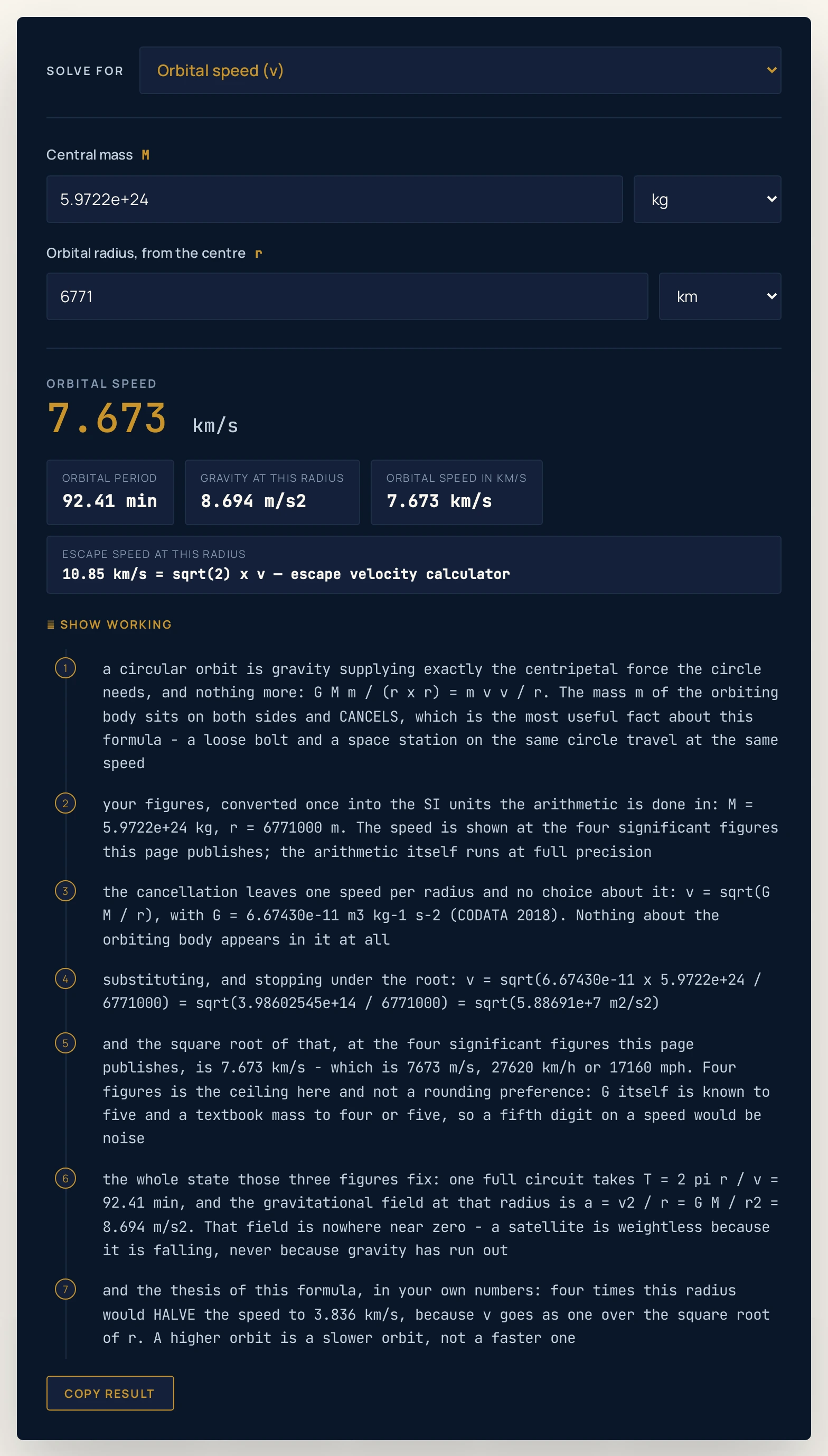
7.673 km/s and a lap time of 92.41 min. The chip to watch is the second one: there is still 8.694 m/s2 of gravity at that radius.Worked example: change one thing at a time
The table starts at the defaults, moves the unknown through all three quantities, then raises the orbit one step at a time from the surface out to the Moon, changes only the body, walks all three unit menus, and finally reaches the entries the calculator declines. Rows 1 to 3 are one orbit solved three ways. Every answer and chip cell was read out of the running widget rather than worked out by hand, so where a cell and the tool ever part company, believe the tool.
| Case | Solving for | What you type | Headline answer | Orbital period | Gravity at this radius |
|---|---|---|---|---|---|
| The page as it opens: the ISS at 400 km | Orbital speed | M 5.9722e24 kg, r 6771 km | 7.673 km/s | 92.41 min | 8.694 m/s2 |
| The same orbit solved for the central mass | Central mass | v 7.673 km/s, r 6771 km | 5.973e+24 kg | 92.41 min | 8.695 m/s2 |
| The same orbit solved for the radius | Orbital radius | v 7.673 km/s, M 5.9722e24 kg | 6770 km | 92.40 min | 8.696 m/s2 |
| A surface-skimming orbit (hypothetical) | Orbital speed | r 6371 km instead of 6771 km | 7.91 km/s | 84.35 min | 9.820 m/s2 |
| Two hundred kilometres up | Orbital speed | r 6571 km | 7.789 km/s | 88.35 min | 9.232 m/s2 |
| Hubble-class, 535 km up | Orbital speed | r 6906 km | 7.597 km/s | 95.19 min | 8.358 m/s2 |
| Four times the ISS radius | Orbital speed | r 27084 km | 3.836 km/s | 12.32 h | 0.5434 m/s2 |
| Navigation orbit, a nominal 20,180 km up | Orbital speed | r 26551 km | 3.875 km/s | 11.96 h | 0.5654 m/s2 |
| The geostationary circle | Orbital speed | r 42164.17 km | 3.075 km/s | 23.93 h | 0.2242 m/s2 |
| The distance of the Moon | Orbital speed | r 384400 km | 1.018 km/s | 27.45 d | 0.002698 m/s2 |
| Low Mars orbit, 400 km up | Orbital speed | M 6.417e23 kg, r 3789.5 km | 3.362 km/s | 118.0 min | 2.982 m/s2 |
| A hundred kilometres above the Moon | Orbital speed | M 7.346e22 kg, r 1837.4 km | 1.634 km/s | 117.8 min | 1.452 m/s2 |
| A thousand kilometres above the 1-bar level of Jupiter | Orbital speed | M 1.89813e27 kg, r 70911 km | 42.27 km/s | 2.928 h | 25.19 m/s2 |
| The Earth about the Sun | Orbital speed | M 1.98847e30 kg, r 149597900 km | 29.79 km/s | 365.3 d | 0.005930 m/s2 |
| The same mass typed in Earth masses | Orbital speed | M 1 Earth masses, r 6771 km | 7.673 km/s | 92.41 min | 8.694 m/s2 |
| The same radius typed in metres | Orbital speed | r 6771000 m | 7.673 km/s | 92.41 min | 8.694 m/s2 |
| A radius of exactly one Earth radius | Orbital speed | r 1 Earth radii | 7.91 km/s | 84.35 min | 9.820 m/s2 |
| The same star and orbit in solar masses and au | Orbital speed | M 1 solar masses, r 1 au | 29.79 km/s | 365.3 d | 0.005930 m/s2 |
| The answer asked for in metres per second | Orbital speed | the speed box set to m/s while it was an input | 7673 m/s | 92.41 min | 8.694 m/s2 |
| The answer asked for in miles per hour | Orbital speed | the speed box set to mph while it was an input | 17160 mph | 92.41 min | 8.694 m/s2 |
| Weighing the Earth from the Moon | Central mass | v 1.018 km/s, r 384400 km | 5.969e+24 kg | 27.46 d | 0.002696 m/s2 |
| Identifying an orbit from a tracked speed | Orbital radius | v 3.875 km/s, M 5.9722e24 kg | 26550 km | 11.96 h | 0.5656 m/s2 |
| A zero central mass is declined | Orbital speed | M 0 | no answer | - | - |
| A negative central mass is declined | Orbital speed | M -5.9722e24 kg | no answer | - | - |
| A zero radius is declined | Orbital speed | r 0 | no answer | - | - |
| A negative radius is declined | Orbital speed | r -6771 km | no answer | - | - |
| A zero speed is declined in the mass direction | Central mass | v 0 with r 6771 km | no answer | - | - |
| A negative speed is declined in the radius direction | Orbital radius | v -7.673 km/s | no answer | - | - |
| An entry that parses to infinity is declined | Orbital speed | M 1e400 | no answer | - | - |
Rows 1 to 3 are one orbit with the Solve for menu in each of its three positions, and they deliberately do not agree in every digit. The forward direction turns 5.9722e24 kg at 6771 km into 7.673 km/s; feeding that four-figure speed back returns 5.973e+24 kg and 6770 km, because both inverse directions go as the square of the speed and 7.673 carries about 5 parts in 100,000 of rounding. The forward direction is the one to trust when you have a mass, and the working says so rather than hiding a fifth digit in a default to make the table tidy.
Rows 4 to 7 are the thesis of the whole page as one falling column. A surface-skimming orbit would need 7.910 km/s, 200 km up needs 7.789 km/s, a Hubble-class orbit needs 7.597 km/s, and four times the ISS radius needs only 3.836 km/s. The halving is exact in the arithmetic even though the two rounded strings are not exactly two to one, which is why the working prints the halved figure for whatever radius you typed rather than inviting you to divide the printed one.
Row 4 is a limit rather than a place. It is also the one row where the headline and the speed chip differ: the chip reads 7.910 km/s and the headline can only render those four figures as 7.91, because the engine drops a trailing zero. A real object at a radius of 6371 km would be inside the atmosphere, and the formula has no way of knowing that.
Rows 8 to 10 climb out of low orbit, and the period unit climbs with them: 11.96 h, 23.93 h, then 27.45 d. The switch from minutes to hours happens at two hours rather than one, because every source quotes a low orbit in minutes and a high one in hours. The speeds fall the whole way, from 3.875 km/s to 1.018 km/s.
Rows 11 to 13 change only the body. Four hundred kilometres above Mars is 3.362 km/s where the same altitude above Earth is 7.673 km/s; a hundred kilometres above the Moon is 1.634 km/s; and a thousand kilometres above the 1-bar level of Jupiter — which has no surface, so that is the level meant — is 42.27 km/s. Rows 11 and 12 have periods within a quarter of a minute of one another, 118.0 min against 117.8 min, from two bodies that share nothing: a coincidence, and a reminder that the period depends on the body only through G M and r.
Rows 15 to 18 change nothing but the units, and every one returns the same strings. One Earth mass is the 5.9722e24 kg in the box, 6771000 m is the 6771 km, and one solar mass at one astronomical unit reproduces row 14 exactly. Row 17 is the neatest of them: a radius of exactly one Earth radius is the surface-skimming orbit of row 4.
Rows 19 and 20 are one answer in different clothes. The same orbit reads 7673 m/s and 17160 mph, and the headline shows whichever unit the speed box was set to before it became the unknown. Choose the unit while the quantity is still an input, then point Solve for back at it.
Rows 21 and 22 are the two inverse directions doing real work. The distance and speed of the Moon weigh the Earth at 5.969e+24 kg, which is its mass to three significant figures from two quantities an astronomer can measure; and a tracked speed of 3.875 km/s places a satellite 26550 km from the centre with a period of 11.96 h. Neither recovers the fourth figure, for the reason rows 1 to 3 showed.
Rows 23 to 29 sit outside the domain and are declined there rather than answered. A zero or negative mass is not a body, a zero radius is a division by zero, a negative radius is not a distance, and a zero or negative speed has no circular orbit behind it. The last of them is anything that parses to infinity, which has to be tested for explicitly: Infinity > 0 is true, so a sign test on its own would publish it.
The no answer rows are what the widget actually does with those entries: the result area prints That combination has no valid solution. Check your inputs.
No chips are drawn beside that message, which is why the last two columns of those rows are hyphens rather than figures. It is a refusal rather than a crash, and nothing on this page ever returns a NaN or an infinity.
One thing the table cannot show is the entry the page does not refuse. A radius smaller than the central body still returns a speed, because there is no radius-of-the-body input for it to be compared against. The formula does not know where any surface is, and recognising that is the reader’s job.
Formula and symbol reference
One rearrangement does all the work. Gravity pulls with G M m / r2 and a circle of radius r travelled at speed v demands m v2 / r; setting them equal cancels the orbiting mass m and leaves v = sqrt(G M / r). The other two positions of the Solve for menu are that same line rearranged: M = v2 r / G and r = G M / v2.
Two quantities follow from the answer rather than needing their own formula. The period is the circumference divided by the speed, T = 2 pi r / v — substitute the speed into it and you get T2 = 4 pi2 r3 / (G M), which is Kepler’s third law for a circle, and the Kepler’s third law calculator is where the general form with a semi-major axis belongs. The field strength is a = v2/r = G M/r2, which is the gravitational acceleration at that radius and the centripetal acceleration the orbit needs, equal because the balance says so; the centripetal force calculator is the force side of that same balance for any circular motion.
One comparison with the neighbour, and then nothing more about it. At the same radius the escape speed is exactly sqrt(2) times the orbital speed, so the 7.673 km/s of the default state sits beneath an escape speed of 10.85 km/s — the escape velocity guide and the escape velocity calculator are where that quantity is derived and worked, and this page does neither.
| Symbol | Meaning | SI unit | Values used on this page |
|---|---|---|---|
| v | The orbital speed — how fast a circular orbit of radius r has to be. It is tangential, at right angles to the pull that holds the orbit, and it is constant all the way round a circle | metre per second | Boxes take km/s, m/s, km/h or mph: 7.673 km/s is the default, which is 7673 m/s, 27620 km/h and 17160 mph. |
| M | The mass of the CENTRAL body — the planet, moon or star being orbited. The only property of it the orbit can feel is the product G M | kilogram | Boxes take kg, Earth masses or solar masses: 5.9722e+24 kg is the default, which is exactly 1 Earth mass. |
| r | The orbital radius, measured from the CENTRE of the central body. For an altitude h above a surface of radius R it is r = R + h, and getting that wrong is the commonest error on this formula | metre | Boxes take km, m, Earth radii or au: 6771 km is the default, which is 6771000 m and 1.063 Earth radii. |
| m | The mass of the ORBITING body, which cancels out of the force balance and is therefore not an input at all | kilogram | No box, because it cancels: 1 kg and 1,000,000 kg give the same speed on the same circle. |
| G | The gravitational constant, a fixed number rather than an input, and the thing that caps every answer here at four significant figures | metre cubed per kilogram per second squared | Fixed at 6.67430e-11 (CODATA 2018), which carries about 2.2 parts in 100,000 of relative uncertainty. |
| T | The orbital period, the time for one full circuit. A chip rather than a box, because T = 2 pi r / v follows from the answer | second | A chip: 92.41 min at the defaults, 23.93 h at geostationary radius, 27.45 d at the distance of the Moon. |
| a | The centripetal acceleration, which at this radius is also the gravitational field strength: a = v2/r = G M/r2. A chip, from the same balance | metre per second squared | A chip: 8.694 m/s2 at the defaults, 9.820 m/s2 for a surface-skimming orbit, 0.2242 m/s2 at geostationary radius. |
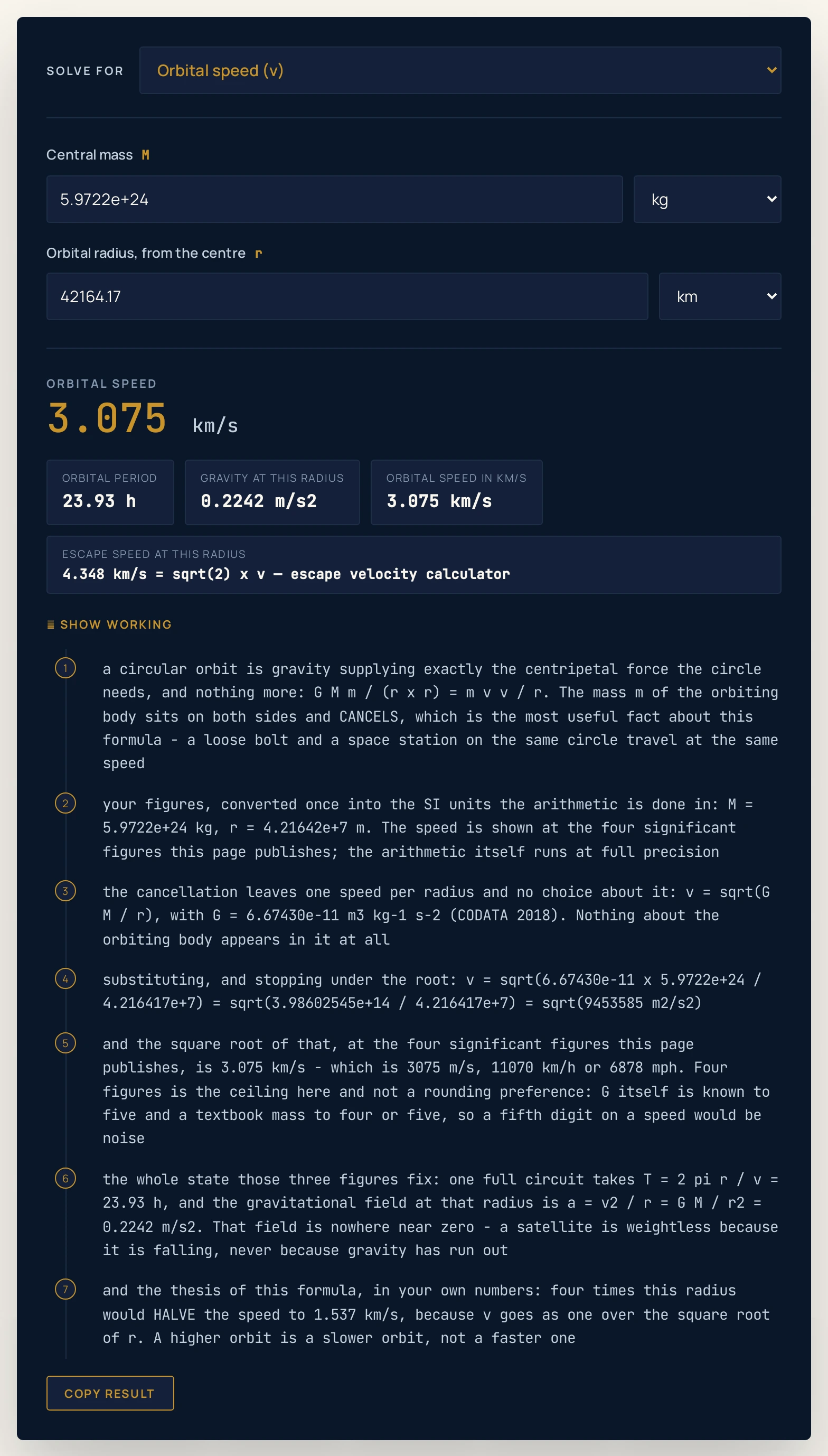
7.673 km/s to 3.075 km/s and the period has grown from 92.41 min to 23.93 h — the thesis of the whole page in two readings. The gravity chip has dropped to 0.2242 m/s2, against the 9.820 m/s2 of a surface-skimming orbit.The physics: why gravity sets one speed per radius
A circular orbit is not a balance between gravity and some outward force; there is no outward force. It is gravity being exactly the right size to bend a straight line into a circle of that radius at that speed, and nothing else. Write the two expressions down and set them equal, and the whole of this page falls out.
Gravity pulls the orbiting body inwards with G M m / r2, from the inverse-square law that the law of gravitation guide sets out. Travelling a circle of radius r at speed v requires a centre-pointing force of m v2 / r, which is what the circular motion guide derives. Setting G M m / r2 = m v2 / r and dividing both sides by m leaves G M / r2 = v2 / r, and one more step gives v = sqrt(G M / r).
That cancellation is the most important line on the page. The m that disappeared is the mass of the satellite, so the formula that remains cannot possibly depend on it: a loose bolt and a space station on the same circle travel at exactly the same speed. It is also why the calculator has no box for the orbiting mass, and why the answer is a property of the orbit rather than of the thing in it.
The second thing the formula says is the one most people have backwards. Because r sits under a square root in a denominator, the speed falls as the orbit rises: four times the radius is exactly half the speed, which the working prints for whatever radius you typed. Press The ISS, 400 km up and then The Moon, 384,400 km out and the headline drops from 7.673 km/s to 1.018 km/s while the period stretches from 92.41 min to 27.45 d. Getting to the higher orbit still costs more energy, because the climb has to be paid for; the orbit you arrive on is simply slower.
The third thing is hiding in the gravity chip. Rearranging the same balance gives a = v2/r = G M/r2, so the number the chip prints is both the acceleration the circle needs and the gravitational field strength at that radius — they are equal by construction. At the default state that is 8.694 m/s2, and an astronaut floats in it because the whole station is falling with them.
Where the orbital velocity calculator breaks down
The arithmetic here is exact to the last digit a double can hold. What goes wrong is physical: a circle the formula assumes and a real orbit only approximates, a single central body that stops being the only thing that matters a long way out, and an atmosphere the formula has never heard of.
- Circles only, and a real orbit is an ellipse
- Every answer here assumes a circular orbit, where the speed is constant and gravity is always at right angles to the motion. A real orbit is an ellipse: the body moves fastest at its closest approach and slowest at its furthest point, and no single speed describes it. The guide to Kepler’s laws is where that case belongs. For a nearly circular orbit this formula at the mean radius is a good approximation and not an exact answer, which is why the Moon row comes out at 1.018 km/s against a measured mean of about 1.022.
- Nothing you can type tells the page there is an atmosphere
- The surface-skimming row of the table is a textbook limit, not a place to put a satellite: 7.910 km/s at a radius of 6371 km is the right answer to the question the formula was asked, and a real object there would burn. Below roughly 150 to 200 km a circular orbit decays in days to weeks. Those altitudes are order-of-magnitude statements rather than measured thresholds — treat them as “about” — and there is no box for atmospheric drag.
- One central body, which stops being true a long way out
- The formula knows about exactly one mass. Far enough from the central body, other bodies matter more than it does, and the number the page returns stops describing anything: Earth keeps gravitational control out to roughly 1.5 million km, but the Moon only to roughly 60,000 km, so a “lunar orbit” at 400,000 km is not an orbit at all. Both of those figures are order-of-magnitude statements this build did not fetch from a primary source. Verify before use.
- Four significant figures, and the fifth is not available
- The gravitational constant is known to about five significant figures and the masses on this page to four or five, so their product cannot support more than four. That is why every speed here stops at four figures: 7.673 km/s is honest and 7672.6 m/s claims a precision the inputs cannot carry. It is a cap on the inputs rather than on the arithmetic, which is exact.
- The inverse directions square the speed, so they lose the fourth figure
- Solve for the mass or the radius and the rounding in the speed is amplified: four significant figures carry between 5 parts in 100,000 and 5 parts in 10,000 depending on the leading digit, and both the mass and the radius go as the square of that. Type 5.9722e24 kg at 6771 km and the speed comes back
7.673 km/s; type that speed back and the mass reads5.973e+24 kgand the radius6770 km. Nothing is wrong: both figures are right to the precision a four-figure speed carries. - A radius inside the body is answered, not refused
- The only radius the page declines is zero or negative. Type a radius smaller than the body and it will still return a speed, because the formula has no idea where the surface is — there is no radius-of-the-body input, so there is nothing for it to compare against. An orbit below a surface is not physical, and recognising that is the reader’s job rather than the widget’s.
- The radius is from the centre, and nothing on the page can check that you did it
- There is no altitude box, deliberately: a second input for the body’s own radius would be needed in all three solve directions. So
r = R + his an addition you do before you type. The label, the note under the widget, the Earth radii unit and the presets all push you towards it, but a radius of 400 km is a perfectly valid entry and the page answers it with31.57 km/s, which is 4.11 times the real figure. - No orbital energy, no transfer, no burn
- This page answers what speed a given circle needs. It does not say how to get there, what it costs, or what happens between two orbits, and the energy of an orbit is not computed anywhere here. A satellite that fires its engine does not simply speed up in place; it changes orbit, and the new circle is slower if it is higher. That is a different calculation on a different page.
- Six entries are declined in words rather than answered
- A zero or negative central mass and a zero or negative radius in the speed direction; a zero or negative speed in the mass and radius directions. Each would produce an infinity, a negative length or a speed for something that is not a body, so the page says so instead. An entry large enough to parse as infinity is refused as well, which makes seven refusals in the table rather than six.
- The calculator measures nothing — you supply the numbers
- Two quantities go in, one balance is rearranged, and the answer describes the circular orbit you described. The preset names are shorthand for the two or three figures behind them and are not claims about any particular spacecraft, mission or constellation.
Where the orbital velocity calculator is actually used
- Sizing a low Earth orbit before anything else is decided
- Almost every question about a satellite starts with how fast it has to go and how long a lap takes. Two hundred kilometres up is
7.789 km/sand88.35 min; four hundred, where the space station flies, is7.673 km/sand92.41 min; a Hubble-class orbit, about 535 km up, is7.597 km/sand95.19 min. The speeds barely move across that band while the lap times do, which is why a low orbit is quoted by its period. - Checking a quoted altitude against a quoted period
- The two are not independent, so one checks the other. Press The geostationary circle and the period comes back
23.93 h, which is one sidereal day — the geostationary orbit guide is the page that explains why that is the number a television dish needs rather than 24 hours. If a figure you have been given for an altitude and a figure for a period disagree here, one of them is wrong. - Weighing a planet from the outside
- Point Solve for at the central mass and the question inverts into the measurement that actually gets made. Nobody weighs the Earth; they watch the Moon go round it. A radius of 384,400 km and a speed of 1.018 km/s return
5.969e+24 kg, which is the mass of the Earth to three significant figures from two numbers an astronomer can measure and the constantG. - Identifying an orbit from a measured speed
- Point Solve for at the radius and a tracked speed becomes an altitude. A satellite measured at 3.875 km/s about the Earth is at
26550 kmfrom the centre, which is a little over 20,000 km up: navigation-constellation territory, where the period of11.96 his close to half a sidereal day so the pattern of satellites repeats about twice a day. The nominal figures are close to exact and this page does not claim they are exact. - Taking the same question to another body
- Only the central mass changes. Four hundred kilometres above Mars is
3.362 km/s, where four hundred above Earth is7.673 km/s, because Mars has about a tenth of the mass and a smaller radius to add. A hundred kilometres above the Moon gives1.634 km/sand a period of117.8 min— within a quarter of a minute of the Martian orbit above, from two wildly different bodies, which is a coincidence worth noticing and not a result. - Settling the “no gravity in space” argument with a number
- The gravity chip is the fastest answer to it. At the radius of the space station the field is
8.694 m/s2, about nine tenths of the value at the ground, and at geostationary radius it is still0.2242 m/s2rather than zero. Weightlessness is free fall, not the absence of gravity, and the chip puts a figure on it at whatever radius you are looking at. - Sizing the next quantity on a neighbouring tool
- This page stops at the speed a circle needs. The escape velocity calculator is the speed that leaves instead of circling, and the physics lab library has the interactive versions of all of this. The two calculators listed at the foot of the page take the same orbit on to its period and to the pull in newtons.
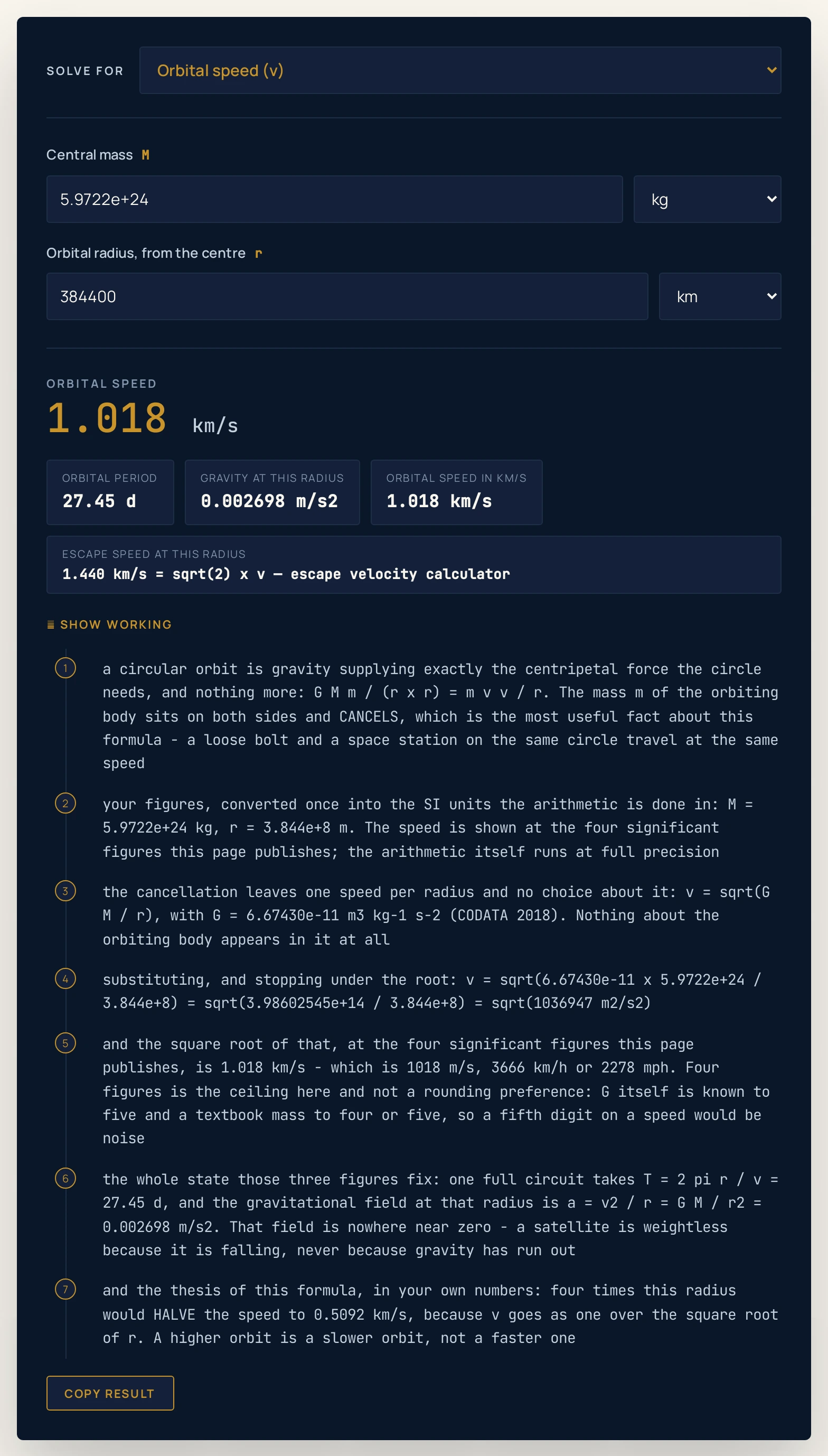
1.018 km/s and one lap now takes 27.45 d, while the field strength has dropped to 0.002698 m/s2 — the 9.820 m/s2 of a surface-skimming orbit divided by about sixty squared, which is the inverse square doing what it says.Where to go next
For the derivation line by line, eight worked problems of rising difficulty and the misconceptions in full, read the orbital velocity guide, which this tool is the arithmetic half of. The law of gravitation guide is the inverse-square law the derivation starts from, the circular motion guide is the other half of the balance, and the escape velocity guide is the speed that leaves rather than circles.
Six more posts pick up what this page deliberately leaves out. The guide to Kepler’s laws is the elliptical case, the geostationary orbit guide is the one radius whose period is a sidereal day, the centripetal force guide is the force this balance sets equal to gravity, and the gravitational potential energy guide is what it costs to climb to a higher orbit in the first place. The free fall guide is what an orbiting astronaut is actually doing, and the weight and mass guide is why the gravity chip is not zero.
Four tools sit next to this one. The escape velocity calculator is the speed that escapes; the Kepler’s third law calculator relates a period to a semi-major axis; the centripetal force calculator and the circular motion calculator handle the circle itself once you already have a speed.
The escape velocity simulator draws the two speeds side by side, the geostationary orbit simulator is the one radius that stays over a point on the ground, the Kepler’s laws simulator shows an ellipse changing speed as it goes round, and the universal gravitation simulator is the inverse-square law on its own.
The full physics lab library and calculator index are open too.
Frequently asked questions
Do I enter the orbital radius or the altitude?
The radius, measured from the centre of the body. For an altitude h above a surface of radius R the radius is r = R + h, so the International Space Station at 400 km up goes in as 6371 + 400 = 6771 km. There is deliberately no altitude box: the label says "from the centre", the Earth radii entry on the unit menu is there for the conversion, and every preset already carries the right radius.
Does the satellite mass matter?
No, and that is the most satisfying thing about this formula. Gravity pulls on the satellite with G M m / r2 and the circle demands m v v / r, so the satellite mass m appears on both sides of the balance and cancels exactly. That is why the calculator has no box for the orbiting mass at all.
Why is a higher orbit slower rather than faster?
Because the speed goes as one over the square root of the radius. Move further out and gravity is weaker, so the circle needs less speed to balance it: quadruple the radius and the speed halves exactly. The space station at 6771 km does 7.673 km/s, a geostationary satellite at 42164.17 km does 3.075 km/s, and the Moon at 384400 km manages only 1.018 km/s. Climbing there still costs energy; the orbit you arrive on is simply slower.
Is orbital velocity the same as escape velocity?
No: at the same radius the escape speed is exactly the square root of two times the circular orbital speed, about 41 per cent larger, which the fourth chip prints beside every answer; nothing here derives it, and the escape velocity calculator is the page that owns the quantity.
What is GM, and is a mass in kilograms good enough?
G M is the only thing about the central body that the orbit can feel, and it is called the standard gravitational parameter. Published values of it are known to about nine significant figures, because they are measured by tracking spacecraft rather than by weighing anything. This page multiplies the fixed G by the M you type, and the product is good to about four significant figures because G itself is known to only five.
Why does solving backwards return a mass whose last digit is different?
Because the inverse directions square the speed. Four significant figures carry between 5 parts in 100,000 and 5 parts in 10,000, and the mass goes as the square of that, so the fourth figure is the first place the rounding shows. Enter 5.9722e24 kg at 6771 km, get 7.673 km/s; enter that speed back and the mass reads 5.973e+24 kg and the radius 6770 km. Both are right to the precision the inputs carry.
Does this work for an elliptical orbit?
No. Everything here assumes a circle. On an ellipse the speed changes continuously - fastest at the closest approach, slowest at the furthest point - so no single number describes it, and the guide to Kepler’s laws is where that case belongs. Most real orbits are very slightly elliptical, and for a nearly circular one this formula at the mean radius is a good approximation rather than an exact answer.
References & formula source
- The relation this page solves is the force balance for a circular orbit: gravity supplies exactly the centripetal force the circle requires, G M m / r squared = m v squared / r, and the mass m of the orbiting body cancels. Rearranged that is v = sqrt(G M / r), with the radius r measured from the centre of the central body. It is derived on this page rather than quoted, and it assumes a circle and a single dominant central body.
- The orbital period printed beside the answer is T = 2 pi r / v, the circumference divided by the speed, and that is how this page computes it. The Kepler’s third law calculator is where the general form, with a semi-major axis rather than a radius, belongs.
- The gravitational field strength printed beside the answer is a = v squared / r = G M / r squared, which is both the local gravitational acceleration at that radius and the centripetal acceleration the orbit needs. The two are equal because the balance that produced the speed says so. At the default state it is 8.694 metres per second squared, which is why an orbiting astronaut is in free fall rather than out of reach of gravity.
- The escape speed quoted in the fourth chip is sqrt(2) times the orbital speed at the same radius, stated here as a comparison and not derived: the escape velocity calculator and its own guide own that quantity. The factor follows from comparing the two expressions and is exact, which an independent reference script checks to one part in a hundred thousand billion for every case this page publishes.
- The gravitational constant is 6.67430e-11 metres cubed per kilogram per second squared, CODATA 2018. It carries about 2.2 parts in 100,000 of relative uncertainty, which is the single thing that caps every answer on this page at four significant figures.
- The masses and radii quoted in the prose, the presets and the worked table - the Earth at 5.9722e24 kg and 6371 km, Mars at 6.417e23 kg, the Moon orbit at 384400 km, the Sun at 1.98847e30 kg and the astronomical unit at 1.495979e11 m - are standard textbook values. VERIFY BEFORE USE: this build did not fetch any of them from a primary source, and no agency is cited as their source anywhere on this page. What was checked is that they are mutually consistent: multiplying each by G reproduces the independently published standard gravitational parameter for that body to better than four parts in ten thousand, worst case the Moon.
- Halliday, Resnick and Walker, Fundamentals of Physics, chapter 13 (Gravitation); Young and Freedman, University Physics, chapter 13; Taylor, Classical Mechanics, chapter 8. Cited as background reading for the circular-orbit derivation and the inverse-square law behind it. Verify before use: these are textbook references rather than links, and no page or edition number is claimed.
- This page computes no altitude, no escape velocity derivation, no elliptical orbit, no perihelion or aphelion speed, no orbital energy and no force in newtons, and none of those is an oversight. Every figure quoted in the prose and the tables above is a string this calculator printed for the inputs named beside it, or a ratio checked against an independent reference written before this page existed and sharing no code with it. Where a cell and the running widget ever part company, believe the widget.
- Further reading: Orbital speed — Wikipedia