Classical Mechanics

Orbital Velocity: Formula and Worked Examples

Definition

Orbital velocity is the speed a body needs to hold a circular orbit at a given radius, and it is fixed by that radius alone: v equals the square root of G times the central mass divided by the orbital radius. Raise the orbit and the required speed falls.

On a clear evening you can sometimes watch the International Space Station cross the sky as a steady white point that never blinks. It is 400 km up, and the whole time you are watching it, it is falling — it simply keeps missing the ground.

Missing the ground takes one very particular speed, and the station does not get to choose it. Gravity does. The surprise is which way that speed goes when you climb: a television satellite holding its place high above the equator is travelling at less than half the station’s speed.

What Is Orbital Velocity?

Orbital velocity is the speed an object must travel to stay on a circular orbit of a given radius, with gravity alone bending its path into the circle. Nothing is holding it up. It is falling continuously, and the ground is curving away beneath it at exactly the rate it falls.

Throw a stone horizontally and it lands a few metres away. Throw it harder and it lands further off, and the Earth’s surface has curved a little in the meantime. Keep increasing the throw and there comes a speed at which the curve of the fall matches the curve of the planet — and the stone never lands at all.

That speed is what this page is about. It is set by two things and two things only: how much mass you are orbiting, and how far from the centre of that mass you are. The thing doing the orbiting contributes nothing — not its mass, not its shape, not what it is made of.

One point of language, because it trips people up in exams. On a circular orbit the speed never changes but the velocity changes every instant, because the direction is always turning. “Orbital velocity” in everyday use means the orbital speed, and that is the quantity the formula below returns.

The Orbital Velocity Formula

The orbital velocity formula gives the speed directly from the central mass and the orbital radius, with no other input at all.

v = sqrt(G M / r)

One lap of that circle takes the circumference divided by the speed, which is the second equation you need and the one examiners pair with the first.

T = 2 pi r / v
SymbolWhat it isSI unitValue for the ISS orbit
vOrbital velocity: the constant speed a circular orbit of radius r requiresmetre per second (m/s)7,673 m/s
GGravitational constant, the same number everywherem3 kg-1 s-26.67430e-11
MMass of the central body, the one being orbitedkilogram (kg)5.9722e24 (Earth)
rOrbital radius, measured from the CENTRE of the central bodymetre (m)6.771e6 m (6,771 km)
RRadius of the central body itselfmetre (m)6.371e6 m (6,371 km)
hAltitude above the surface, so that r = R + hmetre (m)4.00e5 m (400 km)
TOrbital period, the time for one full lapsecond (s)92.41 min
aGravitational field strength at radius r, which is also the centripetal accelerationm/s28.694 m/s2

Every Earth constant this page feeds into the formula is the value NASA publishes. Its Earth fact sheet gives the mass as 5.9722e24 kg, the volumetric mean radius as 6371.000 km, the equatorial radius as 6378.137 km and the mean surface gravity as 9.820 m/s2 — and this page uses the mean radius throughout, which matters once in the table below.

Watch the units. G is quoted in metres, kilograms and seconds, so r has to go in as metres before anything is squared or rooted: 6,771 km becomes 6.771e6 m. Our orbital velocity calculator does that conversion for you and will also run the formula backwards, solving for the central mass or for the radius when the speed is the thing you measured.

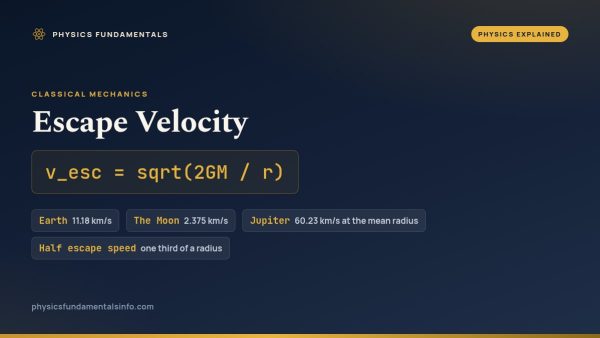
One neighbouring quantity is worth naming here so you do not confuse the two: at the same radius the speed needed to leave altogether, rather than circle, is larger by exactly a factor of sqrt(2) — 10.85 km/s where a circular orbit needs 7.673 km/s — and escape velocity is where that quantity is worked out properly.
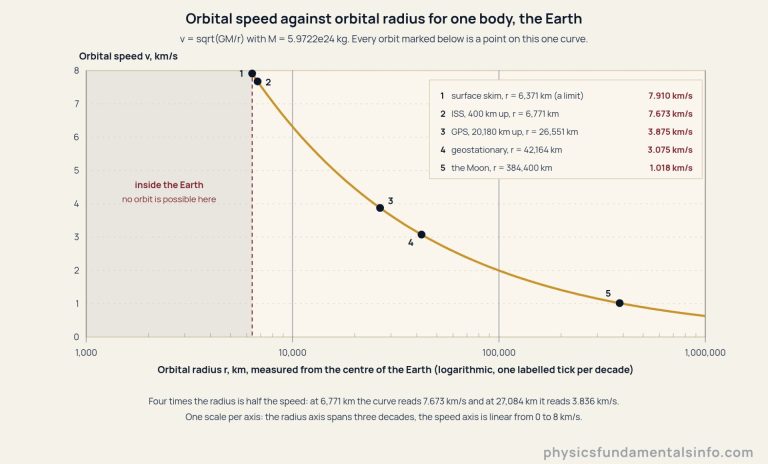
A line graph of orbital speed against orbital radius for the Earth. The horizontal axis is the orbital radius in kilometres, measured from the centre of the Earth, on a logarithmic scale from 1,000 km to 1,000,000 km with one labelled tick per decade. The vertical axis is the orbital speed in kilometres per second, linear from 0 to 8. A single gold curve falls steadily from left to right, starting at the Earth's surface radius of 6,371 km at 7.910 kilometres per second and dropping below 1 kilometre per second beyond a few hundred thousand kilometres. The band to the left of 6,371 km is shaded, carries a dashed wine line at the surface radius and is labelled inside the Earth, no orbit is possible here. Five numbered dark dots mark real orbits on the curve and a key gives each one: 1, the surface skim at 6,371 km, a limit and not an orbit, 7.910 km/s; 2, the International Space Station 400 km up at a radius of 6,771 km, 7.673 km/s; 3, GPS 20,180 km up at a radius of 26,551 km, 3.875 km/s; 4, geostationary at a radius of 42,164 km, 3.075 km/s; and 5, the Moon's orbit at a radius of 384,400 km, 1.018 km/s. Two footnotes state that four times the radius is half the speed, with the curve reading 7.673 km/s at 6,771 km and 3.836 km/s at 27,084 km, and that each axis is drawn to one scale.
Figure 1: v = sqrt(GM/r) drawn across three decades of radius for the Earth, with five real orbits marked on it. The speed falls steadily all the way out, and the shaded band on the left is radii smaller than the Earth itself, where no orbit exists.

Here is the same formula with the controls handed over. Raise the orbit and watch the speed readout fall while the circle grows.

Orbital Velocity Lab

Where the Formula Comes From: Gravity Is the Centripetal Force

The formula comes from setting one force equal to another: the gravitational pull on the orbiting body is exactly the centre-pointing force a circle of that radius and that speed demands. Write both expressions down, set them equal, and the speed drops out in two lines.

The pull comes from the law of gravitation, which gives G M m / r2 for a body of mass m at radius r. The demand comes from the geometry of going round in a circle: travelling a circle of radius r at speed v needs a centripetal force of m v2 / r, pointing at the centre.

There is no third force in the picture, and in particular nothing is pushing outward. A circular orbit is gravity being precisely the right size to bend a straight line into that circle — no more and no less.
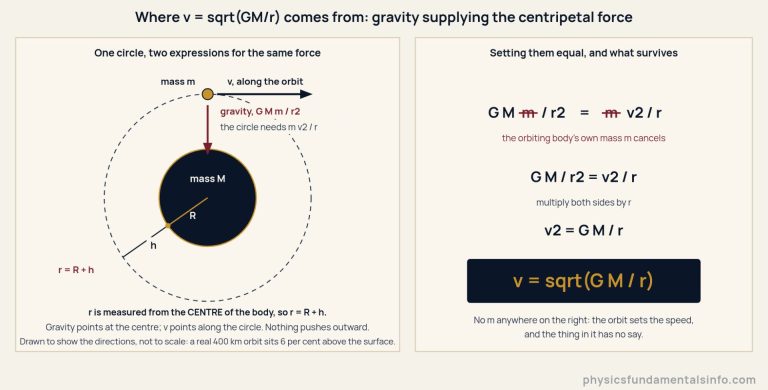
A two-panel diagram showing where the orbital velocity formula comes from. The left panel draws one circular orbit as a dashed circle around a dark disc labelled mass M. A gold dot on the circle is labelled mass m. A wine arrow from that dot points inward along the radius towards the centre and is labelled gravity, G M m over r squared, with a note beside it that the circle needs m v squared over r. A dark arrow from the same dot points along the circle, at right angles to the gravity arrow, and is labelled v, along the orbit. A single line runs from the centre out to the circle and is split by a gold dot where it crosses the surface of the disc, into a gold segment inside the disc marked R and a dark segment outside it marked h, with the whole line labelled r equals R plus h. Three notes under the drawing read: r is measured from the centre of the body, so r equals R plus h; gravity points at the centre, v points along the circle, nothing pushes outward; and drawn to show the directions, not to scale, since a real 400 km orbit sits 6 per cent above the surface. The right panel sets the two expressions equal as G M m over r squared equals m v squared over r, with the m on each side struck through by a wine line and the note that the orbiting body's own mass m cancels. Below that come G M over r squared equals v squared over r, then multiply both sides by r, then v squared equals G M over r, and finally, in gold on a dark band, v equals the square root of G M over r. The closing note reads: no m anywhere on the right, the orbit sets the speed, and the thing in it has no say.
Figure 2: gravity supplies the centripetal force a circle needs. The orbiting body’s own mass m appears once on each side of the balance and divides out, which is why v = sqrt(GM/r) contains nothing about the thing in the orbit.

That cancellation is the most satisfying line in the derivation, and it has a real consequence. A spanner that drifts away from a space station keeps station with it: same radius, same speed, however far apart the two masses are.

It is also why the formula needs no information about the satellite at all. Size, shape, payload, fuel — none of it enters. Only the mass you are orbiting and the distance from its centre.

Why a Higher Orbit Is a Slower Orbit

A higher orbit is slower because the speed falls as one over the square root of the radius. Multiply the radius by four and the required speed halves, exactly, for any central body. That is the single most counter-intuitive thing about this formula.

Most people expect the opposite, and the instinct is understandable: getting higher plainly takes more work, so surely it takes more speed? It takes more energy. It does not take more speed. Those are different quantities, and this is the formula that separates them.

Look at why. Gravity weakens with the square of the distance, so a wider circle needs a gentler centre-pointing force; a gentler force bends the path more slowly, and a slowly bending path is a slow one. The station at 6,771 km does 7.673 km/s. Out at 27,084 km, four times as far, a satellite does 3.836 km/s.

Figure 1 above is that statement as a picture. Five real orbits sit on one falling curve, and the whole ladder from the surface to the Moon is a single line with no kinks, no thresholds and nothing special happening anywhere along it.

The climb still has to be paid for, in fuel and in energy, and nothing here says otherwise. What the formula says is that the circle waiting for you at the top is a slower one than the circle you left.

Real Orbits From a Surface Skim to the Moon

Every orbit below comes out of the same formula with the same two Earth constants, and nothing changes from row to row except the radius. The speeds fall, the periods grow, and the local gravity falls away faster than either.

OrbitAltitude h (km)Radius r (km)Orbital velocityPeriod TGravity at r (m/s2)
Surface skim (a limit, not a real orbit)06,3717.910 km/s84.35 min9.820
Low Earth orbit2006,5717.789 km/s88.35 min9.232
International Space Station4006,7717.673 km/s92.41 min8.694
Hubble-class telescope orbit5356,9067.597 km/s95.19 min8.358
GPS / medium Earth orbit20,18026,5513.875 km/s11.96 h0.5654
Geostationary circle35,79342,1643.075 km/s23.93 h0.2242
The Moon’s orbit378,029384,4001.018 km/s27.45 d0.002698

Two rows need a word of explanation. The surface skim is the formula’s limit as the altitude goes to zero, not a place to put a satellite — at that height there is atmosphere, and plenty of it. The geostationary altitude of 35,793 km in that table is measured from the mean radius of 6,371 km, which is the radius every row uses; subtract the equatorial radius of 6,378.137 km from the same 42,164 km orbit instead and you get the more familiar 35,786 km.

Radius, speed and period do not depend on that choice at all, and 23.93 h is one sidereal day — which is the whole reason the orbit is useful. Why a sidereal day rather than 24 hours is the geostationary orbit‘s own story.

Notice how little the speed moves across the whole of low Earth orbit — 7.789 km/s at 200 km against 7.597 km/s at 535 km — while the lap time moves by nearly seven minutes. That is why a low orbit is quoted by its period rather than its speed.

Change the central body and only M and R change. The formula itself does not notice.

Central bodyThe orbitRadius r (km)Orbital velocityPeriod T
Mars400 km above the surface3,789.53.362 km/s118.0 min
The Moon100 km above the surface1,837.41.634 km/s117.8 min
Jupiter1,000 km above the 1-bar level70,91142.27 km/s2.928 h
The Sunthe Earth’s own orbit, r = 1 au149,597,90029.79 km/s365.3 d

Jupiter has no surface, so its 69,911 km radius is the level where the pressure reaches one bar, and the 1,000 km in that row is measured from there. The last row is the Earth’s own orbit about the Sun, and it is a useful check on the whole method: 29.79 km/s from this formula against the 29.78 km/s NASA publishes as the Earth’s mean orbital velocity.

The lunar row and the Martian row are worth putting side by side for a different reason. Their periods come out within a quarter of a minute of each other — 117.8 min and 118.0 min — from two bodies with nothing in common, which is a coincidence rather than a pattern.

How Much Gravity Is There at the ISS?

There is plenty of gravity at the altitude of the space station: 8.694 m/s2, about 89 per cent of the 9.820 m/s2 at the surface. Astronauts float because they are falling, not because gravity has run out.

The same force balance that gave the speed gives this number too, because the acceleration a circle demands and the gravitational field at that radius are the same thing.

a = v2 / r = G M / r2

Put the ISS numbers in and you get 8.694 m/s2. Drop a pencil in the station and it falls at very nearly the rate it would fall in your kitchen — the difference is about one part in nine. It only looks weightless because the station, the pencil and the astronaut watching are all falling together.

That is free fall, and it is the whole explanation. Weightlessness is a statement about what you can feel, not about how much gravity is present.

Climb to geostationary radius and gravity really has thinned out: 0.2242 m/s2, 2.3 per cent of the surface value. Even there it is not zero, and it is still the only thing holding the satellite on its circle.
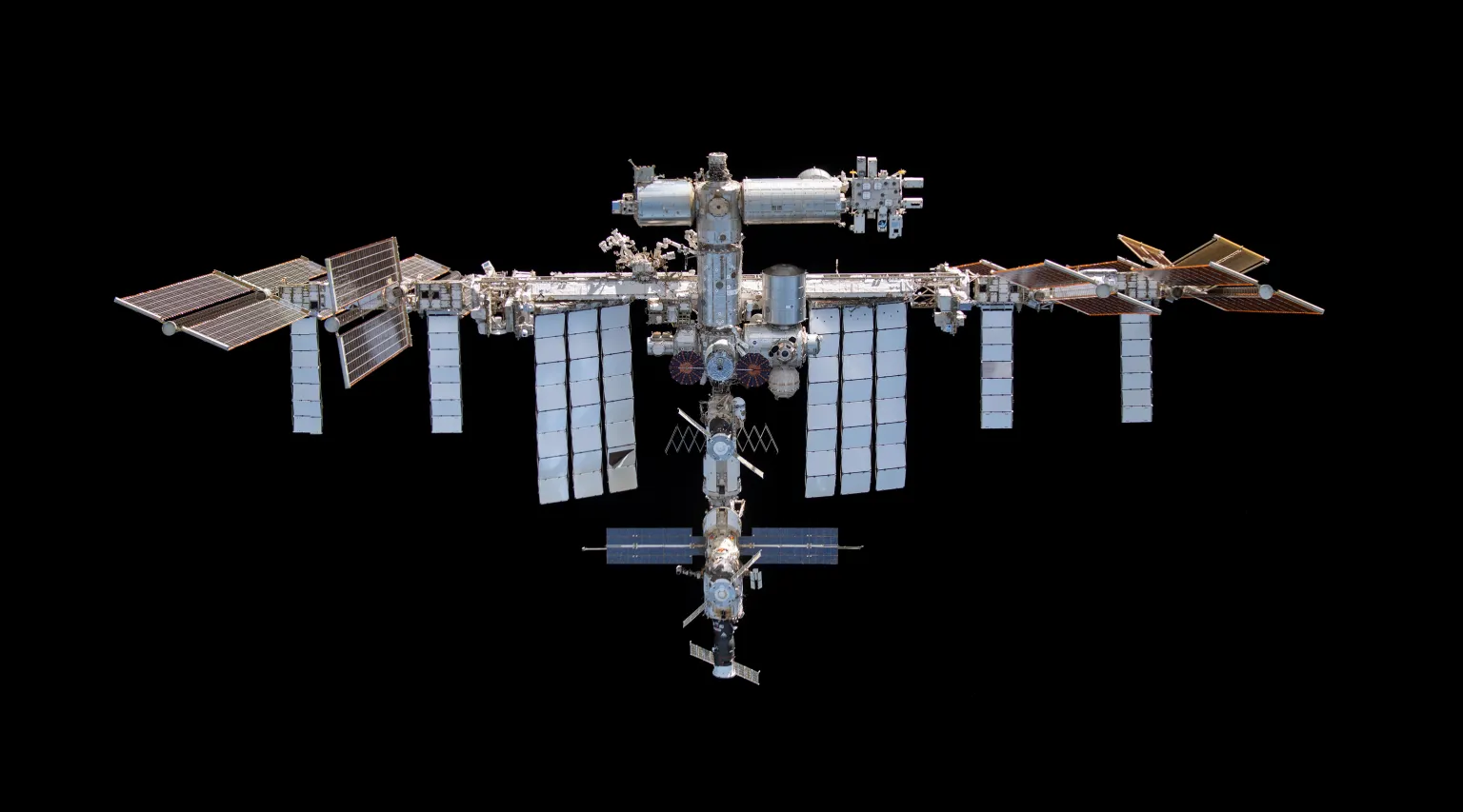
Orbital velocity in practice: the International Space Station in its 400 km orbit, with the curve of the Earth behind it
The space station orbits 400 km up, which is a radius of 6,771 km from the centre of the Earth.

Common Misconceptions About Orbital Velocity

Four mistakes account for almost every wrong answer on this formula, and the first one is in a class of its own.

“The r in the formula is the altitude”

It is not. The r is measured from the centre of the body, so an altitude has to have the body’s own radius added to it first: r = R + h. For a 400 km orbit about the Earth that is 6,371 + 400 = 6,771 km, and 6,371 of those kilometres are underground.

Get this wrong and the error is enormous rather than marginal. Putting 400 km in as the radius gives G M / r = 3.98603e14 / 4.00e5 = 9.96508e8 m2/s2 and a speed of sqrt(9.96508e8 m2/s2) = 31570 m/s, which is 31.57 km/s — more than four times the real answer, for a circle that would lie deep inside the planet.

“A heavier satellite must orbit faster”

The orbiting mass cancelled out of the derivation, so it cannot come back in. A one-tonne satellite and a ten-tonne satellite at 6,771 km both travel at 7.673 km/s, and if they are side by side they stay side by side.

The pull on the heavier one really is bigger — ten times bigger, by the law of gravitation — but the centripetal force its extra mass demands is ten times bigger as well, and the two grow together exactly. That is what cancelling means here, in physical terms rather than algebraic ones.

What the heavier one needs is more fuel to get there. That is a question about energy and thrust, not about the speed the orbit requires once you arrive.

“You have to go faster to reach a higher orbit”

You have to do more work, which is not the same thing. Every orbit above the one you are on is a slower orbit, and a satellite that fires its engine does not simply speed up where it is — it moves onto a bigger circle and ends up going more slowly than before.

“A satellite needs its engine running to stay up”

Nothing is running. Gravity does the whole job, and an orbit is the path a body takes when no force but gravity acts on it. Engines come into it only where the air is thick enough to matter, which is why a satellite 200 km up needs occasional help and one at 20,000 km needs none.

Where the Circular-Orbit Model Breaks Down

Every number on this page assumes a perfect circle around a single point mass, and four things eventually break that assumption. The arithmetic never complains, which is exactly the danger.

Real orbits are ellipses

A circular orbit has one speed. An elliptical one does not: the body runs fastest at its closest approach and slowest at its furthest, and no single figure describes it. For a nearly circular orbit this formula at the mean radius is a good approximation, which is all it is; Kepler’s laws are where the elliptical case is handled.

The Moon shows the size of the error. NASA’s Moon fact sheet gives its orbit an eccentricity of 0.0549 and a mean orbital velocity of 1.022 km/s, against the 1.018 km/s this formula returns at 384,400 km — about four parts in a thousand out, and problem 5 takes that gap apart.

There is an atmosphere, and the formula has never heard of it

Below about 150 to 200 km a circular orbit decays in days to weeks, so the surface-skim row of the table is a textbook limit and not a destination. Those altitudes are order-of-magnitude statements rather than measured thresholds, and no drag term appears anywhere in v = sqrt(GM/r).

There is only one central body in the formula

Far enough out, the body you are orbiting stops being the only thing that matters, and the number the formula returns stops describing anything real. The Earth keeps gravitational control out to roughly 1.5 million km; the Moon only to about 60,000 km. Both figures are orders of magnitude rather than published constants.

Four significant figures, and the fifth is not available

G is known to about five significant figures and the masses here to four or five, so their product cannot support more than four. Every speed on this page therefore stops at four: 7.673 km/s is honest, and a fifth digit on it would be noise rather than precision.

That ceiling has a sharp edge. Run the formula backwards — feed a four-figure speed in and ask for the radius or the mass — and the rounding is amplified, because both inverses go as the square of the speed. Problems 6 and 7 show exactly how much it costs.

Worked Problems

Problem 1
The International Space Station orbits 400 km above the Earth's surface. Taking the Earth's mass as 5.9722e24 kg and its mean radius as 6,371 km, find the orbital radius and then the orbital velocity.
Show Solution
Solution: Step 1: get the radius right first, because it is measured from the centre of the Earth and not from the ground. r = R + h = 6371 + 400 = 6771 km, which is 6.771e6 m. Step 2: work out the product G M once, since it is the only place the central body enters the formula. G M = 6.67430e-11 x 5.9722e24 = 3.98603e14 m3/s2. Step 3: divide by the radius and take the square root. G M / r = 3.98603e14 / 6.771e6 = 5.88691e7 m2/s2, so v = sqrt(5.88691e7 m2/s2) = 7673 m/s. Answer: r = 6,771 km and v = 7.673 km/s, which is 7,673 m/s or about 27,620 km/h. Four significant figures is the ceiling here, not a rounding preference — G itself is only known to five.
Problem 2
Find how long one lap of that same 6,771 km orbit takes, and give the answer in minutes.
Show Solution
Solution: Step 1: one lap is the circumference divided by the speed. T = 2 pi r / v, with r in metres and v in metres per second. Step 2: the circumference. 2 pi x 6.771e6 m = 4.25434e7 m. Step 3: divide by the speed found in problem 1. T = 4.25434e7 m / 7673 m/s = 5544.56 s, and 5544.56 / 60 = 92.41 min. Step 4: a practical note on where the rounding bites. Carrying the four-figure 7673 m/s into step 3 costs about 0.3 s against the unrounded speed, which never shows at four figures in minutes. What it would spoil is a period quoted in seconds — and rounding the seconds to four figures FIRST is worse still, because 5545 / 60 = 92.42 min, which is not the answer. If the period itself is what you want, substitute v = sqrt(G M / r) into T = 2 pi r / v and the speed drops out: T = 2 pi x sqrt(r3 / (G M)), so r3 = (6.771e6 m)3 = 3.1043e20 m3, r3 / (G M) = 3.1043e20 / 3.98603e14 = 7.7879e5 s2, sqrt(7.7879e5 s2) = 882.49 s, and T = 2 pi x 882.49 s = 5544.85 s. Answer: T = 92.41 min, so the station goes round a little over fifteen and a half times a day. Convert to minutes from the unrounded seconds, never from a rounded figure in seconds.
Problem 3
A space telescope orbits at an altitude of 535 km, which is 135 km higher than the space station. Find its orbital velocity and say whether it is faster or slower than the station.
Show Solution
Solution: Step 1: the radius. r = R + h = 6371 + 535 = 6906 km, which is 6.906e6 m. Step 2: the same two operations as before, with the same G M. G M / r = 3.98603e14 / 6.906e6 = 5.77184e7 m2/s2. Step 3: take the root. v = sqrt(5.77184e7 m2/s2) = 7597 m/s, which is 7.597 km/s. Step 4: compare. 7.673 – 7.597 = 0.076 km/s, so the higher telescope is the slower of the two. Answer: 7.597 km/s, slower than the station by 0.076 km/s — 76 m/s lost for 135 km gained. This is the thesis of the whole formula in one pair of numbers.
Problem 4
Mars has a mass of 6.417e23 kg and a mean radius of 3,389.5 km. Find the orbital velocity and the period of a circular orbit 400 km above its surface, and compare the speed with the same altitude above the Earth.
Show Solution
Solution: Step 1: a new central body means a new product. G M = 6.67430e-11 x 6.417e23 = 4.28290e13 m3/s2, which is about a tenth of the Earth’s. Step 2: the radius, from the Martian centre this time. r = R + h = 3389.5 + 400 = 3789.5 km, which is 3.7895e6 m. Step 3: the speed. G M / r = 4.28290e13 / 3.7895e6 = 1.13020e7 m2/s2, so v = sqrt(1.13020e7 m2/s2) = 3362 m/s. Step 4: the period, by the route of problem 2. r3 = (3.7895e6 m)3 = 5.4418e19 m3; r3 / (G M) = 5.4418e19 / 4.28290e13 = 1.2706e6 s2; sqrt(1.2706e6 s2) = 1127.2 s; T = 2 pi x 1127.2 s = 7082.41 s, and 7082.41 / 60 = 118.0 min. Answer: 3.362 km/s and 118.0 min. Four hundred kilometres above the Earth needs 7.673 km/s; the same 400 km above Mars needs less than half of it. Mars carries about a tenth of the Earth’s mass; its much smaller radius claws some of that back, because 400 km up is far closer to the centre there, but nowhere near all of it.
Problem 5
The Moon's mean distance from the centre of the Earth is 384,400 km. Treat its orbit as a circle and find the orbital velocity and the period. Then compare both with the measured values and account for the difference.
Show Solution
Solution: Step 1: the speed, with the Earth’s G M and no altitude to add, because the distance is already measured from the centre. G M / r = 3.98603e14 / 3.844e8 = 1.03695e6 m2/s2, so v = sqrt(1.03695e6 m2/s2) = 1018 m/s. Step 2: the period. r3 = (3.844e8 m)3 = 5.6800e25 m3; r3 / (G M) = 5.6800e25 / 3.98603e14 = 1.4250e11 s2; sqrt(1.4250e11 s2) = 3.7749e5 s; T = 2 pi x 3.7749e5 s = 2.37184e6 s, and 2.37184e6 / 86400 = 27.45 d. Step 3: compare with the real Moon. NASA publishes a mean orbital velocity of 1.022 km/s and a revolution period of 27.3217 d, so the circular model is about 0.4 per cent slow on the speed and about 0.5 per cent long on the period. Close, and not exact. Step 4: the biggest single reason is that the Earth does not stay still. Both bodies circle their common centre of mass, so the mass that sets the period is the pair’s total: 5.9722e24 + 7.346e22 = 6.0457e24 kg, and G x 6.0457e24 = 4.03508e14 m3/s2. Run step 2 again with that figure — 5.6800e25 / 4.03508e14 = 1.4077e11 s2, sqrt(1.4077e11 s2) = 3.7519e5 s, T = 2 pi x 3.7519e5 s = 2.35739e6 s, and 2.35739e6 / 86400 = 27.28 d — and the period now lands about 0.15 per cent SHORT instead. What is left over is the real orbit’s ellipticity and the Sun’s pull, and neither of those is in this formula at all. Answer: 1.018 km/s and 27.45 d from the circular model, against measured means of 1.022 km/s and 27.3217 d. Treating the two-body problem as one fixed centre is the dominant error, and it is worth about half a per cent here.
Problem 6
A satellite is tracked circling the Earth at 3.875 km/s. Find its orbital radius and its altitude, and say what kind of orbit it is.
Show Solution
Solution: Step 1: rearrange rather than guess. v2 = G M / r, so r = G M / v2. Nothing else is needed. Step 2: square the speed, in SI units. v = 3875 m/s, so v2 = 3875 x 3875 = 1.50156e7 m2/s2. Step 3: divide. r = 3.98603e14 / 1.50156e7 = 2.65459e7 m, which is 26546 km. Step 4: subtract the Earth’s radius to get the altitude. 26546 – 6371 = 20175 km. Answer: a radius of about 26,546 km, an altitude of about 20,175 km — navigation-satellite territory, since the GPS constellation flies a nominal 20,180 km. Note the honest wobble: the radius that actually produces 3.875 km/s is 26,551 km, and feeding the rounded speed back lands 5 km away, because r goes as the inverse square of v, so one part in ten thousand in the speed becomes two parts in ten thousand in the radius.
Problem 7
Using only the Moon's distance of 384,400 km, its orbital velocity of 1.018 km/s and the gravitational constant, find the mass of the Earth.
Show Solution
Solution: Step 1: rearrange for the central mass. v2 = G M / r gives M = v2 r / G. Nothing about the Moon’s own mass appears anywhere in that, which is precisely why the method works. Step 2: square the speed in SI units. v = 1018 m/s, so v2 = 1018 x 1018 = 1.03632e6 m2/s2. Step 3: multiply by the distance. v2 r = 1.03632e6 x 3.844e8 = 3.98361e14 m3/s2 — and that quantity is G M itself. Step 4: divide by G. M = 3.98361e14 / 6.67430e-11 = 5.969e24 kg. Answer: M = 5.969e24 kg, against the accepted 5.9722e24 kg — the mass of the planet to three significant figures, from a distance and a speed that anyone with a telescope and a calendar can measure. Nobody has ever put the Earth on a balance; this is how it is weighed.
Problem 8
Satellite A circles the Earth at a radius of 6,771 km. Satellite B circles at exactly four times that radius. Show from the formula alone that B travels at half A's speed, then check it with numbers.
Show Solution
Solution: Step 1: write the ratio instead of the two speeds. vB / vA = sqrt(G M / rB) divided by sqrt(G M / rA), and the G M cancels top and bottom, leaving vB / vA = sqrt(rA / rB). Step 2: substitute the ratio of the radii. rA / rB = 1 / 4, so vB / vA = sqrt(1/4) = 0.5. Exactly half — for any central body, at any starting radius, with no constants required. Step 3: check it at the new radius. rB = 4 x 6771 = 27084 km, so G M / rB = 3.98603e14 / 2.7084e7 = 1.47173e7 m2/s2 and vB = sqrt(1.47173e7 m2/s2) = 3836 m/s. Step 4: read the two printed figures carefully. They are 7.673 km/s and 3.836 km/s, a ratio of 2.0003 rather than exactly 2. The halving is exact in the arithmetic; it is the independent rounding of each speed to four figures that spoils the printed pair. Never halve a printed speed — recompute at the new radius. Answer: vB = vA / 2 exactly, which is 3.836 km/s against 7.673 km/s. Quadruple any orbital radius, about anything, and the orbital velocity halves.

Frequently Asked Questions

What is orbital velocity?
Orbital velocity is the speed a body needs to hold a circular orbit at a given distance from the centre of the object it is orbiting. It is fixed entirely by that distance and by the central mass, through v = sqrt(GM/r). At 6,771 km from the centre of the Earth, which is the space station’s orbit, it comes out at 7.673 km/s.
What is the formula for orbital velocity?
The formula is v = sqrt(GM/r), where G is the gravitational constant 6.67430e-11, M is the mass of the central body in kilograms and r is the orbital radius in metres, measured from that body’s centre. It falls out of setting the gravitational pull equal to the centripetal force a circle needs, which cancels the orbiting body’s own mass.
Why do higher satellites move slower?
Because the required speed falls as one over the square root of the radius. Gravity weakens with the square of the distance, so a wider circle needs a gentler centre-pointing force, and a gentler force bends the path more slowly. Multiply the radius by four and the speed halves exactly: the station manages 7.673 km/s while a geostationary satellite manages 3.075 km/s.
What is the orbital velocity of the ISS?
About 7.673 km/s, which is 7,673 m/s or roughly 27,620 km/h. That comes from an orbital radius of 6,771 km, being the Earth’s mean radius of 6,371 km plus an altitude of 400 km, and one lap takes 92.41 min. The figure stops at four significant figures because the constants behind it cannot honestly carry a fifth.
Does the mass of a satellite affect its orbital velocity?
No, and that is the most useful thing about this formula. The orbiting body’s mass sits on both sides of the force balance and divides straight out, so it is absent from v = sqrt(GM/r). A spanner and the station it drifted away from share a radius and therefore share a speed. Only the central mass and the radius matter.
Do you use altitude or radius in the orbital velocity formula?
Always the radius, measured from the centre of the body, so add the body’s own radius to the altitude: r = R + h. A 400 km orbit about the Earth is 6,371 + 400 = 6,771 km. Typing 400 km in as the radius returns 31.57 km/s, more than four times the real answer, for a circle lying deep inside the planet.
What is the orbital velocity of the Earth?
About 29.79 km/s around the Sun. Put the Sun’s mass of 1.98847e30 kg and one astronomical unit of 149,597,900 km into v = sqrt(GM/r), and the period that goes with it works out at 365.3 d, the sidereal year. NASA publishes the mean orbital velocity of the Earth as 29.78 km/s, so the circular model is doing well here.
P

Written by PhysicsFundamentals Editorial Team

Articles on PhysicsFundamentalsinfo.com are researched, written, and fact-checked by our editorial team. Every piece is reviewed for accuracy before publishing, with formulas and worked examples checked against standard physics references.

View All Authors →