The de Broglie wavelength is the wavelength associated with any moving particle, equal to Planck’s constant divided by the particle’s momentum (λ = h / mv). Every object with mass and velocity has one. It is large enough to measure for electrons and neutrons, but unimaginably small for everyday objects like a cricket ball.
Fire a stream of electrons at a thin crystal and they do something no particle should do. Instead of arriving as a scatter of dots, they pile up in bright rings and dark gaps — the unmistakable signature of a wave passing through a grating.
That pattern is not a quirk of electrons. It is a property of everything that moves, and a young French PhD student worked out the rule for it in 1924 with one short equation.
What Is the De Broglie Wavelength?
The de Broglie wavelength is the wavelength a moving particle behaves as if it has, found by dividing Planck’s constant by the particle’s momentum. Louis de Broglie proposed it in his 1924 doctoral thesis, and it applies to electrons, neutrons, atoms, molecules and, in principle, you.
Physics already accepted that light — obviously a wave — sometimes behaves like a stream of particles. De Broglie asked the obvious question in reverse. If waves can act like particles, why shouldn’t particles act like waves?
The idea sounds like a philosophical flourish. It isn’t. It makes a hard numerical prediction: give a particle a momentum, and its wavelength is fixed. Nothing is left to interpretation.
The De Broglie Wavelength Formula
The de Broglie wavelength formula is Planck’s constant divided by momentum, written as lambda equals h over mv.
Because momentum p = m·v, the same equation is often written more compactly:
| Symbol | Quantity | SI unit |
|---|---|---|
| λ | De Broglie wavelength | metre (m) |
| h | Planck constant = 6.62607015 × 10⁻³⁴ (exact by definition) | joule second (J·s) |
| m | Mass of the particle | kilogram (kg) |
| v | Speed of the particle | metre per second (m/s) |
| p | Momentum, equal to m·v | kilogram metre per second (kg·m/s) |
Since 2019 the Planck constant has been fixed by definition rather than measured — its value is exactly 6.62607015 × 10⁻³⁴ J·s, as published in NIST’s CODATA tables. The kilogram is now defined from it.
Two rearrangements worth memorising
Exam questions rarely hand you the speed directly. Far more often you get a kinetic energy or an accelerating voltage, so these two forms save real time:
Here K is kinetic energy in joules, q is the particle’s charge in coulombs, and V is the accelerating potential difference in volts. Both follow from p = sqrt(2mK), which is just kinetic energy rearranged for momentum.
If you only need the number and not the algebra, our De Broglie Wavelength Calculator takes a mass and a speed and returns the wavelength with the working shown, which makes it a fast way to sanity-check your own answers.
How the De Broglie Wavelength Works
De Broglie’s derivation starts with light and then makes one bold leap. Follow it in three steps.
Step 1 — start with a photon. Einstein and Planck had already established that a light wave of frequency f carries energy in packets of E = hf, the basis of photon energy.
Step 2 — give the photon momentum. Relativity gives a massless particle p = E/c. Substituting E = hf and c = fλ makes the frequency cancel, leaving p = h/λ, or λ = h/p.
Step 3 — drop the assumption of masslessness. De Broglie’s leap was to claim λ = h/p is not a fact about light at all. It is a fact about momentum, so it must apply to an electron exactly as it applies to a photon.
Nothing in step 3 was justified when he wrote it. It was, in the most literal sense, a hypothesis — and three years later the electrons settled it.
The experiment that proved it
In 1927, Clinton Davisson and Lester Germer at Bell Labs fired low-energy electrons at a nickel crystal and found scattering peaks exactly where wave diffraction predicted them. Their 54 eV electrons behaved like a wave of roughly 0.165 nm.
Plug 54 V into the formula and you get 0.167 nm. That agreement, from an experiment that began as an accident after a piece of glassware imploded, is documented in the American Physical Society’s account of the Davisson–Germer landmark. George Paget Thomson found the same effect in thin films weeks later.
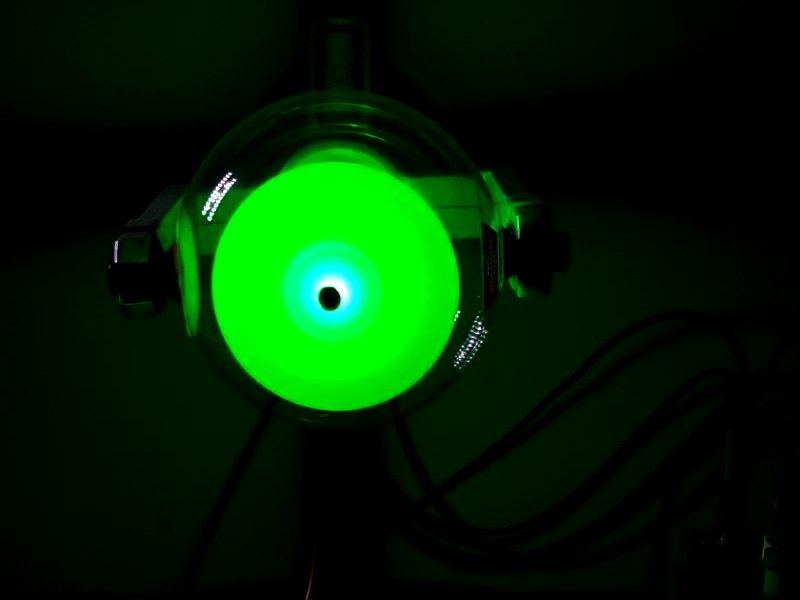
De Broglie Wavelength of an Electron
For an electron accelerated from rest through a potential difference V, the de Broglie wavelength in nanometres is 1.226 divided by the square root of V in volts. It is the single most useful shortcut in this topic.
The constant 1.226 is not arbitrary. It is h / sqrt(2·m·e) converted to nanometres, using the electron mass and the elementary charge — so the shortcut is the full formula with the constants pre-multiplied.
Some quick values: 1 V gives 1.23 nm, 100 V gives 0.123 nm, and 10,000 V gives 0.0123 nm. Every hundredfold rise in voltage shrinks the wavelength by a factor of ten.
In practice, this is why electron microscopes exist. Visible light stalls at roughly 200 nm of resolving power, but a 100 kV electron carries a wavelength near 3.7 pm — about 50,000 times shorter.
Real-World Examples of De Broglie Wavelength
The formula is trivial. What surprises people is the spread of results — twenty-five orders of magnitude between an electron and a walking adult.
| Object | Mass (kg) | Speed (m/s) | De Broglie wavelength | Comparable to |
|---|---|---|---|---|
| Electron through 100 V | 9.11 × 10⁻³¹ | 5.9 × 10⁶ | 1.2 × 10⁻¹⁰ m (0.12 nm) | Spacing of atoms in a crystal |
| Thermal neutron at 300 K | 1.67 × 10⁻²⁷ | 2.7 × 10³ | 1.5 × 10⁻¹⁰ m (0.15 nm) | Spacing of atoms in a crystal |
| Helium atom at 300 K | 6.65 × 10⁻²⁷ | 1.4 × 10³ | 7.3 × 10⁻¹¹ m | Radius of a small atom |
| C60 fullerene molecule | 1.2 × 10⁻²⁴ | 220 | 2.5 × 10⁻¹² m (2.5 pm) | Far smaller than the molecule itself |
| Speck of dust (1 microgram) | 1 × 10⁻⁹ | 1 × 10⁻³ | 6.6 × 10⁻²² m | Millions of times smaller than a proton |
| Cricket ball (160 g) | 0.16 | 40 | 1.0 × 10⁻³⁴ m | About six Planck lengths |
| Adult walking | 70 | 1.4 | 6.8 × 10-36 m | Below the Planck length |
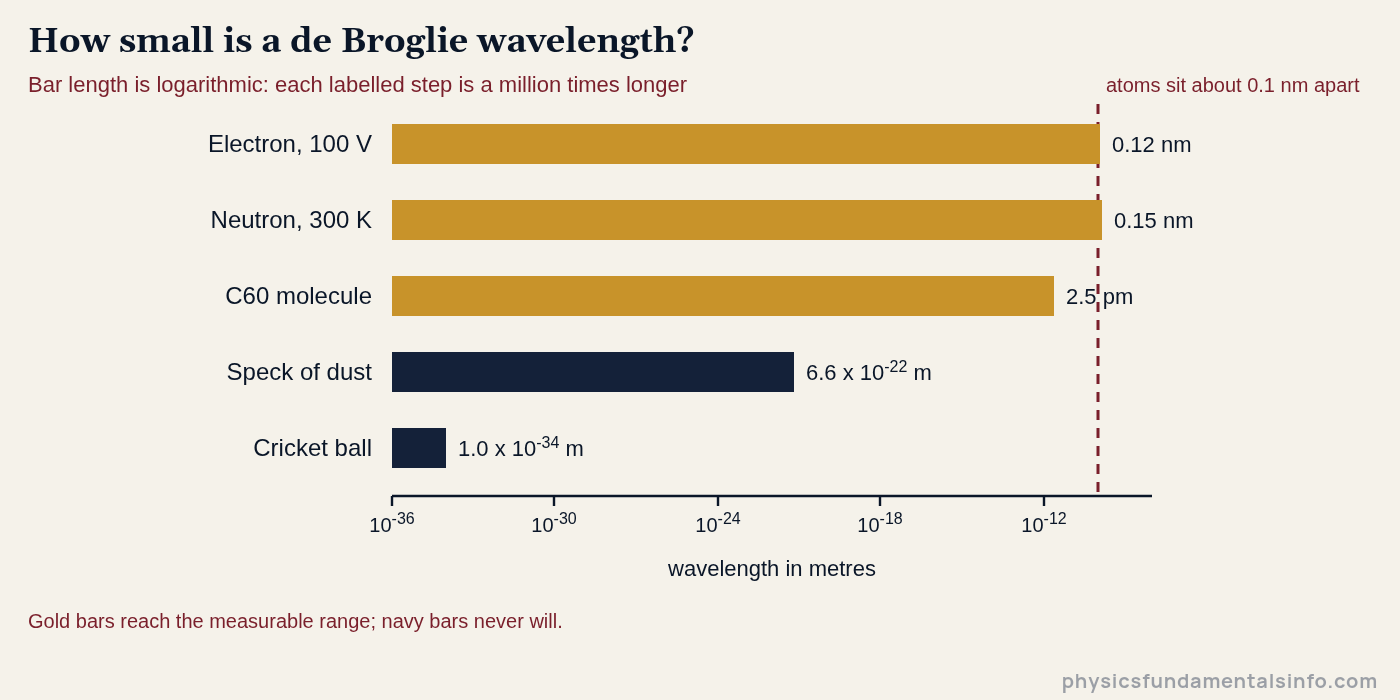
De Broglie wavelengths on a log scale. Only particles whose wavelength reaches atomic spacing can be made to diffract.
Where the wave actually shows up
Neutron diffraction is the clearest payoff. Because a room-temperature neutron carries a wavelength close to atomic spacing, firing neutrons at a crystal maps where its atoms sit — the routine method for locating hydrogen atoms that X-rays largely miss.
The most striking demonstration came in 1999, when a Vienna group sent C60 fullerene molecules — 60 carbon atoms, 720 atomic mass units — through a nanofabricated grating. Travelling at 220 m/s, each molecule had a wavelength of 2.5 pm and produced clean interference fringes.
That wavelength is hundreds of times smaller than the molecule itself. Experiments since 2019 have pushed this to molecules beyond 25,000 atomic mass units, built from up to 2,000 atoms.
Why You Never See the Wavelength of a Cricket Ball
Everyday objects do have a de Broglie wavelength, but it is far too small to produce any observable effect. Planck’s constant sits in the numerator at 10-34, and everyday momentum sits in the denominator at around 1 — so the answer lands near 10-34 m.
Set that against something small. A proton is about 10-15 m across, which makes the cricket ball’s wavelength roughly nineteen orders of magnitude smaller than a proton.
To diffract a wave you need an aperture comparable to its wavelength. There is no aperture that small, and there never will be — the ball’s wavelength is only about six times the Planck length.
So the classical world isn’t exempt from quantum mechanics. It just carries too much momentum for anyone to notice.
Common Misconceptions About the De Broglie Wavelength
“Only electrons have a de Broglie wavelength”
Every object with momentum has one. Electrons simply have small enough momentum for the wavelength to be measurable. A bowling ball obeys the same equation and gets an unmeasurable answer.
“The particle wiggles along a wavy path”
Nothing physically oscillates in space. The wave is a probability amplitude — it tells you where the particle is likely to be found, which is why a single electron sent through a double slit still lands as one dot.
“Faster particles have longer wavelengths”
The relationship is inverse. Speed sits in the denominator, so doubling a particle’s speed halves its de Broglie wavelength. This one costs marks in exams more than any other slip in the topic.
“The formula applies to photons too”
Use λ = h/p for a photon and you are fine. Use λ = h/mv and you are dividing by zero, because a photon has no mass. Photon wavelength comes from E = hf instead.
How the De Broglie Wavelength Relates to Other Ideas
It explains Bohr’s orbits
Bohr had assumed that angular momentum in a hydrogen atom comes in multiples of h/2π, with no reason why. De Broglie supplied one: an electron orbit is stable only when a whole number of its wavelengths fits around the circumference.
Substitute λ = h/mv and Bohr’s rule mvr = nh/2π drops straight out. An orbit with a non-integer fit would interfere with itself and cancel, which is exactly why the electron cannot spiral into the nucleus.
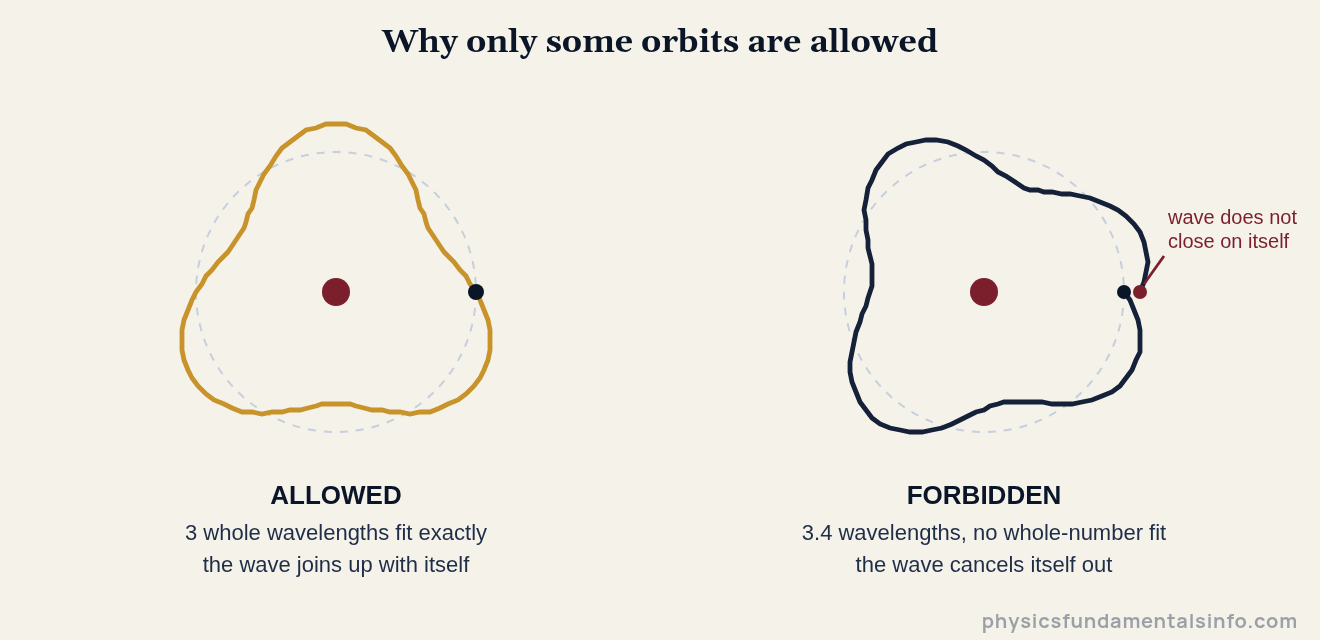
A stable Bohr orbit is one where the electron’s matter wave closes on itself: 2πr = nλ.
It completes wave–particle duality
The photoelectric effect showed light behaving as particles. The de Broglie wavelength showed matter behaving as waves. Together they close the loop: the wave and particle descriptions are two views of one thing.
It needs a correction at high speed
Once a particle approaches a noticeable fraction of the speed of light, momentum is no longer simply mv and special relativity takes over. Use p = γmv, where γ is the Lorentz factor.
The error is not academic. A 100 kV electron microscope beam moves fast enough that the non-relativistic answer is wrong by about 5%.
Momentum is doing all the work
Notice that mass and speed never appear separately — only as their product. Two particles with identical momentum share a wavelength no matter how the mass and speed are divided between them.
Worked Problems
Every step is shown, with units carried through. Work them yourself first, then check.
Show Solution
Solution:
Step 1: Use λ = h / (m·v), with h = 6.63 × 10⁻³⁴ J·s.
Step 2: Find the momentum. p = m·v = (9.11 × 10⁻³¹ kg)(2.0 × 10⁶ m/s) = 1.82 × 10⁻²⁴ kg·m/s.
Step 3: Divide. λ = (6.63 × 10⁻³⁴ J·s) / (1.82 × 10⁻²⁴ kg·m/s) = 3.64 × 10⁻¹⁰ m.
Answer: 3.6 × 10⁻¹⁰ m, or 0.36 nm (2 s.f.)
Show Solution
Solution:
Step 1: The same equation applies, because mass and speed are all that matter. λ = h / (m·v).
Step 2: p = (0.16 kg)(40 m/s) = 6.4 kg·m/s.
Step 3: λ = (6.63 × 10⁻³⁴ J·s) / (6.4 kg·m/s) = 1.04 × 10⁻³⁴ m.
Step 4: Sanity-check the magnitude. A proton is about 10-15 m wide, so this is roughly 1019 times smaller than a proton. No apparatus could ever detect it.
Answer: 1.0 × 10⁻³⁴ m (2 s.f.)
Show Solution
Solution:
Step 1: Work is done on the electron, so its kinetic energy is K = q·V.
Step 2: K = (1.60 × 10⁻¹⁹ C)(100 V) = 1.60 × 10⁻¹⁷ J.
Step 3: Convert energy to momentum. p = sqrt(2·m·K) = sqrt(2 × 9.11 × 10-31 × 1.60 × 10-17) = 5.40 × 10⁻²⁴ kg·m/s.
Step 4: λ = (6.63 × 10⁻³⁴) / (5.40 × 10⁻²⁴) = 1.23 × 10⁻¹⁰ m.
Step 5: Check with the shortcut. λ = 1.226 / sqrt(100) = 0.1226 nm. The two agree.
Answer: 1.23 × 10⁻¹⁰ m, or 0.123 nm (3 s.f.)
Show Solution
Solution:
Step 1: Convert the energy to joules. K = (0.025 eV)(1.60 × 10⁻¹⁹ J/eV) = 4.01 × 10⁻²¹ J.
Step 2: p = sqrt(2·m·K) = sqrt(2 × 1.675 × 10-27 × 4.01 × 10-21) = sqrt(1.343 × 10-47) = 3.66 × 10⁻²⁴ kg·m/s.
Step 3: λ = (6.63 × 10⁻³⁴) / (3.66 × 10⁻²⁴) = 1.81 × 10⁻¹⁰ m.
Step 4: This is comparable to atomic spacing, which is precisely why thermal neutrons are used to probe crystal structure.
Answer: 1.81 × 10⁻¹⁰ m, or 0.181 nm (3 s.f.)
Show Solution
Solution:
Step 1: Rearrange λ = h / (m·v) to make v the subject: v = h / (m·λ).
Step 2: Convert the wavelength to metres. λ = 0.10 nm = 1.0 × 10⁻¹⁰ m.
Step 3: v = (6.63 × 10⁻³⁴) / (9.11 × 10-31 × 1.0 × 10-10) = (6.63 × 10⁻³⁴) / (9.11 × 10-41) = 7.27 × 10⁶ m/s.
Step 4: Check whether relativity is needed. 7.27 × 10⁶ divided by 3.00 × 10⁸ is 2.4% of c, so the non-relativistic formula is safe here.
Answer: 7.3 × 10⁶ m/s (2 s.f.)
Show Solution
Solution:
Step 1: At fixed kinetic energy, λ = h / sqrt(2·m·K), so λ is inversely proportional to sqrt(m).
Step 2: Take the ratio. λe / λp = sqrt(mp / me) = sqrt(1836).
Step 3: sqrt(1836) = 42.8.
Step 4: Confirm with numbers. λe = 0.123 nm from Problem 3, so λp = 0.123 / 42.8 = 0.00287 nm.
Answer: About 43 times longer (λe = 0.123 nm, λp = 2.87 × 10⁻³ nm)
Show Solution
Solution:
Step 1: Non-relativistic first. λ = 1.226 / sqrt(100 000) = 1.226 / 316.2 = 3.88 × 10⁻³ nm = 3.88 pm.
Step 2: The relativistic form divides by an extra factor: λ = h / sqrt(2·m·q·V·(1 + qV / (2·m·c2))).
Step 3: Evaluate the bracket. qV / (2mc2) = 100 keV / (2 × 511 keV) = 0.0978, so the correction factor is sqrt(1.0978) = 1.048.
Step 4: λ = 3.88 pm / 1.048 = 3.70 pm.
Step 5: The error from ignoring relativity is (3.88 – 3.70) / 3.70 = 4.8%.
Answer: 3.88 pm non-relativistic, 3.70 pm relativistic, a 4.8% error if uncorrected
Show Solution
Solution:
Step 1: Find the electron’s wavelength. λ = h / (m·v) = (6.63 × 10⁻³⁴) / (9.11 × 10-31 × 2.19 × 106).
Step 2: The denominator is 1.995 × 10⁻²⁴ kg·m/s, so λ = 3.32 × 10⁻¹⁰ m.
Step 3: Find the circumference. 2·π·r = 2 × 3.1416 × 5.29 × 10-11 = 3.32 × 10⁻¹⁰ m.
Step 4: Divide. (2·π·r) / λ = 1.00, so n = 1.
Answer: n = 1, exactly one wavelength fits, confirming 2πr = nλ