The photon energy formula, E = hf, states that the energy of a single photon equals Planck’s constant (6.626 × 10⁻³⁴ J·s) multiplied by the frequency of the light. Higher-frequency radiation such as ultraviolet or X-rays therefore carries more energy per photon than lower-frequency radio waves. In wavelength form, the same formula becomes E = hc/λ.
A 50,000-watt radio mast can bathe you in electromagnetic waves all day and your skin never notices. Twenty minutes under far weaker spring sunshine can leave you pink. Total power clearly is not the whole story.
The difference lies in how the energy is parcelled up. Light arrives in discrete packets called photons, and the photon energy formula tells you exactly how much each packet carries — the single number that separates harmless radio chatter from bond-breaking ultraviolet.
What Is Photon Energy?
Photon energy is the amount of energy carried by one photon — a single, indivisible packet (quantum) of electromagnetic radiation — and it is fixed entirely by the light’s frequency. Nothing else matters: not brightness, not distance from the source, not how the light was made.
Think of light as currency rather than a continuous fluid. Frequency sets the denomination of each coin, while brightness only sets how many coins arrive per second. A red laser pays you in small coins very fast; a faint gamma-ray source pays rarely, but every coin is enormous.
The denominations involved are tiny by everyday standards. A photon of visible light carries only a few times 10-19 joules, which is why the light around you feels perfectly smooth — you are being showered with billions of billions of packets every second.
The Photon Energy Formula (E = hf)
The photon energy formula is E = hf: a photon’s energy equals Planck’s constant multiplied by the frequency of the radiation.
- E — energy of one photon, in joules (J)
- h — Planck’s constant, 6.626 × 10⁻³⁴ J·s (exact value 6.62607015 × 10⁻³⁴ J·s)
- f — frequency of the radiation, in hertz (Hz, meaning s-1)
Exam questions often hand you a wavelength instead of a frequency. Because frequency and wavelength are tied together by the speed of light through f = c/λ, substituting gives the second working form of the same formula:
- c — speed of light in a vacuum, 2.998 × 10⁸ m/s (exact value 299,792,458 m/s)
- λ — wavelength, in metres (m)
- hc — the combined constant, 1.986 × 10⁻²⁵ J·m
Use E = hf when you are given frequency and E = hc/λ when you are given wavelength — they always agree. You can also get the number instantly, in both joules and electron volts, with our Photon Energy Calculator.
The Electron Volt Shortcut
Joule answers for single photons are awkwardly tiny, so physicists usually quote photon energies in electron volts, where 1 eV = 1.602 × 10⁻¹⁹ J. In these units, hc is very close to 1240 eV·nm.
That gives a shortcut worth memorising: E (in eV) = 1240 divided by λ (in nm). A 620 nm orange photon carries 1240/620 = 2.0 eV — no scientific notation required.
A common student slip is forgetting to convert nanometres to metres before using hc in joules. Here is the sanity check that catches it: visible-light photons always come out at a few times 10-19 J, or roughly 1.8 to 3.1 eV. If your answer is wildly different, a unit slipped somewhere.
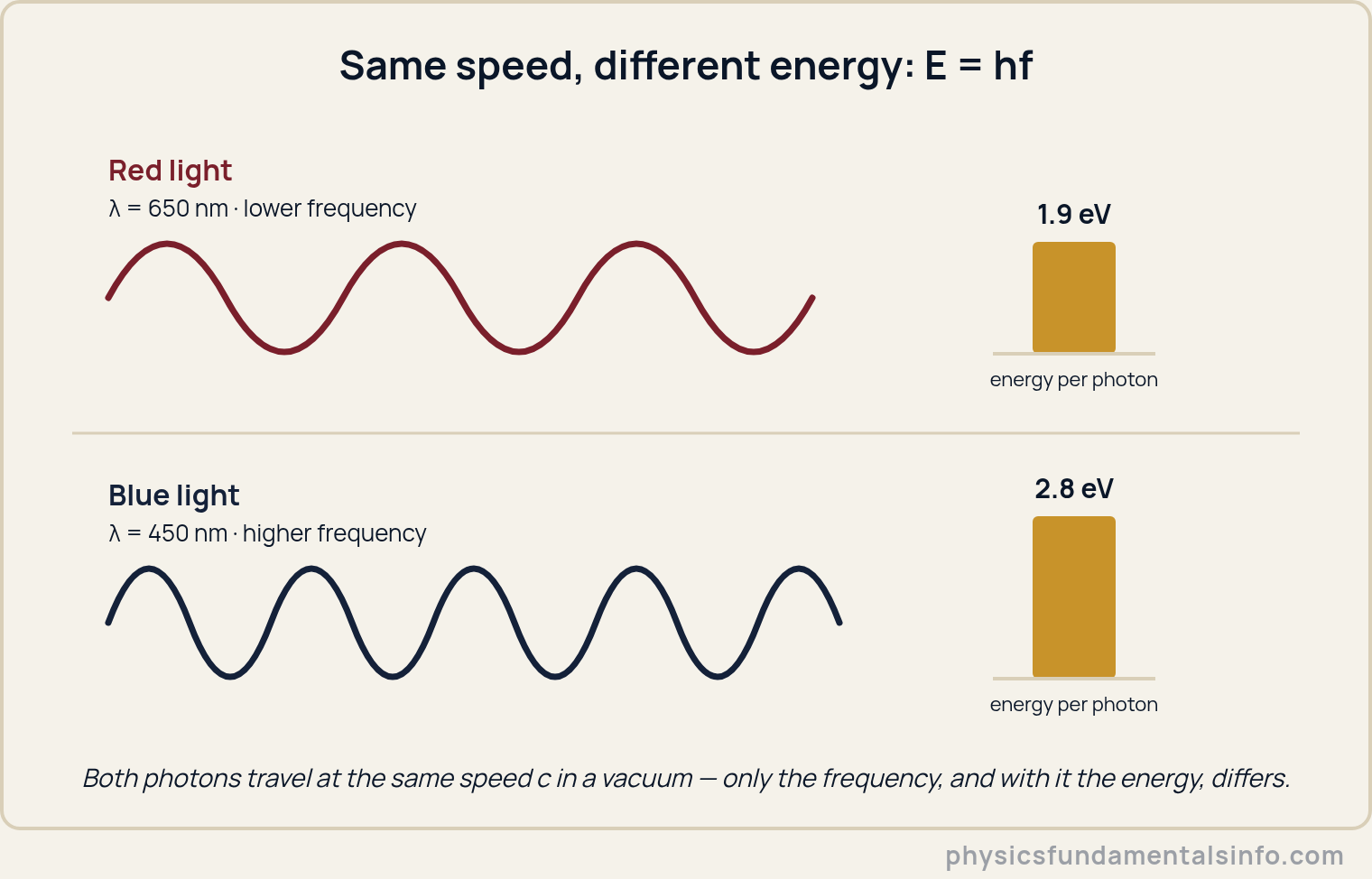
Figure 1: A red and a blue photon move at the same speed, but the blue photon’s higher frequency gives it about 1.4 times more energy per photon, exactly as E = hf predicts.
How the Photon Energy Formula Works
The formula works because light’s energy is quantised: it can only be emitted or absorbed in whole packets, each worth exactly hf. Planck’s constant h is the conversion rate between frequency and energy — a fixed exchange rate built into the universe.
Where did that idea come from? In 1900, Max Planck found he could only explain the glow of hot objects by assuming energy came in steps of hf, a move he initially treated as a mathematical trick. Five years later Einstein took it literally, proposing that light itself travels as quanta — work that earned him the 1921 Nobel Prize in Physics and gave us what chemist Gilbert Lewis later named the photon.
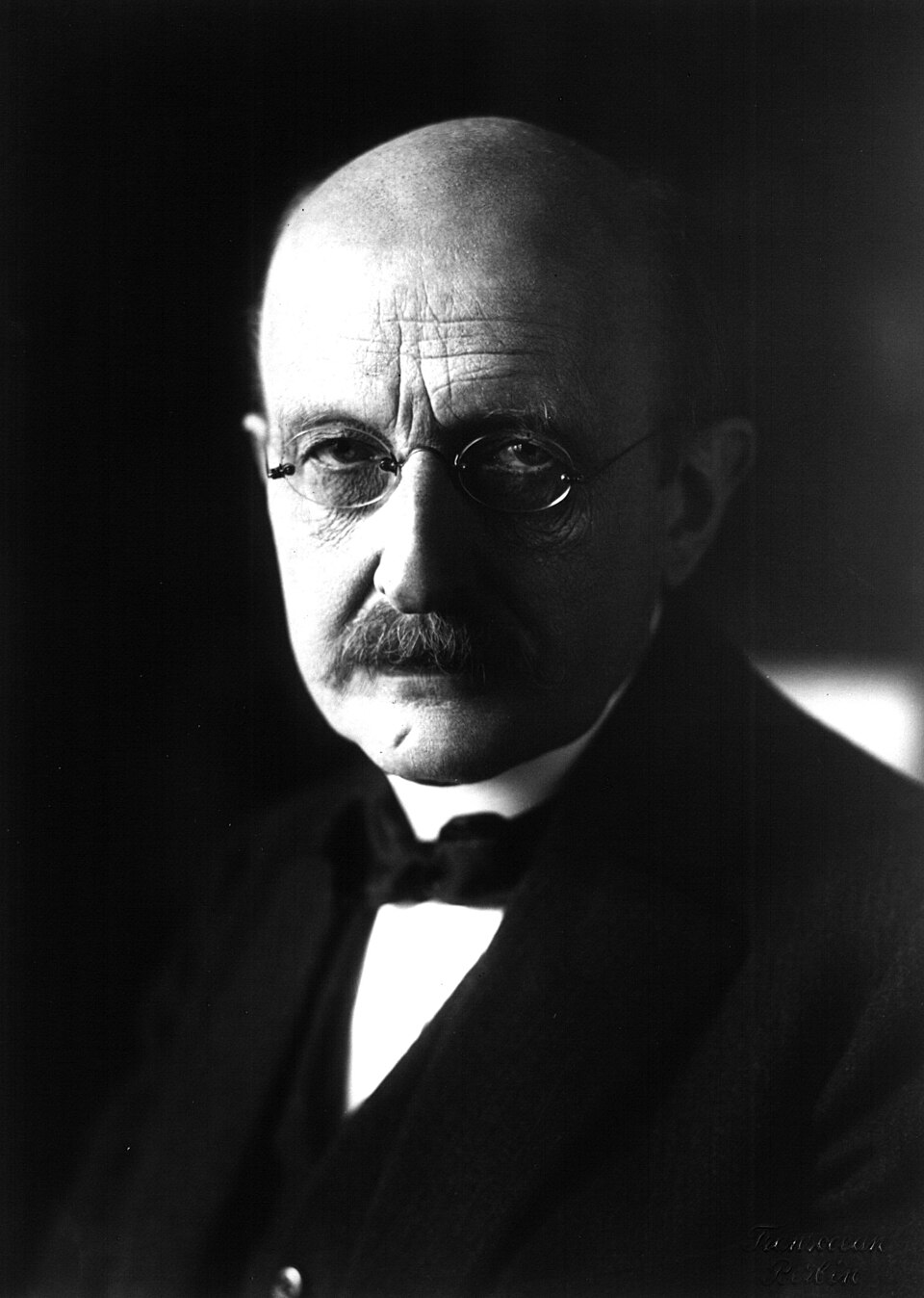
Planck’s constant is no longer something laboratories measure. Since the 2019 redefinition of the SI base units it has an exact defined value, 6.62607015 × 10⁻³⁴ J·s, listed among NIST’s CODATA recommended values of the fundamental constants.
Why does the everyday world feel smooth if energy arrives in steps? Because h is absurdly small, the steps are far below anything your senses — or most instruments — can resolve. The relationship itself is strictly linear: double the frequency and you double the energy of every photon, no exceptions.
Choosing Between E = hf and E = hc/λ
In practice, solving any photon energy problem comes down to four short steps:
- Identify what you are given — a frequency f or a wavelength λ.
- Pick the matching form: E = hf for frequency, E = hc/λ for wavelength.
- Convert to SI units first (Hz for frequency, metres for wavelength — so 650 nm becomes 6.50 × 10⁻⁷ m).
- Substitute, solve, and convert to eV at the end if the question asks for it (divide the joule answer by 1.602 × 10⁻¹⁹).
That is the whole method. Every worked problem later in this article is just these four steps wearing different numbers.
Before the numbers, build the intuition. Drag the wavelength slider in the lab below from radio to gamma and watch the energy readouts respond — in joules and electron volts — exactly as E = hf = hc/λ demands.
Photon Energy Across the Electromagnetic Spectrum
Across the full electromagnetic spectrum, photon energy climbs with frequency through more than twelve powers of ten — from around 10-7 eV for an FM radio photon to millions of eV for gamma rays. Same formula, wildly different consequences.
NASA’s astronomers put it plainly: the different types of radiation are defined by the amount of energy their photons carry, which is why NASA’s Imagine the Universe spectrum guide labels its high-energy bands in electron volts rather than metres.
| Region | Typical frequency (Hz) | Typical wavelength | Photon energy (J) | Photon energy (eV) |
|---|---|---|---|---|
| FM radio | 1.0 × 10⁸ | 3.0 m | 6.6 × 10⁻²⁶ | 4.1 × 10⁻⁷ |
| Microwave (oven, Wi-Fi) | 2.45 × 10⁹ | 12.2 cm | 1.6 × 10⁻²⁴ | 1.0 × 10⁻⁵ |
| Infrared (body heat) | 3.0 × 10¹³ | 10 μm | 2.0 × 10⁻²⁰ | 0.12 |
| Red light | 4.6 × 10¹⁴ | 650 nm | 3.1 × 10⁻¹⁹ | 1.9 |
| Violet light | 7.5 × 10¹⁴ | 400 nm | 5.0 × 10⁻¹⁹ | 3.1 |
| Ultraviolet (UV-C) | 3.0 × 10¹⁵ | 100 nm | 2.0 × 10⁻¹⁸ | 12.4 |
| X-ray | 3.0 × 10¹⁸ | 0.1 nm | 2.0 × 10⁻¹⁵ | 1.24 × 10⁴ (12.4 keV) |
| Gamma ray | 3.0 × 10²⁰ | 1 pm | 2.0 × 10⁻¹³ | 1.24 × 10⁶ (1.24 MeV) |
One line on that table matters for safety. Somewhere around 10 eV — in the deep ultraviolet — individual photons start carrying enough energy to knock electrons out of atoms, which is where the ionising types of radiation begin. Everything below that line, however intense, cannot ionise one atom with one photon.
Real-World Examples of Photon Energy
The photon energy formula shows up everywhere light meets matter — here are five places it quietly runs the show.
1. A Laser Pointer Counts Its Photons
A 5 mW green laser (532 nm) emits photons of about 3.7 × 10⁻¹⁹ J each. Divide the power by that number and you find it fires roughly 1.3 × 10¹⁶ photons every second — ten million billion packets, which is why the beam looks perfectly continuous.
2. Why Ultraviolet Burns and Red Light Does Not
A UV-B photon at 300 nm carries about 4.1 eV, comparable to the energy holding chemical bonds together. One photon can therefore damage a molecule in your skin directly. A 1.9 eV red photon simply cannot, no matter how many of them arrive.
3. Solar Panels Have an Entry Fee
Silicon needs roughly 1.1 eV to promote an electron across its band gap. Only photons with wavelengths shorter than about 1100 nm clear that bar, so a chunk of the Sun’s infrared passes through a panel unused — a limit set directly by E = hc/λ.
4. Microwave Ovens Cook Without Ionising
A 2.45 GHz microwave photon carries a feeble 1.0 × 10⁻⁵ eV — about a million times too little to ionise anything. Ovens and Wi-Fi routers heat or communicate through enormous numbers of weak photons being absorbed collectively, not through powerful individual packets.
5. X-ray Imaging Trades Energy for Penetration
Medical X-ray photons carry tens of thousands of eV, enough to pass through soft tissue and to ionise atoms along the way. That single number explains both why X-rays image bones so well and why the radiographer steps behind a shield.
Common Misconceptions About Photon Energy
Four wrong beliefs cause most lost marks on this topic. Here is each one, corrected.
Trap 1: “Brighter light means each photon has more energy”
Brightness is the number of photons arriving per second; frequency alone sets the energy of each one. A dim ultraviolet lamp ejects electrons from a metal while a blinding red floodlight cannot — the historical evidence that forced physicists to accept E = hf in the first place.
Trap 2: “You can put wavelength straight into E = hf”
The f in the formula is frequency, never wavelength. Energy rises with frequency but falls with wavelength, so multiplying h by λ gives nonsense with wrong units. Given a wavelength, use E = hc/λ — or convert to frequency first with f = c/λ.
Trap 3: “Photons lose energy when light slows down in glass”
When light enters glass or water its speed and wavelength drop, but its frequency does not change — so E = hf stays exactly the same. That is why colours survive refraction: energy is only lost if photons are absorbed, not merely bent.
Trap 4: “Faster photons carry more energy”
There is no such thing as a faster photon: in a vacuum, every photon from radio to gamma travels at exactly c. Energy differences come entirely from frequency. Speed is the one property all photons share; energy is the one they do not.
How Photon Energy Powers the Photoelectric Effect and Beyond
E = hf is the input side of Einstein’s photoelectric equation: shine light on a metal and each photon offers exactly hf to one electron. If that offer exceeds the metal’s work function, the electron escapes with the difference as kinetic energy — the full story, with its own lab and problems, is in our guide to the photoelectric effect.
The same packet logic runs the rest of quantum physics. Atoms emit and absorb light only when a photon’s energy exactly matches a jump between energy levels, which is why each element has its own fingerprint of spectral lines. Master E = hf and you hold the key that unlocks all of it.
Worked Problems
Work through these in order — they climb from direct substitution to the exact style of question that appears in photoelectric-effect papers. Carry units at every step.
Show Solution
Solution:
Step 1: Frequency is given, so use E = hf.
Step 2: E = (6.626 × 10⁻³⁴ J·s) × (6.0 × 10¹⁴ Hz) = 3.98 × 10⁻¹⁹ J.
Step 3: Convert to electron volts: E = (3.98 × 10⁻¹⁹ J) ÷ (1.602 × 10⁻¹⁹ J/eV) = 2.48 eV.
Answer: E = 4.0 × 10⁻¹⁹ J = 2.5 eV (2 significant figures)
Show Solution
Solution:
Step 1: Wavelength is given, so use E = hc/λ, with hc = 1.986 × 10⁻²⁵ J·m.
Step 2: Convert units: λ = 650 nm = 6.50 × 10⁻⁷ m.
Step 3: E = (1.986 × 10⁻²⁵ J·m) ÷ (6.50 × 10⁻⁷ m) = 3.06 × 10⁻¹⁹ J, which is 1.91 eV.
Answer: E = 3.06 × 10⁻¹⁹ J = 1.91 eV
Show Solution
Solution:
Step 1: Rearrange E = hf to f = E/h.
Step 2: f = (4.90 × 10⁻¹⁹ J) ÷ (6.626 × 10⁻³⁴ J·s) = 7.40 × 10¹⁴ Hz.
Step 3: λ = c/f = (2.998 × 10⁸ m/s) ÷ (7.40 × 10¹⁴ Hz) = 4.05 × 10⁻⁷ m = 405 nm.
Answer: f = 7.40 × 10¹⁴ Hz, λ = 405 nm — violet light
Show Solution
Solution:
Step 1: E = hc/λ with λ = 0.100 nm = 1.00 × 10⁻¹⁰ m.
Step 2: E = (1.986 × 10⁻²⁵ J·m) ÷ (1.00 × 10⁻¹⁰ m) = 1.99 × 10⁻¹⁵ J.
Step 3: In eV: (1.99 × 10⁻¹⁵) ÷ (1.602 × 10⁻¹⁹) = 1.24 × 10⁴ eV = 12.4 keV.
Answer: E = 1.99 × 10⁻¹⁵ J = 12.4 keV — about 6,500 times a red-light photon
Show Solution
Solution:
Step 1: Energy of one photon: E = hc/λ = (1.986 × 10⁻²⁵ J·m) ÷ (5.32 × 10⁻⁷ m) = 3.73 × 10⁻¹⁹ J.
Step 2: Energy emitted per second equals the power: 5.00 × 10⁻³ J each second.
Step 3: Photons per second = (5.00 × 10⁻³ J/s) ÷ (3.73 × 10⁻¹⁹ J) = 1.34 × 10¹⁶ s-1.
Answer: about 1.34 × 10¹⁶ photons per second
Show Solution
Solution:
Step 1: E = hf = (6.626 × 10⁻³⁴ J·s) × (1.00 × 10⁸ Hz) = 6.63 × 10⁻²⁶ J.
Step 2: In eV: (6.63 × 10⁻²⁶) ÷ (1.602 × 10⁻¹⁹) = 4.14 × 10⁻⁷ eV.
Step 3: Ratio: (3.73 × 10⁻¹⁹ J) ÷ (6.63 × 10⁻²⁶ J) = 5.6 × 10⁶.
Answer: E = 6.63 × 10⁻²⁶ J (4.14 × 10⁻⁷ eV) — a green photon carries about 5.6 million times more energy
Show Solution
Solution:
Step 1: At the threshold, the photon energy exactly equals the work function: hc/λ = 2.14 eV.
Step 2: Using the shortcut E (eV) = 1240/λ (nm): λ = 1240 ÷ 2.14 = 579 nm.
Step 3: Check in SI: 2.14 eV = 3.43 × 10⁻¹⁹ J, so λ = (1.986 × 10⁻²⁵) ÷ (3.43 × 10⁻¹⁹) = 5.79 × 10⁻⁷ m — the same 579 nm.
Answer: λ = 579 nm (yellow light); anything longer, such as red, ejects nothing
Show Solution
Solution:
Step 1: From Problems 2 and 4: E(red) = 3.06 × 10⁻¹⁹ J and E(X-ray) = 1.99 × 10⁻¹⁵ J.
Step 2: Number needed N = (1.99 × 10⁻¹⁵) ÷ (3.06 × 10⁻¹⁹) = 6.5 × 10³.
Step 3: Spot the shortcut — because E = hc/λ, the ratio of energies is just the ratio of wavelengths: 650 ÷ 0.100 = 6,500. Same answer, no constants needed.
Answer: about 6,500 red photons — energy ratios equal inverse wavelength ratios
Frequently Asked Questions
What is the photon energy formula?
The photon energy formula is E = hf, where E is the photon’s energy in joules, h is Planck’s constant (6.626 × 10⁻³⁴ J·s) and f is the light’s frequency in hertz. Multiply the two to get the energy of one photon. If you are given a wavelength instead, use the equivalent form E = hc/λ.
How do you calculate photon energy from wavelength?
Divide the constant hc by the wavelength: E = hc/λ, with hc = 1.986 × 10⁻²⁵ J·m and λ in metres. A 500 nm photon, for example, carries (1.986 × 10⁻²⁵) ÷ (5.00 × 10⁻⁷) = 3.97 × 10⁻¹⁹ J. The shortcut E (eV) = 1240/λ (nm) gives the same answer in electron volts.
Do all photons have the same energy?
No — all photons cross a vacuum at the same speed c, but their energies differ enormously. Energy depends only on frequency through E = hf, so a gamma-ray photon can carry billions of times more energy than a radio photon. Only photons of one single frequency all share the same energy.
Why is photon energy usually given in electron volts?
Because single-photon energies in joules are awkwardly tiny numbers, physicists use the electron volt: 1 eV = 1.602 × 10⁻¹⁹ J. Visible-light photons then fall in a friendly range of roughly 1.8 to 3.1 eV, and the shortcut E = 1240/λ (with λ in nanometres) makes quick mental estimates possible.
Which has more energy, red light or blue light?
Blue light — a blue photon near 450 nm has a higher frequency than a red photon near 650 nm, so E = hf gives it about 1.4 times more energy, roughly 2.8 eV versus 1.9 eV. Brightness makes no difference: a dim blue beam still beats an intense red one photon for photon.
Does a photon lose energy when light enters glass or water?
No — entering a denser medium reduces light’s speed and wavelength, but the frequency, and therefore the photon energy E = hf, stays exactly the same. That is why colours do not shift underwater. A photon only gives up energy when it is absorbed, not when it is refracted.
That is the photon energy formula from every angle: two working forms, one tiny constant, and consequences that stretch from your Wi-Fi router to a gamma-ray telescope. When you are ready, take E = hf into battle in our photoelectric effect problems — every one of them starts with the calculation you have just mastered.