The electromagnetic spectrum is the full range of electromagnetic radiation, ordered by frequency and wavelength, from low-frequency radio waves to high-frequency gamma rays. Every band — radio, microwave, infrared, visible light, ultraviolet, X-rays and gamma rays — is the same phenomenon: oscillating electric and magnetic fields travelling through a vacuum at the speed of light, linked by the equation c = fλ.
Right now, invisible waves are streaming straight through the room you are sitting in. Wi-Fi and mobile signals, the warmth radiating from a heater, the glow of your screen, even the faint heat of your own skin — all of it is the same kind of wave, racing at the same staggering speed.
That single family of waves is the electromagnetic spectrum. Understand how it is organised and you hold one key that unlocks radio, vision, X-ray scans, the blue of the sky and the light from galaxies billions of years old.
What Is the Electromagnetic Spectrum?
Picture a piano keyboard that stretches far beyond what any ear could hear — low notes rumbling below the lowest key, high notes screaming above the highest. The electromagnetic spectrum is that keyboard for light. Each “note” is a wave of a particular wavelength, and together they span an almost unimaginable range.
More precisely, the electromagnetic spectrum is the complete range of electromagnetic radiation arranged by wavelength and frequency. At one end sit radio waves longer than a football pitch; at the other, gamma rays shorter than the nucleus of an atom.
Here is the idea students most often miss: these bands are not different substances. Physicists call the whole range “light” in the broad sense — and visible light is simply the sliver our eyes happen to detect. Radio waves and gamma rays are made of exactly the same stuff, differing only in how tightly the wave is wound.
The Electromagnetic Spectrum Formula: c = fλ
One short equation ties the whole spectrum together. It links a wave’s speed, its frequency and its wavelength.
- c — the speed of light in a vacuum, a fixed constant of 299,792,458 m/s (about 3.00 × 10⁸ m/s). Units: metres per second (m/s).
- f — the frequency, or number of wave cycles passing a point each second. Units: hertz (Hz = s−1).
- λ — the wavelength, the distance between one crest and the next. Units: metres (m).
Because c never changes in a vacuum, frequency and wavelength are locked in a see-saw: push the frequency up and the wavelength must shrink, and vice versa. That single trade-off is what carries you from one end of the spectrum to the other.
A second formula governs how much energy each wave delivers, one packet — one photon — at a time.
- E — the energy of a single photon. Units: joules (J), often quoted in electronvolts (eV).
- h — the Planck constant, ≈ 6.626 × 10⁻³⁴ J·s.
- f — frequency (Hz); c — speed of light (m/s); λ — wavelength (m).
Energy rises with frequency. So as you climb the spectrum towards gamma rays, each photon hits harder — the fact that explains why the top end is dangerous and the bottom end is not. You can convert between frequency and wavelength in one click with our Wave Speed Calculator.
How the Electromagnetic Spectrum Works
What actually is an electromagnetic wave? It is a self-sustaining ripple of two fields. A changing electric field creates a magnetic field; that changing magnetic field, in turn, regenerates the electric field a step further along. The two keep handing energy back and forth, and the disturbance rolls forward through empty space.
This makes light a transverse wave: the electric and magnetic fields oscillate at right angles to each other and to the direction of travel. Crucially, no medium is required. Sound needs air; an electromagnetic wave needs nothing, which is why sunlight crosses the vacuum of space to reach us.
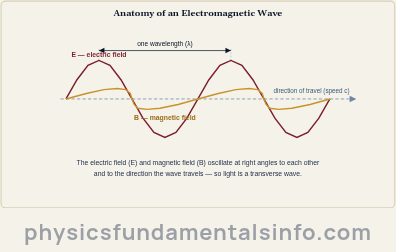
An electromagnetic wave: perpendicular electric and magnetic fields, in step, propagating at the speed of light. The crest-to-crest distance is one wavelength.
Why does climbing the spectrum mean more energy? Because energy travels in photons, and a photon’s energy depends only on frequency (E = hf). A radio photon is feeble; a gamma photon carries trillions of times more. The speed is identical — what changes is the size of each energy packet.
The Seven Bands of the Electromagnetic Spectrum
By long convention the spectrum is split into seven named bands. The boundaries are not sharp lines in nature — they overlap and shade into one another — but the order never changes. From longest wavelength to shortest, it runs radio, microwave, infrared, visible, ultraviolet, X-ray, gamma.
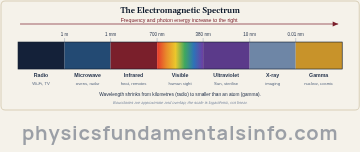
The seven bands of the electromagnetic spectrum. Wavelength decreases left to right while frequency and photon energy rise.
The table below gives the approximate range and everyday role of each band. Treat the figures as round signposts, not exact fences.
| Band | Wavelength (approx.) | Frequency (approx.) | Photon energy (approx.) | Everyday sources & uses |
|---|---|---|---|---|
| Radio | > 1 m | < 300 MHz | below ~1 μeV | Broadcast radio, TV, Wi-Fi, mobile signals, radio astronomy |
| Microwave | 1 mm – 1 m | 300 MHz – 300 GHz | ~1 μeV – 1 meV | Microwave ovens, radar, satellite & phone links |
| Infrared | 700 nm – 1 mm | 300 GHz – 430 THz | ~1 meV – 1.8 eV | Heat, thermal cameras, night vision, TV remotes |
| Visible | 380 – 700 nm | 430 – 790 THz | ~1.8 – 3.3 eV | Human sight, lasers, fibre-optic light, photography |
| Ultraviolet | 10 – 380 nm | 790 THz – 30 PHz | ~3.3 – 124 eV | Sunburn, sterilisation, fluorescence, the Sun |
| X-ray | 0.01 – 10 nm | 30 PHz – 30 EHz | ~124 eV – 124 keV | Medical & dental imaging, security scanners, X-ray astronomy |
| Gamma | < 0.01 nm | > 30 EHz | above ~124 keV | Radioactive decay, nuclear medicine, cosmic events |
NASA’s Tour of the Electromagnetic Spectrum shows how astronomers exploit every one of these bands, since each reveals a different face of the universe — cool gas glows in radio, exploding stars blaze in gamma.
Real-World Examples of the Electromagnetic Spectrum
The spectrum is not an abstraction filed away in a textbook. You use most of it before breakfast.
Radio and microwaves carry your signals
Every text, call and video stream rides on radio and microwave waves. They pass through walls and clouds easily, which is exactly why they are chosen for broadcasting and satellite links rather than visible light.
Infrared is heat you can almost see
Point a TV remote and you fire invisible infrared pulses. Your warm body glows in infrared too — the principle behind thermal cameras, which turn heat into a picture even in total darkness.

Visible light lets you read this
The narrow visible band is the only part your eyes evolved to catch. Red light has the longest visible wavelength, violet the shortest — and mixed together they make the white light of the Sun.
Ultraviolet, X-rays and gamma rays — useful but sharp
Ultraviolet from the Sun tans and burns skin and sterilises equipment. X-rays slip through soft tissue to photograph bone. Gamma rays, the most energetic of all, are aimed with precision to destroy cancerous cells. The higher the energy, the more carefully it must be handled.
Common Misconceptions About the Electromagnetic Spectrum
“Higher-frequency waves travel faster”
They do not. In a vacuum every band travels at exactly the same speed, c. A gamma ray is not “faster” than a radio wave — it simply oscillates far more times per second over a far shorter wavelength. Speed is fixed; frequency and wavelength trade off through c = fλ.
“Each band is a different kind of thing”
Radio, light and gamma rays are not separate phenomena. They are all electromagnetic radiation — the same ripple of electric and magnetic fields, obeying the same equations. The only difference between them is scale: wavelength and frequency.
“Sound is part of the electromagnetic spectrum”
It is not. Sound is a mechanical wave: it compresses a medium and cannot cross a vacuum. Electromagnetic waves need no medium at all. That is precisely why you can see the Sun but could never hear it.
“Microwave ovens tune in to water’s resonant frequency”
A popular myth, but wrong. At 2.45 GHz an oven does not strike a natural resonance of the water molecule. Instead the oscillating field drives polar water molecules to twist and jostle — dielectric heating — and the resulting friction warms the food. The frequency is an engineering choice, not a resonance.
How the Electromagnetic Spectrum Relates to Waves, Light and Relativity
The spectrum sits at a crossroads of several big ideas. Each band’s identity is set by its frequency — the higher the frequency, the shorter the wavelength and the greater the photon energy.
What unites every band is the speed of light. In a vacuum, radio and gamma rays alike travel at exactly 299,792,458 m/s, a value fixed by international definition. That constant is also the cosmic speed limit at the heart of special relativity — nothing carrying information outruns light.
The spectrum even tells us about motion. When a source races away, its light is stretched to longer, redder wavelengths — the Doppler effect for light. This “redshift” is how astronomers measure the expanding universe, reading a galaxy’s speed straight from the colour of its light.
Worked Problems
Show Solution
Solution:
Step 1: Use the wave equation, c = fλ, rearranged for wavelength: λ = c / f.
Step 2: Substitute, with f = 98.0 MHz = 9.80 × 10⁷ Hz and c = 2.998 × 10⁸ m/s. λ = (2.998 × 10⁸ m/s) / (9.80 × 10⁷ Hz).
Step 3: λ = 3.06 m.
Answer: λ ≈ 3.06 m (radio wavelengths are a few metres long).
Show Solution
Solution:
Step 1: Rearrange c = fλ for frequency: f = c / λ.
Step 2: Substitute, with λ = 550 nm = 5.50 × 10⁻⁷ m. f = (2.998 × 10⁸ m/s) / (5.50 × 10⁻⁷ m).
Step 3: f = 5.45 × 10¹⁴ Hz.
Answer: f ≈ 5.45 × 10¹⁴ Hz (545 THz).
Show Solution
Solution:
Step 1: Use E = hc / λ, with hc = 1.986 × 10⁻²⁵ J·m.
Step 2: Substitute. E = (1.986 × 10⁻²⁵ J·m) / (5.50 × 10⁻⁷ m) = 3.61 × 10⁻¹⁹ J.
Step 3: Convert to eV by dividing by 1.602 × 10⁻¹⁹ J/eV: E = 2.25 eV.
Answer: E ≈ 3.61 × 10⁻¹⁹ J ≈ 2.25 eV.
Show Solution
Solution:
Step 1: λ = c / f, with f = 2.45 × 10⁹ Hz.
Step 2: λ = (2.998 × 10⁸ m/s) / (2.45 × 10⁹ Hz) = 0.122 m = 12.2 cm.
Step 3: Hot-spot spacing = λ / 2 = 6.1 cm.
Answer: λ ≈ 12.2 cm; hot spots ≈ 6.1 cm apart — which is why ovens use a turntable.
Show Solution
Solution:
Step 1: Use E = hc / λ with hc = 1240 eV·nm (a handy form for photon energy in eV).
Step 2: Substitute. E = (1240 eV·nm) / (0.10 nm) = 12,400 eV.
Step 3: Convert: 12,400 eV = 12.4 keV.
Answer: E = 12.4 keV — thousands of times more energetic than a visible photon (~2 eV).
Show Solution
Solution:
Step 1: Photon energy is inversely proportional to wavelength (E = hc / λ), so the ratio is E_gamma / E_radio = λ_radio / λ_gamma.
Step 2: Substitute. Ratio = (1.0 m) / (1.0 × 10⁻¹² m).
Step 3: Ratio = 1.0 × 10¹².
Answer: about 1 trillion (1012) times more energy — same speed, vastly different energy, because energy lives in frequency, not speed.