The speed of light is the speed at which electromagnetic radiation travels through a vacuum, equal to exactly 299,792,458 metres per second (about 3 × 10⁸ m/s). Denoted by the symbol c, it is the universe’s ultimate speed limit — nothing carrying mass or information can travel faster.
Flip a switch and the room seems to brighten the instant your finger moves. Look up at a distant star, though, and you’re staring at light that left it years — sometimes thousands of years — ago. The difference comes down to distance and one fixed speed.
That speed is roughly 300,000 kilometres every second. Fast enough to lap the Earth seven and a half times before you finish reading this sentence — yet so slow against cosmic distances that the nearest star’s light still takes over four years to reach us.
What Is the Speed of Light?
Speed just means how much distance something covers in a given time — a car doing 100 km/h, say. The speed of light takes that same idea to its absolute extreme: it is how fast a flash of light travels through empty space.
In a vacuum, light moves at exactly 299,792,458 metres per second. Physicists round this to about 3 × 10⁸ m/s, or roughly 300,000 km/s, and label it with the single letter c.
Here’s the strange part. Unlike a car’s speed, c never changes with your point of view. Whether you race toward a beam of light or sprint away from it, you measure the same value. That one fact — the constancy of light — is the seed from which modern physics grew.
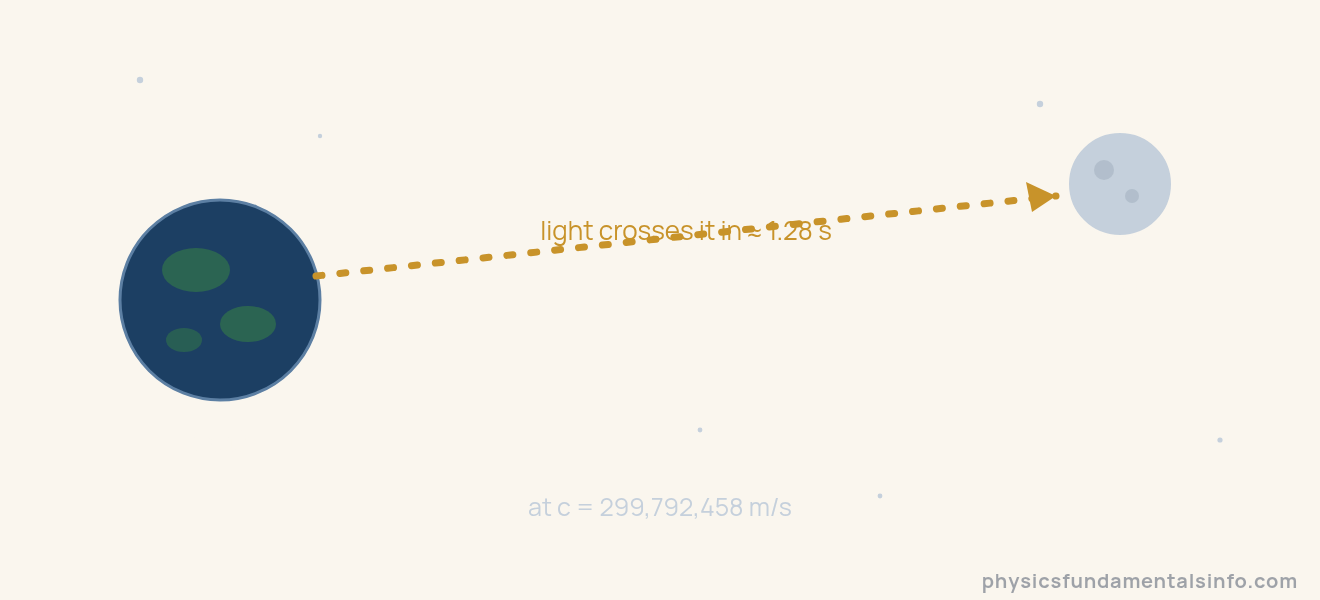
Even at light speed, a signal to the Moon arrives about 1.28 seconds later — the lag you’d hear on a Moon-to-Earth phone call.
Why the letter “c”?
The symbol c is widely thought to come from the Latin celeritas, meaning swiftness. It’s worth being precise about what c describes versus everyday motion — our guide on how speed differs from velocity sorts out the terms. The short version: c is a speed, a pure rate, with no direction attached.
The Speed of Light Formula and Value
The most important “formula” for the speed of light is really just its fixed value:
From there, c slots into several key equations. Because light is a wave, its speed links its frequency and wavelength:
- c — speed of light in a vacuum (metres per second, m/s)
- f — frequency of the wave (hertz, Hz)
- λ — wavelength (metres, m)
This is why all colours of light, from radio waves to gamma rays, share the same speed despite wildly different wavelengths. If you want the mechanics of that relationship, the frequency formula breaks it down.
Inside a material rather than a vacuum, light slows down. Its speed there is:
- v — speed of light in the material (m/s)
- c — speed of light in a vacuum (m/s)
- n — refractive index of the material (a pure number, n ≥ 1)
And the deepest formula of all comes from electromagnetism. James Clerk Maxwell showed that c is built directly into the constants governing electric and magnetic fields:
- μ0 — vacuum permeability, ≈ 1.257 × 10⁻⁶ N/A2
- ε0 — vacuum permittivity, ≈ 8.854 × 10⁻¹² F/m
That vacuum permittivity, ε0, is the same constant that appears in Coulomb’s law for the force between charges. The speed of light, in other words, was hiding inside electricity and magnetism all along.
How Do We Know the Speed of Light?
For most of history, people assumed light arrived instantly. The first crack in that idea came in 1676.
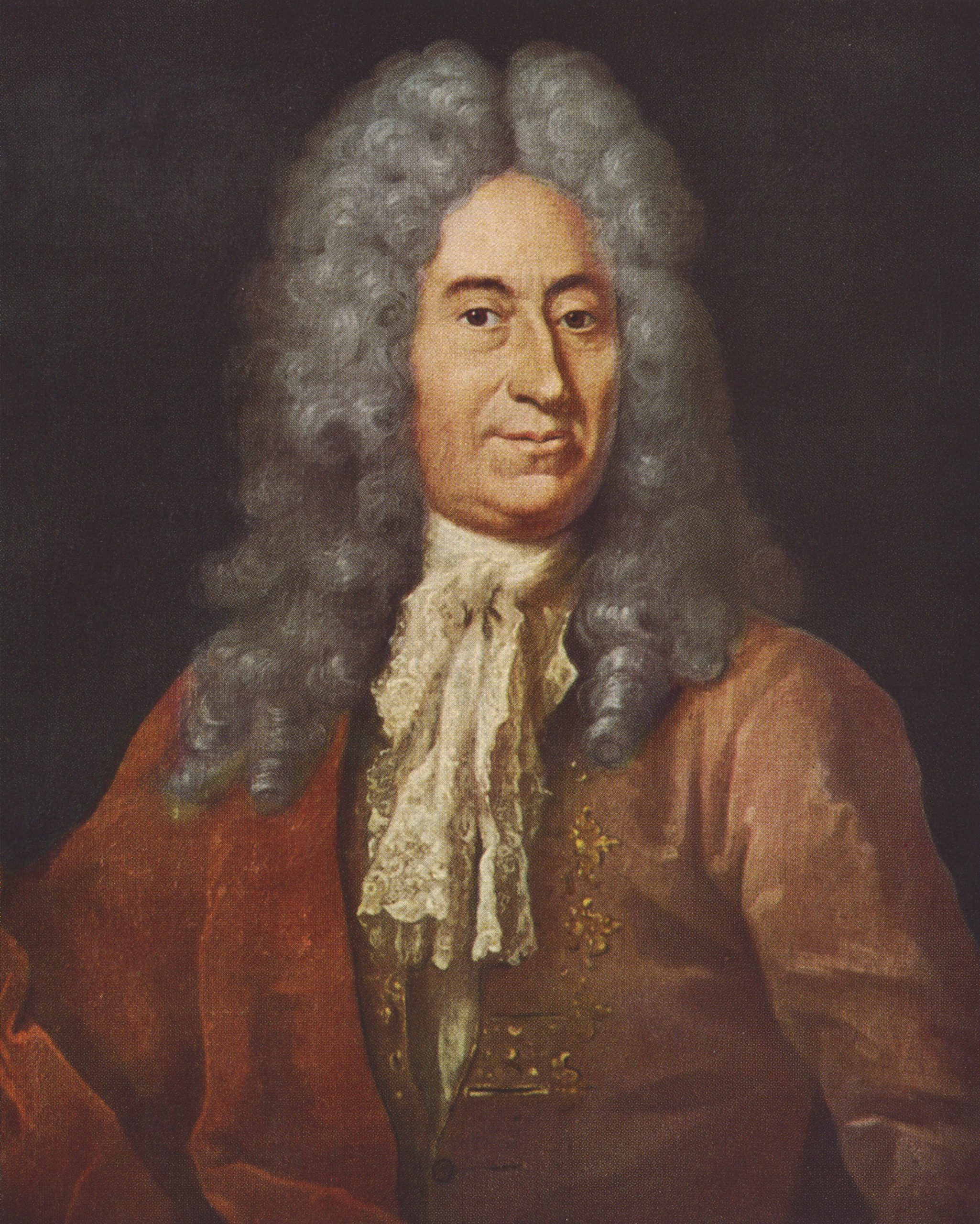
Danish astronomer Ole Rømer was timing eclipses of Io, one of Jupiter’s moons. He noticed the eclipses ran early when Earth was near Jupiter and late when it was far — exactly what you’d expect if light needed extra time to cross the extra distance. Light, he concluded, travels at a finite speed.
Almost two centuries later, Hippolyte Fizeau measured c on Earth. In 1849 he bounced a beam through the gaps of a fast-spinning toothed wheel to a distant mirror and back; by tuning the wheel’s speed until a returning flash was blocked, he timed light over a few kilometres. Léon Foucault and, later, Albert Michelson refined the method with rotating mirrors and pushed the precision ever higher.
Then physics turned the question inside out. Since 1983, c is no longer something we measure — it is defined. The metre itself is set as the distance light travels in 1/299,792,458 of a second, so the speed of light is now exact by international agreement, as the NIST definition of the SI units spells out.
See the scale for yourself — watch a light pulse make the journey in real time:
Why Is the Speed of Light the Universe’s Speed Limit?
If c is just a speed, why can’t we simply go faster? The answer reshaped our understanding of space and time.
In 1905, Einstein took the constancy of light seriously and followed it to its conclusions in his theory of special relativity. One result: the faster an object moves, the more energy it takes to speed it up further. Push toward c and the energy needed climbs without limit.
To accelerate anything with mass all the way to the speed of light would take infinite energy. So massive objects can only ever approach c, never reach it. Massless things — light itself, and gravitational waves — have no choice but to travel at exactly c.
This links to physics’ most famous equation, mass-energy equivalence:
- E — energy (joules, J)
- m — mass (kilograms, kg)
- c — speed of light (m/s)
That huge c2 is why a tiny amount of mass holds an enormous amount of energy. The speed of light isn’t just how fast light goes — it’s the conversion rate between matter and energy, woven into the structure of reality.
Does Light Always Travel at the Same Speed?
Only in a vacuum. The headline value of c applies to empty space; push light through a material and it slows down.
In water, light drops to about three-quarters of its vacuum speed. In ordinary glass it’s closer to two-thirds, and in diamond barely two-fifths. The denser and more optically “sticky” the material — the higher its refractive index — the more light is held up.
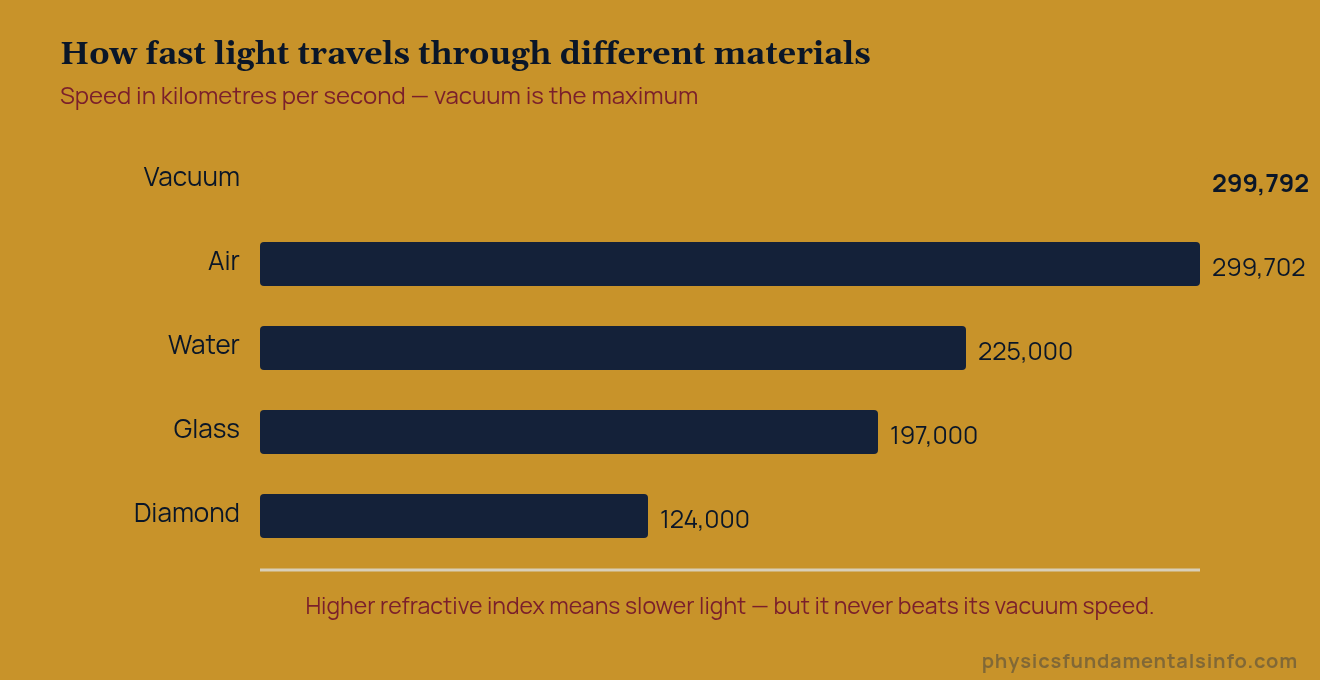
Light slows in matter: about three-quarters of c in water, under half of c in diamond.
This slowdown is what bends light at the surface of water or through a prism, splitting white light into a rainbow. Inside the material, light interacts constantly with the atoms, and those interactions hold up its overall progress. The moment it exits back into a vacuum, it instantly returns to full speed c.
Real-World Examples of the Speed of Light
Sunlight is already eight minutes old
The Sun sits about 150 million kilometres away, so its light takes roughly 8 minutes and 20 seconds to reach us. You never see the Sun as it is right now — only as it was eight minutes ago. If it somehow blinked out, we’d carry on in daylight for over eight minutes.
GPS depends on it
Satellite navigation works by measuring how long signals take to travel from satellites to your phone — at the speed of light. The timing has to be astonishingly precise: an error of just one microsecond translates into a position error of about 300 metres. Engineers even correct for relativistic effects to keep GPS accurate.
It sets a floor on internet latency
No message can cross the planet faster than light allows. A signal between London and New York covers about 5,600 km, so even at full speed it needs roughly 19 milliseconds one way. Through fibre-optic cable, where light travels slower, it’s nearer 28 ms — a hard physical limit no upgrade can beat.
Telescopes are time machines
Because light takes time to travel, looking far away means looking into the past. Astronomers measure these distances in light-years — the distance light covers in one year, about 9.46 trillion kilometres, as NASA explains. Telescopes like James Webb capture light that left its source billions of years ago.
You can’t joystick a Mars rover
Radio waves travel at c too, so commands to a rover on Mars take several minutes to arrive — anywhere from about 3 to 22 minutes one way, depending on where the two planets are. Real-time driving is impossible; rovers must follow pre-planned, self-checking instructions.
Common Misconceptions About the Speed of Light
Myth: nothing can ever move faster than light
More precisely: nothing with mass, and no information or signal, can outrun light in a vacuum. There are loopholes that don’t break this rule. Space itself can expand so quickly that distant galaxies recede faster than light, and inside a medium, particles can briefly outrun light’s slower local speed — that’s what creates the eerie blue Cherenkov glow in nuclear reactor pools.
Myth: the speed of light is exactly 300,000 km/s
It’s actually 299,792.458 km/s. The round “300,000” is a handy approximation, off by less than 0.1%. For schoolwork the 3 × 10⁸ m/s shortcut is fine — just know it isn’t the exact figure.
Myth: light isn’t affected by gravity because it has no mass
Gravity bends light’s path regardless. Massive objects curve the spacetime that light travels through, so starlight passing near the Sun is deflected — a prediction confirmed during the 1919 solar eclipse. This same effect, gravitational lensing, lets distant galaxies act as natural magnifying lenses.
Myth: light always travels at c
Light hits its full speed c only in a vacuum. In water, glass, or any material it slows to v = c/n. So “the speed of light” as a fixed number always refers to its vacuum value.
How the Speed of Light Connects to Relativity, Light-Years and Beyond
The speed of light is a thread running through much of physics. Because c is the same for every observer, fast motion warps time and length — the heart of special relativity, where moving clocks tick slow and E = mc2 turns mass into energy.
In astronomy, c becomes a ruler. The light-year and the eight-minute sunlight delay both come straight from light’s finite speed, letting us map the cosmos and peer into its past.
It also shapes how we read light from moving objects. When a source races toward or away from us, its light shifts in frequency — the Doppler effect. The redshift of distant galaxies, measured this way, is how we know the universe is expanding.
Worked Problems
Show Solution
Solution:
Step 1: Use distance = speed × time, so d = c × t.
Step 2: Substitute c and t = 1 s: d = 299,792,458 m/s × 1 s.
Step 3: d = 299,792,458 m ≈ 3.00 × 10⁸ m.
Answer: about 3 × 10⁸ m (300,000 km) — roughly three-quarters of the way to the Moon, in a single second.
Show Solution
Solution:
Step 1: Rearrange to t = d / c.
Step 2: Convert the distance to metres and substitute: t = (3.844 × 10⁸ m) ÷ (2.998 × 10⁸ m/s).
Step 3: t ≈ 1.28 s.
Answer: ≈ 1.28 seconds.
Show Solution
Solution:
Step 1: Use t = d / c.
Step 2: Substitute: t = (1.50 × 10¹¹ m) ÷ (2.998 × 10⁸ m/s) ≈ 500 s.
Step 3: Convert to minutes: 500 s ÷ 60 ≈ 8.3 min.
Answer: ≈ 8.3 minutes (about 8 minutes 20 seconds).
Show Solution
Solution:
Step 1: Number of laps N = (distance light travels in 1 s) ÷ (circumference).
Step 2: Substitute: N = 299,792 km ÷ 40,075 km.
Step 3: N ≈ 7.48.
Answer: about 7.5 times every second.
Show Solution
Solution:
Step 1: Use v = c / n.
Step 2: Substitute: v = (2.998 × 10⁸ m/s) ÷ 1.33.
Step 3: v ≈ 2.25 × 10⁸ m/s.
Answer: ≈ 2.25 × 10⁸ m/s — about 75% of light’s vacuum speed.
Show Solution
Solution:
Step 1: From c = fλ, rearrange to λ = c / f.
Step 2: Substitute: λ = (2.998 × 10⁸ m/s) ÷ (5.45 × 10¹⁴ Hz).
Step 3: λ ≈ 5.50 × 10⁻⁷ m = 550 nm.
Answer: ≈ 550 nm, squarely in the green part of the visible spectrum.
Show Solution
Solution:
Step 1: Use distance = c × time, with one year ≈ 3.156 × 10⁷ s (365.25 days).
Step 2: Substitute: d = (2.998 × 10⁸ m/s) × (3.156 × 10⁷ s) ≈ 9.46 × 10¹⁵ m.
Step 3: Convert to km: 9.46 × 10¹⁵ m ÷ 1000 = 9.46 × 10¹² km.
Answer: ≈ 9.46 trillion km (9.46 × 10¹² km).
Show Solution
Solution:
Step 1: One-way time t = d / c.
Step 2: Substitute: t = (2.25 × 10¹¹ m) ÷ (2.998 × 10⁸ m/s) ≈ 750 s.
Step 3: Convert and double: 750 s ÷ 60 ≈ 12.5 min one way; round trip = 2 × 12.5 = 25 min.
Answer: ≈ 12.5 minutes one way, ≈ 25 minutes round trip — which is why rovers can’t be driven like remote-control cars.
Frequently Asked Questions
What is the speed of light in m/s and mph?
Can anything travel faster than the speed of light?
Why does light slow down in water or glass?
How long does light from the Sun take to reach Earth?
Who first measured the speed of light?
What is a light-year?
| Destination | Approx. distance | Light travel time | What it means |
|---|---|---|---|
| The Moon | 384,400 km | ≈ 1.28 seconds | A live Moon call would have a clear lag. |
| The Sun | 150 million km (1 AU) | ≈ 8.3 minutes | You always see the Sun as it was 8 minutes ago. |
| Neptune (from the Sun) | ≈ 4.5 billion km | ≈ 4.2 hours | Even within our solar system, light takes hours. |
| Proxima Centauri | ≈ 40 trillion km (4.24 ly) | ≈ 4.24 years | The nearest star beyond our Sun. |
| Centre of the Milky Way | ≈ 26,000 light-years | ≈ 26,000 years | This light left before farming began on Earth. |
| Andromeda Galaxy | ≈ 2.5 million light-years | ≈ 2.5 million years | We see it as it looked before modern humans existed. |