Polarization of light is the orientation of a light wave’s electric-field oscillations relative to its direction of travel. Because light is a transverse electromagnetic wave, its vibrations can be filtered so they lie in a single plane, creating polarized light. Malus’s law, I = I0cos2θ, gives the fraction of intensity a polarizer transmits.
Tilt a pair of polarized sunglasses in front of a phone screen and rotate them slowly. At one angle the screen looks perfectly normal; a quarter-turn later it goes almost completely black. Nothing about the phone changed — you simply rotated a filter across light that was already lined up in one direction.
That hidden “direction” carried by light is what polarization is all about. It is why glare vanishes off a wet road, why 3D cinema glasses work, and why the very screen you are reading this on lights up at all.
What Is Polarization of Light?
Polarization of light describes which way a light wave’s electric field points as the wave races forward. Light is an electromagnetic wave, so it carries an electric field and a magnetic field that both oscillate at right angles to the direction of travel. Polarization is simply the label for the direction of that electric-field vibration.
Picture flicking a rope tied to a post. Shake your hand up and down and the wave travels along the rope while the rope itself moves vertically — that is a vertically “polarized” wave. Shake side to side and you get a horizontal one. Now slide a fence with vertical gaps over the rope: the vertical wave slips through, the horizontal one is blocked. A polarizer does exactly this to light.
In everyday polarization, most light around you is unpolarized. Sunlight and a light bulb pour out countless tiny waves whose electric fields point in every direction at once. Only after light bounces, scatters, or passes through the right material does one direction win out — and the light becomes polarized.
What Are the Types of Polarization?
Light has three polarization states — linear, circular, and elliptical — plus the everyday unpolarized case where the field points every which way. The type depends on how the electric-field vector behaves from one instant to the next.
Linear (plane) polarization
The electric field stays locked to a single line — vertical, horizontal, or any fixed angle. This is the state produced by a Polaroid filter, and it is the case Malus’s law describes.
Circular polarization
Here the field keeps a constant strength but its direction rotates steadily, tracing a corkscrew as the wave advances. It can spin clockwise or anticlockwise, and it is the trick behind modern 3D cinema glasses.
Elliptical polarization
The most general case: the field both rotates and changes length, so its tip sweeps out an ellipse. Linear and circular polarization are really just the two neat extremes of this broader family.
Unpolarized light
No single direction dominates. The field jitters through every orientation at random — this is natural light straight from the Sun or a filament before anything acts on it.
These states are not just textbook labels — they fall straight out of Maxwell’s equations for a transverse wave. For a rigorous, university-level derivation of the linear, circular, and elliptical cases, see MIT’s OpenCourseWare treatment of polarization.
The Malus’s Law Formula
Malus’s law states that when linearly polarized light of intensity I0 meets a polarizer whose axis sits at angle θ to the light’s polarization, the transmitted intensity is I0 multiplied by the square of the cosine of that angle.
Each symbol carries a clear meaning and unit:
- I — transmitted intensity of light leaving the polarizer, in watts per square metre (W/m2).
- I0 — intensity of the already-polarized light arriving at the polarizer (W/m2).
- θ — angle between the light’s polarization direction and the polarizer’s transmission axis, measured in degrees or radians.
The behaviour is easiest to feel at three angles. Line the axes up (θ = 0°) and everything gets through: I = I0. Cross them at a right angle (θ = 90°) and cos 90° = 0, so nothing passes. Sit exactly halfway (θ = 45°) and precisely half the light survives.
One warning that trips up almost everyone: Malus’s law only applies to light that is already polarized. Send unpolarized light into a single ideal polarizer and, whatever the angle, exactly half the intensity comes out — the “one-half rule” — because averaging cos2θ over all random directions gives one-half.
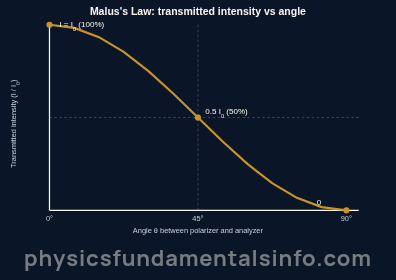
Malus’s law traces a smooth cos2θ curve — full brightness when the axes align, half at 45°, darkness when they cross.
The table below turns the same curve into hard numbers you can check against any Malus’s-law problem — or plug your own values straight into our Malus’s Law Calculator to solve for intensity, incident intensity, or angle in one step. If you want a deeper, worked derivation, OpenStax gives a clear university-level treatment of Malus’s law.
| Angle θ | cos θ | cos2θ | Transmitted intensity (from polarized I0) |
|---|---|---|---|
| 0° | 1.000 | 1.000 | I0 (100%) |
| 30° | 0.866 | 0.750 | 0.75 I0 (75%) |
| 45° | 0.707 | 0.500 | 0.50 I0 (50%) |
| 60° | 0.500 | 0.250 | 0.25 I0 (25%) |
| 90° | 0.000 | 0.000 | 0 (0%) |
How Does Polarization Work?
A polarizer works by transmitting only the part of a light wave’s electric field that lines up with its transmission axis, and absorbing the rest. Light arrives with its field pointing at angle θ to the axis. Split that field into two components — one along the axis, one across it — and only the along-axis part gets through.
That surviving component has size E cos θ, because that is simple vector projection. Here is the crucial step: the intensity of light is proportional to the electric field squared. Square E cos θ and the cos2 term appears — which is exactly where I = I0cos2θ comes from.
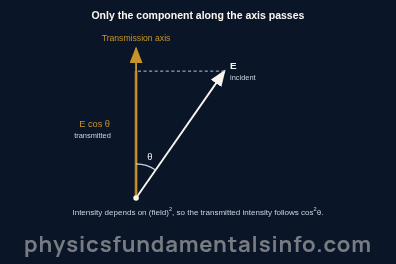
Vector projection: the field that survives is E cos θ, and squaring it gives the cos2θ in Malus’s law.
So what physically does the absorbing? In a Polaroid sheet, long chain-like molecules are stretched into parallel alignment. Electrons in those molecules slosh freely along the chains, soaking up any field component parallel to them, but they can barely move across the chains. The result is neat and slightly counter-intuitive: the transmission axis lies perpendicular to the molecules, not along them.
Feed unpolarized light in and two things happen at once. The intensity halves (the one-half rule), and the light that emerges is now cleanly linearly polarized. Add a second polarizer — an “analyzer” — and Malus’s law governs everything from there.
How Is Light Polarized?
Light becomes polarized in four main ways: selective absorption, reflection, scattering, and birefringence. Each one favours a single direction of vibration and quietly discards the rest.
1. Absorption (dichroism)
This is the Polaroid-filter route. Aligned molecules absorb one direction of the electric field and transmit the perpendicular one, turning unpolarized light into linearly polarized light in a single pass. It is how sunglasses and LCD panels do their job.
2. Reflection and Brewster’s angle
Light glancing off water, glass, or a wet road comes back partly polarized — parallel to the surface. At one special angle, called Brewster’s angle, the reflected light is completely polarized.
- θB — Brewster’s angle, measured from the normal to the surface (degrees).
- n1 — refractive index of the medium the light starts in (no unit).
- n2 — refractive index of the medium reflecting the light (no unit).
For air-to-water (n = 1.33) this works out to about 53°, and for air-to-glass (n = 1.52) about 57°. Because the glare is polarized parallel to a horizontal surface, sunglasses with a vertical transmission axis wipe it out.
3. Scattering
Sunlight bouncing off air molecules is partially polarized, which is why a clear blue sky looks brightest and darkest through rotating polarized lenses. Light scattered at 90° to the Sun is the most strongly polarized of all — a cue some insects use to navigate.
4. Birefringence (double refraction)
Some crystals, such as calcite, have two different refractive indices for the two polarization directions. An unpolarized ray entering the crystal splits into two separate rays with perpendicular polarizations — a vivid demonstration you can see with the naked eye.
| Method | What happens | Everyday example |
|---|---|---|
| Absorption (dichroism) | Aligned molecules absorb one field direction | Polaroid sunglasses, LCD filters |
| Reflection | Glare is partly polarized; fully polarized at Brewster’s angle | Glare on water and roads |
| Scattering | Air molecules re-radiate polarized light | The polarized blue sky |
| Birefringence | A crystal splits light into two polarized rays | A calcite crystal doubling an image |
Real-World Examples of Polarization
Polarization shows up in polarized sunglasses, LCD and OLED screens, camera filters, 3D cinema, blue-sky photography, and engineering stress tests. Once you know the effect, you start spotting it everywhere.
1. Polarized sunglasses
Glare off water and tarmac is horizontally polarized, so lenses with a vertical transmission axis block it while letting ordinary scenery through. That is why polarized lenses cut dazzle without simply dimming everything.
2. LCD and LED screens
Every liquid-crystal display is a polarization sandwich. Two crossed polarizers would normally show black, but a liquid-crystal layer twists the light’s polarization by 90° so it can pass — and a voltage switches that twist off, darkening each pixel on command.
3. Camera polarizing filters
Screw a polarizing filter onto a lens and reflections off glass and water fade away while skies deepen to a richer blue. Photographers rotate the filter to dial the effect in, exactly as Malus’s law predicts.
4. 3D cinema
Modern 3D projects two overlapping images with opposite circular polarizations. Each lens of your glasses passes only one, so each eye sees a slightly different view and your brain fuses them into depth.
5. The blue sky and navigation
Scattered skylight is polarized in a predictable pattern, and animals such as bees read it like a compass even when the Sun is hidden. Vikings may have used “sunstones” — birefringent crystals — for the same trick.
6. Stress analysis (photoelasticity)
Squeeze a clear plastic model between crossed polarizers and rainbow bands appear wherever the material is stressed. Engineers use this “photoelastic” method to see force concentrations in components before they ever build the real thing.
Common Misconceptions About Polarization
The biggest myth is that polarization bends light or changes its direction — it does not; it only selects the direction the field vibrates in. A polarizer trims a wave down, it never steers it. Here are the other slips worth clearing up.
“Sound can be polarized too”
It cannot. Polarization is only possible for transverse waves, and sound is a longitudinal wave — its vibrations run back and forth along the direction of travel, so there is no sideways direction to filter. In fact, the very existence of polarization is proof that light is transverse. This is one reason understanding the difference between transverse and longitudinal waves unlocks so much of optics.
“Two crossed polarizers always block everything”
Not so — and this one is genuinely startling. Cross two polarizers at 90° and no light passes. Now slip a third polarizer at 45° between them, and light reappears. The middle filter rotates the polarization in stages, so a fraction sneaks all the way through. Adding a filter lets more light out, not less.
“Malus’s law works for any light”
Only for light that is already polarized. Unpolarized light hitting the first polarizer follows the one-half rule (I0 becomes 0.5 I0), and only then does Malus’s law take over for any further polarizers. Mixing these two rules up is the single most common exam mistake.
“Polarized light is a rare, exotic thing”
Far from it. Screen light, reflected glare, and much of the daytime sky are all at least partly polarized. You are almost certainly surrounded by polarized light right now.
How Polarization Relates to Other Wave Phenomena
Polarization is one of several properties of light as an electromagnetic wave, sitting alongside its speed, frequency, wavelength, reflection, and refraction. It is the piece that pins down direction of vibration, and it dovetails neatly with the rest of wave physics.
Because polarization only exists for transverse waves, it is tied directly to light’s identity as an electromagnetic wave travelling at the speed of light. A wave still has its other traits at the same time — its frequency and wavelength set its colour and energy, while polarization sets the plane it wobbles in. These properties are independent: red and blue light can each be polarized or not.
Polarization also links to how waves interact with matter and motion. Reflection at Brewster’s angle produces polarized glare; refraction bends the transmitted part; and the Doppler effect shifts a wave’s frequency when the source moves. Together these effects form the toolkit for understanding almost everything light does.
Worked Problems
Show Solution
Solution:
Step 1: Use Malus’s law, I = I0cos2θ, with I0 = 600 W/m2 and θ = 30°.
Step 2: cos 30° = 0.866, so cos230° = 0.750.
Step 3: I = 600 × 0.750 = 450 W/m2.
Answer: 450 W/m2
Show Solution
Solution:
Step 1: For unpolarized light through one polarizer, apply the one-half rule (Malus’s law does not apply directly to unpolarized light).
Step 2: I = 0.5 × I0 = 0.5 × 240 W/m2.
Step 3: I = 120 W/m2.
Answer: 120 W/m2
Show Solution
Solution:
Step 1: Set I/I0 = 0.25 in Malus’s law: cos2θ = 0.25.
Step 2: cos θ = sqrt(0.25) = 0.500.
Step 3: θ = arccos(0.500) = 60°.
Answer: 60°
Show Solution
Solution:
Step 1: First polarizer (one-half rule): I1 = 0.5 × 900 = 450 W/m2, now polarized along the first axis.
Step 2: Second polarizer (Malus’s law, θ = 30°): I2 = 450 × cos230° = 450 × 0.750.
Step 3: I2 = 337.5 W/m2.
Answer: 337.5 W/m2
Show Solution
Solution:
Step 1: This is Brewster’s angle, tan θB = n2/n1, with n1 = 1.00 (air) and n2 = 1.33 (water).
Step 2: tan θB = 1.33 / 1.00 = 1.33.
Step 3: θB = arctan(1.33) = 53.1°.
Answer: 53.1° from the normal
Show Solution
Solution:
Step 1: First polarizer (one-half rule): 1000 W/m2 becomes 500 W/m2, polarized at 0°.
Step 2: Second polarizer at 45° (θ = 45°): 500 × cos245° = 500 × 0.500 = 250 W/m2.
Step 3: Third polarizer at 90° (θ = 45° from the second): 250 × cos245° = 250 × 0.500 = 125 W/m2.
Answer: 125 W/m2 — one-eighth of the original, even though the outer pair alone would pass nothing.
Show Solution
Solution:
Step 1: First polarizer halves it: after it, the intensity is 0.5 I0.
Step 2: Require 0.5 × cos2θ = 0.30, so cos2θ = 0.60 and cos θ = sqrt(0.60) = 0.7746.
Step 3: θ = arccos(0.7746) = 39.2°.
Answer: about 39.2°
Show Solution
Solution:
Step 1: After the first polarizer, intensity = 0.5 I0. After the middle polarizer at θ: (0.5 I0)cos2θ.
Step 2: The last polarizer is 90° from the first, so it is (90° – θ) from the middle one. Output = (0.5 I0)cos2θ × cos2(90° – θ) = (0.5 I0)cos2θ × sin2θ.
Step 3: Using cos2θ × sin2θ = 0.25 sin2(2θ), the output = (I0/8) sin2(2θ), which is largest when 2θ = 90°, i.e. θ = 45°.
Answer: θ = 45° gives the maximum, I0/8.
Frequently Asked Questions
What is polarization of light in simple terms?
Polarization of light is the direction in which a light wave’s electric field vibrates as it travels. Ordinary light vibrates in every direction at once (unpolarized), but a polarizer can filter it down to a single plane. That filtered light is called polarized light.
What is the formula for Malus's law?
Malus’s law is I = I0cos2θ. Here I is the transmitted intensity, I0 is the intensity of the polarized light hitting the polarizer, and θ is the angle between the light’s polarization and the polarizer’s transmission axis. It applies only to light that is already polarized.
Why does unpolarized light lose half its intensity through a polarizer?
An ideal polarizer passes only one direction of vibration, and unpolarized light is an even mix of all directions. Averaging cos2θ over every random angle gives exactly one-half, so half the intensity is transmitted and half is absorbed. This is called the one-half rule.
How do polarized sunglasses reduce glare?
Glare reflecting off horizontal surfaces such as water or roads is mostly polarized in the horizontal direction. Polarized sunglasses have a vertical transmission axis, so they block that horizontal glare while still passing useful light. The result is reduced dazzle without simply darkening the whole scene.
Can sound waves be polarized?
No. Only transverse waves can be polarized, and sound in air is a longitudinal wave — it vibrates back and forth along its direction of travel, leaving no sideways direction to filter. The fact that light can be polarized is direct evidence that light is a transverse wave.
What is Brewster's angle?
Brewster’s angle is the angle of incidence at which light reflected from a surface becomes completely polarized. It is found from tan θB = n2/n1, where n1 and n2 are the refractive indices of the two media. For air to water it is about 53°, and for air to glass about 57°.
Why does adding a third polarizer between two crossed ones let light through?
Two crossed polarizers pass no light. A third polarizer set at 45° in between rotates the polarization in two smaller steps instead of one impossible 90° jump, so a fraction survives each stage. The result is that light emerges — up to one-eighth of the original for unpolarized input.