Refractive index (n) measures how much a material slows light: it is the ratio of the speed of light in a vacuum, c, to its speed in the material, v, so n = c/v. Water has n = 1.33, typical glass about 1.5 and diamond 2.42 — the larger the value, the slower the light and the more strongly it bends.
Hold a cheap cubic zirconia next to a real diamond and, at arm’s length, they look identical. Tilt them under a lamp, though, and the diamond erupts with far more flash. Almost the entire difference comes down to one number: 2.42 versus 2.16.
That number is the refractive index, and this page is built around it. The full lookup table comes first, then the ratio behind it, how to measure it yourself, and where those decimal places quietly run the modern world — from spectacle lenses to fibre broadband.
Refractive Index Table: n Values for 15 Common Materials
The refractive index of common materials runs from exactly 1 for a vacuum, through 1.33 for water and about 1.5 for glass, up to 2.42 for diamond. Unless stated otherwise, the values below are measured with yellow sodium light (589 nm) at roughly 20 °C — the standard reference conditions used in data tables.
| Material | Refractive index (n) | Speed of light inside (v = c/n) |
|---|---|---|
| Vacuum | 1 (exact) | 3.00 × 10⁸ m/s (c itself) |
| Air (0 °C, 1 atm) | 1.000293 | ≈ c (0.03% slower) |
| Ice (0 °C) | 1.31 | 2.29 × 10⁸ m/s |
| Water (20 °C) | 1.333 | 2.25 × 10⁸ m/s |
| Ethanol | 1.361 | 2.20 × 10⁸ m/s |
| Fused quartz (silica) | 1.458 | 2.06 × 10⁸ m/s |
| Olive oil | 1.47 | 2.04 × 10⁸ m/s |
| Glycerol | 1.473 | 2.04 × 10⁸ m/s |
| Crown glass | 1.52 | 1.97 × 10⁸ m/s |
| Table salt (NaCl) | 1.544 | 1.94 × 10⁸ m/s |
| Polycarbonate | 1.586 | 1.89 × 10⁸ m/s |
| Flint glass (dense) | 1.62 | 1.85 × 10⁸ m/s |
| Sapphire | 1.77 | 1.69 × 10⁸ m/s |
| Cubic zirconia | 2.16 | 1.39 × 10⁸ m/s |
| Diamond | 2.417 | 1.24 × 10⁸ m/s |
Notice the pattern as you read down. Gases barely rise above 1, everyday liquids cluster between 1.3 and 1.5, glasses and clear plastics sit around 1.5 to 1.6, and gemstones own the top of the chart.
Even air’s tiny 1.000293 matters more than it looks. Laser interferometers measure lengths in wavelengths of light, so precision labs must correct for air’s index — NIST maintains dedicated calculators (the Ciddor and Edlén equations) for exactly that correction.
One caveat before you quote a value in an exam: n shifts in the third decimal place with the colour of the light and with temperature. More on that below.
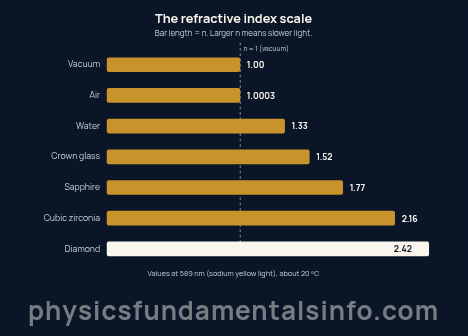
The refractive index scale: every everyday transparent material sits between vacuum (1) and diamond (2.42).
What Is the Refractive Index?
The refractive index is a dimensionless number that tells you how many times slower light travels in a material than in a vacuum. Glass with n = 1.5 slows light to two-thirds of its vacuum speed; diamond, at 2.42, drags it to well under half.
You will also see the same quantity called the index of refraction — the usual term in American textbooks — or described through “optical density”: the optically denser medium is simply the one with the higher n. The reference speed, c, is the fastest anything in the universe can travel, a story we unpack in our guide to the speed of light.
Why does light slow down at all, and why does slowing make a ray bend? That mechanism — waves, wavefronts and the marching-band turn — is the territory of our reflection and refraction guide. Here, we stay with the number itself: what it equals, how to look it up, and how to use it.
The Refractive Index Formula: n = c/v
The refractive index formula is n = c/v: divide the speed of light in a vacuum by the speed of light in the material.
- n — refractive index of the material (dimensionless, no units)
- c — speed of light in a vacuum = 299,792,458 m/s, usually rounded to 3.00 × 10⁸ m/s
- v — speed of light inside the material, in metres per second (m/s)
Because it is one speed divided by another, the units cancel completely — n is a pure number, and it is at least 1 for every ordinary transparent material. Rearranged, the same relationship hands you the speed directly:
That rearrangement is exactly how the third column of the table above was built. Try it once by hand — glass: v = 3.00 × 10⁸ ÷ 1.5 = 2.00 × 10⁸ m/s — or work it out instantly either way round with our Refractive Index Calculator, which solves for n or for v.
A quick sanity check worth keeping: every transparent solid and liquid you are likely to meet has n between 1 and about 2.65. If your calculation returns 0.44 or 4.4, the ratio has almost certainly been flipped upside down.
Absolute vs Relative Refractive Index
An absolute refractive index compares a material with a vacuum, while a relative refractive index compares one material directly with another. Every value in the table above is absolute; the relative version is what you need when light crosses from one substance straight into a second.
Here n21 is the index of medium 2 relative to medium 1. Take light passing from water (1.333) into crown glass (1.52): n21 = 1.52 ÷ 1.333 = 1.14, so the light travels 1.14 times slower in the glass than it did in the water.
Run the trip in reverse and you get 1.333 ÷ 1.52 = 0.88 — and yes, a relative index below 1 is perfectly fine. It simply says light speeds up crossing that boundary. One handy exam shortcut: air’s absolute index (1.0003) is so close to 1 that “from air into X” problems use the absolute values directly.
How Do You Measure Refractive Index?
You measure refractive index either by tracing how a light ray bends and applying Snell’s law, or by reading it straight off an instrument called a refractometer. Four methods cover almost every situation:
- Glass-block ray tracing (the classroom method). Shine a ray into a rectangular block, mark the path, and measure the angles of incidence and refraction from the normal. Then n = sin θ1 ÷ sin θ2 for light arriving from air.
- Critical-angle method. With a semicircular block, find the angle at which the emerging ray just grazes the surface; the index follows from n = 1 ÷ sin θc.
- Refractometer. A drop of liquid on an Abbe or handheld refractometer returns n to four decimal places in seconds — the standard tool in chemistry, brewing and gemmology, as this University of Toronto lab guide walks through.
- Apparent depth. For a transparent liquid, n = real depth ÷ apparent depth — the same effect that makes a swimming pool look only about three-quarters as deep as it is.
The single most common student slip? Measuring angles from the glass surface instead of from the normal — the imaginary line at 90° to the boundary. Every angle in refraction work is measured from the normal, and marking that line first saves the lost mark.
In practice, professionals also correct for temperature: a liquid’s reading drifts by roughly 0.0004 to 0.0005 per degree Celsius, which is why bench refractometers circulate temperature-controlled water around the sample.
Why Does Refractive Index Change with Wavelength?
Refractive index changes with wavelength because a material’s electrons respond more strongly to some frequencies of light than others, so violet light is slowed more than red. In a typical crown glass, n climbs from about 1.51 in the red to about 1.53 in the violet.
That spread is called dispersion, and it is the whole reason a prism fans white light into a spectrum and raindrops split sunlight into a rainbow — a story we trace, prism in hand, in our guide to the dispersion of light.
It is also why careful tables pin the wavelength down. The standard reference is the sodium D-line at 589 nm — the warm yellow of an old street lamp — so that two labs quoting “n = 1.52” for the same glass are genuinely measuring the same thing.
Diamond takes dispersion to extremes. Its index climbs from about 2.41 in the red to about 2.44 in the violet, and that spread is the “fire” jewellers prize: each colour exits a facet at a slightly different angle, splashing tiny rainbows around the room.
Real-World Examples of Refractive Index
From gem testing to fibre broadband, the refractive index is a working number that whole industries measure, tune and buy by. Here are four places it earns its keep.
Spotting a fake diamond
Diamond (2.42), cubic zirconia (2.16) and moissanite (2.65) look similar at a glance, but their indices give them away through sparkle, fire and light return. Here is a working gemmologist’s detail: a standard contact refractometer only reads up to about 1.81, so diamond and its imitations all show “over the limit” — one reason testers lean on thermal conductivity instead.
Fibre-optic broadband
The glass core of an optical fibre has n ≈ 1.468, so your data physically travels at roughly two-thirds of c — about 4.9 microseconds per kilometre. In practice that index, not the electronics, sets the floor on internet latency between continents.
Thinner spectacle lenses
A strong prescription in standard n = 1.5 plastic needs thick, heavy edges. High-index lens materials at 1.67 or 1.74 bend light more per millimetre, so the same correction fits in a visibly slimmer, lighter lens — you are literally paying for decimal places of n.
Sugar, beer and antifreeze
Dissolving sugar in water nudges its refractive index upward in a predictable way. A handheld Brix refractometer converts that shift straight into a sugar percentage, which is how brewers track fermentation and how winemakers time the harvest. The same trick, recalibrated, tests the strength of engine coolant.
Common Misconceptions About Refractive Index
Four wrong beliefs cause most refractive index mistakes. Clearing them now will save marks later.
“A higher refractive index means a denser material.”
Not necessarily — optical density and mass density are different things. Olive oil (n = 1.47) is optically denser than water (n = 1.333), yet it floats on top. The index tracks how strongly a material’s electrons respond to light, not how much the material weighs.
“Light changes frequency when it slows down.”
No — the frequency is fixed by the source and never changes at a boundary. What shrinks is the wavelength, to λ/n, exactly compensating for the lower speed; our frequency formula guide unpacks how v, f and λ lock together. Since colour rides on frequency, red light stays red inside the glass.
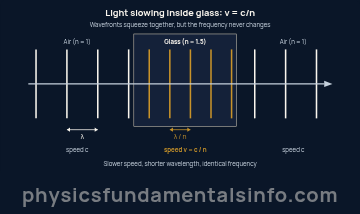
Inside the glass the wavefronts bunch up: wavelength drops to λ/n while the frequency stays exactly the same.
“A material’s refractive index is one fixed number.”
Any single value is a snapshot at one wavelength and one temperature. Crown glass runs from roughly 1.51 (red) to 1.53 (violet), and a warm liquid reads a few ten-thousandths lower than a cold one. For rough work, one number is fine; for precise work, quote the conditions.
“Nothing can have an index below 1.”
For visible light in ordinary transparent materials, n is indeed always above 1. But X-rays travelling through glass have n a whisker below 1: the wave’s phase pattern moves slightly faster than c. No energy or information ever outruns light in a vacuum, so relativity is perfectly safe.
How Refractive Index Relates to Refraction and Total Internal Reflection
The refractive index sets both how sharply light bends at a boundary and whether it can escape at all. Every headline behaviour of light at a surface is these table values fed into two short equations.
The bending is governed by Snell’s law, which weighs the two indices against each other:
Bigger jump in n, bigger bend — and that single line carries a five-step solving method, worked traps and all, in our dedicated Snell’s law guide.
Run light the other way, from a high-n material towards a low-n one, and there is an angle beyond which it cannot get out:
That critical angle is about 41° for glass into air, about 49° for water into air, and a remarkably tight 24.4° for diamond — which is precisely why a well-cut diamond traps light and fires it back out of the top. Past the critical angle, the boundary becomes a perfect mirror, the effect our total internal reflection guide explores from optical fibres to sparkling gems.
Look the numbers up once; the rest is trigonometry.
Worked Problems
Show Solution
Solution:
Step 1: Rearrange the definition n = c/v to solve for speed: v = c/n.
Step 2: Substitute with units: v = (3.00 × 10⁸ m/s) ÷ 1.333.
Step 3: Solve: v = 2.2506 × 10⁸ m/s.
Answer: v = 2.25 × 10⁸ m/s (3 s.f.)
Show Solution
Solution:
Step 1: Apply the definition directly: n = c/v.
Step 2: Substitute with units: n = (3.00 × 10⁸ m/s) ÷ (1.24 × 10⁸ m/s).
Step 3: Solve: n = 2.42 (dimensionless — the units cancel).
Answer: n = 2.42, matching diamond (2.417) in the reference table.
Show Solution
Solution:
Step 1: Use the relative index formula: n21 = n2 / n1, with water as medium 1 and glass as medium 2.
Step 2: Substitute: n21 = 1.52 ÷ 1.333.
Step 3: Solve: n21 = 1.140.
Answer: n21 = 1.14 — light travels 1.14 times slower in the glass than in the water.
Show Solution
Solution:
Step 1: Apply Snell’s law: n1 sin θ1 = n2 sin θ2, both angles measured from the normal.
Step 2: Substitute: (1.00)(sin 50.0°) = (1.52)(sin θ2), so sin θ2 = 0.766 ÷ 1.52 = 0.504.
Step 3: Solve: θ2 = sin-1(0.504) = 30.26°.
Answer: θ2 = 30.3° — the ray bends towards the normal, as expected entering a higher-n medium.
Show Solution
Solution:
Step 1: Use the critical angle relation for light heading from a dense medium (1) to a rarer one (2): sin θc = n2 / n1.
Step 2: Substitute: sin θc = 1.00 ÷ 2.417 = 0.4137.
Step 3: Solve: θc = sin-1(0.4137) = 24.44°.
Answer: θc = 24.4° — any ray inside the diamond hitting a facet beyond this shallow angle is totally internally reflected.
Show Solution
Solution:
Step 1: In a medium the wavelength shrinks to λ = λ0/n, while the frequency f = c/λ0 is unchanged.
Step 2: Substitute for wavelength: λ = 589 nm ÷ 1.333 = 441.9 nm. For frequency: f = (3.00 × 10⁸ m/s) ÷ (589 × 10-9 m).
Step 3: Solve: λ = 442 nm; f = 5.09 × 10¹⁴ Hz.
Answer: λ = 442 nm inside the water; f = 5.09 × 10¹⁴ Hz, exactly the same as in the vacuum.
Show Solution
Solution:
Step 1: For viewing along the normal, n = real depth ÷ apparent depth, so apparent depth = real depth ÷ n.
Step 2: Substitute with units: apparent depth = 1.50 m ÷ 1.333.
Step 3: Solve: apparent depth = 1.125 m.
Answer: about 1.13 m — the pool looks roughly three-quarters of its true depth, a genuine drowning hazard worth remembering.
Show Solution
Solution:
Step 1: The speed in the core is v = c/n, so the transit time is t = distance ÷ v = nL/c.
Step 2: Substitute with units: t = (1.468 × 1.00 × 104 m) ÷ (3.00 × 10⁸ m/s).
Step 3: Solve: t = 4.89 × 10⁻⁵ s = 48.9 microseconds. In a vacuum: t = (1.00 × 10⁴ m) ÷ (3.00 × 10⁸ m/s) = 3.33 × 10⁻⁵ s = 33.3 microseconds.
Step 4: Compare: 48.9 − 33.3 = 15.6 microseconds of extra delay caused purely by the glass’s refractive index.
Answer: t = 4.89 × 10⁻⁵ s (48.9 microseconds) — about 15.6 microseconds longer than in a vacuum.