A light scale is any of three different measurement scales the phrase can mean: colour temperature in kelvins, illuminance in lux, or dark-sky brightness. Colour temperature is the one most people want, and a lamp’s kelvin rating is a correlated colour temperature, not the temperature of anything inside the lamp.
One box on the shelf says 2700 K, the pack beside it says 800 lm, and the dark-sky map you checked last night puts your garden somewhere on the Bortle class. Three readings, three completely different scales, and nothing on a box or a map explains how they relate.
That is the knot this page unties. The kelvin figure places the light on a warm-to-cool range, the lumen figure says how much light there is, and a third scale altogether is used by astronomers to grade how dark a night sky is. Keep them apart and the whole subject stops being confusing.
What Is a Light Scale? Three Scales, One Phrase
The phrase “light scale” has no single referent: three distinct quantities are all called it, and they do not constrain one another. Colour temperature is reported in kelvins, illuminance is reported in lux, and night-sky darkness is graded on the Bortle class alongside the apparent-magnitude scale.
Each one answers a different question. What colour is it? How much of it is landing here? How dark is the sky behind it?
A lamp can be moved closer to your desk without its kelvin rating changing by a hair. That is the quickest way to see that the first two scales are independent axes.
| What is being measured | Unit | What the number tells you | Where you meet it |
|---|---|---|---|
| The colour of a white light — its correlated colour temperature (CCT) | kelvin, K | Where the light sits on the warm-to-cool range | Lamp packaging, camera white balance |
| Light arriving on a surface — illuminance | lux, lx, where 1 lx = 1 lm/m2 | How much luminous flux lands per unit area | Light meters, lighting specifications |
| Darkness of the night sky itself | Bortle class; apparent magnitude for single objects | How much the sky is glowing where you are standing | Amateur astronomy, light-pollution maps |
None of the three is a scale of wavelength, and that is worth saying out loud, because wavelength is what light actually varies in. The seven bands that wavelength is carved into — radio through gamma — are inventoried in our electromagnetic spectrum guide, and a band is not a measurement scale with a unit and a reading.
If you came here from a bulb box, you want the first row. The rest of this page is mostly about the kelvin scale, with the other two placed properly so you never confuse them again.
The Kelvin Scale of Light, Band by Band
The kelvin is the SI unit of thermodynamic temperature, and the lighting scale borrows it wholesale. It is named after William Thomson, Lord Kelvin, who argued for a temperature scale whose zero sits at absolute zero rather than at some convenient fixed point like the melting of ice.
Write it “kelvin”, lower case, and “K” as the symbol — never “degrees kelvin”. The lighting trade’s labels run from about 1800 K at the warm end to around 10,000 K at the cool end, and the consumer part of that range stops at about 6500 K.
Why does a colour get a temperature at all? Heat a bar of iron and it glows dull red, then orange, then yellow-white, and the colour climbs with the temperature. That is the intuition the scale rests on — and it is only an intuition until the next section puts a formula under it.
The band ladder, and what its third column really is
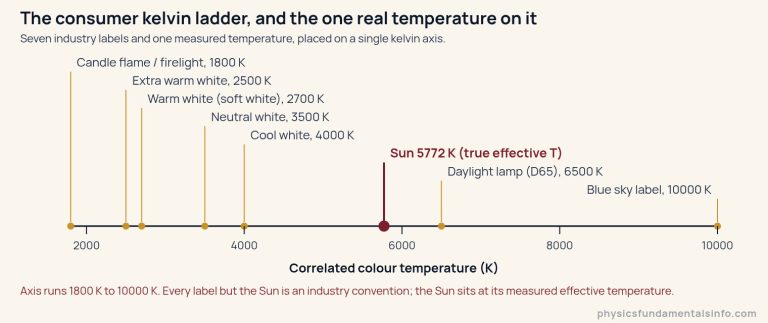
Here is the ladder, with the band names the lighting trade uses. Read the third column carefully: it is not the lamp’s peak wavelength. It is where a true blackbody held at that temperature would peak, which is a different claim entirely.
| Band label (lighting-industry convention) | Rating on the scale (K) | Peak wavelength a true blackbody at this temperature would have (nm) | Where that peak falls | Is the kelvin figure a real temperature? |
|---|---|---|---|---|
| Candle flame / firelight | 1800 | 1610 | Infrared | No — a convention |
| Extra warm white | 2500 | 1159 | Infrared | No — a convention |
| Warm white (soft white) | 2700 | 1073 | Infrared | No — a convention |
| Neutral white | 3500 | 827.9 | Infrared | No — a convention |
| Cool white | 4000 | 724.4 | Infrared | No — a convention |
| The Sun (effective temperature) | 5772 | 502.0 | Visible — green | Yes — measured |
| “Daylight” lamp (D65) | 6500 | 445.8 | Visible — violet-blue | No — a convention |
| Blue sky (top of the band) | 10,000 | 289.8 | Ultraviolet | No — a convention |
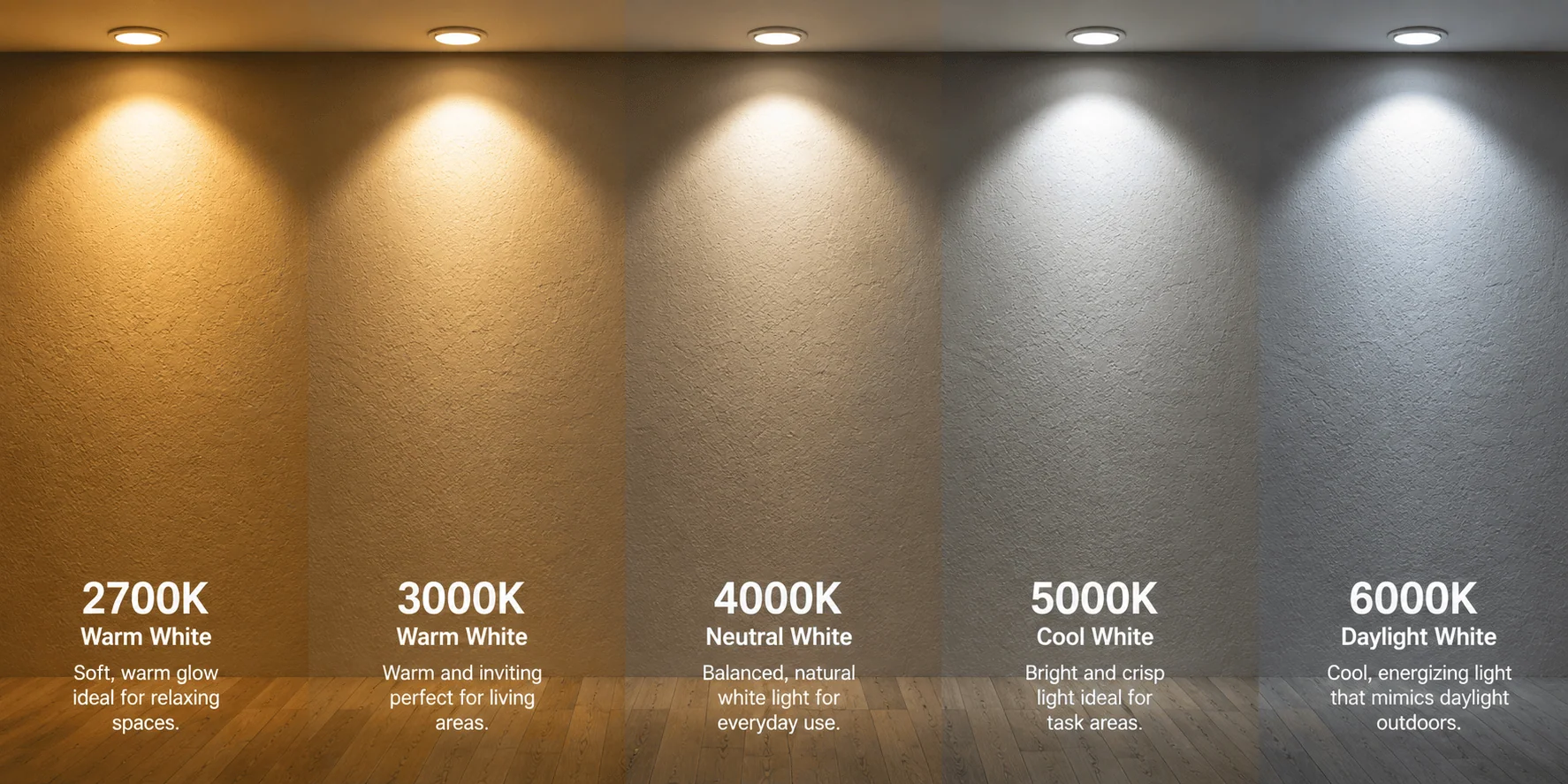
The band names are industry conventions, not physical boundaries. Vendors genuinely disagree about where they fall: one supplier’s chart calls 3500 K “white” while another calls it “neutral white”, a third folds it into a “neutral/cool white” band and a fourth puts it at the very top of “warm white”, and “daylight” is variously printed as 4800–6000 K, 5000–6500 K or a flat 6500 K. No measurement settles those edges, because there is nothing there to measure.
So treat the labels as rough shelf-talk and the kelvin numbers as the real content of the scale.
Why a Colour Is Given as a Temperature: Wien’s Formula
Because a hot body’s spectrum has a peak, and the peak’s wavelength is fixed by its temperature alone. Planck’s law gives the full shape of that spectrum; Wien’s displacement law pulls out the one number people care about, the wavelength at which the spectrum is brightest.
- λmax — the peak wavelength of the spectrum, in metres (quoted in nanometres, nm, throughout this page).
- T — the absolute temperature of the radiating body, in kelvins (K). It must be a thermodynamic temperature, not a label.
- b — the Wien wavelength displacement constant, 2.897771955 × 10⁻³ m K. NIST’s CODATA entry for the Wien displacement constant lists it as exact in the 2022 set, so it carries no uncertainty at all.
Both directions of that relation are worth having to hand, and you can run either of them in our Wien’s Law calculator — enter a temperature to get the peak wavelength, or a peak wavelength to get the temperature that would produce it.
What the law does not give you is how much power lands in the visible band, which is a separate integral over Planck’s law. Our blackbody radiation guide works that out properly, and gets 36.64% for a blackbody at the Sun’s temperature. This page needs only the peak.
A note on the constant that saves an argument later. The CODATA page prints 2.897 771 955… with a trailing ellipsis, because b is exact but non-terminating — it is a combination of the Planck constant, the speed of light, the Boltzmann constant and the root of a transcendental equation. Quote the ten digits and you are quoting an exact value, not a rounded one.
Now set the simulator below to 2700 K and watch where the peak lands. The two band-edge sliders already frame the visible band at 400 nm and 700 nm, so leave them where they are and push the probe out to 1073 nm, which is where the curve is actually tallest. The peak is nowhere near the band those sliders mark — and that is the next section.
Where the Rule Stops: Correlated Colour Temperature
A lamp’s kelvin rating is a correlated colour temperature, which means Wien’s law does not describe the lamp’s spectrum at all. The rating is the temperature of the blackbody whose colour the lamp most nearly matches — the nearest point on the Planckian locus to the lamp’s own chromaticity — and nothing inside the lamp is at that temperature.
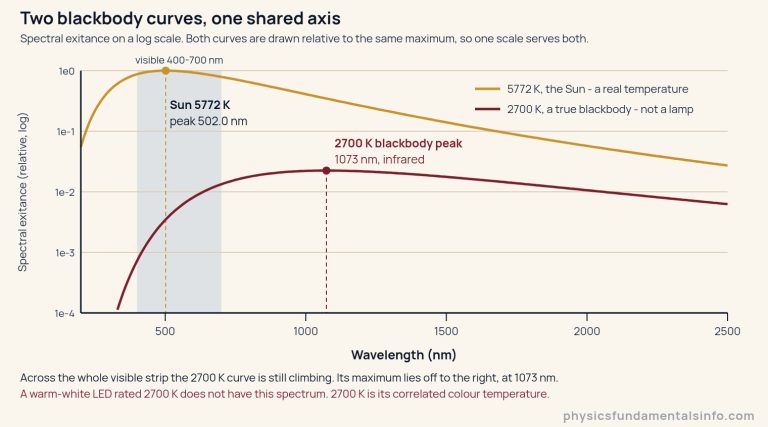
Run the arithmetic and the gap is impossible to miss. A true blackbody at 2700 K peaks at 1073 nm, which is infrared radiation, not light you can see. A warm-white LED rated 2700 K emits essentially nothing at 1073 nm; it is not a covert heater.
Push the point harder with the inverse direction. A true blackbody has to reach 4140 K before its peak even arrives at 700 nm, the red edge of the visible band, and 7244 K before that peak leaves 400 nm at the violet edge. Between those two temperatures the peak genuinely is inside the visible band, which is why the ladder above puts 5772 K at 502.0 nm and 6500 K at 445.8 nm. Below 4140 K it is not: the whole warm half of the consumer scale, 1800 K through 4000 K and most of what is on the shelf, has its blackbody peak in the infrared.
Yet those warm lamps obviously make visible light. Both statements are true, and the only way to hold them together is to accept that the kelvin figure on the box was never a temperature. That contradiction is the lesson, and it is the thing the warm-to-cool charts never mention.
If you want to drive the curves yourself rather than read them, the Blackbody Radiation Simulator landing page explains every control on the lab above, including the band edges and the probe.
“Daylight” Is Not the Sun
The Sun’s effective temperature is 5772 K, and the 6500 K printed on a “daylight” lamp is a lighting convention rather than a measurement of it. NASA’s Sun Fact Sheet gives the effective temperature directly; 6500 K is the D65 daylight-illuminant convention, which bundles blue skylight in with direct sunlight.
The ranking charts do not agree with each other either. One supplier prints daylight and direct sunlight at 4800–6000 K, another at 5000–6500 K, a third at a flat 6500 K. None of those ranges is a measurement, and none of them could be: the figure is a convention, so there is nothing to cite.
Then comes the part that catches people out. Put 5772 K through Wien’s law and the peak comes out at 502.0 nm, which is green. Not blue — green, sitting squarely in the middle of the visible band.
A reader who has just absorbed “hotter is bluer” does not expect that, and the reason is worth holding on to: a spectrum’s peak and a spectrum’s perceived colour are different things. The Sun looks white because its spectrum is broad and your eye integrates all of it, not because its peak is white.
One Number Cannot Specify White Light
Chromaticity is two-dimensional, so a single kelvin figure cannot fix the colour of a white light. CCT tells you which point on the Planckian locus the light is nearest to; it says nothing about how far off that locus the light actually sits.
That missing second coordinate has a name and a standard. NIST’s paper on the practical use and calculation of CCT and Duv puts it bluntly: chromaticity is two-dimensional, the distance from the Planckian locus is often missing, and Duv is defined in ANSI C78.377 for exactly that purpose.
The practical consequence is one most people have seen without naming it. Two lamps marked with the same kelvin number can look visibly different — one faintly green, the other faintly pink — because they sit on opposite sides of the locus at the same CCT. The kelvin figure is blind to that difference by construction.
A second property the kelvin figure misses is colour rendering, reported as the Colour Rendering Index (CRI), which describes how faithfully a source reproduces the colours of the objects it lights rather than the colour of the source itself. Worth knowing the name; it is a separate measurement and not part of the kelvin scale.
The Other Scale: Lumens, Lux and Footcandles
Lumens measure the light leaving a source, lux measure the light arriving on a surface, and neither has anything to do with kelvins. Luminous flux in lumens (lm) is the total visible light a lamp puts out; illuminance in lux (lx) is how much of it lands per square metre of whatever you pointed it at.
- E — illuminance, in lux (lx).
- Φ — luminous flux falling on the surface, in lumens (lm).
- A — the area it is spread over, in square metres (m2).
- footcandle — the customary-unit counterpart of the lux, defined as one lumen per square foot. Same idea, different area unit.
That relation is a definition, not a model, so there is nothing in it to approximate. One lux is one lumen per square metre, exactly. The chain of units goes back to the candela, the SI base unit for luminous intensity, which our SI units in physics guide sets out alongside the other six.
Here is the whole argument in two rows. One lamp, 800 lm, spread over two different areas:
| Luminous flux from the lamp | Area it is spread over | Illuminance, flux divided by area |
|---|---|---|
| 800 lm | 4.0 m2 | 200 lx |
| 800 lm | 16.0 m2 | 50 lx |
Same lamp, same kelvin rating, same lumen figure — two illuminances that differ by a factor of four. Colour temperature and illuminance are independent axes, and neither constrains the other. That is the structural reason “light scale” cannot name one scale.
A common student slip here is to treat lumens as brightness. Lumens are a total; what you perceive depends on how that total is spread, which is the lux figure.
The Dark-Sky Scale: Bortle Class and Apparent Magnitude
The third scale grades the night sky rather than a lamp, and astronomers use two closely related measures for it. The Bortle class is a numbered grading of how much the sky itself is glowing at an observing site, and apparent magnitude is the logarithmic brightness scale used for individual objects in it.
Two features of the magnitude scale trip up newcomers. It runs backwards — smaller numbers mean brighter objects — and it is logarithmic, so equal steps are equal ratios of brightness, not equal differences. No arithmetic on it appears here; the point is only that it is a brightness scale and not a colour scale.
And if what you actually wanted was why light splits into colours in the first place, that is a question about wavelength and refraction, not about any scale. Our dispersion of light guide handles it.
Common Misconceptions About the Light Scale
“A 2700 K bulb is at 2700 K.” It is not, and nothing inside it is. The figure is a correlated colour temperature, which records a colour match to a blackbody, not a temperature of the lamp. A true blackbody at 2700 K would peak at 1073 nm in the infrared.
“Daylight on the box means sunlight.” It means the D65 illuminant convention, usually printed as 6500 K. The Sun’s own effective temperature is 5772 K, and the two are not the same claim.
“Hotter is bluer, so a hot source peaks in the blue.” Only eventually. At 5772 K the peak is still at 502.0 nm, which is green; a true blackbody’s peak does not reach the violet-blue end of the band until about 6500 K, and does not leave the band altogether until 7244 K.
“A higher kelvin number means a brighter light.” It means a cooler-looking light, nothing more. Brightness lives on the lumen and lux scales, and the two numbers move entirely independently.
“Two lamps marked the same kelvin number are the same colour.” They can differ visibly, because one number cannot pin a two-dimensional chromaticity. The offset from the Planckian locus, Duv, is the part the kelvin figure leaves out.