Wien’s displacement law: the wavelength of peak emission from a black body is inversely proportional to its absolute temperature, λmax = b/T. This free calculator solves for the peak wavelength or the temperature, in nm, µm or m, and shows every step of the working.
What Is the Wien's Law Calculator?
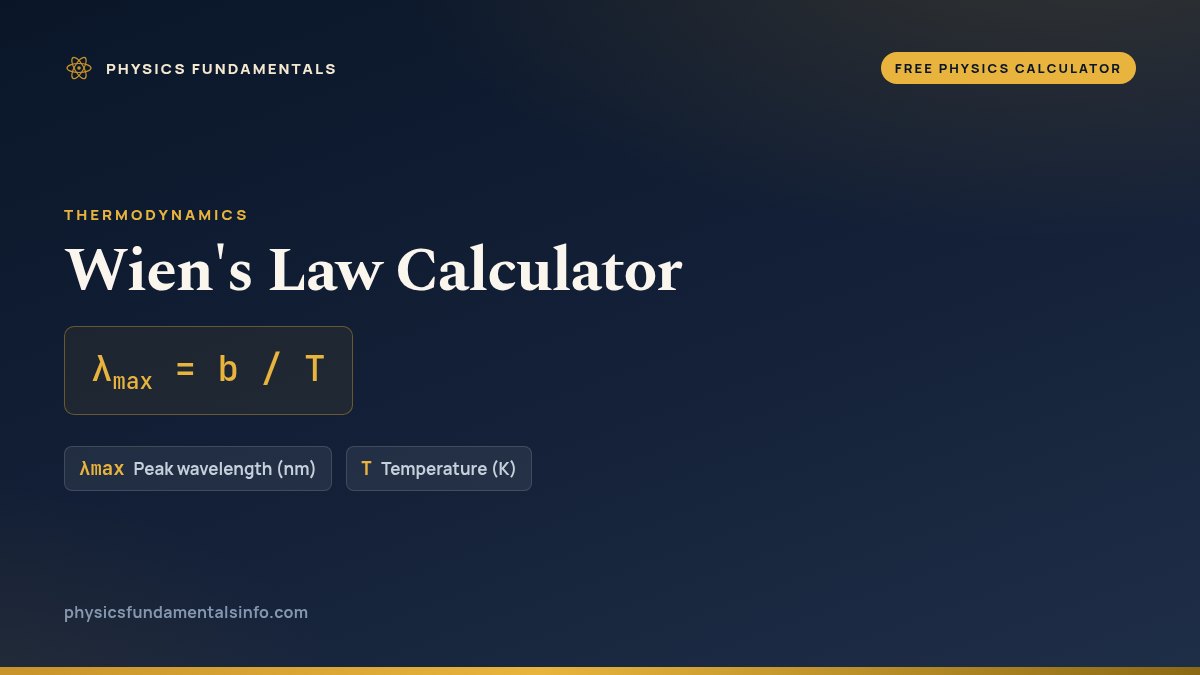
The Wien's law calculator is a free online tool built on the formula λmax = b / T. Enter the values you already know, in whichever units suit you, and it solves for peak wavelength or temperature and shows every step of the substitution. Wien's Law is peak wavelength of black-body radiation, λmax = b/T.
| Symbol | Quantity | Default unit | Also accepts | Example value |
|---|---|---|---|---|
| λmax | Peak wavelength | nm | µm, mm, m | — |
| T | Temperature | K | °C, °F | 5778 |
How to calculate the peak wavelength
Wien’s displacement law tells you the colour a hot object glows. Every black body radiates across a spread of wavelengths, but there is one wavelength at which the emission is strongest, and it depends only on the temperature. To find it, divide Wien’s constant b (2.897772×10⁻³ m·K) by the absolute temperature: λmax = b/T. The hotter the body, the shorter the peak wavelength — the colour shifts from red toward blue.
There are three steps. First, decide whether you want the peak wavelength or the temperature, and select it in the Solve for menu. Second, enter the value you know: a temperature in kelvin, °C or °F, or a wavelength in nanometres, micrometres or metres. Third, read the answer with the worked steps, which show the formula, the constant b substituted in, and the result with units.
As with all black-body formulae, the temperature must be absolute. The law is an inverse proportion to T, so the zero point has to be absolute zero — use kelvin (K = °C + 273.15). This calculator will accept Celsius or Fahrenheit and convert them for you, but by hand you should always work in kelvin.
Wien’s law is the companion of the Stefan-Boltzmann law: one gives the peak colour, the other the total power. To turn a peak wavelength into a photon energy, use the photon energy calculator, and to relate wavelength and frequency see the wave speed calculator or the physics glossary.
Worked example
The Sun’s surface is about 5778 K. Its peak wavelength is λmax = b/T = 2.897772×10⁻³ / 5778 ≈ 5.02×10⁻⁷ m = 502 nm — green-yellow light, near the middle of the visible band, which is no accident given that our eyes evolved under sunlight. A cooler 3000 K filament peaks at about 966 nm, out in the near-infrared, which is why an incandescent bulb wastes most of its energy as heat rather than visible light.
Why it matters
Wien’s law is how astronomers read a star’s surface temperature from its colour, how infrared and thermal-imaging cameras are designed around the wavelengths warm objects emit, and how engineers understand why filaments, furnaces and molten metal change colour as they heat. It also fixed a historical crisis: the failure of classical physics to explain the black-body peak is what led Planck to quantise energy and launch quantum theory.
Frequently asked questions
What is Wien’s displacement law?
Wien’s displacement law says that the wavelength at which a black body radiates most intensely is inversely proportional to its absolute temperature: λmax = b/T, where b = 2.897772×10^-3 m·K is Wien’s constant. Hotter objects peak at shorter wavelengths, which is why a heated metal glows red, then orange, then white-blue as it gets hotter.
What is the value of Wien’s constant?
The Wien wavelength displacement law constant is b = 2.897771955×10^-3 m·K (about 2898 µm·K). It is a fixed constant derived from the Planck radiation law, equal to hc divided by roughly 4.965 times the Boltzmann constant. Multiply or divide by it to move between a black body’s temperature and its peak wavelength.
How do I find a star’s temperature from its colour?
Measure the wavelength at which the star is brightest and divide Wien’s constant by it: T = b/λmax. The Sun peaks near 500 nm (green-yellow), giving T ≈ 2.898×10^-3 / 500×10^-9 ≈ 5800 K. This is exactly how astronomers estimate the surface temperature of stars from their spectra.
How does Wien’s law relate to the Stefan-Boltzmann law?
They are the two headline results of black-body radiation. Wien’s law tells you where the emission peaks (the colour), λmax = b/T, while the Stefan-Boltzmann law tells you the total power radiated, P = σAεT^4. Together they describe both the colour and the brightness of a glowing object as its temperature changes.
Why must the temperature be in kelvin?
Wien’s law is an inverse proportionality with absolute temperature, so the zero point must be absolute zero. Enter temperatures in kelvin (K = °C + 273.15); this calculator accepts °C and °F but converts them to kelvin before applying the law. Using Celsius directly would give a meaningless peak wavelength.
References & formula source
- Halliday, Resnick & Walker — Fundamentals of Physics, Chapter 38 (Photons and Matter Waves).
- Young & Freedman — University Physics with Modern Physics, §39.5 (Continuous Spectra and black-body radiation).
- NIST — CODATA value of the Wien wavelength displacement law constant b = 2.897771955 × 10^-3 m·K.
- Further reading: Wien's displacement law — Wikipedia