Absolute zero is the lowest possible temperature, 0 kelvin, which is -273.15 °C and -459.67 °F. It is the point at which a substance holds no thermal energy left to give up: the ideal-gas laws extrapolate to zero pressure and zero volume there, and the Kelvin scale counts upwards from it.
Your freezer sits at about -18 °C. Liquid nitrogen, tipped out of a flask in a school laboratory, boils away at -195.79 °C, and liquid helium at -268.93 °C. Every one of those steps down costs far more work than the step before it.
Somewhere below the last of them the scale simply stops. Not because our machines run out of puff, but because temperature itself has a floor, one written into the gas laws a century before anyone could get close to it. That floor is absolute zero.
What Is Absolute Zero?
Absolute zero is the temperature at which a substance has surrendered all the thermal energy it can, so that no colder state exists. It sits at 0 K, -273.15 °C and -459.67 °F, and all three of those figures are exact by definition rather than the result of a measurement.
Temperature is not a measure of how much energy something holds. It measures how vigorously the particles in it are jiggling, which is why a spark from a sparkler, at something like 1,000 °C, can land on your skin harmlessly while a mug of tea at 80 °C scalds — the difference between heat and temperature. Cooling drains that jiggling away, and absolute zero is where there is none of it left to drain.
One qualification belongs with that sentence, and it is the one most often dropped. Stripping out the thermal motion does not leave a perfectly still world: quantum mechanics grants every particle a residual zero-point motion that no amount of cooling can take, a point NIST’s introduction to the kelvin makes explicitly. Cooling removes the thermal share of that motion; the quantum share stays where it is.
Why physicists bother with a second scale
Celsius puts its zero at the freezing point of water, which is a fine choice for weather and a terrible one for physics. Halving a Celsius reading from 30 °C to 15 °C means nothing physically. Halving an absolute temperature from 300 K to 150 K halves the mean translational kinetic energy of every molecule — a real, measurable statement, and the reason the gas laws insist on kelvin.
The Kelvin Scale and the Absolute Zero Formula
The Kelvin scale is the Celsius scale slid down until its zero lands on absolute zero. A kelvin and a degree Celsius are exactly the same size, so the conversion is a single addition and nothing more:
The other two scales in common use follow from the same arithmetic. Fahrenheit keeps its own offset and a degree five ninths the size; Rankine is the absolute version of Fahrenheit, starting at 0 °R where kelvin starts at 0 K.
- T(K) — thermodynamic (absolute) temperature, in kelvin (K). It is never negative, and the unit is written K, not °K.
- T(°C) — the same temperature in degrees Celsius. Its zero is 273.15 K.
- T(°F) — degrees Fahrenheit, whose degree is 5/9 of a kelvin.
- T(°R) — degrees Rankine, an absolute scale with the Fahrenheit degree size. 0 °R is absolute zero.
- 273.15 — the exact offset between the Celsius and Kelvin scales, fixed by definition rather than measured.
Room temperature of 20 °C is therefore 293.15 K, and body temperature of 37 °C is 310.15 K. If you would rather skip the arithmetic, or you want the molecular speed and thermal energy that belong to a reading, the Absolute Zero Calculator prints all four scales together with the root-mean-square speed, kT and the mean kinetic energy per molecule.
| Scale | Unit | Where its zero sits | Size of one degree | Water freezes | Water boils |
|---|---|---|---|---|---|
| Kelvin | K | absolute zero | same as one degree Celsius | 273.15 K | 373.15 K |
| Celsius | °C | 273.15 degrees above absolute zero | one degree Celsius | 0 °C | 100 °C |
| Fahrenheit | °F | 459.67 degrees above absolute zero | five ninths of a degree Celsius | 32 °F | 212 °F |
| Rankine | °R | absolute zero | five ninths of a degree Celsius | 491.67 °R | 671.67 °R |
Notice what the last two columns of that table are doing. The two absolute scales, kelvin and Rankine, put water’s freezing point at 273.15 and 491.67 — awkward numbers, because neither scale was built around water. That awkwardness is the price of a zero that means something.
One unit convention worth getting right
Write 300 K, never 300 °K. The degree sign was dropped from the kelvin in 1967, and an absolute temperature is a count of kelvins rather than a position on a graduated scale. Since 2019 the unit has been pinned to a fixed value of the Boltzmann constant, k = 1.380649 × 10⁻²³ J/K exactly, one of the seven defining constants listed in the SI base units by the BIPM.
Try the lab below before reading on. Drag the temperature down and watch the speed readout: every halving of the molecular speed costs three quarters of the kelvin reading you had left. Change gas and the volume bar does not budge: the Charles ratio never mentions the gas, so only the speed and the phase note respond.
Why Is Absolute Zero -273.15 °C?
Absolute zero sits at -273.15 °C because that is where the straight line of an ideal gas’s volume against temperature runs out of volume to lose. Cool a fixed amount of dilute gas at constant pressure and it shrinks by 1/273.15 of its 0 °C volume for every degree Celsius removed, which is a loss of about 0.366 per cent per degree.
Keep going and the arithmetic is relentless. Halve the absolute temperature and you halve the volume; at 136.6 K the gas fills half the space it filled at 0 °C. Extend the line to zero volume and it crosses at -273.15 °C, whatever gas you started with and however much of it you had.
That last clause is what makes the result convincing rather than a coincidence. Helium, nitrogen and carbon dioxide give three different slopes, because a different amount of gas fills a different volume at 0 °C, yet all three slopes point at the same intercept.
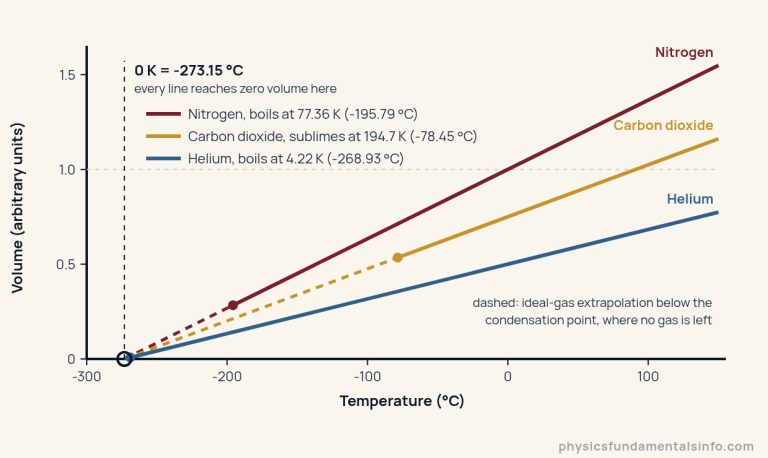
Honesty about those dashed sections matters. No real gas follows its line to the bottom: nitrogen liquefies at 77.36 K and carbon dioxide has already turned solid by 194.7 K, and a liquid or a solid still occupies plenty of space. The intercept is an extrapolation, and it was the agreement between extrapolations, not any measurement at the bottom, that pinned the number down.
Helium is the outlier that made the region accessible. It stays a gas until 4.22 K, so its line runs almost all the way to the axis, and helium gas thermometers were how the last stretch of the scale was mapped. Charles’s law has a pressure twin that gives the same answer: cool a sealed rigid vessel instead, and the pressure heads for zero at the same -273.15 °C.
Who worked it out
Guillaume Amontons noticed around 1702 that the pressure of air in a sealed vessel fell as it cooled and that the trend, extended, implied a lowest possible temperature. A century later Charles and Gay-Lussac measured the volume version carefully enough to give a number near -273 °C. In 1848 William Thomson, later Lord Kelvin, proposed putting the zero of the scale there and counting upwards, which is the scale we still use.
What Happens to Molecules Near Absolute Zero?
As a gas is cooled towards absolute zero its molecules slow down, and in the kinetic-theory picture their mean translational kinetic energy falls in direct proportion to the absolute temperature until, at 0 K, the model leaves none at all. Two equations carry the whole story.
- k — the Boltzmann constant, 1.380649 × 10⁻²³ J/K exactly, the energy that corresponds to one kelvin.
- R — the molar gas constant, 8.314462618 J/(mol·K) exactly, equal to k times the Avogadro constant.
- M — molar mass of the gas, in kg/mol. Nitrogen is 0.028013 kg/mol.
- v_rms — root-mean-square molecular speed, in m/s.
- T — absolute temperature, in kelvin. Feed this equation a Celsius reading and the answer is nonsense.
Put room temperature into them and the numbers come out human-sized. At 20 °C each molecule of air carries 6.071 × 10⁻²¹ J of translational kinetic energy on average, and kT is 25.26 meV. A nitrogen molecule crosses the room at a root-mean-square 510.9 m/s, roughly one and a half times the speed of sound in that same air.
Now cool it. At the boiling point of nitrogen, 77.36 K, the same molecule is down to 262.5 m/s. The temperature has fallen by a factor of 3.79 but the speed by only 1.95, because the speed tracks the square root of the absolute temperature.
That square root is why deep cooling is such slow going. Halving the kelvin reading divides the molecular speed by only 1.414, so the temperature has to fall by a factor of four before the molecules are moving at half the speed.
Three cautions on those two numbers
- The root-mean-square speed is not the average speed. It weights the fast molecules more heavily and comes out about 8.5 per cent above the plain arithmetic mean of a Maxwell-Boltzmann distribution, so quote whichever one your problem asks for.
- (3/2)kT counts translational motion only. A diatomic molecule such as nitrogen also spins, which is why its molar heat capacity at room temperature is nearer (5/2)R than (3/2)R.
- Both expressions describe an ideal gas. Push a real substance far enough down and it condenses, at which point the molecules are held in contact and the formulae stop applying.
Can We Reach Absolute Zero?
No, and the obstacle is not the quality of the refrigerator: the third law of thermodynamics states that absolute zero cannot be reached by any finite sequence of operations, however many of them you chain together. The barrier is one of bookkeeping rather than engineering.
Cooling works by moving entropy out of a sample and into somewhere colder, or into a magnetic field, or into a beam of light. As the temperature drops there is less entropy left to move and less of a gradient to move it down. The third law is the accounting statement of that squeeze, and it sits alongside the other laws of thermodynamics as a statement about what cannot be done.
Even empty space is no help as a dumping ground. The cosmic microwave background fills the universe with radiation at 2.725 K, a blackbody temperature measured by the FIRAS instrument on NASA’s Cosmic Background Explorer, so anything left passively in deep space settles near that value rather than anywhere close to zero.
What laboratories do instead is clever and strictly finite. Dilution refrigerators reach a few thousandths of a kelvin, adiabatic demagnetisation goes lower, and laser cooling followed by evaporative cooling takes dilute clouds of atoms into the nanokelvin range and below. Each technique gets astonishingly close; none of them arrives.
Real-World Temperatures Near Absolute Zero
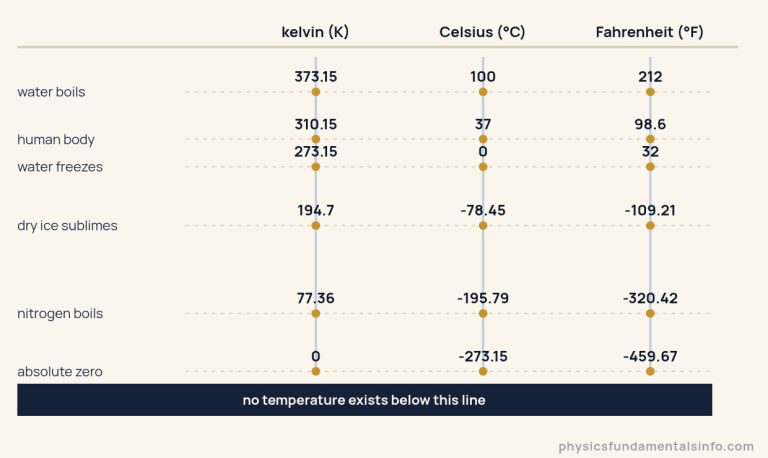
The bottom of the scale is not an abstraction — a working laboratory moves through most of it. The table below lists the landmarks in all three everyday scales, and each one marks a real physical event rather than a round number.
| Temperature (K) | Celsius (°C) | Fahrenheit (°F) | What happens there |
|---|---|---|---|
| 0 | -273.15 | -459.67 | Absolute zero: the ideal-gas lines run out, and the third law puts it out of reach |
| 2.725 | -270.42 | -454.76 | The cosmic microwave background, the temperature of empty space itself |
| 4.22 | -268.93 | -452.07 | Helium boils at 1 atm; liquid helium cools the magnets in an MRI scanner |
| 77.36 | -195.79 | -320.42 | Nitrogen boils; the cheap cryogen used in laboratories and food freezing |
| 194.7 | -78.45 | -109.21 | Dry ice sublimes at 1 atm, going straight from solid to gas |
| 273.15 | 0 | 32 | Water freezes at 1 atm, the old ice point of the Celsius scale |
| 310.15 | 37 | 98.6 | Normal human body temperature |
| 373.15 | 100 | 212 | Water boils at 1 atm, the old steam point of the Celsius scale |
Liquid nitrogen at 77.36 K is the workhorse. It is cheap enough to pour, it freezes biological samples in seconds, and it sits comfortably below the transition temperature of the high-temperature superconductors, which is why a levitating superconductor demonstration needs nothing more exotic than a flask of it.
Liquid helium at 4.22 K is the specialist. The superconducting magnets inside an MRI scanner are bathed in it, and below 2.17 K helium becomes a superfluid that creeps up the walls of its container and flows without viscosity. Lower still, in the microkelvin and nanokelvin range, dilute atomic gases form Bose-Einstein condensates in which thousands of atoms share a single quantum state.
Common Misconceptions About Absolute Zero
Misconception 1: all motion stops at absolute zero
It does not. Thermal motion would cease, which is a narrower claim than it sounds: quantum mechanics forbids a particle from sitting perfectly still in a well-defined place, and the zero-point motion that survives is real and measurable. Helium is the proof — at ordinary pressure it stays liquid all the way down, because its zero-point motion alone is enough to keep it from locking into a solid.
Misconception 2: absolute zero is just a matter of a better fridge
The barrier is a law, not an engineering budget. Doubling the money, the magnets or the laser power moves the last few decimal places and never closes the gap, because the third law is a statement about entropy rather than about apparatus.
Misconception 3: a gas would shrink to nothing at absolute zero
Only the ideal gas of the model does that. Every real substance condenses to a liquid or a solid on the way down, and those states have a volume set by the size of their atoms, not by the temperature. The straight line in Figure 1 is an extrapolation from the region where a gas really is a gas.
Misconception 4: the Kelvin scale’s zero is just another convention
Celsius and Fahrenheit both begin at a human choice, so their readings can be negative and their ratios are meaningless. The Kelvin scale begins at a physical limit, which is what lets you say that 600 K holds twice the mean translational energy of 300 K. A common student slip is to write the ratio of two Celsius readings into a gas-law problem; the answer that comes back is wrong by a wide margin.
How Absolute Zero Connects to the Gas Laws and Thermodynamics
Every gas law is written in absolute temperature, and that is not an accident of notation. The ideal gas law, PV = nRT, only balances if T counts upwards from the point where the pressure-temperature line hits zero, which is exactly what absolute zero is defined to be.
Heat engines make the same point from the other end. The best possible efficiency of an engine running between a hot reservoir at Th and a cold one at Tc is 1 – Tc/Th, so a cold reservoir at 0 K would mean perfect efficiency. The unattainability of absolute zero is one more way of saying that no heat engine can be perfectly efficient, a conclusion the second law reaches by its own route.
Entropy closes the loop. As a substance is cooled towards 0 K the entropy of a perfect crystal tends to a constant, conventionally taken as zero, and its heat capacity has to vanish along with it. That is what makes the last stretch so hard to hold on to: with almost no heat capacity left, the smallest stray leak of heat warms the sample straight back up.