Thermal diffusivity is how quickly a temperature change travels through a material, and it equals the thermal conductivity divided by the density times the specific heat capacity. In symbols it is alpha = k / (rho c), measured in square metres per second. Conductivity says how much heat eventually flows; diffusivity says how long the change takes to arrive.
Put your hand flat on a stone windowsill on a hot afternoon and it is cool. Come back at midnight, hours after sunset, and the same stone is warm — the heat of the day has only just finished crossing it.
Nothing about that lag is explained by how well stone conducts. It is set by a second quantity entirely, one that answers a question conductivity cannot touch: not how much heat gets through, but how long it takes.
What Is Thermal Diffusivity?
Thermal diffusivity is the rate at which a temperature change spreads through a material, defined as its thermal conductivity divided by the heat needed to warm a unit volume of it by one kelvin.
Think of heat arriving at one face of a wall with two jobs to do. Some of it moves on towards the far side; the rest stays behind, warming the material it has just passed through. The second job is a tax on the first.
Conductivity, k, decides how fast heat can move on. Volumetric heat capacity, rho times c, decides how much has to be paid before it can. Diffusivity is simply the ratio — how much gets through per unit of tax.
That makes a good conductor with a lot of heat to absorb surprisingly slow, and a poor conductor with almost nothing to absorb surprisingly quick. Still air is the standard shock: it is among the worst conductors in any handbook, and yet on the published figures it spreads a temperature change about four and a half times faster than stainless steel.
For the steady state that comes afterwards — the conductivity table, R-value, U-value and layers in series — Fourier’s law of thermal conduction covers all of it, and this page takes it as read. What follows is the transient that ends in Fourier’s straight line.
The Thermal Diffusivity Formula
One relation does the whole job, and every symbol in it is something a handbook already lists.
Density and specific heat capacity enter only as a product, so they are really one number wearing two hats. That product, rho c, is the volumetric heat capacity: the energy needed to raise a cubic metre of the material by one kelvin. Halve one and double the other and the diffusivity does not move — which is algebra, not a discovery.
| Symbol | What it is | SI unit | Worth knowing |
|---|---|---|---|
| alpha | thermal diffusivity | m2/s | tables almost always print mm2/s, where ordinary solids run from about 0.08 to 120 |
| k | thermal conductivity | W/(m K) | the only property here that carries heat forward rather than storing it |
| rho | density | kg/m3 | never appears on its own, only multiplied by c |
| c | specific heat capacity | J/(kg K) | per kilogram, not per gram; a factor of 1000 hides here |
| rho c | volumetric heat capacity | J/(m3 K) | usually quoted in MJ/(m3 K); the whole of what rho and c contribute |
| L | layer thickness | m | not a material property, and it never changes alpha — only the clock |
The unit falls straight out of the algebra: watts per metre per kelvin divided by joules per cubic metre per kelvin leaves metres squared per second. Those are big units for the job, so almost every table you will meet uses mm2/s instead, and one mm2/s is a millionth of an m2/s.
Any of the four quantities in that relation can be the unknown. If you have a measured diffusivity and want the conductivity behind it, or you know everything except the specific heat capacity, our thermal diffusivity calculator rearranges the same relation four ways and prints the settling times beside the answer. If specific heat capacity is the term you are least sure of, that guide defines it properly first.
How Fast Does a Temperature Front Cross a Wall?
A temperature front crosses a wall on a clock set by one dimensionless group, the Fourier number Fo = alpha t / L2, and the mid-depth is 99 per cent of the way there when Fo reaches 0.4911.
Picture the cleanest possible experiment. A slab sits at one temperature throughout; at t = 0 one face is stepped to a new temperature and held there, while the far face is pinned at the original one for ever. That is the transient that ends in the straight line Fourier’s law assumes.
Feed that into the heat equation and something useful happens. The elapsed time, the thickness and the diffusivity stop mattering separately and appear only in the combination alpha t / L2. Two different materials at the same Fourier number have identical temperature profiles — they simply took different lengths of time to get there.
Take that literally. A still-air-like gap and a water-like layer of the same thickness, both at Fo = 0.300, sit at exactly the same mid-depth temperature and pass exactly the same fraction of their final flux; the gap took 3.76 min to reach 99 per cent and the layer needs 9.474 h, a factor of about 151.
Notice what is missing, too. The size of the temperature step never appears — it cancels out of the Fourier number, out of t99 and out of every percentage here, so a face stepped by 100 K and one stepped by 5 K trace the same shape. That is algebra rather than a finding.
Three Fourier numbers are worth memorising for this arrangement, and they are pure numbers, the same for brick as for copper:
- Fo = 0.0947 — the mid-depth has made half its final rise.
- Fo = 0.4911 — the mid-depth has made 99 per cent of it. This is the one that matters, and it drops out of a closed form that is exact here.
- Fo = 0.5368 — the far face is finally passing 99 per cent of its steady heat flux. This one is a root solved numerically, and the closed form that nails the second misses it, as problem 8 shows.
Read that third one twice. At the moment the temperature is 99 per cent settled, the flux out of the far side is only 98.43 per cent settled and the slab is holding 99.36 per cent of the energy it will eventually hold. Temperature arrives before flow does, and the gap is real.
These three constants belong to that boundary condition and to no other. Heat a slab from both faces, insulate its back, or bend it into a cylinder, and the same alpha t / L2 turns up with different numbers in front of it. Nothing on this page makes them universal.
Turning the clock into seconds needs only one rearrangement. Setting Fo = 0.4911 gives the time the mid-depth takes to get 99 per cent of the way there, which is the practical answer to “how long until this has warmed through”.
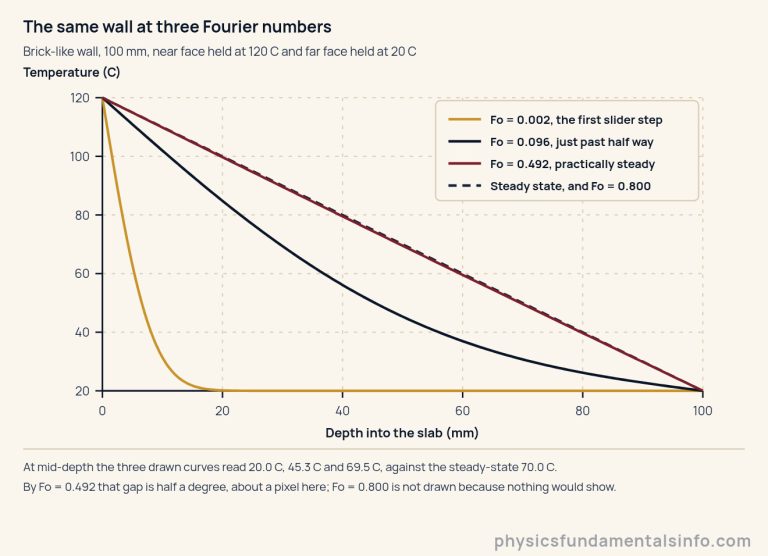
Drag the time slider in the lab below and watch the solid curve peel away from the dashed straight line and then settle back onto it. The band between the two is heat that has gone into warming the wall rather than passing through it.
The three profiles below are the same wall photographed at three instants, computed from the series rather than sketched. Each one bows away from the dashed straight line by the amount of heat the wall has absorbed but not yet passed on.
Double the Thickness, Quadruple the Wait
Look again at where L sits in t99 = 0.4911 L2 / alpha. It is squared, and that single exponent is the most practically useful fact on this page.
Take the brick-like wall used throughout this article: k = 1 W/(m K), rho = 1995.26 kg/m3, c = 900 J/(kg K), giving alpha = 0.5569 mm2/s. At 25 mm it settles in 9.19 min. Make it four times thicker, 100 mm, and the wait is 2.450 h — sixteen times longer, not four. At 300 mm it takes 22.046 h.
Those ratios are exactly 16 and 9, and they are not approximations of anything. Nothing about the material changed between the three rows; only the clock did.
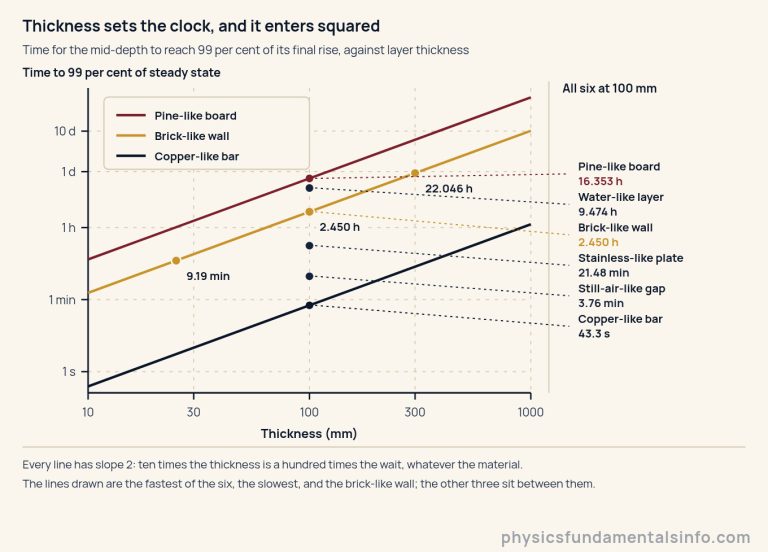
This is why a 300 mm stone wall behaves so differently from a 100 mm one, and why doubling a thin fast layer barely registers while doubling a thick slow one can push its response past a whole day. A common student slip is to assume the wait scales with thickness because the steady heat flow does. It does not.
Why Metal Feels Colder Than Wood
Metal and wood in the same room are at the same temperature, and everyone knows metal feels colder. The quantity that settles the question is neither conductivity nor diffusivity but a third arrangement of the same three properties, the thermal effusivity.
Effusivity is measured in J/(m2 K sqrt(s)) and describes the first instant of contact rather than the long haul. Press two bodies together and their interface settles immediately at a temperature weighted by their effusivities: Tc = (e1T1 + e2T2) / (e1 + e2).
Two limits fall straight out of that. Equal effusivities meet exactly at the midpoint of the two temperatures; a hugely more effusive body drags the interface nearly all the way to its own. Between those limits the formula does the rest.
Run the copper-like and pine-like triples from the table below through it and the bar comes out at 37388 J/(m2 K sqrt(s)) against the pine-like board’s 346, a factor of 108. That ratio is what the familiar observation is actually about. It is not a statement about skin, and this page does not put a number on how cold anything feels, because no figure for that was sourced.
Our guides to conduction, convection and radiation and to heat versus temperature both answer this question the short way — metal carries heat away from your hand faster — and that answer is correct. Effusivity is the name of the quantity behind it.
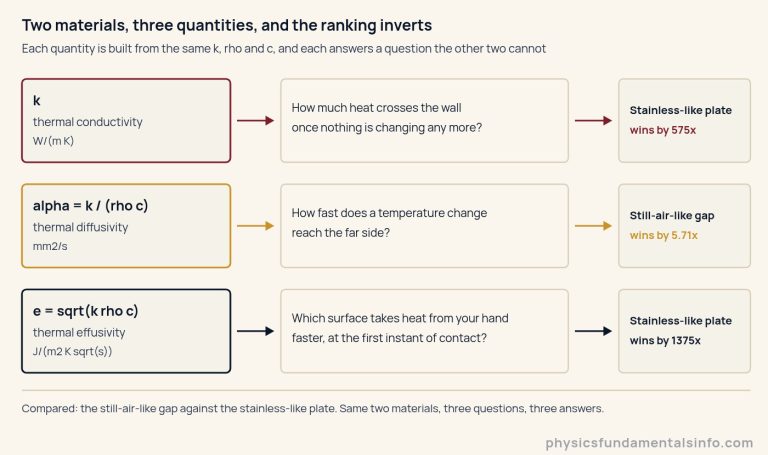
Here is the sharp part. Diffusivity and effusivity are built from exactly the same three numbers, and they disagree about which material is extreme: k = e sqrt(alpha) and rho c = e / sqrt(alpha), so the pair (alpha, e) carries everything that (k, rho, c) carries for conduction. The still-air-like gap below has the lowest effusivity of the six by a wide margin, and a higher diffusivity than every one of the solids except the copper-like bar.
Thermal Diffusivity of Common Materials
The six rows below are idealised (k, rho, c) triples, each chosen to land near a published diffusivity. They are not measurements of real brick, copper or pine, which is why every name carries a “-like”, and the last column prints the published figure to read the alpha column against, with each triple’s departure from it in brackets.
| Material-like triple | k, W/(m K) | rho, kg/m3 | c, J/(kg K) | alpha, mm2/s | e, J/(m2 K sqrt(s)) | t99 at 100 mm | published alpha, mm2/s |
|---|---|---|---|---|---|---|---|
| Brick-like wall | 1 | 1995.26 | 900 | 0.5569 | 1340 | 2.450 h | 0.52 (+7.1%) |
| Copper-like bar | 398.107 | 9120.11 | 385 | 113.3807 | 37388 | 43.3 s | 111 (+2.1%) |
| Stainless-like plate | 15.1356 | 7943.28 | 500 | 3.8109 | 7753 | 21.48 min | 4.2 (-9.3%) |
| Still-air-like gap | 0.0263027 | 1.20226 | 1005 | 21.7689 | 5.6 | 3.76 min | 19 (+14.6%) |
| Water-like layer | 0.60256 | 1000 | 4185 | 0.1440 | 1588 | 9.474 h | 0.143 (+0.7%) |
| Pine-like board | 0.1 | 630.957 | 1900 | 0.0834 | 346 | 16.353 h | 0.082 (+1.7%) |
The published column comes from the thermal diffusivity table on Wikipedia’s thermal diffusivity page, which cites each row separately; the computed column is what these particular triples give. The two disagree, and the gap is printed rather than tidied away.
Worst of all is the still-air-like gap, 14.6 per cent high, because handbook figures for the conductivity, density and specific heat of air multiply up to about 21.8 mm2/s while the published diffusivity is 19. Tuning the triple to close that gap would be dishonest about where each number came from.
Two rows deserve a second look. The copper-like bar computes to 113.3807 mm2/s while the published figure for copper is 111 — both correct for what they are, and neither adjusted to meet the other. And the whole set spans a factor of about 1359 from the copper-like bar to the pine-like board, which on the published figures is 1354 from copper to yellow pine.
Real-World Examples of Thermal Diffusivity

Thermal mass in buildings. A heavy wall delays the outside temperature rather than blocking it, and the delay is a diffusivity-and-thickness question. The brick-like wall reaches half way at mid-depth in 28.34 min at 100 mm; at 300 mm the 99 per cent figure is 22.046 h, which is most of a day and the entire point of building thick.
Heat treatment and quenching. Whether a steel section hardens all the way through or only near its surface depends on how fast the temperature front crosses it. The stainless-like plate gives 21.48 min at 100 mm, and because the thickness is squared a section three times thicker needs nine times as long to treat evenly.
Cooking. Most foods are mostly water, and water is slow: the water-like layer computes to 0.1440 mm2/s against a published 0.143 for water at 25 C. Because the thickness is squared, the depth of a joint matters more to its cooking time than its weight does, and a hotter oven brings the centre to any given temperature sooner without shortening the clock that counts the fraction of the way there.
Measuring conductivity in the laboratory. The flash method pulses one face of a thin disc and watches the other. What it measures directly is the diffusivity; the conductivity is then reconstructed from it with a separately measured density and specific heat capacity, using k = alpha rho c.
Electronics. A heat sink is chosen on conductivity, but whether a short burst of power spikes a junction temperature depends on how fast that heat spreads away from it. For a burst that ends before the heat has spread far, the surface temperature rise is governed by the effusivity, which folds the storage in alongside the conduction.
Common Misconceptions About Thermal Diffusivity
“A good conductor always heats through quickly.” Not always. Diffusivity is conductivity divided by volumetric heat capacity, so a material that conducts well but also stores a great deal per cubic metre can be beaten by a gas that stores almost nothing. Still air and stainless steel are the classic inversion, and the numbers are worked out in problem 4.
“Thermal diffusivity is just another name for thermal conductivity.” They have different units, different dimensions and, for some pairs of materials, opposite orderings. Conductivity is the numerator of diffusivity, nothing more. If what you need is the steady heat loss through a wall, the thermal conduction calculator and our guide to Fourier’s law are the right tools; diffusivity has nothing to say about it.
“Making the layer thicker changes its diffusivity.” It cannot. Diffusivity is a property of the material and thickness does not appear in alpha = k / (rho c) at all. What thickness changes is the clock the diffusivity is measured against, and it changes it as the square.
“The constants 0.4911 and 0.5368 apply to any shape.” They apply to one slab with one face stepped and the far face held. A different geometry or a different boundary condition keeps the L2/alpha scaling and changes the number in front of it.
“One diffusivity describes a whole wall.” A layered wall has no single value: each layer has its own, and the order they sit in matters as well as their thicknesses. Running one layer at a time gives you the individual timescales, and the slowest usually dominates. The same caution applies to anything that melts or boils, where the energy goes into a latent heat and no single specific heat capacity describes the material at all. You can watch how a single layer behaves on the thermal diffusivity simulator.