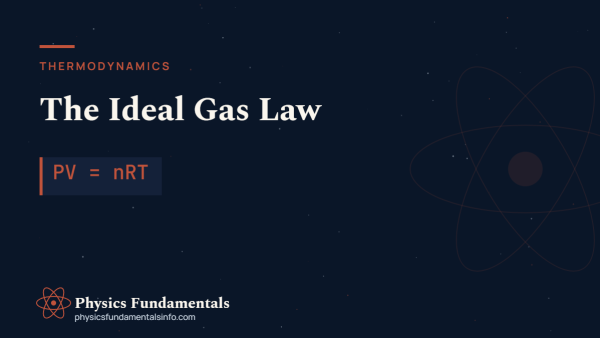
Entropy is a measure of how many microscopic arrangements a system’s particles can adopt while still looking identical from the outside, and it tracks how widely energy is spread. Entropy change equals the heat transferred reversibly divided by the absolute temperature, written ΔS = Q/T, and it is measured in joules per kelvin.
Drop a sugar cube into hot tea and it dissolves. Wait as long as you like, and it will never reassemble itself on your spoon. Nothing in Newton’s laws forbids the reverse — every collision is perfectly reversible — yet the universe has a firm opinion about which way that film runs.
That one-way arrow is entropy. It is the reason your coffee cools, your phone battery warms up, and no engine ever built converts all its fuel into motion. Learn to count with it and a whole class of “why can’t we just…” questions answers itself.
What Is Entropy?
Entropy is a state variable that measures the number of microscopic arrangements consistent with a system’s large-scale properties, and equivalently how thoroughly energy is dispersed. Its symbol is S and its SI unit is the joule per kelvin (J/K).
Think of a dropped deck of cards. There is exactly one arrangement that counts as “sorted” and roughly 8 × 1067 that count as “shuffled”. You do not need a law of physics to explain why a dropped deck lands shuffled — you just need to count.
Two definitions, one quantity
Physics reaches entropy by two routes that turn out to describe the same thing. Clausius came at it from steam engines: track the heat and the temperature. Boltzmann came at it from atoms: count the arrangements.
Both give a number in J/K, and both obey the same rule — for an isolated system, that number never decreases.
The Entropy Formula
Two equations carry almost all the work. The first handles heat in the laboratory; the second explains where entropy comes from in the first place.
This is the Clausius definition. It gives the entropy change when heat Q enters or leaves a system at a steady absolute temperature T, along a reversible path.
- ΔS — change in entropy, in joules per kelvin (J/K)
- Q — heat transferred reversibly, in joules (J). Positive when heat enters the system, negative when it leaves
- T — absolute temperature, in kelvin (K). Never degrees Celsius
That last line catches more students than any other part of the topic. Kelvin is not optional here: dividing by a Celsius temperature can hand you a negative or infinite answer for a perfectly ordinary process. If you want the arithmetic done for you, our Entropy Change Calculator solves ΔS = Q/T for any of the three quantities and keeps the units straight — and it helps to be clear on the difference between heat and temperature before you use it, because Q and T are not two versions of the same idea.
This is Boltzmann’s definition, and it gives the absolute entropy rather than a change.
- S — entropy, in joules per kelvin (J/K)
- k — the Boltzmann constant, exactly 1.380649 × 10⁻²³ J/K in the SI system as fixed by CODATA and NIST
- W — the number of microstates: distinct microscopic arrangements that all produce the same macroscopic state. A pure count, so it has no units
- ln — the natural logarithm
The logarithm is doing something clever. Microstate counts multiply when you combine two systems, but we want entropy to add — and a logarithm turns multiplication into addition. That is the whole reason it is there.
How Entropy Works: Counting Microstates
Entropy increases because high-entropy states are simply more numerous, so a randomly evolving system stumbles into them far more often. There is no force pushing the system towards disorder; there is only arithmetic.
Take four labelled particles rattling around a box with an imaginary line down the middle. Each particle is on the left or the right, so there are 24 = 16 equally likely microstates. Sort those 16 into macrostates by how many sit on each side.
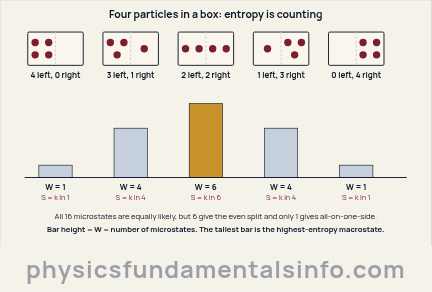
Entropy as microstate counting: the even 2-2 split has six times as many arrangements as an all-on-one-side state, so it dominates.
Six of the sixteen microstates give an even 2-2 split. Only one gives all four particles on the left. The even split is not preferred — it is just six times more common.
Now scale up. For a real gas with 1023 particles, the ratio between “spread evenly” and “all in one half” is not six to one but something like 10(1022) to one. The air in your room could spontaneously bunch into one corner. It simply never will, and now you know precisely why.
Clausius vs Boltzmann: Two Routes to the Same Number
Clausius measured entropy from the outside using heat and temperature; Boltzmann derived it from the inside by counting microstates. Both land on the same quantity in the same units.
| Feature | Clausius (thermodynamic) | Boltzmann (statistical) |
|---|---|---|
| Equation | ΔS = Q/T | S = k ln W |
| What you measure | Heat and temperature, both readable on instruments | W, the number of microstates |
| What it gives | A change, ΔS, between two states | An absolute value, S, for one state |
| Introduced | 1865, from heat-engine theory | 1877, from the statistics of atoms |
| Constant needed | None, beyond using kelvin | k = 1.380649 × 10⁻²³ J/K |
| Best for | Engines, phase changes, calorimetry | Gases, magnets, information theory |
| Main limitation | Q must be traced along a reversible path | W is hard to count for real systems |
| Unit | J/K | J/K |
Boltzmann never wrote his equation in the compact form we use today — that tidy version is due to Planck. It is nonetheless carved on Boltzmann’s gravestone in Vienna, which is about as strong an endorsement as physics offers.

Why Entropy Almost Always Increases
Total entropy increases because heat leaving a hot body costs less entropy than the same heat costs the cold body that receives it. Divide by a big T and you get a small number; divide by a small T and you get a bigger one.
Watch the ledger. Six hundred joules leaves a 500 K block and arrives at a 300 K block.
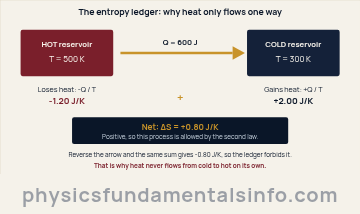
The entropy ledger for 600 J flowing from 500 K to 300 K: the total change is positive, so the process is allowed.
The hot side loses 600/500 = 1.20 J/K. The cold side gains 600/300 = 2.00 J/K. The books close at +0.80 J/K, comfortably positive, so nature permits it.
Run the same sum backwards and you get -0.80 J/K. Nothing about energy conservation objects — the first law is perfectly happy either way. It is the second law of thermodynamics that vetoes it, and NASA’s engineering treatment of entropy states the same rule: only processes in which total entropy stays constant or rises actually occur.
In practice: a quick sanity check before you trust any thermodynamics answer — add up ΔS for every body involved, including the surroundings. If the total comes out negative, the process you have described cannot happen.
Real-World Examples of Entropy
1. Ice melting in a drink
Melting is the textbook entropy jump. A rigid crystal lattice becomes a liquid whose molecules can sit almost anywhere, so W rockets. Melting 1 kg of ice at 0 °C absorbs 3.34 × 10⁵ J and raises entropy by about +1.22 × 10³ J/K — a calculation that leans directly on latent heat.
2. Your coffee going cold
Heat leaks from the mug into the room and never returns. The room warms by an unmeasurable fraction of a degree, but because it sits at a lower temperature than the coffee, its entropy gain outweighs the coffee’s loss.
3. Perfume spreading across a room
No force drags the molecules outward. They wander at random, and there are astronomically more arrangements with the scent spread through the room than crammed near the bottle. Diffusion is entropy made visible.
4. A gas expanding into a larger volume
Let an ideal gas double its volume at fixed temperature and its entropy rises by nR ln 2. For one mole that is +5.76 J/K, and it happens even though the temperature never changed.
5. Your fridge, which cheats locally
A refrigerator lowers the entropy inside itself. It gets away with it by dumping more entropy into your kitchen via the coils at the back — which is why the room ends up warmer overall, not cooler.
| Process | How it is worked out | Entropy change |
|---|---|---|
| Melting 1 kg of ice at 0 °C | Q = 3.34 × 10⁵ J at T = 273 K | +1.22 × 10³ J/K |
| Boiling 1 kg of water at 100 °C | Q = 2.26 × 10⁶ J at T = 373 K | +6.06 × 10³ J/K |
| Heating 1 kg of water from 20 °C to 80 °C | mc ln(T2/T1) | +780 J/K |
| 1 mol of ideal gas doubling its volume | nR ln 2 at constant temperature | +5.76 J/K |
| 600 J flowing from 500 K to 300 K | Q/Tcold minus Q/Thot | +0.80 J/K |
Common Misconceptions About Entropy
Myth 1: entropy is just disorder
“Disorder” is a metaphor, not a definition, and it misleads badly. Water freezing into a snowflake looks more ordered yet the total entropy of the universe still rises, because the released latent heat raises the surroundings’ entropy by more.
Count microstates instead. That definition never lets you down.
Myth 2: entropy can never decrease anywhere
Local entropy decreases constantly. Your fridge does it, a growing plant does it, and every crystal that forms does it. The second law constrains the total for system plus surroundings, not each piece.
Myth 3: entropy is a kind of energy
Check the units. Energy is measured in joules; entropy in joules per kelvin. Entropy does not tell you how much energy a system holds — it tells you how much of that energy is unavailable for doing work.
Myth 4: ΔS = Q/T works for any process
It works only for heat transferred along a reversible path at temperature T. For an irreversible process you must invent a reversible route between the same two states and integrate along that instead.
Entropy is a state function, so the answer is identical either way — which is exactly what makes the trick legitimate.
Myth 5: life or evolution violates the second law
Earth is not an isolated system. It receives concentrated, low-entropy sunlight and radiates diffuse, high-entropy infrared back to space, exporting far more entropy than any biosphere builds. The ledger balances with room to spare.
How Entropy Connects to Heat, Temperature and Engine Efficiency
Entropy links heat and temperature by fixing the exchange rate between them: one joule buys a lot of entropy at low temperature and very little at high temperature. That single fact caps what every engine can do.
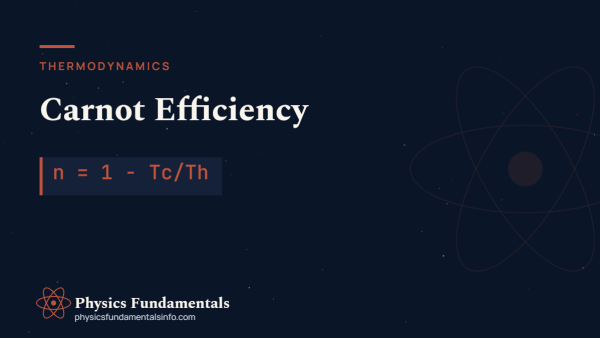
Feed heat Qh into an engine from a hot reservoir and it must dump some heat Qc to a cold one, or the entropy books will not balance. Work through the requirement that total ΔS is never negative and you land on the Carnot efficiency limit, η = 1 – Tc/Th.
No engineering ingenuity beats that ceiling. It is not a limit of materials or design — it is bookkeeping.
Entropy and the third law
Cool a perfect crystal towards absolute zero and W falls towards 1, so S = k ln W tends to zero. That is the third law of thermodynamics, and it is what makes absolute entropies measurable rather than merely relative.
Worked Problems
Show Solution
Solution:
Step 1: Melting happens at constant temperature, so use ΔS = Q/T with Q = mL.
Step 2: Q = mL = 0.500 kg × 3.34 × 105 J/kg = 1.67 × 10⁵ J. Convert temperature: T = 0 °C = 273 K.
Step 3: ΔS = Q/T = 1.67 × 10⁵ J / 273 K = 611.7 J/K.
Answer: ΔS = +612 J/K (3 s.f.)
Show Solution
Solution:
Step 1: Each reservoir is large, so its temperature is unchanged. Apply ΔS = Q/T to each, with Q negative for heat leaving.
Step 2: Hot reservoir: ΔS = -600 J / 500 K = -1.20 J/K. Cold reservoir: ΔS = +600 J / 300 K = +2.00 J/K.
Step 3: Total: ΔS = -1.20 + 2.00 = +0.80 J/K.
Answer: -1.20 J/K, +2.00 J/K, total +0.80 J/K, so the process is allowed
Show Solution
Solution:
Step 1: Use the Boltzmann definition, S = k ln W, with k = 1.380649 × 10⁻²³ J/K.
Step 2: W = 6, so ln W = ln 6 = 1.7918.
Step 3: S = 1.380649 × 10⁻²³ J/K × 1.7918 = 2.4738 × 10⁻²³ J/K.
Answer: S = 2.47 × 10⁻²³ J/K (3 s.f.)
Show Solution
Solution:
Step 1: Boiling is isothermal, so ΔS = Q/T with Q = mL.
Step 2: Q = 0.250 kg × 2.26 × 106 J/kg = 5.65 × 10⁵ J. T = 100 °C = 373 K.
Step 3: ΔS = 5.65 × 10⁵ J / 373 K = 1514.7 J/K.
Answer: ΔS = +1.51 × 10³ J/K (3 s.f.)
Show Solution
Solution:
Step 1: For an isothermal expansion of an ideal gas, ΔS = nR ln(V2/V1).
Step 2: ΔS = 2.00 mol × 8.314 J/(mol·K) × ln 2 = 2.00 × 8.314 × 0.6931 = 11.53 J/K.
Step 3: Internal energy is unchanged at constant temperature, so Q = TΔS = 300 K × 11.53 J/K = 3458 J.
Answer: ΔS = +11.5 J/K and Q = +3.46 × 10³ J
Show Solution
Solution:
Step 1: Temperature changes throughout, so ΔS = Q/T cannot be used with a single T. Integrate dS = mc dT/T to get ΔS = mc ln(T2/T1).
Step 2: Convert to kelvin: T1 = 293 K, T2 = 353 K. Then ln(353/293) = ln 1.2048 = 0.18629.
Step 3: ΔS = 1.00 kg × 4186 J/(kg·K) × 0.18629 = 779.8 J/K.
Answer: ΔS = +780 J/K (3 s.f.)
Show Solution
Solution:
Step 1: Energy is conserved: 1200 J in equals 800 J of work plus 400 J rejected, so the first law is satisfied. Test the second law with total ΔS.
Step 2: Hot reservoir: ΔS = -1200 J / 600 K = -2.00 J/K. Cold reservoir: ΔS = +400 J / 300 K = +1.33 J/K. The engine itself runs in a cycle, so its own ΔS = 0.
Step 3: Total ΔS = -2.00 + 1.33 = -0.67 J/K, which is negative. Cross-check: the claimed efficiency is 800/1200 = 66.7%, above the Carnot limit of 1 – 300/600 = 50%.
Answer: Impossible. Total ΔS = -0.67 J/K violates the second law