Thermodynamics

Energy Transfers in Physics: Stores and Pathways

Definition

Energy transfers physics is the accounting of joules as they move: energy sits in stores and travels between them along named pathways, which are mechanically, electrically, by heating and by radiation. A transfer names the store the joules leave, the pathway they take and the store they arrive in. Add the branches up and the account must balance.

A 2200 W kettle left to run for a hundred seconds takes in 220 000 joules. Not one of them vanishes. They end up in a short list of places, and the whole of this topic is learning to write that list down.

The catch is that one place on the list is never measured. You name the destinations you can count, add them up, deduct them from the supply, and whatever is missing has gone to the surroundings — which is how an energy account finds a loss that nobody put a meter on.

Energy Transfers in Physics: What Is a Store and What Is a Pathway?

A store is somewhere joules are held and can be counted; a pathway is the named route they travel while moving from one store to another.

The distinction sounds like bookkeeping, and that is exactly what it is. Stores are nouns: the thermal store of a litre of water, the gravitational potential store of a load held ten metres up. Pathways are adverbs — the joules moved mechanically, or by heating. Ask “which store?” and “by which pathway?” as two separate questions and most of the confusion in this topic disappears.

Older teaching listed kinds of energy and gave each a name, which quietly invited the question of what happens to a kind of energy when it stops being that kind. The prior question of what energy actually is is worth settling first. Stores and pathways answer the follow-up: not what energy is, but where it is held and how it got there.

Two consequences land immediately. Several items on the old list of energy kinds turn out to be pathways rather than stores, and electrical working is the clearest case, because no joules are ever held “as electricity”. And a store or a pathway can be named while carrying nothing at all.

The Four Pathways Energy Can Travel By

There are four named pathways: mechanically, electrically, by heating and by radiation. Each one names how the joules moved, not what they became.

  • Mechanically — a force acts through a distance. A winch cable lifting a load moves joules mechanically into the load’s gravitational potential store.
  • Electrically — a current does work in a circuit. This is the supply route for both machines in the simulator below, and it is the pathway most often mistaken for a store.
  • By heating — a temperature difference drives joules across a boundary by conduction or convection. Conduction, convection and radiation are the three mechanisms; the first two sit inside this pathway and the third gets a name of its own, immediately below.
  • By radiation — joules leave as electromagnetic waves, which need no material to travel through. Keeping this branch separate is what lets the radiated joules be computed and read on their own.

Naming a pathway does not oblige it to carry anything. On the simulator’s kettle the mechanical pathway is named and carries exactly 0 J; on its winch the radiated branch is named and carries exactly 0 J. At most three of the four names ever do the work at once — exactly three on each of the simulator’s five presets, and fewer still if you push a slider until another branch empties — so a device that uses all four at once is not something this model promises.
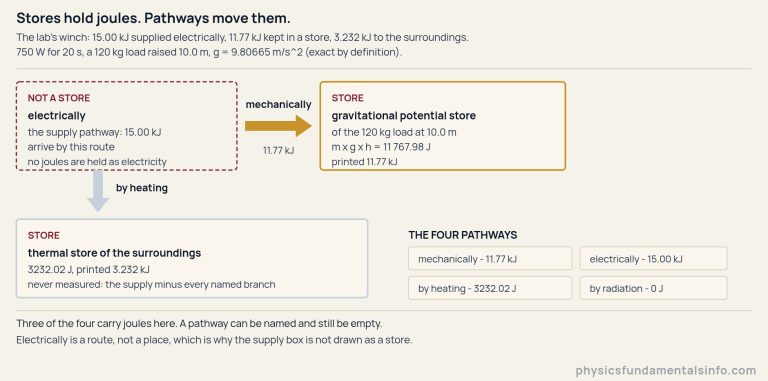
A stores-and-pathways map of the simulator's winch account, with 750 W supplied for 20 s to raise a 120 kg load through 10.0 m and standard gravity g taken as 9.80665 metres per second squared, exact by definition. On the left is a box drawn with a dashed dark red outline and headed NOT A STORE, labelled electrically, the supply pathway, with 15.00 kJ arriving by this route and a closing line saying no joules are held as electricity. A gold arrow points right from that box to a second box drawn with a solid gold border and headed STORE, labelled the gravitational potential store of the 120 kg load at 10.0 m, with m times g times h equal to 11 767.98 J printed as 11.77 kJ; the arrow itself is labelled mechanically above and 11.77 kJ below. A second, pale grey arrow points downward from the supply box, labelled by heating, to a third box with a solid grey border, also headed STORE, labelled the thermal store of the surroundings, carrying 3232.02 J printed as 3.232 kJ, with a closing line saying it is never measured because it is the supply minus every named branch. To the right of that, under the heading THE FOUR PATHWAYS, four chips give mechanically 11.77 kJ, electrically 15.00 kJ, by heating 3232.02 J and by radiation 0 J. Two closing lines state that three of the four carry joules here and a pathway can be named and still be empty, and that electrically is a route rather than a place, which is why the supply box is deliberately not drawn as a store.
The winch account as a map rather than a chart: two real stores at the ends, two named pathways between them, and a supply box deliberately drawn dashed because electrically is a route and not a place. Three of the four pathway chips carry joules on this machine and the fourth reads zero.

The Energy Account Formula

One identity carries the whole topic: the joules supplied equal the joules into the store you are keeping plus the joules that end up in the surroundings.

E_in = E_store + E_surroundings    E_in = P × t
  • E_in — the joules supplied, in joules (J). On both machines in the simulator they arrive electrically.
  • P — the power supplied, in watts (W), which is joules per second. Power is a rate, so it only becomes an amount of energy once a time is attached to it.
  • t — the run time, in seconds (s).
  • E_store — the joules that reached the store you are keeping, in joules (J).
  • E_surroundings — the joules that ended up in the thermal store of everything else, in joules (J).

Three branch formulae do the arithmetic underneath that identity: one for a thermal store, one for a gravitational potential store, and the net Stefan-Boltzmann form for the radiated branch.

Q = m × c × dT    E_pe = m × g × h    E_rad = sigma × A × eps × (T_surf^4 – T_room^4) × t
  • m — a mass in kilograms (kg): of water heated, or of load lifted.
  • c — specific heat capacity, in J/(kg·K). The simulator states 4181 J/(kg·K) for liquid water near room temperature as a model value, not as a measurement of a particular sample.
  • dT — the temperature rise, in kelvin (K). A rise, not a temperature.
  • g — standard gravity, 9.80665 m/s2, exact by definition.
  • h — the height risen, in metres (m).
  • sigma — the Stefan-Boltzmann constant, 5.670374419e-8 W/(m2·K4), fixed by the SI defining constants.
  • A and eps — the radiating area in m2 and the emissivity, which has no unit. The simulator states 0.045 m2 and 0.30 for its kettle body as assumptions about its own model, not as specifications of any product.
  • T_surf and T_room — absolute temperatures in kelvin (K). The simulator states surroundings at 293.15 K, which is 20.00 °C, and assumes the body reaches the water temperature.

Work the thermal branch by hand a few times, then check it against the Water Heating Energy Calculator, which takes a mass, a specific heat capacity and a temperature rise and returns the joules that reach the store. How one branch compares with the supply as a ratio is a different question from how many joules each branch carries, and the efficiency calculator is the tool that answers that one.

How the Account Is Built, Branch by Branch

Build it in four moves: total the supply, compute every branch you can name, deduct those from the supply, and hand the remainder to the surroundings.

  1. Total the supply. For the simulator’s kettle preset, 2200 W for 100 s gives 220 000 J, which the four-significant-figure display rounds to 220.0 kJ.
  2. Compute the store branch. One kilogram of water rising 50 K at the stated 4181 J/(kg·K) takes 209 050 J, printed as 209.1 kJ, and it travels by heating.
  3. Compute every other named branch. With the stated 0.045 m2 at emissivity 0.30 and a body at 343.15 K against surroundings at 293.15 K, the radiated branch over 100 s is 496.1 J.
  4. Deduct, and name the remainder. 220 000 minus 209 050 minus 496.07 leaves 10 453.93 J, which goes by heating into the thermal store of the surroundings.

Five settings make the pattern visible. Three of them heat water and two lift a load; the last two rows have no radiated branch at all, because nothing in the model radiates on that machine.

Setting Supplied electrically Into the store By radiation By heating, to surroundings Total to surroundings
Kettle, one litre — 2200 W, 100 s, 1.00 kg, 50 K 220.0 kJ 209.1 kJ — water’s thermal store 496.1 J 10.45 kJ 10.95 kJ
One mug, fast boil — 2200 W, 30 s, 0.30 kg, 50 K 66.00 kJ 62.72 kJ — water’s thermal store 148.8 J 3.136 kJ 3.285 kJ
Low power, long run — 500 W, 480 s, 1.00 kg, 50 K 240.0 kJ 209.1 kJ — water’s thermal store 2.381 kJ 28.57 kJ 30.95 kJ
Winch, 120 kg load — 750 W, 20 s, 10.0 m 15.00 kJ 11.77 kJ — gravitational potential store 0 J 3.232 kJ 3.232 kJ
Hoist, heavy and slow — 1500 W, 45 s, 400 kg, 15.0 m 67.50 kJ 58.84 kJ — gravitational potential store 0 J 8.660 kJ 8.660 kJ

Rows one and three are the pair worth staring at. Both put an identical 209 050 J into the water’s thermal store, and the slower, gentler one sends nearly three times as much to the surroundings — 30.95 kJ against 10.95 kJ. Radiation is a rate multiplied by a time, so holding a surface hot for 480 s instead of 100 s radiates 4.8 times the joules, exactly the ratio of the two run times.

Draw that account with branch widths proportional to the joules and the shape of it becomes obvious at a glance.
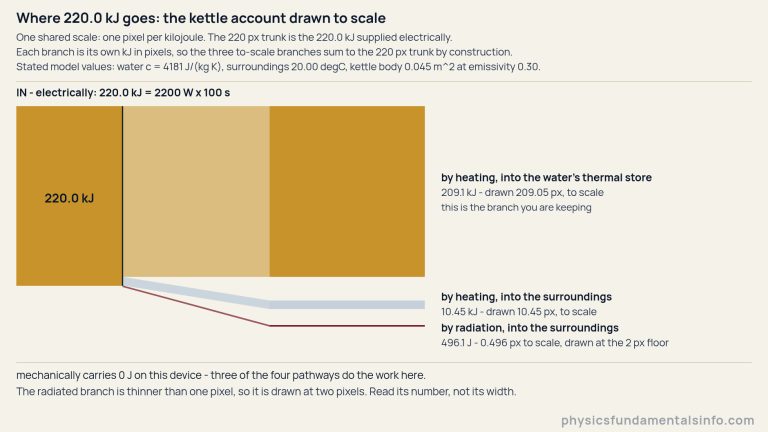
A Sankey diagram of the simulator's kettle account drawn on one shared scale of one pixel per kilojoule, so the input trunk is 220 pixels tall for the 220.0 kJ supplied electrically as 2200 W for 100 s. Subtitles state that each branch is its own kilojoules in pixels, so the three to-scale branches sum to the 220 pixel trunk by construction, and that the stated model values are water c equal to 4181 joules per kilogram kelvin, surroundings at 20.00 degrees Celsius, and a kettle body of 0.045 square metres at emissivity 0.30. A tall gold band continues straight on from the trunk: it is the branch by heating into the water's thermal store, labelled 209.1 kJ and drawn 209.05 pixels tall, described as the branch you are keeping. A pale grey band peels downward from the bottom of the trunk to a thinner bar: it is the branch by heating into the surroundings, labelled 10.45 kJ and drawn 10.45 pixels tall. A dark red sliver peels further down to a bar just two pixels tall: it is the branch by radiation into the surroundings, labelled 496.1 J, which is 0.496 pixels to scale and is drawn at the two pixel floor. Two closing lines state that mechanically carries 0 joules on this device so three of the four pathways do the work here, and that the radiated branch is thinner than one pixel, so it is drawn at two pixels and the reader should read its number rather than its width.
One shared scale, one pixel per kilojoule: the 220 px trunk is the 220.0 kJ supplied, and the branches are 209.05 px, 10.45 px and 0.496 px. The last of those is thinner than a pixel, so it is drawn at a 2 px floor and labelled with its joules instead — on this account the width of the smallest branch is not readable, and the figure says so.

The simulator below is that account with the settings under your hand. Choose the machine, set the power and the run time, set the mass and either the temperature rise or the lift height, and the diagram redraws with every branch width recomputed and every figure printed beside it.

Energy Transfers Lab

Why the Last Branch Is a Deduction, Not a Measurement

The surroundings branch is never measured. It is defined as whatever is left when every branch you can name is taken off the supply.

So the balance line reads zero because it was built to read zero. Add the store branch, the radiated branch and the remainder back together and the supply comes back exactly, at every setting, because the remainder was constructed as that difference in the first place. Presenting a tautology as a result that came out right would be dishonest. It is the method, not a coincidence.

That sounds like a weakness, and it is the point. Nobody can meter the warmed body of a kettle, the worktop underneath it, the warm air above it or the steam leaving the spout. What you can do is insist that the joules add up, and let the arithmetic tell you how large the unmeasured branch has to be. Conservation of energy is what licenses the deduction: nothing is permitted to simply disappear, so a shortfall has to be somewhere.

Being honest about what sits inside that branch matters more than the figure. For the kettle it holds the warmed metal, the warmed worktop, the warm air and every joule the steam carries away, all lumped together, because none of those is modelled separately. The kettle body’s own thermal store is not tracked at all, and the model simply assumes the outer surface reaches the water temperature. That choice is deliberately generous: the final temperature is applied across the whole run, when a real surface starts cool and warms, so the radiated branch is best read as an upper bound.
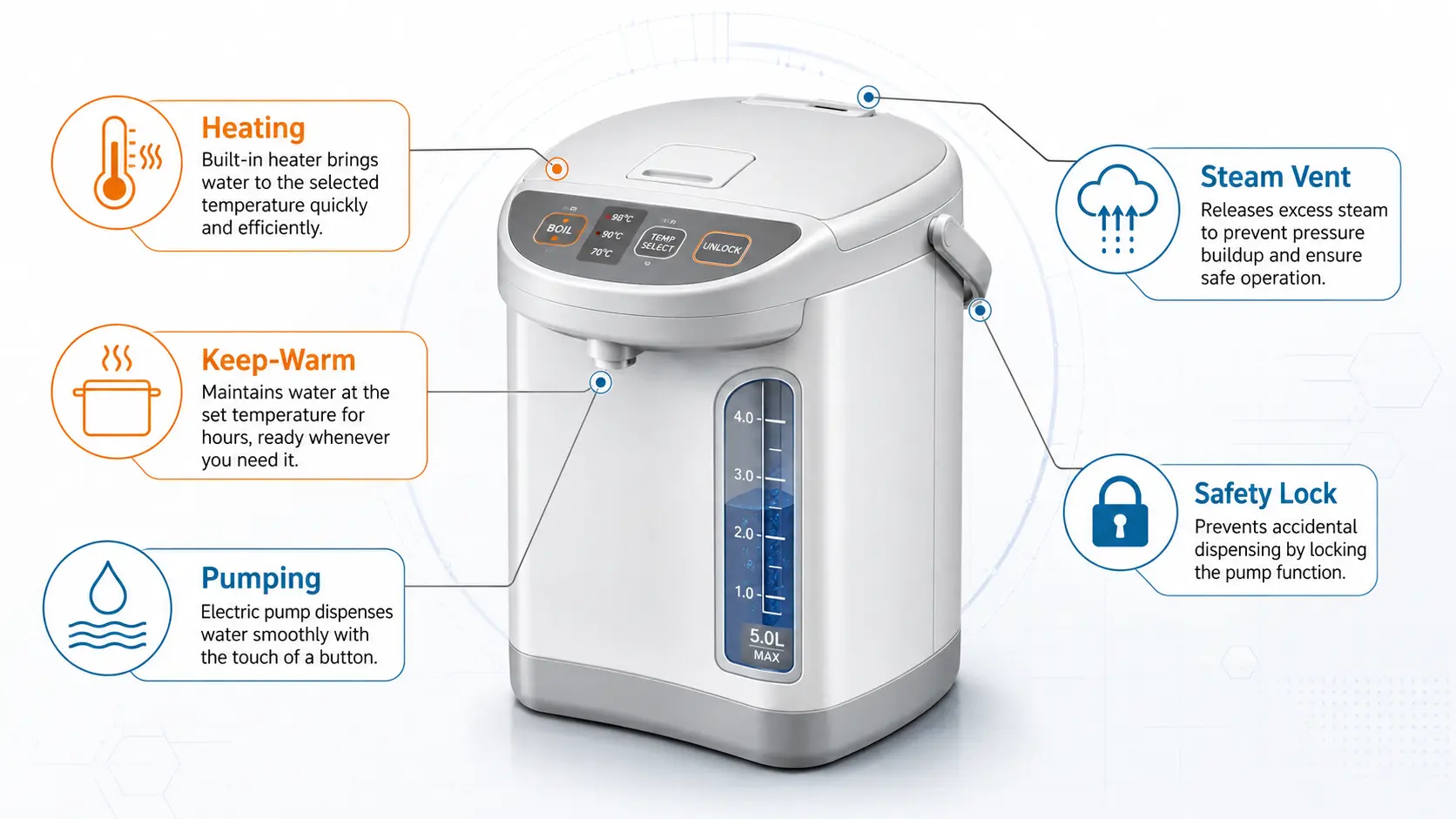
An electric kettle boiling, steam rising from the spout
Every joule the steam carries away is inside the branch nobody measures.

Four numbers in that account are the simulator’s stated assumptions rather than measurements: 4181 J/(kg·K) for water, surroundings at 293.15 K, a radiating area of 0.045 m2 and an emissivity of 0.30. Change the area or the emissivity and the radiated branch moves with them, while the remainder quietly absorbs the difference. So the honest form of the result is “with the simulator’s stated 0.045 m2 at emissivity 0.30, the radiated branch is 496.1 J” — dropping the assumptions would turn it into a claim about kettles, which this page does not make.

One state in the model is not a tautology, and it is the one worth pushing the sliders into. Ask for a temperature rise that needs more joules than the supply can provide and the account becomes impossible: the named branches demand more than arrived, and the remainder would have to be negative. An honest model reports the shortfall and clamps the branch at zero, because you cannot take more out of a store than went into it.

Common Mistakes About Energy Transfers

Every mistake below is cured the same way: write the account down, name each store and each pathway separately, and read what the arithmetic says rather than what the words suggest. The headings quote the sentences as people usually say them.

“The energy was used up”

Nothing was used up; it moved. The 220 000 J the simulator’s kettle takes in are all still there afterwards — with its stated 1.00 kg, 50 K rise and 4181 J/(kg·K), 209 050 of them are in the water and the rest is spread through the kitchen. What has been spent is not the energy but how concentrated it was, because joules thinly spread through a room already at room temperature are very hard to do anything with.

“Electricity is a kind of energy you can store”

Electrically names a route, not a place. A charged battery holds a chemical store and a charged capacitor holds an electrostatic one, but no device anywhere holds joules “as electricity”, and that is why an energy account lists electrically as a supply pathway and never as a destination. Asking which store, separately from which pathway, kills this one outright.

“The missing joules are lost”

They are not missing and they are not lost — they are in the thermal store of the surroundings, and the account says exactly how many. “Lost” is a statement about what you can still do with them, not about whether they exist. Call the branch what it is and the bookkeeping stays honest.

“A slower, gentler run must be kinder”

Not in this model, and not in a real kitchen either. The store depends on mass, specific heat capacity and temperature rise; the losses depend on how long the surface stays hot. At 500 W for 480 s the water gains the same 209 050 J as it does at 2200 W for 100 s, and 20 000 J more go to the surroundings — every joule of the extra supply.

Where Energy Accounting Earns Its Keep

Any machine with one supply and more than one destination is an energy account waiting to be written down. The method does not care what the machine is: name the stores, name the pathways, deduct, and read the remainder.

The two machines in the simulator are deliberately ordinary. A kettle sends most of its joules into a thermal store and the rest into the room; a winch sends most of its joules into a gravitational potential store and the rest into the room. Same three lines, different store, different pathway into it. Swap the kettle for a motor and only the names on the lines change: decide which store the machine exists to fill, name the pathways out, and the branch nobody meters is still the one you reach by deduction.

The picture that goes with this accounting is older than any simulator. A Sankey diagram is a flow diagram in which the width of the arrows is proportional to the flow rate of the depicted extensive property, so a branch’s width is its quantity and a small branch cannot pretend to be a large one. The form is named after the Irish engineer Captain Matthew Henry Phineas Riall Sankey, who used one in 1898 in a figure showing the energy efficiency of a steam engine.

In practice the remainder is the branch that pays for itself. It is the number that tells you whether to insulate the tank, shorten the run or buy a different machine — and on the low-power row above, the remainder nearly trebles from 10.45 kJ to 28.57 kJ while the store does not budge. A magnitude check is worth running too: 10.95 kJ into a kitchen is about what a 100 W lamp puts out in under two minutes, which is why nobody notices it.

How Energy Transfers Relate to Conversion, Conservation and Stores

A transfer says how the joules moved; a transformation says which kind of store they ended up in. They describe the same event along different axes, and neither one replaces the other.

Take the winch. “Electrically in, mechanically into a gravitational potential store” is the transfer account, and it names routes. The conversion account asks instead what became what, example by example, and that is the sibling question to this one rather than a rival answer. If you can name the pathway, you can usually name the transformation; the reverse is not reliable, which is why the pathway is the better place to start.

Conservation sits underneath both. It is what forces the account to close and therefore what makes the deduction legitimate; without it the remainder would be a guess rather than an arithmetic consequence. Everything else on this page is bookkeeping built on that one guarantee.

Worked Problems

Every figure below is recomputed from the givens stated inside its own problem, and the four model values are named as the simulator’s assumptions wherever they are used.
Problem 1
An electric kettle is supplied with electrical power P = 2200 W and runs for t = 100 s. How many joules enter the account, by which pathway, and why is that pathway not a store?
Show Solution
Solution: Step 1: The supply is a power multiplied by a time. E_in = P x t, with P in watts, which are joules per second, and t in seconds. Step 2: Substitute the givens. E_in = 2200 W x 100 s. Step 3: Multiply. 2200 x 100 = 220 000, so E_in = 220 000 J, which is 220.0 kJ at four significant figures. Step 4: Name the pathway. The joules arrive electrically, because a current does work in the element. Nothing is held as electricity at any point: the pathway is a route, and the stores sit at its ends. Answer: 220 000 J, that is 220.0 kJ, supplied electrically
Problem 2
The same kettle heats m = 1.00 kg of water through a rise of 50 K. Using the simulator's stated model value of 4181 joules per kilogram per kelvin for liquid water, how many joules reach the water's thermal store, and by which pathway?
Show Solution
Solution: Step 1: A thermal store is filled by a mass, a specific heat capacity and a temperature rise. Q = m x c x dT. Step 2: Substitute the given mass, the simulator’s stated c and the given rise. Q = 1.00 kg x 4181 J/(kg K) x 50 K. Step 3: Multiply. 4181 x 50 = 209 050, and 1.00 x 209 050 = 209 050, so Q = 209 050 J. Step 4: Round for display. Four significant figures of 209 050 is a tie at the final zero, which rounds up, so the figure is printed 209.1 kJ. Step 5: Name the pathway and the store. The joules travelled by heating and now sit in the water’s thermal store. The 4181 figure is the simulator’s stated model value for liquid water near room temperature, not a measurement of a particular sample. Answer: 209 050 J, printed 209.1 kJ, into the water’s thermal store, by heating
Problem 3
With the simulator's stated assumptions - a radiating area of 0.045 square metres, an emissivity of 0.30, surroundings at 293.15 K, and a body that is assumed to reach the water temperature - how many joules leave by radiation during the 100 s run at a 50 K rise?
Show Solution
Solution: Step 1: Use the net Stefan-Boltzmann form. E_rad = sigma x A x eps x (T_surf^4 – T_room^4) x t, with sigma = 5.670374419e-8 W/(m^2 K^4). Step 2: Get the surface temperature from the stated model assumption. T_surf = 293.15 K + 50 K = 343.15 K. Step 3: Take the fourth powers. 343.15^4 = 1.3865515e10 K^4 and 293.15^4 = 7.3851546e9 K^4, so the difference is 6.48036e9 K^4 to six significant figures. Six is deliberate: eight-figure operands cannot support eight figures of their own difference. Step 4: Collect the constants. sigma x A x eps = 5.670374419e-8 x 0.045 x 0.30 = 7.655005e-10 W/K^4. Step 5: Multiply to get the radiated power. 7.655005e-10 x 6.48036e9 = 4.96072 W. Step 6: Multiply by the run time. 4.96072 W x 100 s = 496.072 J, which is 496.07 J to two decimal places and 496.1 J at four significant figures. Answer: 496.1 J by radiation – true for the simulator’s stated area and emissivity, and for no particular product
Problem 4
A kettle account has 220 000 J supplied, 209 050 J in the water's thermal store and 496.07 J radiated. How many joules went to the surroundings by heating, what is the total to the surroundings, and why is the balance check certain to pass?
Show Solution
Solution: Step 1: Everything you can name is deducted from the supply. E_oth = E_in – Q – E_rad. Step 2: Substitute. E_oth = 220 000 J – 209 050 J – 496.07 J. Step 3: Subtract in order. 220 000 – 209 050 = 10 950, and 10 950 – 496.07 = 10 453.93, so E_oth = 10 453.93 J, printed 10.45 kJ. Step 4: Total the two surroundings branches. 496.07 + 10 453.93 = 10 950.00 J, printed 10.95 kJ. Step 5: Add every branch back. 209 050 + 496.07 + 10 453.93 = 220 000 J, exactly the supply. That check can never fail, because step 1 defined E_oth as the difference: the zero is built in rather than discovered. Answer: 10 453.93 J by heating, 10.95 kJ to the surroundings in total, and a balance that is zero by construction
Problem 5
An electric winch takes P = 750 W for t = 20 s and raises a 120 kg load through h = 10.0 m. Take standard gravity as g = 9.80665 metres per second squared. Find the supply, the joules into the gravitational potential store, and the remainder.
Show Solution
Solution: Step 1: Total the supply first. E_in = P x t = 750 W x 20 s = 15 000 J, printed 15.00 kJ. Step 2: The mechanical branch fills the gravitational potential store. E_pe = m x g x h. Step 3: Substitute and multiply. 120 x 9.80665 = 1176.798, and 1176.798 x 10.0 = 11 767.98, so E_pe = 11 767.98 J, printed 11.77 kJ. Step 4: Deduct. E_oth = 15 000 – 11 767.98 = 3232.02 J, printed 3.232 kJ, and it goes by heating into the thermal store of the surroundings. Step 5: Name the empty pathway. Nothing in the model radiates on this machine, so the radiated branch is exactly 0 J. Named, and empty. Answer: 15.00 kJ in, 11.77 kJ into the gravitational potential store, 3.232 kJ to the surroundings, 0 J by radiation
Problem 6
One setting supplies 2200 W for 100 s and another supplies 500 W for 480 s, both heating 1.00 kg of water through 50 K at the stated 4181 joules per kilogram per kelvin. Show that the water's thermal store gains the same joules in both, and find how much more goes to the surroundings in the slow run.
Show Solution
Solution: Step 1: Total both supplies. 2200 x 100 = 220 000 J, and 500 x 480 = 240 000 J. Step 2: The store depends on m, c and dT only, and all three are the same in both settings. Q = 1.00 x 4181 x 50 = 209 050 J either way. Step 3: The radiated power is the same in both too, because the temperature rise is the same: 4.96072 W from problem 3. Over 100 s that is 4.96072 x 100 = 496.07 J; over 480 s it is 4.96072 x 480 = 2381.15 J. Step 4: Deduct for the slow run. 240 000 – 209 050 – 2381.15 = 28 568.85 J by heating, so the surroundings take 2381.15 + 28 568.85 = 30 950.00 J, printed 30.95 kJ. Step 5: Compare. The fast run sent 10 950.00 J to the surroundings and the slow one 30 950.00 J, a difference of 20 000.00 J – which is exactly the extra 20 000 J that was supplied, since the store took the same amount both times. Answer: 209 050 J into the store either way; the slow run loses 30.95 kJ against 10.95 kJ, an extra 20.00 kJ
Problem 7
A Sankey diagram of the kettle account draws the 220 000 J supply as a trunk 220 pixels tall, one pixel per kilojoule. How tall is each branch on that one shared scale, and what has to happen to the smallest one?
Show Solution
Solution: Step 1: Fix the scale from the trunk. 220 px for 220 000 J is 1 px per 1000 J, so a branch’s height in pixels is its joules divided by 1000. Step 2: The store branch. 209 050 / 1000 = 209.05 px. Step 3: The surroundings-by-heating branch. 10 453.93 / 1000 = 10.45393 px, which is 10.45 px. Step 4: The radiated branch. 496.07 / 1000 = 0.49607 px, which is 0.496 px – thinner than a single pixel, so it cannot be drawn to scale at all. Step 5: Floor it, and say so. Drawn at a 2 px minimum the three branches stack to 209.05 + 10.45 + 2 = 221.50 px against a 220 px trunk, so the caption has to tell the reader to read the number rather than the width on that one branch. Answer: 209.05 px, 10.45 px and 0.496 px – the last floored to 2 px, with the overshoot stated in the caption
Problem 8
A setting supplies only 100 W for 10 s but asks for 3.00 kg of water to rise by 80 K at the stated 4181 joules per kilogram per kelvin. Show that the account cannot balance, and find the shortfall.
Show Solution
Solution: Step 1: Total the supply. E_in = 100 W x 10 s = 1000 J. Step 2: Work out what the store demands. Q = 3.00 x 4181 x 80. First 4181 x 80 = 334 480, then 334 480 x 3.00 = 1 003 440 J. Step 3: Compare at once. The store alone asks for 1 003 440 J against 1000 J supplied, so there is no remainder to deduct and the arithmetic would drive the surroundings branch negative. Step 4: Add the radiated branch, computed exactly as in problem 3 but with T_surf = 293.15 + 80 = 373.15 K over 10 s, which comes to 91.88 J. The named branches then demand 1 003 440 + 91.88 = 1 003 531.88 J. Step 5: Take the shortfall. 1 003 531.88 – 1000 = 1 002 531.88 J. An honest model reports that deficit, clamps the surroundings branch at zero and draws no negative branch, because you cannot take more out of a store than went into it. Answer: impossible – the named branches demand 1 003 531.88 J against 1000 J supplied, a shortfall of 1 002 531.88 J

Frequently Asked Questions

What is the difference between an energy store and an energy pathway?
A store is where joules are held and can be counted; a pathway is the named route they travel between stores. Water in a kettle has a thermal store, and a raised load has a gravitational potential store. Mechanically, electrically, by heating and by radiation are pathways: routes, not places. Asking which store and which pathway as two questions clears up most of the confusion here.
What are the four energy transfer pathways?
Mechanically, electrically, by heating and by radiation. Mechanically means a force acting through a distance; electrically means a current doing work in a circuit; by heating means a temperature difference driving joules across by conduction or convection; by radiation means joules leaving as electromagnetic waves. One device rarely uses all four at once: in the simulator at most three ever carry joules together, and exactly three do on every preset.
Is there such a thing as an electrical energy store?
No, and the phrase survives only as shorthand for energy transferred electrically. The test is whether you can count what is inside: a store holds joules that a formula gives you from measurable quantities, while a pathway only has a total that has passed through it. That is why the first figure on this page draws the supply box with a dashed outline and heads it NOT A STORE.
Why is the energy that goes to the surroundings never measured?
Because nothing practical measures it. You cannot meter a warmed worktop, the warm air above a kettle or the steam leaving its spout, so the branch is worked out instead: add up every branch you can name, deduct them from the supply, and the remainder is what reached the surroundings. Conservation of energy is what licenses that deduction.
Does an energy balance check prove the physics is right?
No, because the balance is zero by construction. The surroundings branch is defined as the supply minus every branch that was named, so adding the branches back always returns the supply exactly. That is the method working, not a measurement coming out right. What the account can genuinely be tested on is whether the named branches ever demand more joules than were supplied.
Why does a slower run put the same energy into the water but lose more?
Because the run time appears in the supply and in the losses, but nowhere in the store. What the water keeps is fixed once the mass and the temperature rise are chosen, so stretching the run cannot add a joule to it. The radiated branch, by contrast, is a rate multiplied by a time, so it grows with the clock, and the remainder absorbs the rest of the extra supply.
What is a Sankey diagram?
It is a flow picture whose branches are sized to the quantity each one carries, so an energy account can be taken in by eye instead of from a column of figures. Its weakness is the smallest branch: scaled honestly it vanishes, which is why the second figure on this page gives that branch a visible floor and prints its joules beside it. A branch that looks like a hairline needs its label read.
P

Written by PhysicsFundamentals Editorial Team

Articles on PhysicsFundamentalsinfo.com are researched, written, and fact-checked by our editorial team. Every piece is reviewed for accuracy before publishing, with formulas and worked examples checked against standard physics references.

View All Authors →