The Stefan-Boltzmann law states that the power radiated by a surface equals the Stefan-Boltzmann constant multiplied by its emissivity, its surface area, and its absolute temperature raised to the fourth power. Written P = σεAT4, it means that doubling an object’s absolute temperature multiplies the power it radiates by sixteen.
Open an oven door at 220 °C and the heat hits your face before any hot air reaches you. That is thermal radiation arriving at the speed of light — and it does not scale gently.
Push that oven to twice its absolute temperature and it would not glow twice as fiercely. It would pour out sixteen times the power. That single exponent is why a filament can light a room, why the Sun dominates our sky, and why Earth does not cook itself.
What Is the Stefan-Boltzmann Law?
The Stefan-Boltzmann law says that the total power radiated by a surface across all wavelengths is proportional to the fourth power of its absolute temperature. Every object above absolute zero obeys it — you, this screen, an ice cube, a star.
Josef Stefan found the relationship experimentally in 1879, working from measurements of hot platinum. Five years later Ludwig Boltzmann derived the same result from thermodynamics, treating radiation as a gas of photons exerting pressure. Experiment first, theory second — an unusually clean example of how physics actually advances.
The law describes emission, not the mechanism of transfer. If you want the wider picture of how radiation sits alongside conduction and convection as a mode of heat transfer, that comparison is covered separately. Here we stay on the equation itself.
Why “absolute” temperature is non-negotiable
T must be in kelvin. Always. A fourth power of a Celsius reading is physically meaningless, because Celsius has an arbitrary zero — and a negative Celsius temperature raised to the fourth power flips sign, which would imply an object absorbing energy simply for being cold.
This is the single most common source of a wrong answer in exam scripts. Convert first: K = °C + 273.15. If you are shaky on why absolute scales exist at all, the distinction between heat and temperature is the concept underneath it.
The Stefan-Boltzmann Law Formula
The full form of the law, valid for any real surface, is:
Every symbol, with its SI unit:
| Symbol | Quantity | SI unit | Notes |
|---|---|---|---|
| P | Radiated power | watt (W) | Energy emitted per second |
| σ | Stefan-Boltzmann constant | W m-2 K-4 | 5.670374419 × 10⁻⁸, exact |
| ε | Emissivity | dimensionless | 0 to 1; equals 1 for a black body |
| A | Radiating surface area | m2 | The area actually facing outward |
| T | Absolute temperature | kelvin (K) | Never Celsius |
Note what P is: a rate. It is power measured in watts, joules leaving every second, not a quantity of energy. A 500 W plate emits 500 joules each second for as long as you hold it at that temperature.
Set ε = 1 and you get the idealised black-body form, P = σAT4. If you would rather not push the fourth powers through a calculator by hand, our Stefan-Boltzmann Calculator takes ε, A and T and returns the radiated power — and rearranges to solve for temperature when you already know the power.
The constant is now exact
Since the 2019 SI redefinition, σ is no longer a measured quantity with an experimental uncertainty. It is fixed by definition, because it is built from the Planck constant, the Boltzmann constant and the speed of light — all of which now have exact defined values.
That is why you will see it quoted to ten significant figures: σ = 5.670374419 × 10⁻⁸ W m-2 K-4. For any exam or engineering estimate, 5.67 × 10⁻⁸ is plenty.
Why the Fourth Power Changes Everything
The fourth power means radiated power climbs far faster than temperature does. Raise T by 10% and you get 46% more power; double T and you get 16 times as much; triple it and you get 81 times as much.
Look at what that does to a curve. For most of the temperature range the line barely lifts off the axis — then it goes nearly vertical.
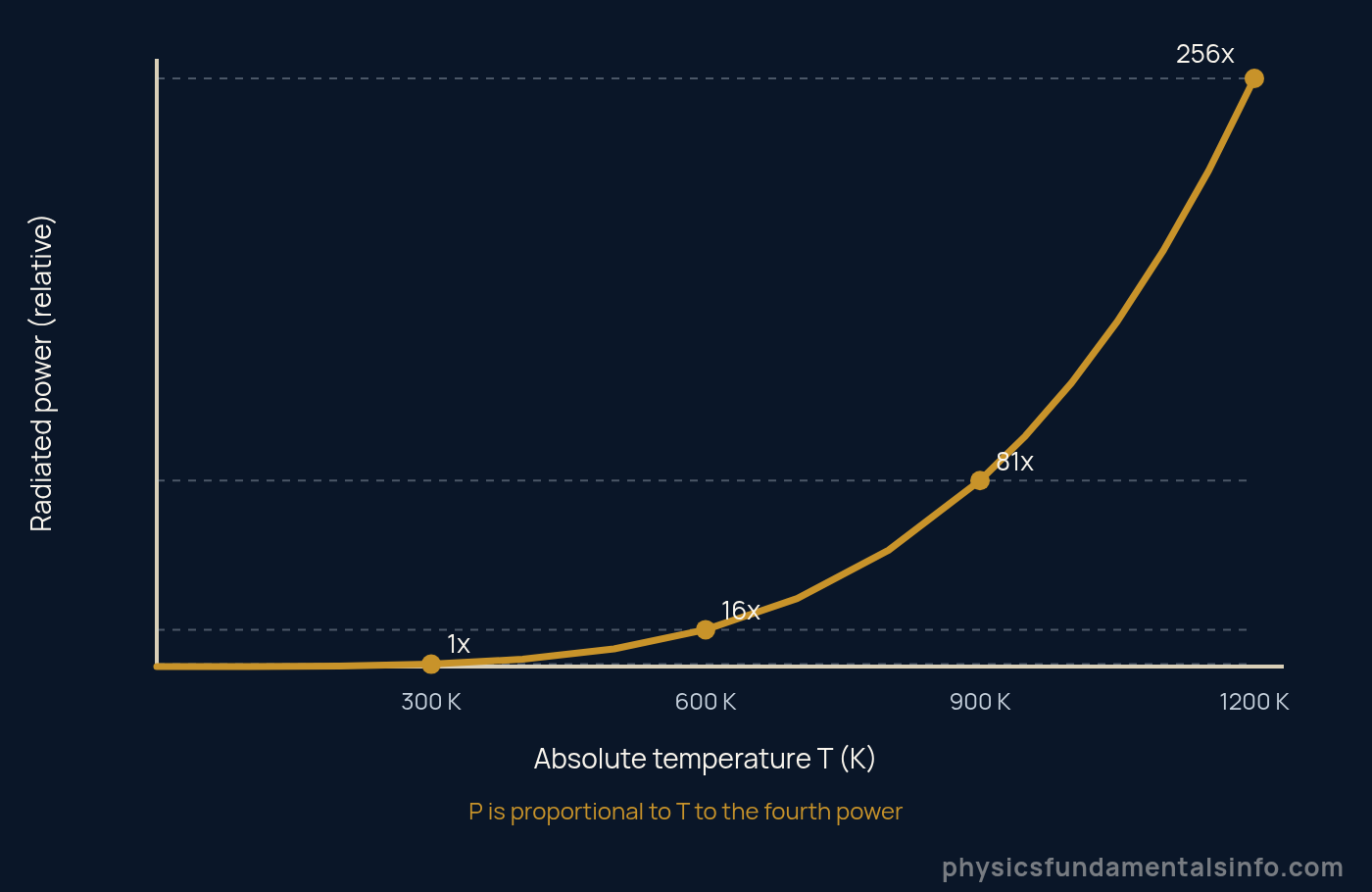
Radiated power against absolute temperature. Each marked point is four times the previous temperature step, yet the power multiplies by 16, 81 and 256.
Here are the same ratios as numbers you can quote:
| Temperature change | Power multiplier | Everyday reading |
|---|---|---|
| T rises 1% | 1.04x | 4% more power for a barely detectable warming |
| T rises 10% | 1.46x | Nearly half as much again |
| T doubles | 16x | The headline result of the law |
| T triples | 81x | Room temperature to a glowing element |
| T quadruples | 256x | Room temperature to a bulb filament |
This steepness is a stabiliser. NASA describes the same behaviour as radiative cooling: because a warming surface sheds energy so much faster than it warms, Earth’s energy budget self-corrects rather than running away.
Black Bodies vs Real Surfaces: What Emissivity Actually Measures
Emissivity is the fraction of black-body radiation a real surface actually emits at a given temperature. A perfect black body has ε = 1; every real material sits below it.
A black body is an idealisation — a surface that absorbs every wavelength that lands on it and re-emits the theoretical maximum. Nothing is perfect, but a small hole in a heated cavity comes remarkably close, which is exactly how black-body spectra were measured in the first place.
Now the part that trips almost everyone up. Emissivity has very little to do with the colour you can see.
Thermal radiation from everyday objects peaks deep in the infrared, around 10 micrometres for something near room temperature — far outside the visible band on the electromagnetic spectrum. What matters is how the surface behaves at those wavelengths, not how it looks to your eye.
White paint has an emissivity around 0.9. So does black paint. Visually opposite, thermally near-identical. The genuine low-emissivity materials are bare polished metals.
| Surface | Typical emissivity ε | Why it matters |
|---|---|---|
| Polished silver | 0.02 | Near-mirror in the infrared; the basis of vacuum flasks |
| Polished aluminium | 0.05 | Used as radiant barrier and spacecraft foil |
| Oxidised steel | 0.80 | Oxidation raises ε dramatically over bare metal |
| Anodised aluminium | 0.82 | Same metal, treated surface, sixteen times the emission |
| Brick and concrete | 0.92 | Buildings radiate almost as well as black bodies |
| Matt paint (any colour) | 0.90 to 0.96 | Visible colour is almost irrelevant in the infrared |
| Water | 0.96 | Oceans radiate nearly as ideal emitters |
| Human skin | 0.98 | Why thermal cameras read people so reliably |
Treat these as representative values, not constants. Real emissivity shifts with surface finish, oxidation, temperature and the wavelength band being measured — a polished pan that has been used for a year is no longer a polished pan.
How to Calculate Net Radiated Power
An object in a warm room does not lose everything it radiates, because the room is radiating back. The net rate is the difference between what leaves and what arrives:
- T — absolute temperature of the object, in kelvin (K)
- Tc — absolute temperature of the surroundings, in kelvin (K)
- All other symbols as defined above; Pnet is in watts (W)
Get the sign intuition right and this equation stops being fiddly. If T is greater than Tc, the answer is positive and the object is cooling. If the surroundings are hotter, the answer is negative — the object is gaining energy on balance.
Georgia State University’s HyperPhysics sets out the same net radiation loss rate, with a useful corollary: if the surroundings are hotter than the object, the negative answer simply means net transfer into it.
Nothing here contradicts the laws of thermodynamics. A cold object genuinely does radiate towards a hot one; it simply receives more than it sends, so the net flow always runs hot to cold.
In practice, this is why you feel cold standing beside a large window on a winter night even in a heated room. The air is warm, but the glass surface is not — and your skin, at an emissivity of about 0.98, is radiating to it far more than it gets back.
Why the Sun’s Temperature Matters So Much
The Sun’s output is set by the fourth power of its surface temperature, which is why a modest-sounding 5772 K produces such an overwhelming luminosity. Apply P = σAT4 to a sphere of radius 6.957 × 10⁸ m and you get 3.83 × 1026 W — the accepted solar luminosity, from one equation.
That is the real power of this law. You cannot put a thermometer on the Sun, but you can measure the energy arriving here, work backwards, and recover its temperature.
From luminosity to the solar constant
Spread that 3.83 × 1026 W over a sphere with the radius of Earth’s orbit and you get about 1361 W per square metre at the top of our atmosphere. About 1.36 kilowatts on every square metre — the number every solar panel is ultimately rated against.
And why Earth sits at -18 °C
Balance absorbed sunlight against radiated heat for the whole planet and the Stefan-Boltzmann law returns an effective temperature of about 255 K, or -18 °C. Earth’s actual surface averages roughly 15 °C.
That 33-degree gap is the natural greenhouse effect, and this calculation is how it was first quantified. Worked problem 6 below runs the full derivation.
Real-World Examples of the Stefan-Boltzmann Law
Five places the fourth power shows up, from your kitchen to deep space.
- Incandescent bulbs. A tungsten filament near 2800 K radiates roughly 7,600 times as much per square metre as the same filament at room temperature. That is the whole trick — and also why so much of it leaves as invisible infrared rather than light.
- Vacuum flasks. The vacuum kills conduction and convection, so radiation is the only route left. Silvering the walls drops ε to about 0.02, cutting that last channel by roughly fifty times.
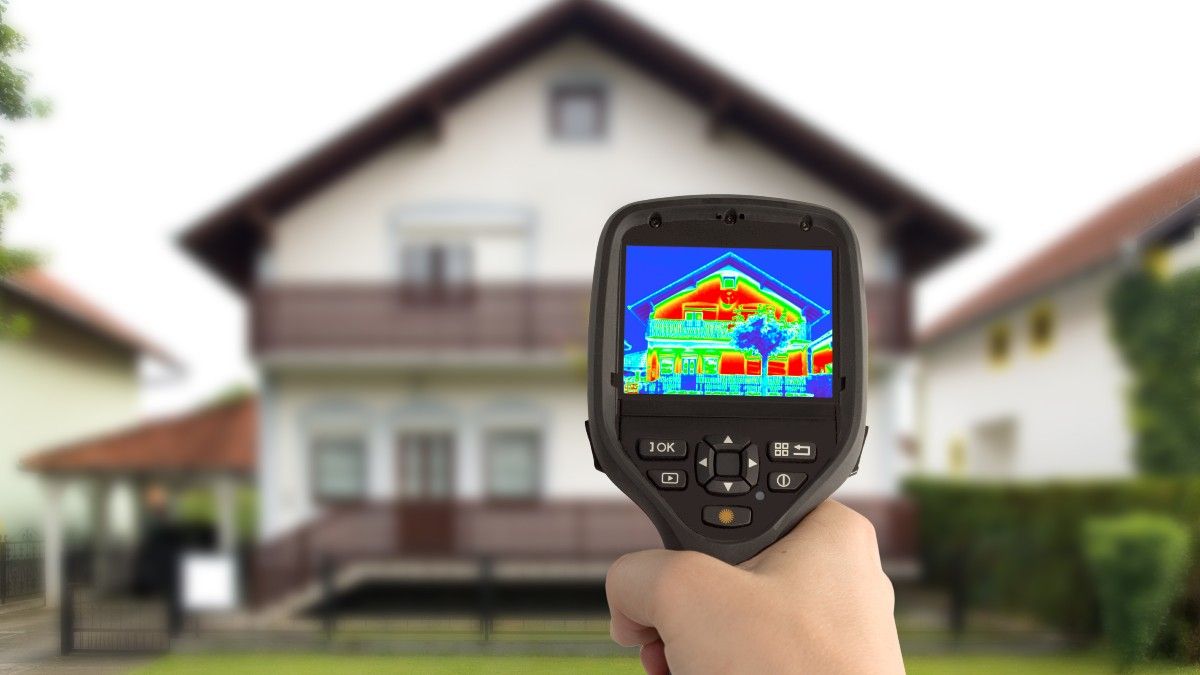
- Thermal imaging. A camera measures emitted infrared and inverts the law to get temperature. It must be told the target’s emissivity first — point one at polished metal without correcting ε and it will read far too cold.
- Spacecraft thermal control. In orbit there is no air to carry heat away, so radiators are sized purely from σεAT4. Multi-layer insulation and gold foil are emissivity engineering, not decoration.
- Measuring stars. A star’s colour gives its temperature and its brightness gives its power; the Stefan-Boltzmann law converts the pair into a radius. It is how we size stars we will never visit.
Common Misconceptions About the Stefan-Boltzmann Law
“Only hot things radiate”
Everything above absolute zero radiates continuously. An ice cube at -10 °C is radiating hundreds of watts per square metre; it just receives more than it emits, so it warms. Cold surfaces are quiet emitters, never silent ones.
“Thermal radiation is a kind of nuclear radiation”
They share a word and nothing else. Thermal radiation is ordinary electromagnetic waves, mostly infrared, emitted by any warm object — no nuclei involved. The genuinely nuclear types of radiation come from unstable atoms, not from being warm.
“A shiny white surface stays coolest because it reflects”
In sunlight, yes — white reflects visible light well. But for radiating heat away, white paint (ε of about 0.9) massively outperforms bare polished aluminium (ε of about 0.05). Good absorbers are good emitters, at the same wavelength: that is Kirchhoff’s law, and it is why the two questions have different answers.
“You can subtract the temperatures first”
You cannot. (T – Tc)4 is not T4 – Tc4, and the gap is enormous. Raise each temperature to the fourth power separately, then subtract — a slip that turns 140 W into about 0.02 W in the human-body problem below.
How the Stefan-Boltzmann Law Relates to Other Concepts
The law is one member of a family describing how warm matter emits light.
Planck’s law gives the full spectrum — how much energy comes out at each wavelength. Integrate it over all wavelengths and the Stefan-Boltzmann law falls out. One is the detail; the other is the total.
Wien’s displacement law handles the peak. It tells you where in the spectrum the emission is strongest: about 500 nm for the Sun at 5772 K, which lands in visible green, and about 9.5 micrometres for skin at 306 K, deep in the infrared.
Kirchhoff’s law ties absorption to emission, guaranteeing that a surface’s emissivity equals its absorptivity at the same wavelength. Without it, ε would need two separate values and the whole framework would fall apart.
Together these three answer the complete question: how much energy, at which wavelengths, and how efficiently a real surface manages it.
Worked Problems
Show Solution
Solution:
Step 1: Apply the Stefan-Boltzmann law, P = σεAT4, with σ = 5.670374419 × 10⁻⁸ W m-2 K-4.
Step 2: Substitute the values. P = (5.670374419 × 10⁻⁸ W m-2 K-4)(0.90)(0.25 m2)(450 K)4
Step 3: Evaluate the fourth power first. (450 K)4 = 4.100625 × 10¹⁰ K4
Step 4: Collect the constants and multiply. σεA = 1.2758 × 10⁻⁸ W K-4, so P = (1.2758 × 10⁻⁸)(4.100625 × 10¹⁰) = 523.2 W
Answer: P = 523 W (3 s.f.)
Show Solution
Solution:
Step 1: Only the temperature has changed, so work with the ratio. Since P is proportional to T4, we have P2/P1 = (T2/T1)4
Step 2: Substitute the temperatures. (900 K / 450 K)4 = 24 = 16
Step 3: Scale the answer from problem 1. P2 = 16 × 523.2 W = 8371 W
Answer: P = 8.37 kW (3 s.f.). Doubling the absolute temperature multiplied the power by exactly 16.
Show Solution
Solution:
Step 1: Convert both temperatures to kelvin. T = 33 + 273.15 = 306 K and Tc = 20 + 273.15 = 293 K (both to 3 s.f.)
Step 2: Use the net form of the law. Pnet = σεA(T4 – Tc4)
Step 3: Raise each temperature to the fourth power separately, then subtract. (306 K)4 = 8.7677 × 10⁹ K4 and (293 K)4 = 7.3701 × 10⁹ K4, giving a difference of 1.3976 × 10⁹ K4
Step 4: Multiply by the constants. σεA = (5.670374419 × 10⁻⁸)(0.98)(1.8) = 1.0003 × 10⁻⁷ W K-4, so Pnet = (1.0003 × 10⁻⁷)(1.3976 × 10⁹) = 139.8 W
Answer: Pnet = 140 W (2 s.f.). That is comparable to the body’s entire resting metabolic output, which is why an unheated room feels so punishing.
Show Solution
Solution:
Step 1: Convert to kelvin. T = 353 K and Tc = 293 K
Step 2: Compute the temperature term once, since both kettles share it. (353 K)4 – (293 K)4 = 1.55274 × 10¹⁰ – 7.3701 × 109 = 8.1574 × 10⁹ K4
Step 3: Polished kettle. Pnet = (5.670374419 × 10⁻⁸)(0.05)(0.12)(8.1574 × 10⁹) = 2.78 W
Step 4: Matt black kettle. Pnet = (5.670374419 × 10⁻⁸)(0.95)(0.12)(8.1574 × 10⁹) = 52.7 W
Answer: 2.78 W versus 52.7 W, a factor of 19 — produced by surface finish alone at identical temperature.
Show Solution
Solution:
Step 1: Convert the area to SI units. A = 0.50 cm2 = 5.0 × 10⁻⁵ m2
Step 2: Rearrange the law to make temperature the subject. From P = σεAT4 we get T4 = P / (σεA)
Step 3: Evaluate the denominator. σεA = (5.670374419 × 10⁻⁸)(0.35)(5.0 × 10⁻⁵) = 9.9232 × 10⁻¹³ W K-4
Step 4: Divide, then take the fourth root. T4 = 60 W / (9.9232 × 10⁻¹³ W K-4) = 6.0465 × 10¹³ K4, so T = 2788 K
Answer: T = 2790 K (3 s.f.). Sanity check: that sits safely below tungsten’s melting point of about 3695 K, so the result is physically sensible.
Show Solution
Solution:
Step 1: Use the black-body form with ε = 1. P = σAT4
Step 2: Find the surface area of the sphere, converting the radius to metres. A = 4πR2 = 4π(6.957 × 10⁸ m)2 = 6.0821 × 10¹⁸ m2
Step 3: Raise the temperature to the fourth power. (5772 K)4 = 1.10995 × 10¹⁵ K4
Step 4: Multiply everything together. P = (5.670374419 × 10⁻⁸)(6.0821 × 10¹⁸)(1.10995 × 10¹⁵) = 3.828 × 1026 W
Answer: P = 3.83 × 1026 W (3 s.f.), which matches the accepted solar luminosity.
Show Solution
Solution:
Step 1: Set absorbed power equal to radiated power at equilibrium. Earth intercepts sunlight across its disc of area πR2 but radiates from its whole sphere of area 4πR2, so S(1 – a)πR2 = σT4(4πR2)
Step 2: Cancel πR2 from both sides — notice Earth’s radius drops out entirely. S(1 – a) = 4σT4
Step 3: Rearrange for temperature. T4 = S(1 – a) / (4σ)
Step 4: Substitute, with S = 1361 W m-2 and albedo a = 0.30. T4 = (1361)(0.70) / (4 × 5.670374419 × 10-8) = 4.2003 × 10⁹ K4, so T = 254.6 K
Answer: T = 255 K, or -18 °C (3 s.f.). Earth’s true surface average is about 15 °C, and that 33 °C gap is the natural greenhouse effect.