Every surface radiates, and the power it sends out climbs with the fourth power of its absolute temperature: P = σεAT4. Drag the temperature, emissivity, area and surroundings sliders below and watch the gross power, the net power and the power per square metre respond.
The Stefan-Boltzmann Law
Every surface radiates, and it does so as the fourth power of its absolute temperature. Drag T and the power readout leaps; drag emissivity or area and it only scales in step. Double the temperature and the power goes up by exactly sixteen.
What Is the Stefan-Boltzmann Simulator?
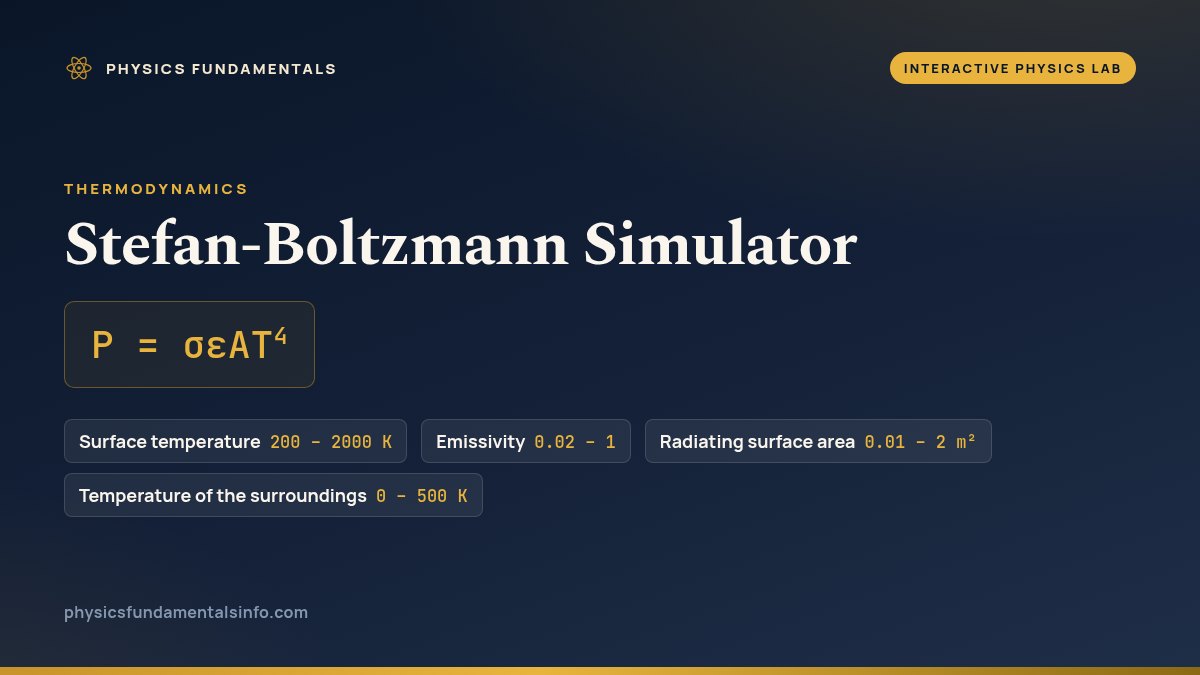
The Stefan-Boltzmann simulator is a free interactive physics lab that runs in your browser — nothing to install and no sign-up. Drag temperature, emissivity and area to see radiated power jump with the fourth power of temperature. It reports radiated power, net power Pnet, power per unit area P/A and Against a 300 k baseline (t / 300 K)4 as you drag the sliders.
| Control | Range | Step |
|---|---|---|
| Surface temperature | 200 – 2000 K | 10 |
| Emissivity | 0.02 – 1 | 0.01 |
| Radiating surface area | 0.01 – 2 m² | 0.01 |
| Temperature of the surroundings | 0 – 500 K | 1 |
How to Use the Stefan-Boltzmann Simulator
Four sliders drive the whole panel. Temperature T runs from 200 K to 2000 K and sets how hot the plate is. Emissivity ε spans 0.02 to 1.00 and scales the answer in direct proportion, as does surface area A between 0.01 m² and 2 m². Surroundings Tc, from 0 K to 500 K, touches only the net figure: it sets how much radiation arrives back at the plate from everything around it. Two buttons, Double T and Halve T, jump the temperature for you and report the factor the power actually moved by.
Spend your time on the temperature slider, because it is the one that misbehaves. Drag it from 300 K to 600 K and the power reading does not double — it multiplies by exactly sixteen, and the arrows leaving the plate thicken to match. Do the same to emissivity or to area and the reading merely doubles. That difference is the whole content of the Stefan-Boltzmann law, and it is much easier to trust once you have watched the number move. The running (T / 300 K)4 readout keeps score against a room-temperature baseline while you drag.
Behind the picture the lab evaluates P = σεAT4 for the gross power and Pnet = σεA(T4 − Tc4) for the net, with σ held at its exact SI value. Push Tc above T and the net figure goes negative while the arrows turn around: the plate is now gaining energy rather than losing it, though it is still radiating exactly as hard as it was. If you need the arithmetic for your own numbers rather than the picture, the Stefan-Boltzmann calculator solves the same formula directly.
One misconception the emissivity slider is good at breaking: emissivity is not the colour you can see. It describes how readily a surface emits infrared, which is where a warm object does nearly all its radiating, so it need not agree with brightness at all. Matt white paint sits near 0.9 and polished aluminium near 0.05 — the white paint is by far the better radiator despite looking brighter. That is why radiation behaves so unlike conduction and convection, and why it pays to know which part of the electromagnetic spectrum a warm surface actually works in.
Frequently asked questions
What do the sliders in the Stefan-Boltzmann simulator control?
There are four. Temperature T runs from 200 K to 2000 K and sets the surface temperature of the plate. Emissivity, from 0.02 to 1.00, says how good a radiator that surface is compared with a perfect black body. Surface area A, from 0.01 to 2 square metres, is how much radiating surface there is. Surroundings Tc, from 0 K to 500 K, is the temperature of everything the plate is radiating into, and it affects only the net figure, never the gross one.
Why does the power readout jump 16 times when I double the temperature?
Because the temperature enters the formula raised to the fourth power, and 2 to the fourth power is 16. Doubling T multiplies T x T x T x T by 2 x 2 x 2 x 2, so a plate at 600 K radiates exactly sixteen times as much as the same plate at 300 K. Nothing else in the formula behaves that way: doubling the emissivity or the area doubles the answer and stops there. The Double T button in the simulator does this jump for you and prints the factor it actually produced.
What emissivity value should I enter for my material?
Polished metals sit at the bottom of the range, roughly 0.02 to 0.10 for clean aluminium or silver. Oxidised and painted metals sit much higher, typically 0.7 to 0.95. Matt paint of any colour, brick, concrete, wood, water and human skin all sit near 0.9 to 0.95. A perfect black body is 1.00, which nothing real quite reaches. If you only know that a surface is dull and non-metallic, 0.9 is a sound working figure.
Why does the net power go negative when surroundings are hotter?
The net figure is the gross radiation leaving the plate minus the radiation arriving from the surroundings. When Tc is higher than T, more arrives than leaves, so the balance reverses and the plate gains energy instead of losing it. The simulator shows this by turning the arrows around rather than hiding them, because the plate is still radiating exactly as much as before. Set Tc equal to T and the net figure is exactly zero, which is thermal equilibrium.
Does the simulator use Celsius or Kelvin?
Kelvin, for both temperatures, and this is not a preference but a requirement. The fourth power only works on an absolute scale, so a Celsius value would give a wrong answer and a negative Celsius value would give a nonsensical one. To convert, add 273.15 to a Celsius reading before entering it: 20 degrees Celsius is 293 K, and 100 degrees Celsius is 373 K.
References & formula source
- Young & Freedman — University Physics with Modern Physics, §17.7 (Mechanisms of Heat Transfer: Radiation).
- Incropera & DeWitt — Fundamentals of Heat and Mass Transfer, ch. 12 (Radiation: Processes and Properties), emissivity tables.
- BIPM — The International System of Units (SI Brochure, 9th ed.): the Stefan-Boltzmann constant follows exactly from the defined values of k, h and c.
- Further reading: Stefan–Boltzmann law — Wikipedia