The combined gas law states that for a fixed amount of gas, the pressure times the volume divided by the absolute temperature keeps the same value through any change: P1V1/T1 = P2V2/T2. Hand it any five of those six quantities and it returns the sixth. Temperatures go in kelvin, pressures are absolute.
A sealed bag of crisps carried up a mountain road arrives looking like a pillow. The air outside thinned as you climbed, the air trapped inside had nowhere to go, and the packet stretched to take up the slack. Meanwhile the temperature fell, quietly pulling the other way.
That tug-of-war is the whole subject. Boyle’s law handles a squeeze at a steady temperature, Charles’s law a warming at a steady pressure — but a balloon, a tyre and a crisp packet rarely hold anything steady. One equation covers the case where two things move at once.
What Is the Combined Gas Law?
The combined gas law says that for a sealed sample of gas, the group PV/T keeps the same value no matter how the three quantities inside it change. Move two of them and the third has to shift so the group stays put.
Think of it as a budget. The gas is handed a fixed allowance at the start; spend some of it on a higher pressure and something has to give, either the volume or the temperature. Nothing is created and nothing is lost, because the allowance was set by how much gas is in there.
Fixed amount is the condition that does all the work. The same molecules have to be present at the end as at the beginning — no leak, no gas dissolving into a liquid, no reaction quietly eating or making them. Break that and the law has nothing to say.
The name is literal. Three older relations each pinned one quantity and let the other two move; this one refuses to pin anything, which is why it is the version that survives contact with a real balloon.
The Combined Gas Law Formula
Written for two states of the same sample, the law is a single equality between two groups.
Subscript 1 is the state before, subscript 2 the state after. Rearranged for the quantity people usually want, the volume at the end, it becomes one multiplication over another.
Any of the six can be the unknown, so there are six rearrangements and no one of them is more fundamental than the others. If you would rather not do the algebra by hand, the combined gas law calculator takes any five values, in kilopascals, litres, kelvin, Celsius or Fahrenheit, and returns the sixth with the working shown.
- P2 = P1V1T2 / (T1V2)
- T2 = T1P2V2 / (P1V1)
- V1 = P2V2T1 / (T2P1)
- P1 = P2V2T1 / (T2V1)
- T1 = T2P1V1 / (P2V2)
| Symbol | What it is | SI unit | Worth knowing |
|---|---|---|---|
| P1 | pressure of the gas before the change | Pa | absolute pressure, never a gauge reading; kilopascals, atmospheres, bars and psi all work provided P2 uses the same one |
| V1 | volume it occupies before | m3 | litres are the practical unit here; the volume unit cancels, so it only has to match V2 |
| T1 | temperature before | K | kelvin only, because the law divides by it — NIST puts it plainly that zero degrees Celsius is 273.15 K |
| P2 | pressure after | Pa | the second state has to be a settled one, not a reading taken mid-squeeze |
| V2 | volume after | m3 | the quantity asked for in most exam questions, and the one the simulator below computes for you |
| T2 | temperature after | K | a value of exactly 0 K sends the volume to zero, which is why a good tool refuses it rather than printing it |
Notice what is missing from that table: the amount of gas, and any constant of nature. Both cancel when you divide one state by the other, which is exactly why the units of pressure and volume are free and the unit of temperature is not.
The simulator below puts the equation on screen. Five sliders set the pressure, volume and temperature before, and the pressure and temperature after; the volume after is not a slider at all, because that one belongs to the physics. Drag any slider and watch which way the second cylinder moves.
Where the Combined Gas Law Comes From
It is not a new law. Start from the equation of state for an ideal gas and hold one thing fixed, and this drops out in a line.
Divide both sides by T and you get PV/T = nR. For a sealed sample the number of moles n never changes, and R is the same number for every gas, so the whole right-hand side is a fixed quantity for that particular sample. Whatever PV/T was before, it is that again afterwards.
That single step is worth more than it looks, because it tells you precisely what breaks the law: anything that changes n. Our guide to the ideal gas law carries the full derivation and the value of R; this page takes the finished result and uses it.
One warning about the word constant. PV/T is constant for one sample of gas, not across samples — double the amount of gas and the constant doubles with it. It is a bookkeeping value for the gas in front of you, not a property of the universe.
The Three Gas Laws Hiding Inside It
Set any one of the three quantities equal on both sides and a familiar law falls out of the algebra. That is the sense in which the combined law contains the others rather than competing with them.
| Hold this equal | What is left | Whose law it is | Read more |
|---|---|---|---|
| T2 = T1 | P1V1 = P2V2 | Boyle’s law | squeeze it at a steady temperature |
| P2 = P1 | V1/T1 = V2/T2 | Charles’s law | warm it at a steady pressure |
| V2 = V1 | P1/T1 = P2/T2 | Gay-Lussac’s law | heat it inside something rigid |
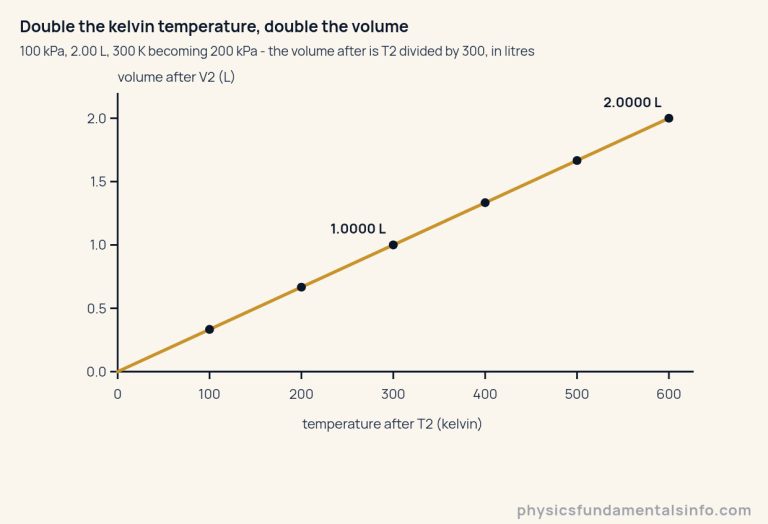
Read the two halves separately and you get the two shapes below. Hold the pressure after fixed and sweep the temperature after, and the volume lands on a straight line through the origin; the graph is drawn from the exact values, not from readouts.
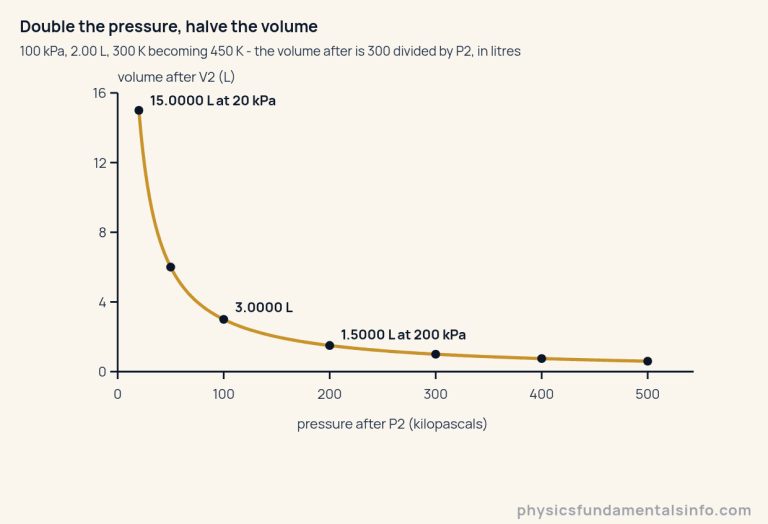
Hold the temperature after fixed instead and sweep the pressure after, and the same equation bends into a hyperbola. Doubling the pressure after from 100 kPa to 200 kPa takes the volume from 3.0000 L to exactly 1.5000 L, and the curve flattens without ever touching the axis.
There is a trap in the third row of that table, and it is worth flagging here. Imposing V2 = V1 as a condition — a gas sealed in a rigid steel cylinder — genuinely gives you Gay-Lussac’s law. A volume that merely happens to come back to its starting figure is a different thing entirely, and the misconceptions section deals with it.
Two Routes, One Answer: The Check That Can Actually Fail
Here is the uncomfortable part of every gas-law page, stated plainly. When a tool computes V2 from P1V1/T1 = P2V2/T2 and then shows you that PV/T is the same before and after, it has proved nothing at all. The two are equal because the answer was chosen to make them equal.
So what would count as evidence? Doing the change a different way and seeing whether you arrive at the same place. Squeeze first and then warm, or warm first and then squeeze — different arithmetic, different numbers in the middle, and no guarantee in advance that the two agree.
Worked problem 6 below puts numbers on it. A sample sitting at 120 kPa and 5.00 L at 250 K is taken to 300 kPa and 400 K, and the change is made three different ways.
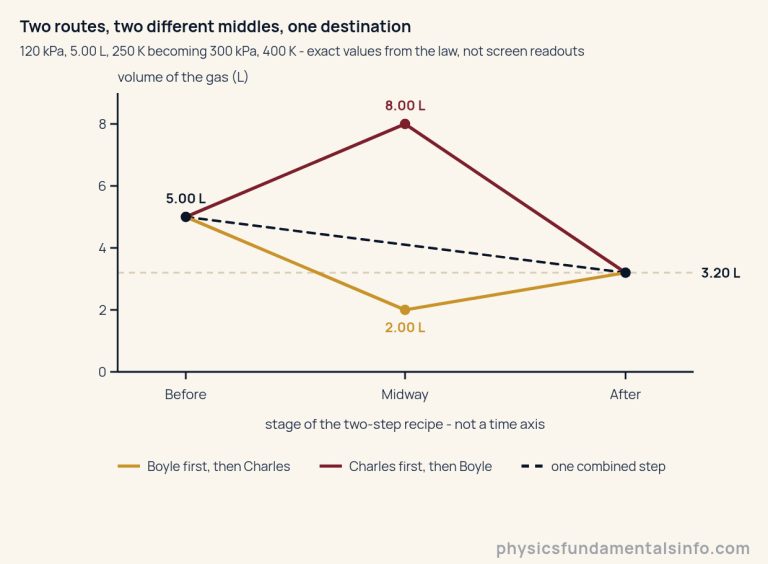
The gap between those two midpoints is the point of the picture. One route passes through 2.00 L, the other through 8.00 L, and they are four times apart — yet the finish is identical to the last digit either way.
This was checked over a grid of 10,584 starting and finishing states while the cluster was being built. The worst disagreement between a two-step route and the single step was 4.0645e-16, which is the size of a rounding error in double-precision arithmetic. In 2,142 of those 10,584 states the two-step answer was not even bit-identical to the one-shot answer, because the multiplications happen in a different order — so the agreement is physics, not the same expression written twice.
One caution before you try it on paper. Carry the midpoint at full precision; rounding it to two decimals and then continuing changes the printed answer in about one state in five. Taking 50 kPa, 0.5 L and 150 K to 90 kPa and 330 K, the true midpoint of 0.277778 L shown as 0.28 L and carried on gives 0.62 L when the honest answer is 0.61 L.
Do not read that as a warning against the two-step method. Four times out of five the rounded midpoint lands on the same printed answer anyway; the method is sound and it is the rounding that is fragile.
You can watch both routes at once. Their two volumes are printed on screen already, in the simulator above and on the combined gas law simulator page; pressing Show both routes draws them as two dashed levels across the cylinders. Drag the pressure after from there and route A’s middle slides while route B’s stays exactly where it was — and both routes still land on whatever the one-step answer has become.
The Two Mistakes That Wreck a Combined Gas Law Answer
Almost every wrong answer on this equation comes from what went into it, not from the arithmetic. Two inputs do nearly all the damage, and neither announces itself: both produce a number that looks perfectly reasonable.
Celsius fed straight into the ratio
The law divides by temperature, and the Celsius scale starts wherever water happens to freeze. That zero is a convenience, not a physical floor, so ratios of Celsius numbers mean nothing. Add 273.15 to every reading first — our article on absolute zero covers why the kelvin scale stops where it does.
The table below starts a 2.00 L sample at 25 °C, holds the pressure steady and warms it. The middle column uses the honest kelvin ratio; the next column uses the Celsius numbers as they stand.
| Warmed to | Correct volume | Volume from the Celsius ratio | How far out |
|---|---|---|---|
| 50 °C | 2.1677 L | 4.0000 L | 84.5 % too big |
| 100 °C | 2.5031 L | 8.0000 L | 219.6 % too big |
| 150 °C | 2.8385 L | 12.0000 L | 322.8 % too big |
| 200 °C | 3.1739 L | 16.0000 L | 404.1 % too big |
| 250 °C | 3.5093 L | 20.0000 L | 469.9 % too big |
| 300 °C | 3.8447 L | 24.0000 L | 524.2 % too big |
Two things make it worse. A bigger change widens the gap, as every row of the table shows, and a start nearer 0 °C collapses the Celsius denominator — at exactly 0 °C the shortcut divides by zero and returns nothing at all.
Is it ever near enough? Sweeping every whole-degree change between 1 °C and 400 °C, the smallest error the shortcut can make is 0.1016 %, going from 400 °C to 399 °C. So the honest statement is that it is always wrong when the temperature moves, not usually wrong.
Gauge pressure fed straight into the ratio
A gauge on a tyre or a cylinder reads the excess over the air around it, so its zero is today’s weather rather than a vacuum. The law wants absolute pressure. Add the atmosphere before the number goes anywhere near the equation.
At sea level that addition is 101.325 kPa, the standard atmosphere — a defined figure, fixed by agreement rather than measured on the day. Worked problem 5 puts the cost of skipping it at 3.78 %: 11.659427 L from the gauge readings against 12.117974 L done properly.
Three point eight per cent sounds survivable until you notice that nothing in the output flags it. The wrong answer has the right units, the right order of magnitude and the right sign.
Common Misconceptions About the Combined Gas Law
Two of the five below carry figures measured against this cluster’s own simulator while it was being built, by sweeping a systematic sample of the states its sliders can reach. The other three are points of logic, not guesses about what students find hard.
- “The two PV/T readouts agreeing proves the law.” They agree because the answer was computed to make them agree. Treat them as the law being displayed, never as a result you have confirmed — the two-route check above is the one that could come out wrong and does not.
- “You can check it by multiplying the numbers on screen.” Over 406,016 states sampled across the simulator’s slider ranges, recomputing PV/T from the rounded volume on the display disagrees with the printed value in 331,281 of them, or 81.59 %. Your arithmetic is fine; the second decimal place is not there.
- “When the volume ends where it started, the volume was held.” Nothing held it. The pressure ratio happened to match the temperature ratio and the two effects cancelled. Gay-Lussac’s law applies when a rigid container forces the volume to stay put, which is a condition, not a coincidence.
- “The answers come out to round numbers.” Of 67,865 sampled simulator states, only 1,543 — 2.27 % — give a volume that lands exactly on two decimal places. Textbook problems are chosen to be tidy; reality is not.
- “It describes what happens on the way.” It relates one settled state to another settled state and says nothing about the middle. That silence is precisely why two different routes arriving at the same answer is interesting rather than obvious.
There is a smaller display effect worth knowing about too. Even the two PV/T readouts can disagree with each other at four significant figures, in 791 of those 406,016 sampled states — 0.19 %, and purely a rounding artefact rather than a crack in the physics.
The last misconception is about scope rather than arithmetic. This is an ideal-gas result, and real gases drift from it when the molecules are crowded enough for their own size and their attraction to each other to matter — near a boiling point, or at pressures where the gas is close to liquefying.
Where You Meet the Combined Gas Law in Real Life
The cases that need this equation rather than one of its three special cases share a signature: something sealed travels between two places whose pressure and temperature both differ. That is more common than the textbook suggests.
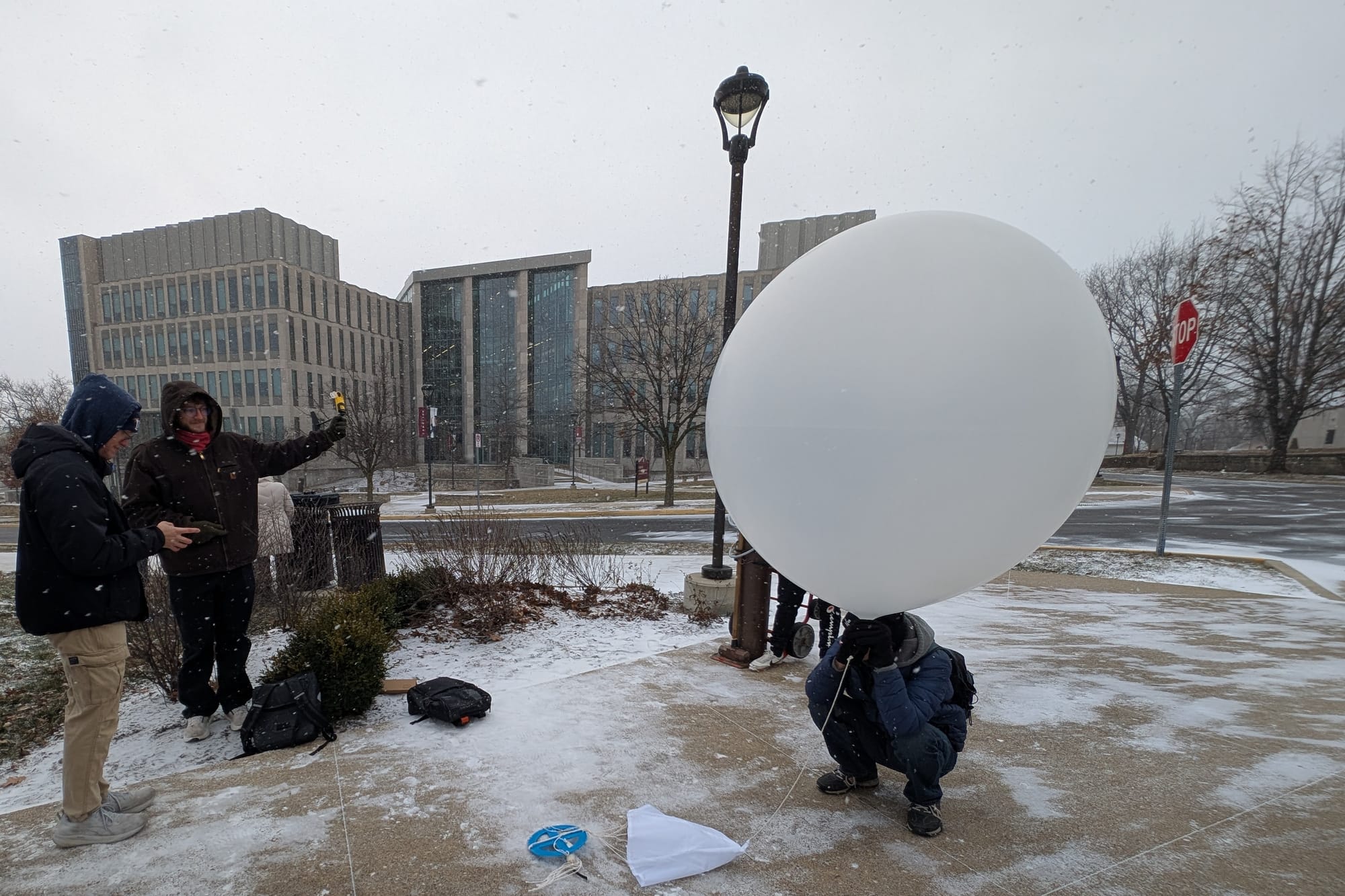
- Weather balloons. Worked problem 7 is the standard one: 8.00 L at the ground becomes 49.9 L high in the atmosphere, a factor of 6.24. Getting that figure right needs both effects in the sum, because the thinning air on its own would have predicted 67.55 L and the cold pulls the honest answer well below it. An envelope is designed around the real number.
- Tyres that barely flex. Heat from a motorway run has almost nowhere to go, so the pressure takes nearly all of it. That is why a recommended pressure is always a cold one, and why worked problem 5 is about the gauge rather than the volume.
- Compressed gas let out into the open. The whole reason a diving cylinder is worth its weight is the volume factor when the contents reach ordinary pressure and a different temperature. The two changes fight, and the pressure wins by a very wide margin.
- Anything sealed that travels. Crisp packets over a mountain pass, shampoo bottles in an unpressurised hold, instrument housings in a cargo bay. The number that matters is usually the volume factor, because that is what the seam has to hold.
- The gas-syringe practical. Trap air, change the pressure and the temperature, predict the reading, then measure it. A gap between prediction and measurement is nearly always a leak or a thermometer that has not settled — which is itself a lesson about the fixed-amount condition.
- Volumes measured on different days. Two gas volumes recorded at different laboratory pressures and temperatures cannot be compared until both are brought to the same conditions. Doing that conversion is what the phrase “corrected to standard conditions” means on a data sheet.
How the Combined Gas Law Fits the Rest of Thermodynamics
It occupies one narrow slot, and knowing the edges of that slot saves a lot of wasted effort. The combined gas law is the two-state reading of PV = nRT with the amount of gas held fixed. Everything it cannot do follows from that sentence.
When the amount of gas is the thing that changes — pumping more air in, or a reaction producing a gas — the relation you want is Avogadro’s law, which ties volume to the number of moles instead. When you have a single state and want to know how much gas is in it, you need the mole count and the gas constant back, so it is the ideal gas law.
And when the question is about energy, this equation is silent. It will tell you the volume a gas ends up at; it will not tell you how much heat went in, how much work the gas did on its surroundings, or how long any of it took. Those belong to the first law and its neighbours.
Which is a fair summary of the whole page: six quantities, one relation, two states, and a very clear boundary around what it promises.