A nuclear reactor is a machine that splits uranium nuclei in a controlled chain reaction, converting a tiny fraction of their mass into heat. That heat boils water into steam, which spins a turbine and generator to make electricity. Each fission releases about 200 MeV, following Einstein’s mass-energy relation, energy equals mass times the speed of light squared.
Somewhere under a slab of concrete a metre thick, a few kilograms of uranium are quietly getting smaller. Not by burning. Nothing in a reactor burns. Atoms are coming apart, and a sliver of what they used to weigh is leaving as heat.
The strange part is how ordinary the rest of it is. Past the reactor vessel, a nuclear power station is a steam engine — the same basic machine James Watt would recognise, boiling water to push a turbine round. All the exotic physics happens in one room, and its only job is to keep a kettle hot.
What Is a Nuclear Reactor?
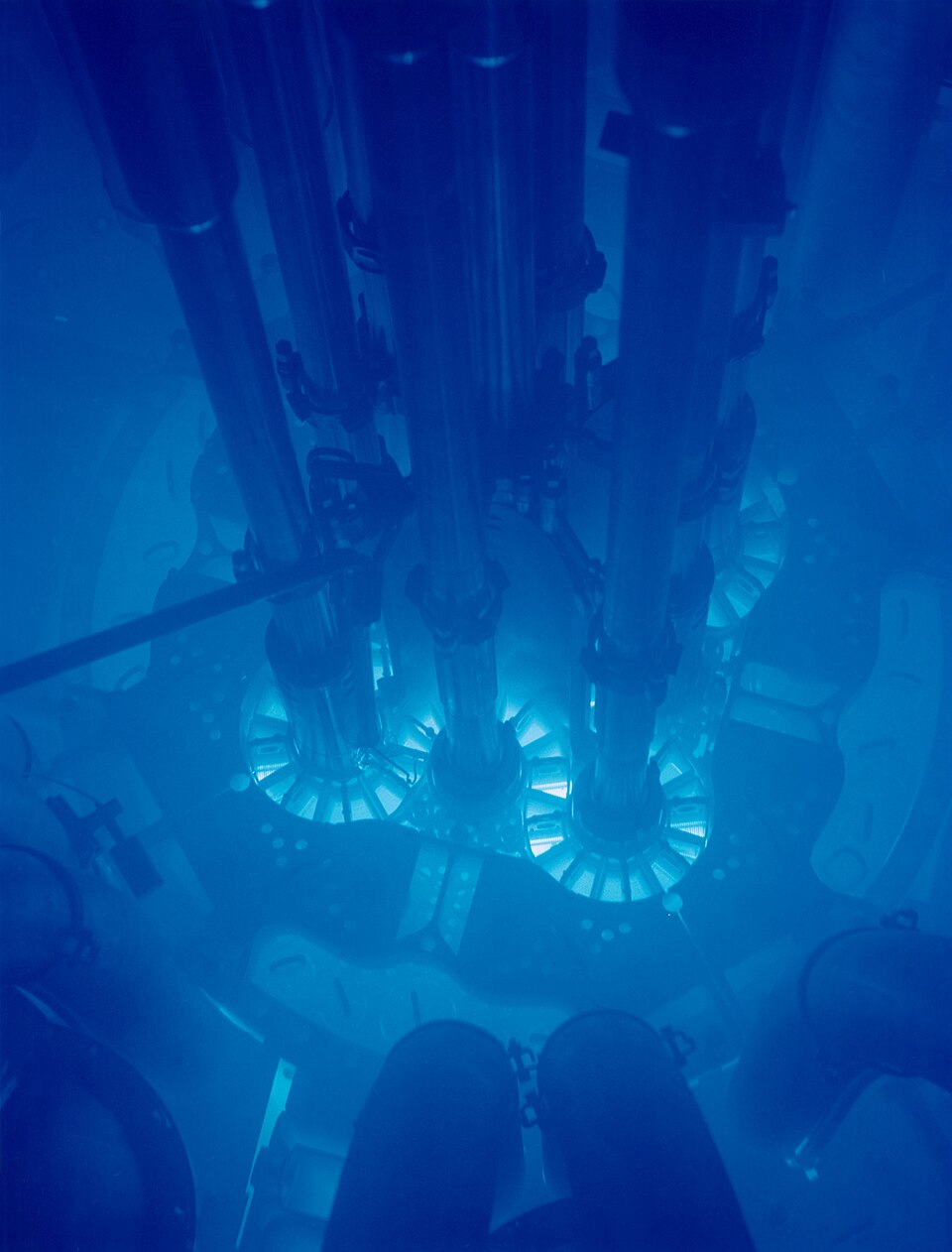
A nuclear reactor is a vessel designed to start, sustain and above all control a fission chain reaction, so that the energy locked in atomic nuclei comes out as usable heat rather than all at once.
Picture a room full of dominoes standing on end. Knock one over and it topples two more; those topple four. That is a chain reaction, and left alone it finishes in seconds.
A reactor does something cleverer. It removes just enough dominoes that each falling tile topples exactly one other — forever. The cascade never dies and never accelerates. That single condition is the whole art of reactor engineering.
The fuel is uranium, and only one isotope really matters. Natural uranium is 99.3% uranium-238 and just 0.72% uranium-235, and it is the rare U-235 that splits readily when a slow neutron nudges it. Reactor fuel is therefore enriched, typically to between 3% and 5% U-235.
Why so little? Because 3% is enough to keep a chain reaction going in a big, carefully arranged, water-filled core — and nowhere near enough to do anything else. We will come back to that.
The Nuclear Reactor Formula: E = mc² and 200 MeV Per Split
The formula behind every nuclear reactor is Einstein’s mass-energy equivalence, which says the energy released equals the mass that disappears multiplied by the speed of light squared.
- E — energy released, in joules (J)
- m — mass converted, in kilograms (kg)
- c — speed of light in vacuum, exactly 299,792,458 m/s
That squared term is doing something violent. Because c² is about 9.0 × 10¹⁶ m²/s², a single gram of mass — a paperclip — is worth roughly 9.0 × 10¹³ J, or about 25 gigawatt-hours.
Nothing converts a whole gram, of course. When a U-235 nucleus splits, the fragments and neutrons that fly apart weigh slightly less than the nucleus did. That missing sliver is the energy.
The number every physics course quotes is about 200 MeV per fission. In SI units that is 3.20 × 10⁻¹¹ J, and the mass that vanished to pay for it is 3.57 × 10⁻²⁸ kg — just 0.09% of the original nucleus.
Compare that with chemistry. Burning a carbon atom releases a few electronvolts; splitting a uranium atom releases 200 million. Atom for atom, fission beats combustion by a factor of roughly 50 million — which is why a reactor swaps part of its fuel every 18 months or so, while a coal station burns through trainloads every day.
If you want to feel how small the mass cost really is, put your own figures into our E = mc² calculator and watch the kilograms shrink. The fuller derivation lives in our guide to what E = mc² really means.
Turning Fissions Into Megawatts
Reactor power is just a counting problem. Multiply the energy per fission by how many happen each second:
- P — thermal power, in watts (W)
- R — fission rate, in fissions per second (s-1)
- E — energy per fission, in joules (J), about 3.20 × 10⁻¹¹ J
Rearranged, one watt of thermal power needs about 3.1 × 10¹⁰ fissions every second. A large 3 GW thermal reactor is therefore running roughly 9.4 × 10¹⁹ fissions per second — and converting about 2.9 grams of mass into energy per day.
How a Nuclear Reactor Works, Step by Step
A nuclear reactor works by using a controlled chain reaction to heat water, which becomes steam, which spins a turbine attached to an electrical generator. Here is the full journey from a splitting nucleus to a light switch in your house — the same sequence the US Nuclear Regulatory Commission sets out for a commercial pressurised water reactor.
The three water loops of a pressurised water reactor. Only the gold loop is radioactive; it never leaves the containment building.
- A neutron splits a nucleus. A slow-moving neutron is absorbed by a U-235 nucleus, which deforms and tears into two lighter fragments, releasing about 200 MeV and, on average, 2.4 fresh neutrons.
- The fragments stop dead and heat the fuel. Those fragments fly apart at enormous speed but travel less than a hair’s width before colliding to a halt inside the ceramic pellet. Their kinetic energy becomes heat.
- Water carries the heat out. In a pressurised water reactor the coolant is held at roughly 155 bar, which raises water’s boiling point to around 345 °C, so water leaving the core at about 325 °C stays stubbornly liquid.
- A steam generator makes clean steam. The hot, mildly radioactive primary water passes through thousands of tubes; clean secondary water outside those tubes boils. The two never mix.
- Steam spins the turbine. High-pressure steam pushes turbine blades, then condenses back to water in a condenser cooled by river, sea or cooling-tower water.
- The generator makes electricity. The spinning shaft turns a magnet inside coils, and electromagnetic induction does the rest.
Steps three to six are not nuclear physics at all. They are thermodynamics, and they set the plant’s efficiency far more than the reactor does.
A typical station turns about 3,000 MW of heat into roughly 1,000 MW of electricity — around 33%. That sounds wasteful until you check the ceiling: with a hot side near 325 °C and a condenser near 30 °C, the Carnot efficiency limit is only about 49%. Two thirds of the heat is thrown away because thermodynamics insists on it.
The Six Core Parts of a Nuclear Reactor
Every fission reactor ever built, from Fermi’s 1942 pile to a modern submarine plant, contains the same six functional parts. The US Department of Energy’s reactor primer counts them the same way: over 200 fuel rods bundle into an assembly, and a couple of hundred assemblies make up a core.
| Part | Typical material | What it actually does |
|---|---|---|
| Fuel | Uranium dioxide pellets, 3–5% U-235, in zirconium-alloy tubes | Supplies the fissile nuclei and contains the radioactive fragments |
| Moderator | Ordinary water, heavy water or graphite | Slows fast neutrons down so U-235 will actually absorb them |
| Control rods | Boron, cadmium or hafnium | Swallow surplus neutrons; sliding them in or out sets the power level |
| Coolant | Water, heavy water, carbon dioxide or liquid sodium | Carries heat from the fuel to the steam plant — and stops the core melting |
| Pressure vessel | Forged steel, roughly 20 cm thick | Holds the core and keeps the coolant at pressure |
| Containment | Reinforced concrete and steel, about 1–1.5 m thick | The last barrier — keeps radioactivity inside if everything else fails |
Notice what is missing from that list: anything that makes neutrons go faster. A reactor’s hardest engineering problem is slowing them down.
Fission neutrons come out at around 2 MeV. U-235 will absorb them at that speed, but reluctantly — the fission cross-section is roughly one barn. Slow the same neutron to thermal energy, about 0.025 eV, and the cross-section leaps to around 585 barns.
That is a target roughly 500 times bigger, bought purely by taking the energy out of the neutron. The moderator does it by collision: light nuclei such as hydrogen in water absorb recoil well, in the same way a cue ball transfers almost everything to another cue ball but almost nothing to a bowling ball.
Slide the sliders below and watch the chain reaction respond in real time.
Why Does the Chain Reaction Not Run Away?
The chain reaction does not run away because operators hold the neutron multiplication factor, k, at exactly 1.000 — and because the physics of the core pushes back automatically whenever it drifts above that.
- k < 1 — subcritical: neutron numbers fall, power dies away
- k = 1 — critical: neutron numbers hold steady, power is constant
- k > 1 — supercritical: neutron numbers grow, power climbs
“Critical” is a piece of vocabulary that has caused a century of needless alarm. A critical reactor is not a reactor in trouble. It is a reactor working perfectly.
One number decides everything: whether the neutron population fades, holds or grows.
The Trick That Makes Control Possible
Here is the problem. A neutron generation in a thermal reactor lasts about 10-4 seconds. If k were 1.005 and every neutron were prompt, the population would multiply 147-fold in a tenth of a second — far too fast for any human, or any mechanism, to catch.
Reactors are controllable because of a quirk of fission products. About 99.35% of fission neutrons appear instantly. The remaining 0.65% trickle out seconds later, as certain unstable fragments decay.
That thin trickle of delayed neutrons stretches the average generation time from 10-4 seconds to roughly 0.08 seconds — nearly a thousandfold. The same 147-fold rise now takes about 80 seconds instead of a tenth of one.
Eighty seconds is a human timescale. Control rods can move; alarms can sound; an operator can drink half a cup of tea. Reactor control is only possible because 0.65% of the neutrons are late.
Feedback That Needs No Operator
Physics provides a second layer of protection that runs without anyone deciding anything.
- Doppler broadening. As fuel gets hotter, U-238 nuclei jiggle faster and absorb a wider band of neutron energies, so a temperature rise directly steals neutrons from the chain reaction.
- Negative void coefficient. In a water-moderated reactor, if the coolant boils or drains, the moderator vanishes with it. Without moderation, neutrons stay fast, fissions collapse, and power falls.
- Fission poisons. Xenon-135 builds up in a running core and absorbs neutrons voraciously — its cross-section is about 2.6 million barns, thousands of times greater than the fuel’s.
That second point is the one worth remembering. In a Western light-water reactor, losing coolant kills the chain reaction rather than feeding it. Chernobyl’s RBMK was a graphite-moderated design with a positive void coefficient, so boiling made the reaction stronger — a design choice no light-water reactor shares.
Types of Nuclear Reactor Compared
Reactor designs differ mainly in two choices: what slows the neutrons, and what carries the heat away. Everything else follows.
| Type | Moderator | Coolant | Fuel | Defining feature |
|---|---|---|---|---|
| PWR | Ordinary water | Ordinary water, ~155 bar | 3–5% enriched UO2 | Most common design worldwide; core water never boils |
| BWR | Ordinary water | Ordinary water, ~70 bar | 3–5% enriched UO2 | Boils in the vessel; steam goes straight to the turbine |
| PHWR (CANDU) | Heavy water | Heavy water | Natural uranium (0.72%) | Needs no enrichment; can refuel while running |
| AGR | Graphite | Carbon dioxide gas | Slightly enriched UO2 | Much hotter gas outlet than a PWR, so better steam efficiency |
| RBMK | Graphite | Ordinary water | Slightly enriched UO2 | Positive void coefficient; the Chernobyl design |
| Fast reactor | None | Liquid sodium or lead | Plutonium or highly enriched uranium | Runs on fast neutrons; can breed new fuel from U-238 |
The fast reactor at the bottom breaks the rule established above — it deliberately has no moderator. Skip moderation and you lose the 585-barn bargain, so the fuel must be far richer in fissile material to compensate. In exchange, fast neutrons can convert useless U-238 into plutonium that will itself fission.
Real-World Examples of Nuclear Reactors
Reactors do more than fill the grid. According to the IAEA, over 400 power reactors in 32 countries supply about a tenth of the world’s electricity, and hundreds of smaller reactors do jobs most people never hear about.
- Grid power stations. A single large unit produces around 1,000 MW of electricity continuously, enough for a city, from a core that is refuelled roughly every 18 months.
- Naval propulsion. Submarines and aircraft carriers run compact reactors that let them stay submerged or at sea for months without refuelling. No air is needed for combustion, because nothing is being burned.
- Icebreakers. Russia’s nuclear icebreaker fleet keeps Arctic sea routes open, where the reactor’s endurance matters more than its power.
- Medical isotope production. Research reactors bombard targets with neutrons to make isotopes such as molybdenum-99, the parent of the technetium-99m used in tens of millions of medical scans each year.
- Desalination and district heating. Some plants divert low-grade steam to distil seawater or warm nearby towns, using heat that would otherwise be dumped into a river.
The story starts, as most nuclear stories do, in a squash court. On 2 December 1942, Enrico Fermi’s team achieved the first self-sustaining chain reaction beneath the stands at the University of Chicago, using graphite blocks and cadmium control rods pulled out by hand.
Electricity came nine years later. On 20 December 1951, the experimental breeder reactor EBR-I in Idaho became the first reactor to produce usable electrical power — and lit four light bulbs.
Common Misconceptions About Nuclear Reactors
Reactors attract more confident misinformation than almost any topic in physics. These four come up constantly.
“A reactor can explode like a nuclear bomb”
It cannot, and the reason is arithmetic rather than engineering. A weapon needs uranium enriched above roughly 90% U-235, assembled into a critical mass in under a millionth of a second.
Reactor fuel is 3–5% enriched and diluted through water and structure. Trying to make it explode like a bomb is like trying to make a bonfire out of damp logs by stacking them faster. Chernobyl’s explosion was a steam explosion followed by a graphite fire — violent and devastating, but chemical and thermal, not nuclear.
“Cooling towers emit radioactive smoke”
Those plumes are water vapour, and many nuclear stations have no cooling towers at all. A cooling tower belongs to the condenser at the far end of the steam cycle, hydraulically separated from anything radioactive by two loops.
Coal and gas plants use identical towers. The plume is the least nuclear thing on the site.
“Shutting a reactor down stops the heat”
Dropping the control rods stops fission within seconds, but not the heat. The fission products piled up in the fuel keep decaying, and that radioactive decay releases roughly 6–7% of full power at the instant of shutdown.
An hour later it is still around 1%. On a 3,000 MW reactor, 1% is 30 MW — a serious furnace that must be cooled for days. This is exactly what overwhelmed Fukushima Daiichi in 2011: the reactors shut down correctly, then lost the power needed to remove decay heat.
“Nuclear waste is a vast glowing liquid”
Spent fuel is solid ceramic, still in its metal cladding, and a large reactor produces roughly 20–30 tonnes of it a year. The intense radioactivity is genuinely dangerous and genuinely short-lived; the long-lived component is far weaker.
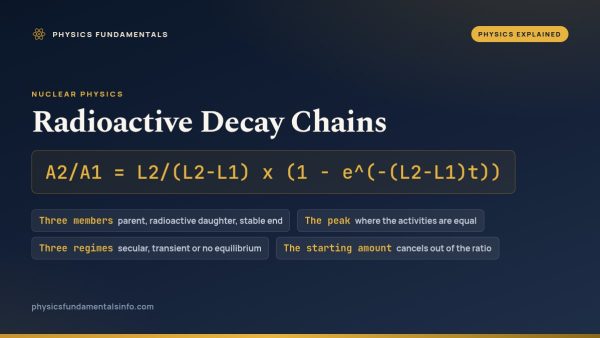
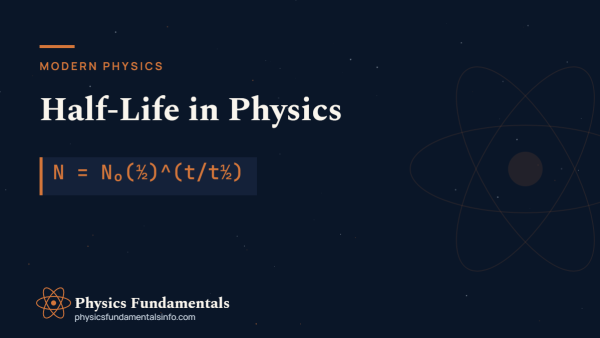
That inverse relationship is the whole logic of half-life: anything decaying fast enough to be fiercely radioactive is, by definition, not sticking around.
How Nuclear Reactors Relate to Fission, Half-Life and Thermodynamics
A reactor sits at the meeting point of three areas of physics, which is exactly why it makes such a good teaching example.
Nuclear physics supplies the fuel. The energy comes from the binding-energy curve: iron sits at the bottom, so heavy nuclei release energy by splitting and light nuclei release it by joining. Our comparison of fission versus fusion traces both sides of that curve.
Radioactivity governs what happens afterwards. Decay heat, fuel poisoning by xenon-135 and the storage timescale for spent fuel are all consequences of half-life, not of the chain reaction itself.
Thermodynamics takes over past the steam generator, and quietly imposes the biggest constraint on the whole plant. No reactor can beat its Carnot limit, which is why raising outlet temperature — the goal of most advanced designs — matters more than raising neutron flux.