Quantum mechanics is the branch of physics describing matter and energy at atomic and subatomic scales, where energy comes in fixed packets called quanta rather than a continuous range. A photon’s energy equals Planck’s constant multiplied by its frequency, and every particle also behaves as a wave whose squared amplitude sets the probability of each measurement outcome.
Look at the screen in front of you. Its blue pixels glow because electrons inside a semiconductor drop by one exact amount of energy — not a bit more, not a bit less — and hand that energy to a photon. Change the gap and you change the colour. There is no dial in between.
That single fact, that nature counts rather than pours, is the whole of quantum mechanics in miniature. It is also why atoms are stable, why the sun shines, why your phone camera works in dim light, and why a solid floor holds you up. None of it makes sense in the physics of Newton.
What Is Quantum Mechanics?
Quantum mechanics is the theory that describes how matter and energy behave at the scale of atoms, where physical quantities such as energy and angular momentum can only take certain discrete values. It replaced classical mechanics for small systems because classical mechanics gave the wrong answers — badly wrong, not slightly wrong.
Start with the word itself. A quantum is simply “a fixed amount”, the way a vending machine takes whole coins and refuses half a penny. Nature, at small scales, works the same way.
Energy in a bound system is not a smooth ramp you can stop anywhere on. It is a staircase. An electron in an atom can sit on step one or step two, but never hovering between them.
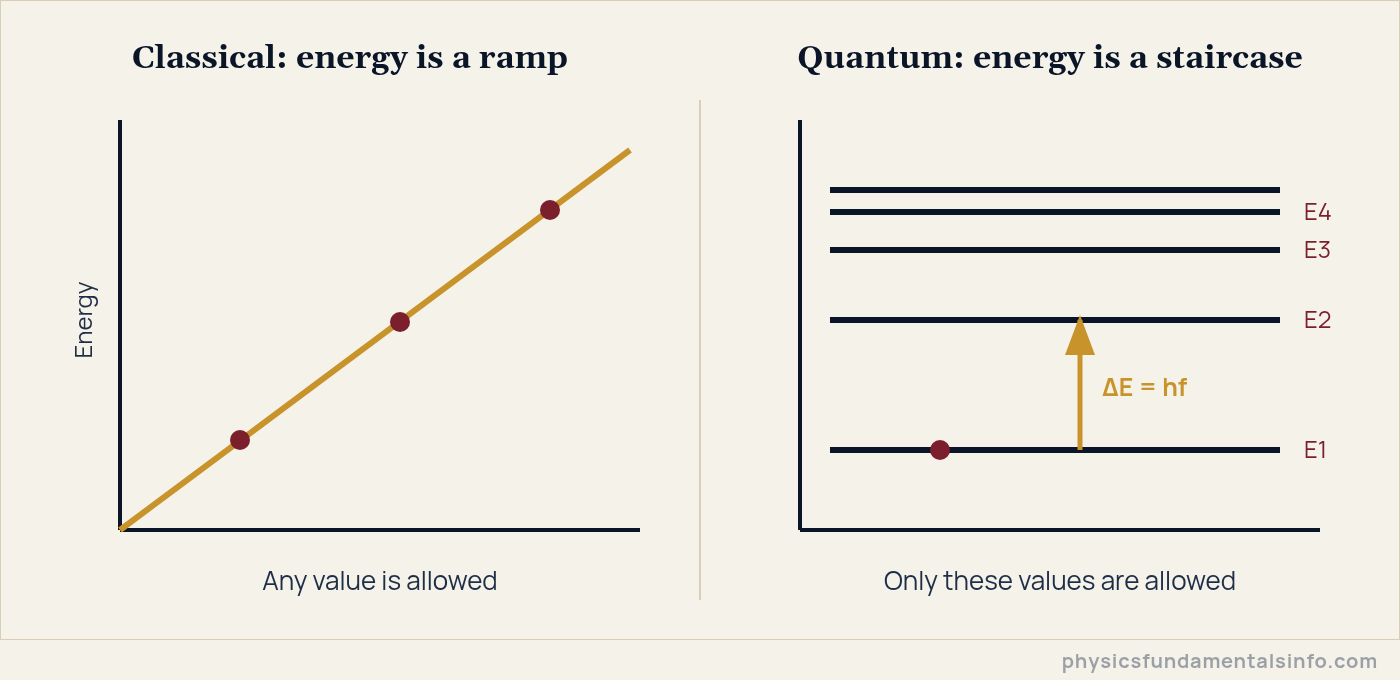
Classical energy varies smoothly; quantum energy is restricted to discrete levels. A jump between two levels emits or absorbs exactly one photon carrying the energy difference.
Where the Boundary Sits
Quantum effects never switch off — they just become unmeasurably small for heavy, fast, warm objects. The rough test is whether a particle’s wavelength is comparable to the space it moves in.
For an electron in an atom, the two are the same size, so quantum behaviour dominates. For a cricket ball, the wavelength is about twenty orders of magnitude smaller than a proton, and Newton wins.
Why Did Classical Physics Fail?
Classical physics failed because three experiments gave results that continuous, wave-only theories of light and matter could not produce at all — not even with better instruments. Each one forced a piece of the quantum picture.
Black-body radiation (1900). Classical theory predicted that a hot object should radiate infinite energy at short wavelengths. Max Planck fixed it by assuming energy was exchanged in packets of size hf — a mathematical trick he disliked, and the first quantum.
The photoelectric effect (1905). Shine light on a metal and electrons fly off — but only if the light’s frequency is high enough. Turn a red lamp up to blinding brightness and nothing happens; a faint ultraviolet source works instantly.
That is impossible for a continuous wave, which should deliver energy steadily until an electron shakes loose. Einstein explained it by treating light as particles, each carrying hf. He received the 1921 Nobel Prize in Physics for this law, not for relativity.
Our full walkthrough of the experiment, including stopping voltage and the role of intensity, is in the photoelectric effect guide.
Atomic line spectra (1913). Heated gases emit sharp, specific colours instead of a smooth rainbow. Niels Bohr matched hydrogen’s lines by allowing only certain orbits — an idea developed in our Bohr model explainer.
The photoelectric graph below is the single most convincing piece of evidence a beginner can look at. Plot the maximum electron energy against light frequency and you get a straight line whose slope is Planck’s constant — identical for every metal ever tested.

Maximum photoelectron energy rises linearly with frequency. Changing the metal shifts the line sideways but never tilts it — the slope is always Planck’s constant.

The Key Quantum Mechanics Formulas
Three equations carry most of an introductory course. Learn what each one says in words before you push numbers through it.
1. Photon Energy
A photon’s energy is set entirely by its frequency. Brightness changes how many photons arrive, never how much energy each one carries — the point that breaks classical intuition. There is more on this relation, including the wavelength form, in our photon energy formula guide.
Using wavelength instead, E = hc / λ, which for photons in nanometres reduces to the handy shortcut E (eV) = 1240 / λ (nm).
2. The de Broglie Wavelength
Louis de Broglie’s 1924 proposal turned the photon idea around: if waves can act like particles, particles should act like waves. Every object with momentum has a wavelength, and you can check any case with our De Broglie Wavelength calculator before committing to an exam answer.
Electron diffraction confirmed it in 1927. That is not a curiosity — it is the operating principle of every electron microscope built since.
3. The Uncertainty Principle
Position and momentum cannot both be sharp at once. Pin down where a particle is and its momentum spreads out; fix its momentum and its position blurs.
This is a statement about what a quantum state is, not about clumsy laboratory technique. Even a perfect instrument runs into it.
| Symbol | Quantity | SI unit | Typical value |
|---|---|---|---|
| E | Energy of one photon | joule (J) | 4.0 × 10⁻¹⁹ J for green light |
| h | Planck constant | joule second (J s) | 6.62607015 × 10⁻³⁴ J s (exact) |
| f | Frequency | hertz (Hz) | 6.0 × 10¹⁴ Hz for green light |
| λ | Wavelength | metre (m) | 500 nm for green light |
| m | Mass of the particle | kilogram (kg) | 9.11 × 10⁻³¹ kg for an electron |
| v | Speed of the particle | metre per second (m/s) | varies |
| Δx, Δp | Spread in position, spread in momentum | m, kg m/s | product at least 5.27 × 10⁻³⁵ J s |
| φ | Work function of a metal | joule (J), often quoted in eV | 2.3 eV sodium, 4.3 eV zinc |
One unit note that costs marks every year: 1 eV = 1.602176634 × 10⁻¹⁹ J. Work functions and photon energies are usually quoted in electronvolts, but the formulas above need joules unless every term is in eV.
See the Quantum Threshold for Yourself
Set the wavelength and the work function, then watch what happens at the threshold. Below it, cranking the intensity to maximum still emits nothing — the classical prediction fails in front of you.
Try caesium at 2.1 eV first, then copper at 4.7 eV. The threshold wavelength moves from about 590 nm — visible orange light — down to 264 nm, deep in the ultraviolet.
How Quantum Mechanics Works: 5 Core Ideas
Quantum mechanics works by describing a system with a wavefunction that evolves smoothly and predictably, then converting that wavefunction into probabilities whenever a measurement is made. Five ideas do the heavy lifting.
1. Quantisation
Bound systems have discrete energy levels. An atom’s electron occupies allowed levels only, and moving between them means absorbing or emitting a photon of exactly the right energy.
This is why each element has its own barcode of spectral lines — and why sodium street lamps are that particular orange.
2. Wave-Particle Duality
Every quantum object shows both wave behaviour and particle behaviour, depending on what you measure. Fire electrons one at a time at two slits and they arrive as individual dots, yet the dots pile up into an interference pattern.
The wave interference is the same phenomenon covered in our guide to diffraction; what is new is that a single particle produces it. Worked numerical examples live in the de Broglie wavelength guide.
3. The Wavefunction and the Born Rule
The state of a quantum system is a wavefunction, written ψ. It is not a physical ripple you could photograph — it is a mathematical object carrying everything knowable about the system.
Square its magnitude and you get a probability density. Where the wavefunction is large, the particle is likely to be found; where it vanishes, the particle is never found.
4. Superposition
A quantum system can occupy a combination of states at once, and that combination is a perfectly ordinary solution of the equations. An electron can be in a superposition of two energy levels the way two musical notes can sound together.
Measure it and you get one definite answer, with odds set by the Born rule. Superposition is not vagueness about which state it is really in — the interference effects it produces are measurable.
5. Uncertainty and Complementarity
Some pairs of quantities cannot both be pinned down: position and momentum, energy and time. Sharpening one always blurs the other, because a wave packet narrow in space must be built from a wide spread of wavelengths.
In practice this is what stops electrons spiralling into the nucleus. Squeeze an electron closer in and its momentum spread — and so its energy — shoots up. The atom settles at the size where that trade-off is cheapest.
| Feature | Classical mechanics | Quantum mechanics |
|---|---|---|
| Energy of a bound system | Any value, continuous | Discrete allowed levels |
| State of the system | Position and velocity | Wavefunction ψ |
| What a prediction gives | One definite trajectory | Probabilities for each outcome |
| Measurement | Reads a pre-existing value | Yields one outcome from the allowed set |
| Simultaneous quantities | All exact at once | Limited by Δx · Δp ≥ h / (4π) |
| Governing equation | Newton’s second law | Schrödinger equation |
| Where it is accurate | Everyday masses and speeds | All scales; essential at atomic scale |
Real-World Examples of Quantum Mechanics
Quantum mechanics is not confined to laboratories — it underpins a large slice of modern technology. Here are five you can point at.
- LEDs and laser pointers. The colour is fixed by the energy gap electrons fall across. A wider gap gives a bluer photon, straight from E = hf.
- Solar panels and camera sensors. Both rely on photons above a threshold energy knocking electrons free. Photons below the threshold are wasted no matter how many arrive.
- Electron microscopes. Electrons accelerated to high speed have wavelengths thousands of times shorter than visible light, so they resolve detail optical microscopes physically cannot reach.
- Flash memory. Storing data means pushing electrons through an insulating barrier by quantum tunnelling — a move that is flatly forbidden classically.
- Atomic clocks and GPS. The second is defined by a caesium transition of exactly 9,192,631,770 Hz. Satellite navigation depends on that precision.
A magnitude check worth carrying: a 1 W green laser emits roughly 2.5 × 10¹⁸ photons every second. Individual quanta are tiny, which is exactly why the graininess of light stayed hidden until 1900.
Common Misconceptions About Quantum Mechanics
Four errors do most of the damage in early study. Each one is worth unlearning deliberately.
Misconception 1: Quantum Mechanics Means Anything Can Happen
It means the opposite. The Schrödinger equation is deterministic — feed in a state and it tells you exactly how the wavefunction evolves.
Probability enters only at measurement, and even then the odds are fixed and testable. Quantum electrodynamics predicts the electron’s magnetic moment to better than one part in a billion.
Misconception 2: Uncertainty Is Just Clumsy Measurement
The uncertainty principle is not about disturbing a particle with a probing photon. A state that is sharply localised in position simply does not possess a sharp momentum, in the same way a single sharp click does not possess a single pitch.
Misconception 3: Observation Requires a Conscious Observer
“Measurement” means irreversible interaction with a larger system — a detector, a stray air molecule, a photon bouncing off. No mind is required.
This process, decoherence, happens in vanishingly small fractions of a second for anything bigger than a molecule. That is why cats are never found in superpositions.
Misconception 4: Quantum Effects Only Apply to Tiny Things
The rules apply to everything, including you. Run a cricket ball through λ = h / (m v) and the wavelength comes out around 10-34 m.
No slit that narrow exists, so no interference is ever observed. Quantum mechanics does not stop at some size — it just stops being noticeable.
How Quantum Mechanics Relates to Other Areas of Physics
Quantum mechanics connects to the rest of physics as the small-scale layer that classical theories approximate. It fits alongside relativity, chemistry and particle physics rather than replacing them wholesale.
Relativity. Quantum mechanics governs the small; special relativity governs the fast. Combining them gives quantum field theory, which describes particles as excitations of underlying fields.
Chemistry. The periodic table is a quantum result. Allowed electron states and the exclusion principle set how many electrons fit in each shell, and therefore how elements bond.
Particle physics. Quarks, leptons and force carriers are all quantum objects. Gravity remains the outstanding gap: no complete quantum theory of it yet exists, which is honest to state rather than paper over.
Worked Problems
Show Solution
Solution:
Step 1: For a photon, E = hc / λ, with h = 6.626 × 10⁻³⁴ J s and c = 2.998 × 10⁸ m/s.
Step 2: E = (6.626 × 10⁻³⁴ J s × 2.998 × 10⁸ m/s) / (500 × 10-9 m).
Step 3: E = 3.97 × 10⁻¹⁹ J. Converting: 3.97 × 10⁻¹⁹ J ÷ 1.602 × 10⁻¹⁹ J/eV = 2.48 eV.
Answer: 3.97 × 10⁻¹⁹ J, or 2.48 eV
Show Solution
Solution:
Step 1: Convert to joules: E = 1.9 eV × 1.602 × 10-19 J/eV = 3.04 × 10⁻¹⁹ J.
Step 2: From E = hf, f = E / h = 3.04 × 10⁻¹⁹ J ÷ 6.626 × 10⁻³⁴ J s = 4.59 × 10¹⁴ Hz.
Step 3: λ = c / f = 2.998 × 10⁸ m/s ÷ 4.59 × 10¹⁴ Hz = 6.53 × 10⁻⁷ m.
Answer: 4.59 × 10¹⁴ Hz, wavelength 653 nm (red, as expected)
Show Solution
Solution:
Step 1: Einstein’s photoelectric equation is KE(max) = hf – φ, and hf = 1240 / λ in eV with λ in nm.
Step 2: Photon energy = 1240 / 400 = 3.10 eV.
Step 3: KE(max) = 3.10 eV – 2.3 eV = 0.80 eV, which is 0.80 × 1.602 × 10-19 = 1.28 × 10⁻¹⁹ J.
Answer: 0.80 eV, or 1.28 × 10⁻¹⁹ J
Show Solution
Solution:
Step 1: At threshold the photon energy exactly equals the work function, so hf(0) = φ.
Step 2: f(0) = φ / h = (4.3 × 1.602 × 10-19 J) / (6.626 × 10⁻³⁴ J s) = 1.04 × 10¹⁵ Hz.
Step 3: λ(0) = c / f(0) = 2.998 × 10⁸ ÷ 1.04 × 1015 = 2.88 × 10⁻⁷ m.
Answer: 1.04 × 10¹⁵ Hz, longest wavelength 288 nm (ultraviolet)
Show Solution
Solution:
Step 1: λ = h / (m v), using the non-relativistic momentum since 5.0 × 10⁶ m/s is under 2 per cent of c.
Step 2: m v = 9.11 × 10-31 kg × 5.0 × 106 m/s = 4.56 × 10⁻²⁴ kg m/s.
Step 3: λ = 6.626 × 10⁻³⁴ ÷ 4.56 × 10-24 = 1.45 × 10⁻¹⁰ m.
Answer: 1.45 × 10⁻¹⁰ m, or 0.145 nm — comparable to atomic spacing, which is why electrons diffract off crystals
Show Solution
Solution:
Step 1: λ = h / (m v).
Step 2: m v = 0.145 kg × 40 m/s = 5.80 kg m/s.
Step 3: λ = 6.626 × 10⁻³⁴ ÷ 5.80 = 1.14 × 10⁻³⁴ m.
Answer: 1.14 × 10⁻³⁴ m — about 20 orders of magnitude smaller than a proton, so no wave behaviour is ever detectable
Show Solution
Solution:
Step 1: Take Δx = 0.10 nm = 1.0 × 10⁻¹⁰ m and use Δx · Δp ≥ h / (4π).
Step 2: Δp ≥ (6.626 × 10⁻³⁴) / (4π × 1.0 × 10-10) = 5.27 × 10⁻²⁵ kg m/s.
Step 3: Δv = Δp / m = 5.27 × 10⁻²⁵ ÷ 9.11 × 10-31 = 5.8 × 10⁵ m/s.
Answer: about 5.8 × 10⁵ m/s — enormous, which is why an electron cannot be pictured as sitting still in an orbit
Show Solution
Solution:
Step 1: E(3) = -13.6 / 9 = -1.51 eV and E(2) = -13.6 / 4 = -3.40 eV.
Step 2: Energy released, ΔE = -1.51 – (-3.40) = 1.89 eV = 3.03 × 10⁻¹⁹ J.
Step 3: λ = hc / ΔE = (6.626 × 10-34 × 2.998 × 108) / (3.03 × 10⁻¹⁹) = 6.56 × 10⁻⁷ m.
Answer: 656 nm — the red hydrogen-alpha line seen in every hydrogen discharge tube
Frequently Asked Questions
What is quantum mechanics in simple terms?
Is quantum mechanics hard to learn?
What is the difference between quantum mechanics and quantum physics?
Why does light behave as both a wave and a particle?
Does quantum mechanics apply to large objects?
What is Planck's constant and why does it matter?
Who invented quantum mechanics?
If you want to go further than a beginner guide, MIT’s 8.04 Quantum Physics I publishes its full lecture notes and problem sets free, and NIST maintains the official CODATA values of h and every other constant used above.