The Schrodinger equation is the central equation of quantum mechanics: it describes how a particle’s wave function evolves in time and which energies that particle is allowed to have. In words, the energy operator acting on the wave function equals the total energy multiplied by the wave function. Solving it for a given potential returns every permitted energy level.
Look at the screen you are reading this on. The colour of every pixel, the switching of every transistor behind it, and the chemistry of the battery keeping it alive were all designed using solutions to one equation written down in 1926.
That equation does something Newton’s laws cannot. It explains why an atom does not collapse, why the periodic table has the shape it does, and why an electron can pass through a wall it has no business crossing.
What Is the Schrodinger Equation?
The Schrodinger equation is the equation of motion for a quantum particle — it plays the same role in quantum mechanics that Newton’s second law plays in classical physics. Feed it a force landscape, and it tells you how the particle behaves.
But the thing it evolves is not a position. Newton hands you x(t), a dot moving along a line. Schrodinger hands you ψ(x, t), a spread-out mathematical object called the wave function that encodes everything knowable about the particle at once.
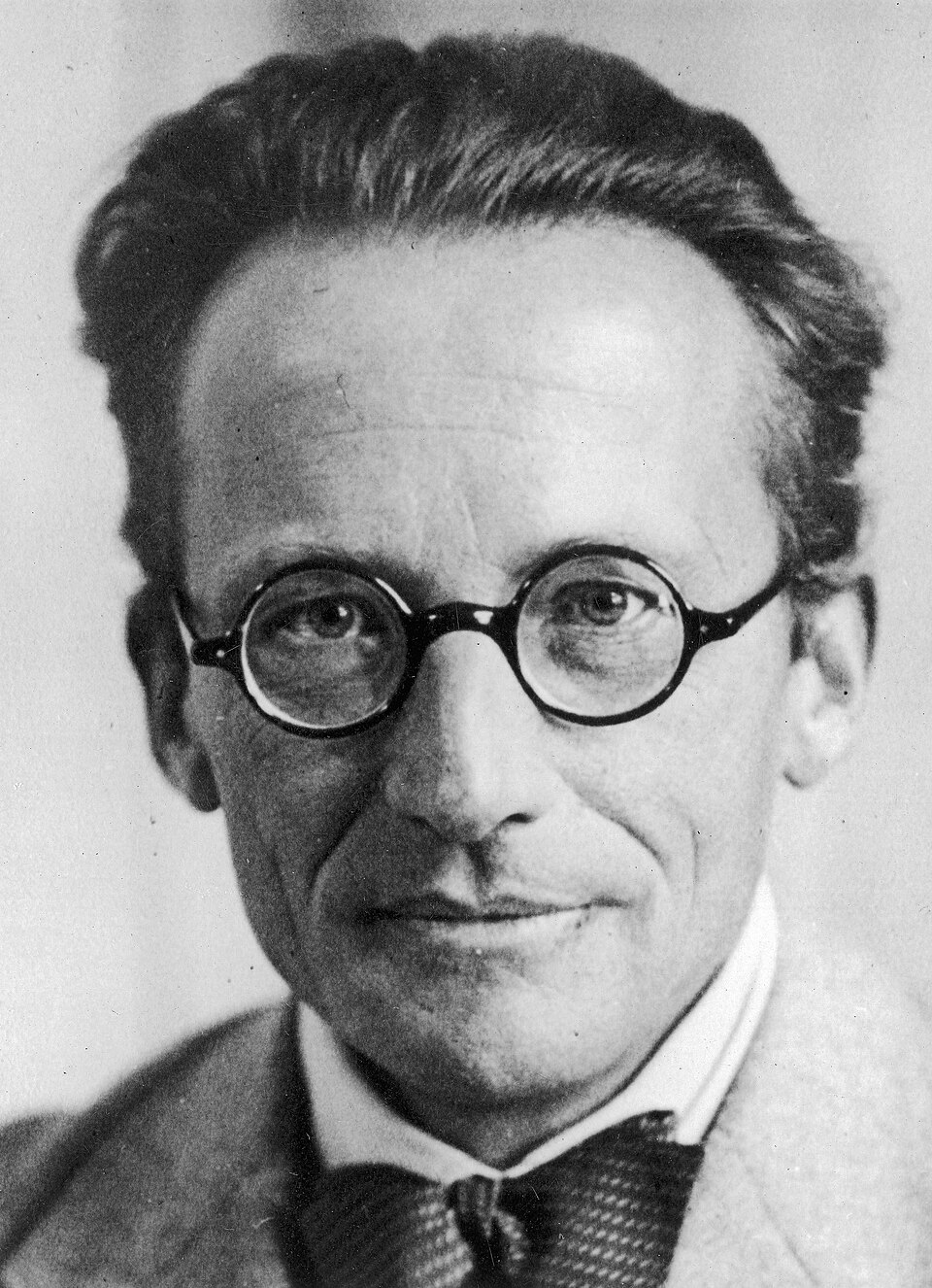
Erwin Schrödinger — usually written “Schrodinger” in English — arrived at it over the Christmas holiday of 1925, chasing an idea of Louis de Broglie’s: that matter has a wavelength. If electrons are waves, Schrodinger reasoned, there must be a wave equation governing them. He shared the 1933 Nobel Prize in Physics with Paul Dirac for the result.
Here is the payoff, and it is worth pausing on. Nobody puts quantisation into the equation. You supply a potential, demand that the solution behave sensibly at the edges, and discrete energy levels fall out on their own — the way a guitar string clamped at both ends can only sound certain notes.
The Schrodinger Equation Formula
The Schrodinger equation has two standard forms, and choosing between them is the first decision in any problem. The full time-dependent version describes how a wave function changes from moment to moment:
For a single particle moving in one dimension, the Hamiltonian operator Ĥ is kinetic energy plus potential energy, which makes the time-independent form concrete:
Read the second one aloud and it is just energy bookkeeping: kinetic term plus potential term equals total energy. Every variable, with its SI unit:
- ψ (psi) — the wave function. Units of m-1/2 in one dimension, so that |ψ|² is a probability per metre.
- ħ — the reduced Planck constant, read “h-bar”, equal to h/2π = 1.054571817 × 10⁻³⁴ J s.
- m — the particle’s mass, in kilograms (kg).
- V(x) — the potential energy at position x, in joules (J).
- E — the total energy of the state, in joules (J).
- Ĥ — the Hamiltonian, the operator representing total energy.
- i — the imaginary unit, the square root of minus one.
That factor of i is not decoration. It forces ψ to be a complex number, and complex numbers are what let quantum amplitudes interfere and cancel. Strip the i out and interference disappears.
The value of ħ above is fixed exactly by the 2019 SI redefinition, since h is now a defined constant; you can check it against the CODATA values published by NIST.
Time-Dependent vs Time-Independent: Which One Do You Need?
Use the time-independent form whenever the potential does not change with time and you want energy levels. Use the time-dependent form when you need to watch a state evolve.
| Feature | Time-dependent (TDSE) | Time-independent (TISE) |
|---|---|---|
| Equation | iħ ∂ψ/∂t = Ĥψ | Ĥψ = Eψ |
| Unknown | ψ(x, t), a function of space and time | ψ(x) and E, together |
| Use it when | The potential changes, or you are tracking evolution | The potential is fixed and you want allowed energies |
| Maths type | Partial differential equation, first order in time | Eigenvalue problem |
| Output | The state at any later time | The energy ladder E1, E2, E3… |
| Typical exam use | Phase evolution, wave packets | Particle in a box, atoms, oscillators |
The two are not rivals. Solve the time-independent equation for the energies, and the time-dependent behaviour of each of those states is just a phase rotating at angular frequency ω = E/ħ.
What Does the Wave Function Actually Mean?
The wave function itself is not measurable — its squared magnitude is. Max Born’s 1926 insight, the rule that earned him his own Nobel, is that |ψ(x)|² gives the probability density of finding the particle at x.
So ψ can dip negative, or be complex, and none of that is a problem. Square it and you always get something positive and real, which is what a probability has to be.
The wave function ψ for the second level of a particle in a box, and the probability density |ψ|² beneath it. The midpoint is a node: an electron in this state is never found there.
Notice the node in the middle. An electron in the n = 2 state is found on the left or on the right, but never at the centre — and it never crosses. That is not a gap in our knowledge; it is what the equation predicts.
Two conditions come attached. The wave function must be continuous and single-valued, and the total probability over all space must equal 1, since the particle is definitely somewhere. That second requirement is called normalisation, and it is what fixes the height of every curve above.
How the Schrodinger Equation Works, Step by Step
Solving the Schrodinger equation always follows the same three moves, no matter how ugly the potential gets.
Step 1: Write down the potential V(x)
The physics of the problem lives entirely in V(x). An electron in an atom feels the Coulomb attraction of the nucleus. A particle trapped between two walls feels nothing inside and an infinite wall outside.
Step 2: Solve for the wave functions that fit
Substitute V(x) and solve the differential equation. In regions where E is greater than V, solutions oscillate; where E is less than V, they decay exponentially instead of stopping dead.
Step 3: Apply the boundary conditions
This is where quantisation appears. Demanding that ψ be continuous and that it vanish where it must eliminates almost every candidate solution — only a discrete set survives, each with its own energy.
A common student slip is treating step 3 as bookkeeping and rushing it. It is the opposite: steps 1 and 2 are the machinery, and step 3 is where the physics of “allowed” versus “forbidden” is actually decided.
Solving the Schrodinger Equation: Particle in a Box
The particle in a box is the one exact solution every physics student should be able to reproduce from memory. Put a particle between two infinitely high walls a distance L apart, with V = 0 inside.
Inside the box the equation reduces to a familiar shape whose solutions are sines and cosines. The walls force ψ to zero at x = 0 and x = L, which kills the cosine and only allows sine waves that fit a whole number of half-wavelengths into the box.
That single condition produces the energy ladder:
with n = 1, 2, 3, … The normalised wave functions are ψn(x) = sqrt(2/L) · sin(nπx/L). Note what the n² does: levels are not evenly spaced, they spread out as you climb.
The first three energy levels of a particle in a box, drawn to scale in the ratio 1 : 4 : 9, each shown with its own wave function.
Two consequences deserve attention. First, the lowest energy is not zero — a trapped particle can never be perfectly still, which is exactly what the Heisenberg uncertainty principle demands.
Second, energy scales as 1/L². Halve the box and every level quadruples. This is why quantisation dominates at the nanometre scale and vanishes at human scale.
MIT’s open lecture notes for 8.04 work through the infinite and finite square wells in full algebraic detail if you want the derivation line by line: see the MIT OpenCourseWare 8.04 lecture notes.
Real-World Examples of the Schrodinger Equation
Solutions to the Schrodinger equation underpin most of the technology invented since 1950. Five that you can point to today:
- The periodic table. Solve the equation for the hydrogen atom and you get the orbitals s, p, d and f, with the right energies and shapes. The structure of the table is a consequence, not an observation.
- Transistors and every chip you own. Solving the equation for electrons in a repeating crystal lattice produces energy bands and the gaps between them. That band gap is the difference between a conductor, an insulator and a semiconductor.
- Quantum dots in QLED screens. These are literally particles in a box. Because energy scales as 1/L², shrinking a nanocrystal shifts its emission from red towards blue — colour tuned by size alone.
- Flash memory and the scanning tunnelling microscope. Both depend on electrons crossing barriers they classically cannot, a solution the equation permits because ψ decays rather than stopping at a wall.
- Lasers and LEDs. A laser needs sharply defined energy levels to hold a population inversion. Those levels come from solving the equation for the atoms or the semiconductor junction involved.
There is an economic footnote worth knowing. Solving the equation approximately for molecules is now routine in pharmaceutical research, where computational chemistry screens candidate drugs before anyone synthesises them.
Common Misconceptions About the Schrodinger Equation
Myth 1: The wave function is a physical wave
It is not. No instrument detects ψ, and it is generally complex-valued, so it cannot be a displacement of anything. What is real and measurable is |ψ|², the probability density.
Myth 2: The equation itself is random
The Schrodinger equation is perfectly deterministic. Give it a wave function now, and it returns exactly one wave function later, with no randomness anywhere in the maths.
Probability enters only when you measure. The equation predicts the odds with total precision; it just does not promise which single outcome you will see.
Myth 3: Electrons orbit the nucleus in little circles
The Bohr model‘s planetary picture is a useful stepping stone, and it gets hydrogen’s energies right. But it is wrong about the mechanism. Schrodinger’s solutions are standing-wave clouds with no trajectory at all — an electron in a 1s orbital has no orbit to speak of.
Myth 4: Quantisation should be visible in everyday objects
It is there; it is just absurdly small. Take a 1 g bead sliding in a 10 cm box at 1 cm/s: its quantum number works out at roughly 3 × 1027, and the gap to the next level is about 3 × 10-35 J.
That gap is smaller than the bead’s energy by a factor of 1027. No measurement could ever resolve it, so the ladder looks like a smooth ramp — which is precisely why classical physics works so well.
How the Schrodinger Equation Relates to Other Quantum Ideas
The Schrodinger equation is the framework that earlier quantum results turned out to be special cases of. It did not replace them so much as explain where they came from.
De Broglie’s matter waves were the seed. The relation λ = h/p supplied the idea that particles have wavelengths; Schrodinger supplied the equation those waves obey. Working out a de Broglie wavelength is still the fastest way to check whether a problem needs quantum treatment at all.
The uncertainty principle is not an extra assumption bolted on. It follows from the mathematics of wave functions: a ψ localised tightly in position necessarily contains a broad spread of momentum components.
Planck’s and Einstein’s photon energy connects the ladder to what you actually see. When an electron drops between two solved levels, the emitted photon carries the difference, and the photon energy formula E = hf converts that gap into a wavelength.
The photoelectric effect ran the other way, and historically came first. Einstein’s 1905 explanation established that light is quantised, which is half of the wave-particle picture the equation completes — the photoelectric effect gave quantum theory its first hard experimental footing.
One boundary is worth naming. The Schrodinger equation is non-relativistic, so it fails for particles moving near the speed of light and it does not contain spin. Dirac’s 1928 equation fixed both, which is why he shared that Nobel Prize.