Antimatter is matter built from antiparticles — particles with the same mass and spin as ordinary particles, but opposite electric charge and opposite quantum numbers. When antimatter touches matter, both are destroyed and their entire mass becomes energy, given by Einstein’s E = mc2, released mostly as gamma-ray photons.
Right now, in a hospital somewhere near you, a patient is lying still while a machine counts antimatter. A PET scanner does nothing more exotic than watch antimatter destroy itself inside a human body — hundreds of millions of times a second — and turn that destruction into a picture of a tumour.
So antimatter is not a plot device. It won a Nobel Prize, it falls out of thunderstorms, it drifts out of the banana in your fruit bowl — and if you could hold a single gram of it, you would be holding the energy of roughly three Hiroshima bombs.
What Is Antimatter?
Antimatter is matter made of antiparticles: for every particle in the Standard Model there is an antiparticle with exactly the same mass and spin, but with reversed electric charge and reversed additive quantum numbers such as baryon number and lepton number.
The idea arrived by accident, out of algebra. In 1928 Paul Dirac wrote an equation that forced quantum mechanics and special relativity to agree with each other about the electron.
The equation worked beautifully, then handed him a second solution he had not asked for. Square roots always come in pairs, and this one was no exception: alongside the ordinary electron sat a mirror solution carrying negative energy, which nothing in classical physics was supposed to allow.
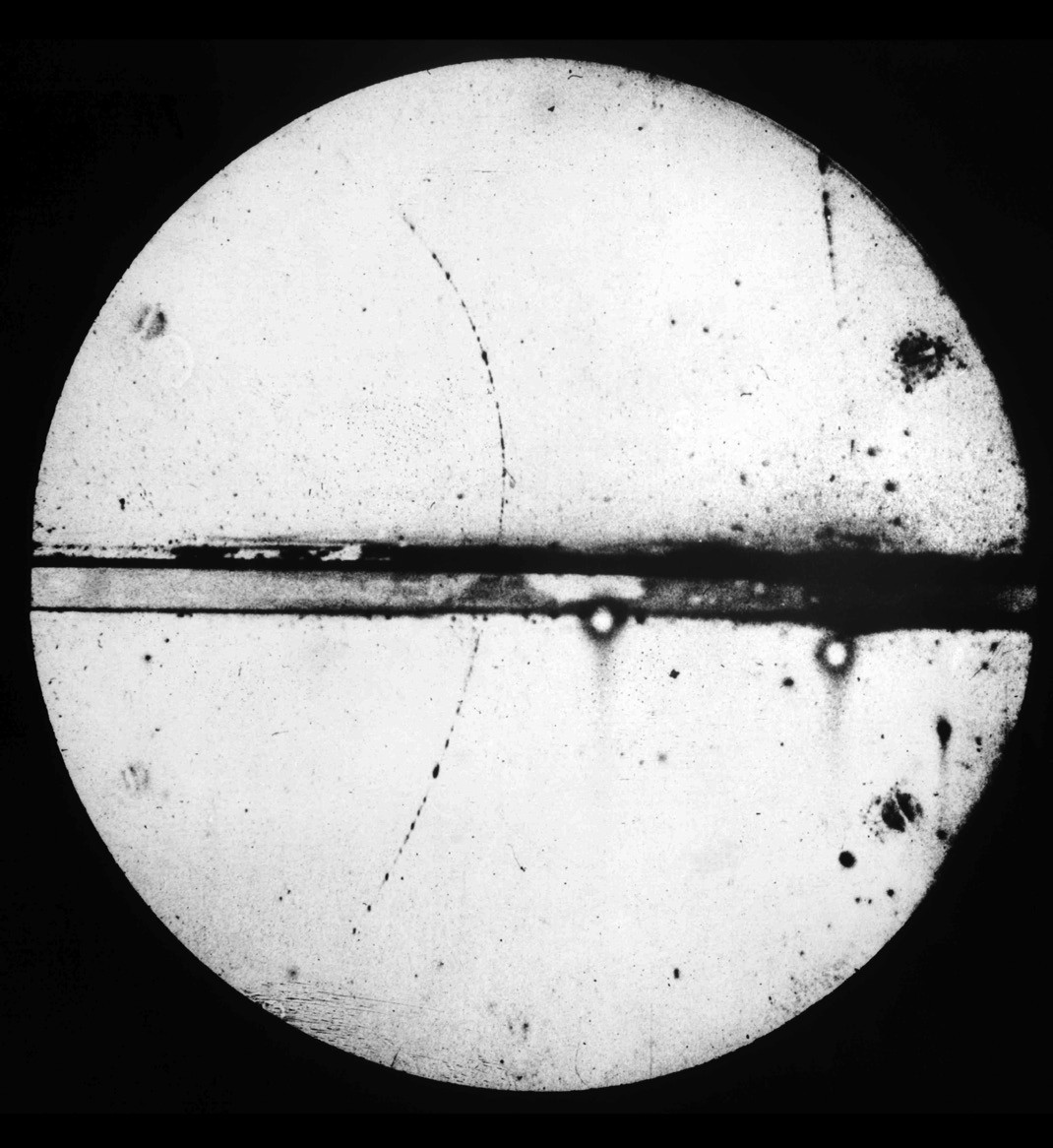
Dirac could have swept the extra solution under the rug. Instead he took it seriously and proposed a particle identical to the electron but positively charged. Four years later, Carl Anderson found exactly that in a cloud chamber, photographing a cosmic-ray track that curved the wrong way in a magnetic field. He named it the positron.
Every Particle Has a Twin — Except the Ones That Are Their Own Twin
The antiproton followed in 1955 at Berkeley’s Bevatron, the antineutron a year later. Antihydrogen — a positron orbiting an antiproton — was first assembled at CERN in 1995.
Note the neutron in the table below. It carries no charge, yet it still has a distinct antiparticle, because “opposite charge” is only the headline. What really flips is the full set of quantum numbers, including the baryon number carried by its quarks.
| Particle | Antiparticle | Charge (particle / antiparticle) | Rest energy | First observed |
|---|---|---|---|---|
| Electron (e−) | Positron (e+) | −e / +e | 0.511 MeV | 1932 |
| Proton (p) | Antiproton (p̄) | +e / −e | 938.3 MeV | 1955 |
| Neutron (n) | Antineutron (n̄) | 0 / 0 (baryon number flips) | 939.6 MeV | 1956 |
| Electron neutrino (νe) | Electron antineutrino (ν̄e) | 0 / 0 (lepton number flips) | Below 1 eV | 1956 |
| Photon (γ) | Itself | 0 | 0 (massless) | — |
That last row matters. A photon is its own antiparticle, and so are the Z boson, the gluon and the neutral pion — which is why “everything has an opposite” is a half-truth worth stating carefully. Whether neutrinos join that club is still an open question in physics, and one of the most actively hunted answers in the field. CERN’s antimatter programme exists largely to test how perfectly the mirror holds.
The Antimatter Formula: E = mc2 and the Factor of Two
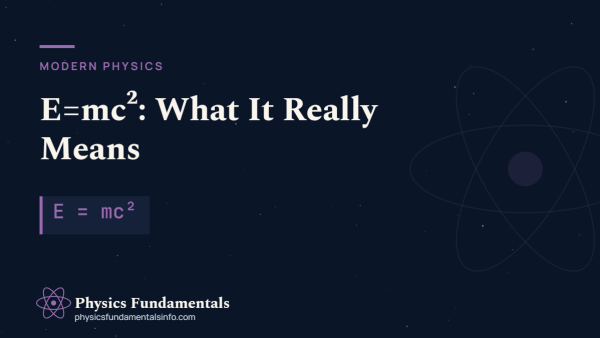
The energy released when antimatter annihilates is E = mc2, where m is the total mass destroyed — the antimatter and the equal mass of ordinary matter it takes with it.
- E — energy released, in joules (J)
- m — total mass converted, in kilograms (kg)
- c — speed of light in vacuum, 299,792,458 m/s exactly
Because annihilation always destroys a particle and its antiparticle, the mass that vanishes is twice the mass of the antimatter you started with. Working from the antimatter mass alone, the formula becomes:
- E — energy released, in joules (J)
- m — mass of the antimatter alone, in kilograms (kg)
- c — speed of light in vacuum, 299,792,458 m/s
This is the single most common slip students make with this topic. Ask “how much energy is in a gram of antimatter?” and the instinct is to punch 0.001 kg into E = mc2 and report 9.0 × 10¹³ J. That answer is exactly half the truth — the gram of ordinary matter it annihilates is destroyed too.
The full picture of where that c2 comes from is in our guide to E = mc2 explained, and if you just want the arithmetic done for a given mass, our E = mc2 Calculator will convert mass to energy in one step — just remember to enter the total mass, both halves.
How Does Matter–Antimatter Annihilation Work?
Annihilation happens because a particle and its antiparticle carry equal and opposite quantum numbers, so together they add up to nothing that has to be conserved — leaving mass-energy free to convert entirely into radiation.
Picture an electron and a positron drifting towards each other. Charge: −1 and +1, summing to zero. Lepton number: +1 and −1, summing to zero. There is nothing left that the universe insists on preserving except energy and momentum.
So the pair simply stops existing, and the books are balanced with photons. For a slow electron–positron pair the outcome is beautifully clean: two gamma photons, flying out back to back, each carrying 0.511 MeV.
- Eγ — energy of each photon, in joules (J) or MeV
- m — rest mass of one of the annihilating particles, in kilograms (kg)
- c — speed of light in vacuum, 299,792,458 m/s
Why two photons and not one? Because of conservation of momentum. A pair at rest has zero total momentum, but a single photon always carries momentum p = E/c, which can never be zero. Two photons flying in opposite directions cancel; one cannot.
Those photons are enormously energetic — you can check the size of them against the photon energy formula, and you will find a wavelength of about 2.4 picometres, far shorter than any X-ray from a dental clinic.

An electron and a positron annihilate at rest. Momentum conservation forces two photons, back to back, each carrying the rest energy of one electron.
Protons and antiprotons are messier. They annihilate into a spray of about five pions, and because charged pions decay into muons and neutrinos, roughly half the released energy is carried off by neutrinos that stream straight through the walls of any conceivable reactor.
Push the slider in the lab below and watch what stays constant. The total energy depends only on the mass you annihilate — never on which particles you chose.
How Much Energy Does Antimatter Really Release?
One gram of antimatter annihilating with one gram of ordinary matter releases 1.8 × 10¹⁴ J — about 43 kilotons of TNT, or roughly three times the Hiroshima bomb.
What makes that number extraordinary is not its size but its efficiency. Chemical fuels convert a laughably small sliver of their mass into energy; even nuclear fission and fusion only cash in a fraction of a percent. Annihilation spends the lot.
| Energy source | Energy per kg of fuel | Fraction of mass converted |
|---|---|---|
| Petrol (chemical burning) | 4.6 × 10⁷ J | about 0.00000005% |
| Uranium-235 fission | 8.2 × 10¹³ J | about 0.09% |
| Hydrogen to helium fusion (stellar) | 6.3 × 10¹⁴ J | 0.7% |
| Matter–antimatter annihilation | 1.8 × 10¹⁷ J per kg of antimatter | 100% |
Then comes the reality check. CERN estimates that if its Antimatter Factory ran flat out for a full year and every antihydrogen atom were trapped and annihilated at once, the yield would be a few thousandths of a joule — about what you spend tapping a phone screen.
Antimatter is the best fuel in the universe and the worst fuel available to us, at the same time. Making it costs vastly more energy than annihilating it ever returns.
Where Does Antimatter Actually Come From?
Antimatter is produced naturally by radioactive decay, cosmic-ray collisions and lightning, and artificially by hospital cyclotrons and particle accelerators — but it never lasts, because it annihilates the moment it meets ordinary matter.
Your Fruit Bowl
Bananas are rich in potassium, and a tiny fraction of natural potassium is the radioactive isotope potassium-40. A very rare branch of its decay emits a positron, which works out at roughly one positron every 75 minutes from an average banana. Your own body, which also runs on potassium, is doing the same thing right now.
Hospitals
PET stands for positron emission tomography, and it means what it says. A tracer such as fluorine-18 attached to a glucose-like molecule is injected, concentrates in metabolically busy tissue, and decays by beta-plus emission — one of the types of radiation studied in nuclear physics.
Each positron travels a millimetre or two, meets an electron, and dies in a flash of two 511 keV photons heading in opposite directions. Detectors ringing the patient catch both, draw the line between them, and the intersection of millions of such lines is the image.
In practice this is why PET tracers are made on site or nearby: fluorine-18 has a half-life of about 110 minutes, so a dose loses more than half its strength during a long delivery.
Thunderstorms and Cosmic Rays
NASA’s Fermi space telescope has detected beams of positrons produced by terrestrial gamma-ray flashes above thunderstorms. High-energy cosmic rays smashing into the upper atmosphere make antiparticles too — which is exactly where Anderson found the first one.
Accelerators
CERN’s Antimatter Factory delivers around 400 million antiprotons an hour, of which experiments capture roughly a tenth. The ALPHA experiment builds these into antihydrogen atoms at up to 3,000 per hour and can hold them for as long as 100 hours — long enough to shine lasers at them and compare them with ordinary hydrogen to twelve significant figures.
Why Is There So Little Antimatter in the Universe?
There is almost no antimatter left because the early universe produced a tiny excess of matter — roughly one extra matter particle for every billion matter–antimatter pairs — and everything else annihilated away.
Think about what that means. Nearly all the matter that ever existed was destroyed in the first moments after the Big Bang. Every atom in your body, every star in every galaxy, is the leftover crumb from that near-perfect cancellation. The photons from the annihilation are still around us, vastly outnumbering matter particles.

Everything made of atoms is the residue of a cancellation that was almost, but not quite, perfect.
Why the imbalance? Physicists know the ingredients required — the laws must treat matter and antimatter slightly differently, and the universe must fall out of thermal equilibrium while it happens. A small difference of exactly this kind was found in 1964 in the decays of neutral kaons, and more have been measured since.
The trouble is arithmetic. Every difference measured so far is far too feeble to explain a whole universe of matter. It is one of the largest unsolved problems in physics, and the reason experiments keep weighing antihydrogen against hydrogen looking for a crack.
Common Misconceptions About Antimatter
“Antimatter has negative mass and falls upwards”
It does not. Antiparticles have positive mass and positive energy; only their charges and quantum numbers are reversed. In 2023 the ALPHA-g experiment at CERN released trapped antihydrogen and watched where it went — antihydrogen falls downwards, just like hydrogen. Antigravity is out.
“Antimatter is the same thing as dark matter”
Completely different. Antimatter is ordinary, well-understood, and interacts with light violently — annihilation is a blaze of gamma rays. Dark matter is unidentified, does not appear to interact with light at all, and is inferred from gravity alone. The names rhyme; the physics does not.
“Antimatter would solve the energy crisis”
Only if you ignore where it comes from. Antimatter is not a fuel you dig up — it must be manufactured, and manufacturing it consumes far more energy than annihilating it returns. It is a battery with terrible charging efficiency, not a power source.
“A gram of antimatter gives 9 × 10¹³ J”
That is half the answer, and it is the single most common mistake in this topic. A gram of antimatter drags a gram of matter into the reaction, so 2 grams are converted and the real figure is 1.8 × 10¹⁴ J.
How Antimatter Relates to Relativity, Quantum Mechanics and Nuclear Physics
Antimatter sits at the junction of the three great pillars of modern physics, which is precisely why it is worth studying even though you will never hold any.
- Special relativity supplies E = mc2, the exchange rate that makes annihilation and pair creation possible at all.
- Quantum mechanics supplied the prediction: Dirac’s equation demanded antiparticles years before anyone saw one.
- Nuclear physics supplies the everyday supply chain — beta-plus decay is a proton inside a nucleus turning into a neutron, a positron and a neutrino.
- Particle physics supplies the bookkeeping: an antiproton is built from antiquarks, and the matter–antimatter asymmetry is one of the Standard Model’s loudest unanswered questions.
There is one more link worth holding on to. Annihilation runs in reverse: give a gamma photon at least 1.022 MeV and it can convert into an electron–positron pair. Matter is not created or destroyed so much as exchanged, at the rate c2 sets.
Worked Problems
Show Solution
Solution:
Step 1: Use the mass–energy relation for a single particle at rest, E = mc2.
Step 2: Substitute with units. E = (9.11 × 10⁻³¹ kg) × (2.998 × 10⁸ m/s)2 = (9.11 × 10−31) × (8.988 × 1016) J.
Step 3: Solve. E = 8.19 × 10⁻¹⁴ J. Convert using 1 MeV = 1.602 × 10⁻¹³ J, so E = 8.19 × 10⁻¹⁴ ÷ 1.602 × 10−13 = 0.511 MeV.
Answer: 8.19 × 10⁻¹⁴ J, or 0.511 MeV
Show Solution
Solution:
Step 1: The total energy released is the rest energy of both particles, E = 2mc2. The two photons share it equally, so each gets Eγ = mc2.
Step 2: Substitute. Eγ = 8.19 × 10⁻¹⁴ J = 0.511 MeV, from Problem 1.
Step 3: Find the wavelength from Eγ = hc/λ, so λ = hc/Eγ = (6.626 × 10⁻³⁴ J s × 2.998 × 10⁸ m/s) ÷ (8.19 × 10⁻¹⁴ J).
Answer: 0.511 MeV per photon, wavelength 2.43 × 10⁻¹² m (2.43 pm)
Show Solution
Solution:
Step 1: The photon must supply at least the rest energy of both new particles, Emin = 2mc2.
Step 2: Substitute. Emin = 2 × 0.511 MeV.
Step 3: Solve and convert. Emin = 1.022 MeV = 1.022 × 1.602 × 10−13 J.
Answer: 1.022 MeV, or 1.64 × 10⁻¹³ J
Show Solution
Solution:
Step 1: Identify the total mass destroyed. The antimatter annihilates an equal mass of matter, so m = 2.00 g = 2.00 × 10⁻³ kg.
Step 2: Substitute into E = mc2. E = (2.00 × 10⁻³ kg) × (8.988 × 10¹⁶ m2/s2).
Step 3: Solve, then convert. E = 1.80 × 10¹⁴ J; dividing by 4.184 × 10¹² J per kiloton gives 43.0 kilotons.
Answer: 1.80 × 10¹⁴ J, about 43 kilotons of TNT
Show Solution
Solution:
Step 1: Total energy per pair is E = 2mc2 = 2 × 938.3 MeV = 1876.6 MeV.
Step 2: Convert to joules. E = 1876.6 × 1.602 × 10−13 J = 3.01 × 10⁻¹⁰ J.
Step 3: Divide to find the number of pairs. N = 1.00 J ÷ 3.01 × 10⁻¹⁰ J = 3.33 × 10⁹.
Answer: 3.01 × 10⁻¹⁰ J per pair; about 3.3 × 10⁹ pairs for 1 joule
Show Solution
Solution:
Step 1: Find the energy required from E = Pt.
Step 2: Substitute. E = 100 W × 3.156 × 107 s = 3.156 × 10⁹ J.
Step 3: Rearrange E = 2mc2 for the antimatter mass, m = E/(2c2) = 3.156 × 10⁹ ÷ (2 × 8.988 × 1016) kg.
Answer: 1.76 × 10⁻⁸ kg, about 18 micrograms of antimatter
Show Solution
Solution:
Step 1: Use the decay law A = A0(½)t/t½ with t = 360 min and t½ = 110 min, so t/t½ = 3.27.
Step 2: Substitute. A = 370 MBq × (0.5)3.27 = 370 × 0.103 MBq.
Step 3: For the photon rate at t = 0, multiply the activity by the branching ratio, then by 2 photons per annihilation. Rate = 370 × 106 × 0.97 × 2 = 7.2 × 10⁸ photons per second.
Answer: about 38 MBq after 6 hours; roughly 7.2 × 10⁸ photons per second at injection