Mass–energy equivalence says that matter itself is stored energy, E = mc². Drag the sliders below to set a mass and the fraction of it that converts, and watch the energy released climb through joules, tonnes of TNT and household-years.
Mass into Energy: E = mc²
Set a mass and choose what fraction of it is actually converted. The lab computes E = f · m · c² and shows the result in joules, in tonnes of TNT, and against things you already have a feel for.
so c² = 8.98755 × 10¹⁶ m²/s²
Energy scale on the canvas is logarithmic — each step is 10 times the one before.
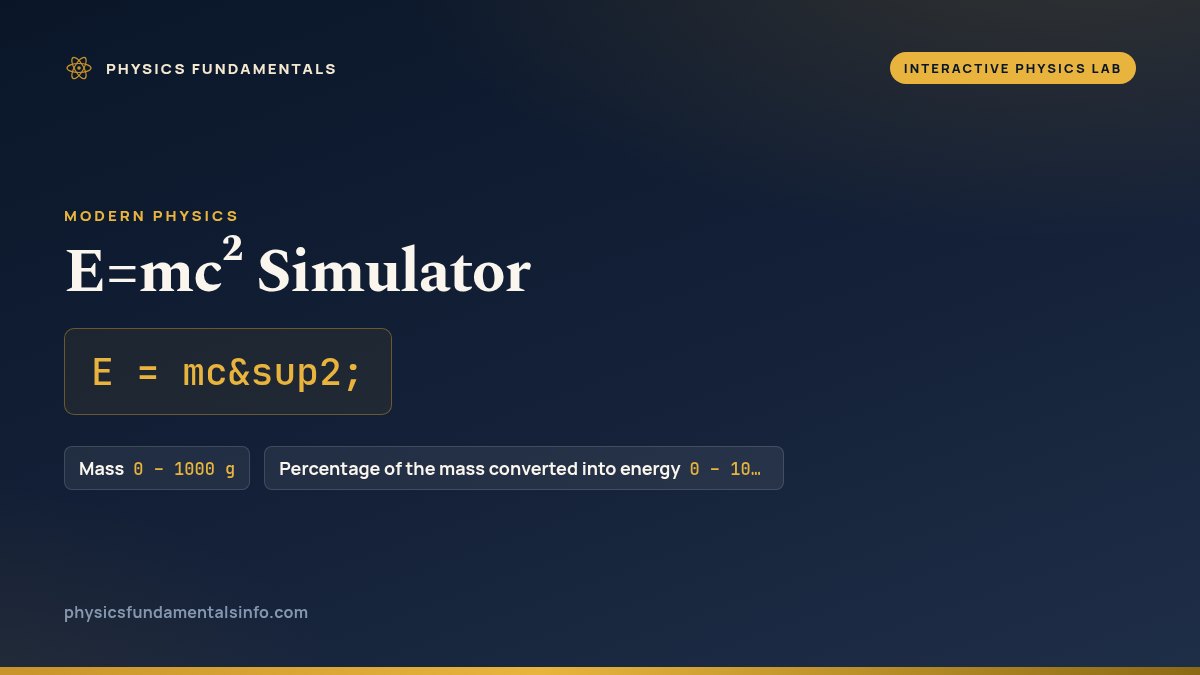
What Is the E=mc² Simulator?
The E=mc² simulator is a free interactive physics lab that runs in your browser — nothing to install and no sign-up. Set a mass and how much of it converts, then watch the energy released in joules and tonnes of TNT. See why one gram equals a bomb. It reports energy released as you drag the sliders.
| Control | Range | Step |
|---|---|---|
| Mass | 0 – 1000 g | 0.5 |
| Percentage of the mass converted into energy | 0 – 100 % | 0.01 |
How to use the E=mc² simulator
Two sliders drive the whole lab. The mass slider sets how much matter you start with, anywhere from nothing up to a kilogram, and the fraction converted slider sets how much of that mass is actually turned into energy rather than left sitting there as matter. Neither slider is a guess about the physics; they are the two quantities the equation needs. The readout updates live, giving the energy in joules, the same energy expressed in tonnes of TNT, and a plain-language comparison so the number means something. If you want to type exact figures instead of dragging, the E = mc² Calculator solves the same relationship numerically.
What the readouts prove is easier to feel than to read. Because the sim computes E = f · m · c² with c fixed at 299,792,458 m/s, the arithmetic is strictly linear in both inputs: double the mass and the energy doubles, halve the fraction and the energy halves. Yet nudging the fraction from chemical levels up to nuclear levels sends the output up by billions, because chemical reactions convert a vanishingly small share of their fuel's mass while nuclear ones convert a much larger share. The preset buttons make the contrast unmistakable in a single click. The equation itself comes out of special relativity, where energy and mass turn out to be two accounts of the same thing.
The misconception the lab is built to correct is the assumption that nuclear and chemical reactions release broadly comparable energy, just with different fuels. Snap the fraction to Fission 0.09% and then to Annihilation 100% with the mass held at one gram, and the readout shows the two differing by more than a thousand times. Change the fuel all you like; the ceiling is set by the equation, not by the chemistry. That single gram at full conversion releases about 8.99 × 10¹³ joules, roughly 21.5 kilotonnes of TNT.
Finish with a reality check. Only matter–antimatter annihilation reaches 100% conversion, and it exists in laboratories in vanishing quantities. Real machines and real stars sit far lower on the slider: nuclear fission and fusion in reactors and in the Sun convert well under one percent of the mass they process. That is precisely why fuel lasts. Set the fraction near 0.7% and you are modelling hydrogen fusing to helium, the reaction that has kept the Sun burning for four and a half billion years on a budget the slider makes look almost frugal.
Frequently asked questions
What does the fraction slider represent?
It sets the percentage of the entered mass that is actually turned into energy. Real reactions convert only a sliver of their fuel's mass, so the slider is how you move between chemical burning, nuclear fission, fusion and total annihilation without changing the amount of matter you started with.
Why is the energy so large for such a small mass?
Because the simulator multiplies mass by c², which is roughly 90 quadrillion m²/s². That constant is the whole story: even a gram of matter carries about 90 trillion joules of rest energy, so converting a tiny fraction of it still releases more than any chemical reaction of the same size could.
Does the simulator use the exact speed of light?
Yes, c = 299,792,458 m/s exactly, which is the defined SI value rather than a rounded 300 million m/s. The lab squares that number to get c² = 8.98755e16 m²/s², about 90 quadrillion, so the joule figures on screen match a hand calculation to the digits shown.
Can I model the Sun with it?
Set the fraction near 0.7%, the share of mass lost when hydrogen fuses into helium. That is the Fusion preset, and it shows why the Sun can burn for billions of years: it converts less than one percent of the mass it processes, yet that is enough to power a star.
What is the maximum possible energy from a mass?
Full 100% conversion, which is achievable only by matter-antimatter annihilation. That is the ceiling the equation sets, and no reactor, bomb or star reaches it, so the Annihilation preset shows the theoretical limit rather than anything engineers can build today.
References & formula source
- A. Einstein (1905), "Does the Inertia of a Body Depend Upon Its Energy Content?", Annalen der Physik 18, 639–641.
- Young & Freedman — University Physics with Modern Physics, §37.8 (Relativistic Momentum and Energy).
- R. Nave — HyperPhysics, Georgia State University, "Einstein Mass-Energy Relation" / nuclear binding energy section.
- Further reading: Mass–energy equivalence — Wikipedia