Fission vs fusion describes two opposite nuclear reactions: fission splits one heavy nucleus (such as uranium-235) into lighter nuclei, while fusion joins light nuclei (such as hydrogen isotopes) into a heavier one. Both convert a tiny loss of mass into energy through E = mc2, but fusion releases far more energy per kilogram of fuel.
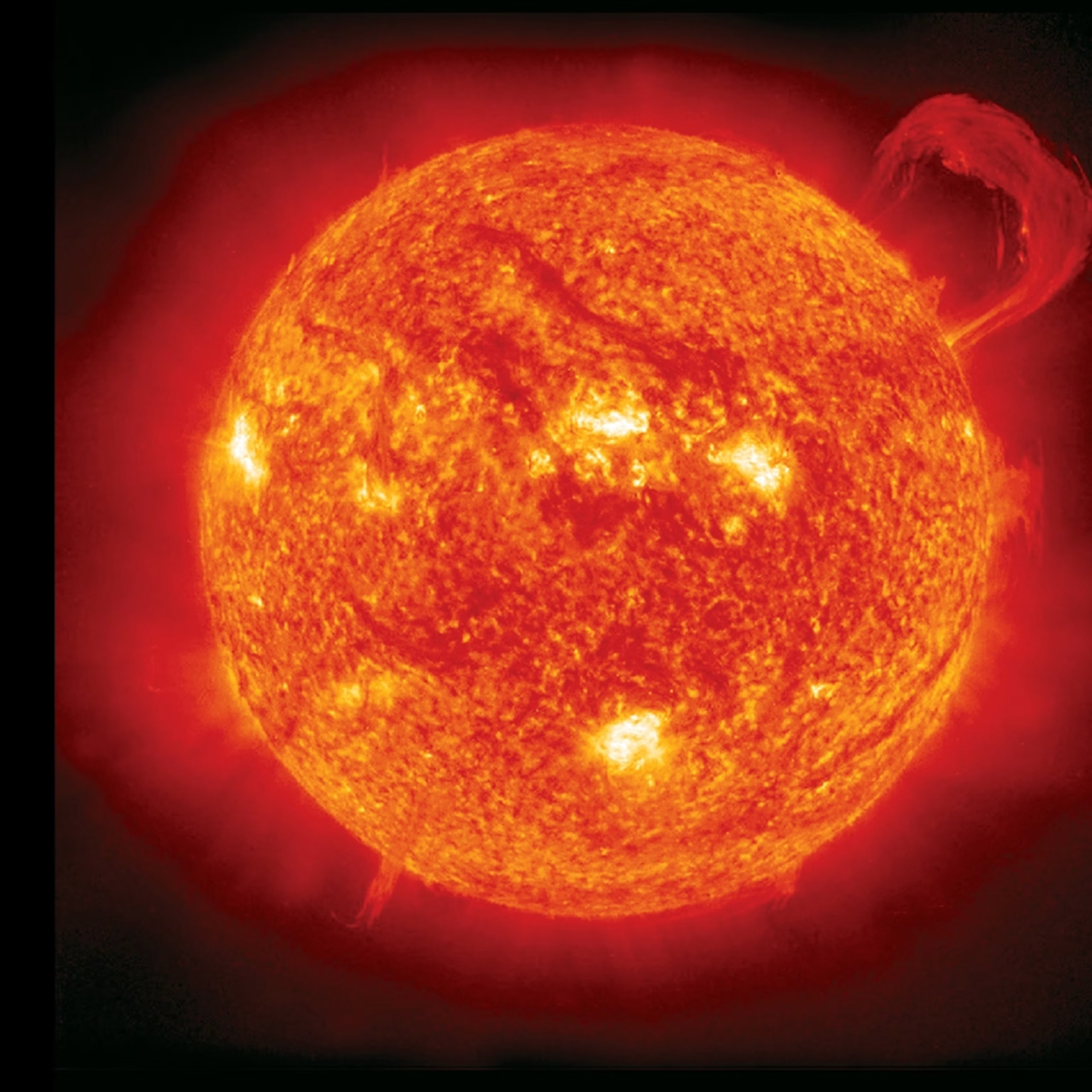
Look up on a clear day and you are staring straight at a fusion reactor — the Sun, 150 million kilometres away. The very same family of nuclear reactions runs the power station that may be lighting your room right now.
Both fission and fusion unlock the staggering energy hidden inside an atom’s nucleus. The twist is that they do it in opposite directions — one tears heavy atoms apart, the other forces light ones together — and that single difference shapes everything from nuclear waste to the future of clean power.
What Are Nuclear Fission and Fusion?
Strip away the jargon and the idea is simple. Energy is locked inside every atomic nucleus, and there are exactly two ways to prise it loose: break a big nucleus, or build a bigger one.
Nuclear fission
Fission is the splitting of a single heavy nucleus into two lighter nuclei, usually after the nucleus absorbs a passing neutron. Picture an overloaded water balloon: add one more drop and it wobbles, stretches, and tears in two.
When uranium-235 swallows a neutron it becomes briefly unstable, then splits — flinging out two smaller “fission-product” nuclei, two or three fresh neutrons, and a burst of energy. Heavy, fissile fuels like uranium-235 and plutonium-239 are used precisely because they split so readily.
Nuclear fusion
Fusion runs the film backwards. Two light nuclei slam together hard enough to merge into one heavier nucleus, releasing energy as they bond. The classic reaction fuses two heavy forms of hydrogen — deuterium and tritium — into helium.
There is a catch. Nuclei are positively charged, so they fiercely repel one another. Only at ferocious temperatures and pressures do they move fast enough to touch and fuse. The U.S. Department of Energy sums the pair up neatly: two physical processes that release massive amounts of energy from atoms — by opposite means.
Fission vs Fusion: The Key Differences at a Glance
If you remember one thing, make it this table. It contrasts the two reactions across the points students and exam questions care about most.
| Feature | Nuclear fission | Nuclear fusion |
|---|---|---|
| What happens | One heavy nucleus splits into two lighter nuclei | Two light nuclei merge into one heavier nucleus |
| Typical fuel | Uranium-235, plutonium-239 (heavy) | Deuterium and tritium (light hydrogen) |
| What triggers it | A neutron is absorbed; a self-sustaining chain reaction | Extreme temperature and pressure (~107–108 K) to beat the nuclei’s repulsion |
| Energy per reaction | ~200 MeV (≈ 3.2 × 10⁻¹¹ J) | ~17.6 MeV (≈ 2.8 × 10⁻¹² J) |
| Energy per kg of fuel | ~8 × 10¹³ J | ~3.4 × 10¹⁴ J (about 4× fission) |
| Where it happens today | Power plants, submarines, fission (“atomic”) bombs | The Sun and stars, hydrogen bombs, experimental reactors (no grid power yet) |
| Radioactive by-products | Long-lived, highly radioactive fission products | Mainly short-lived; activated parts and tritium — far less long-lived waste |
| Chain reaction / meltdown | Yes — needs constant control; meltdown is possible | No self-sustaining chain; the plasma just fizzles out — no meltdown |
| Maturity | Commercial since the 1950s | Still experimental; net facility energy not yet achieved |
The headline contrast: fission gives more energy in a single reaction, yet fusion gives more energy per kilogram of fuel. Hold that thought — it trips up almost everyone.
Why Both Fission and Fusion Release Energy
Here is the part that surprises people. Fission and fusion look like exact opposites, so how can splitting and joining both pour out energy? The answer is one of the most elegant graphs in physics: the binding-energy curve.
Every nucleon (a proton or neutron) inside a nucleus is held by the strong nuclear force. The binding energy per nucleon measures how tightly, on average, each one is locked in. Plot it against nucleus size and you get a curve that climbs steeply, peaks, then gently falls.
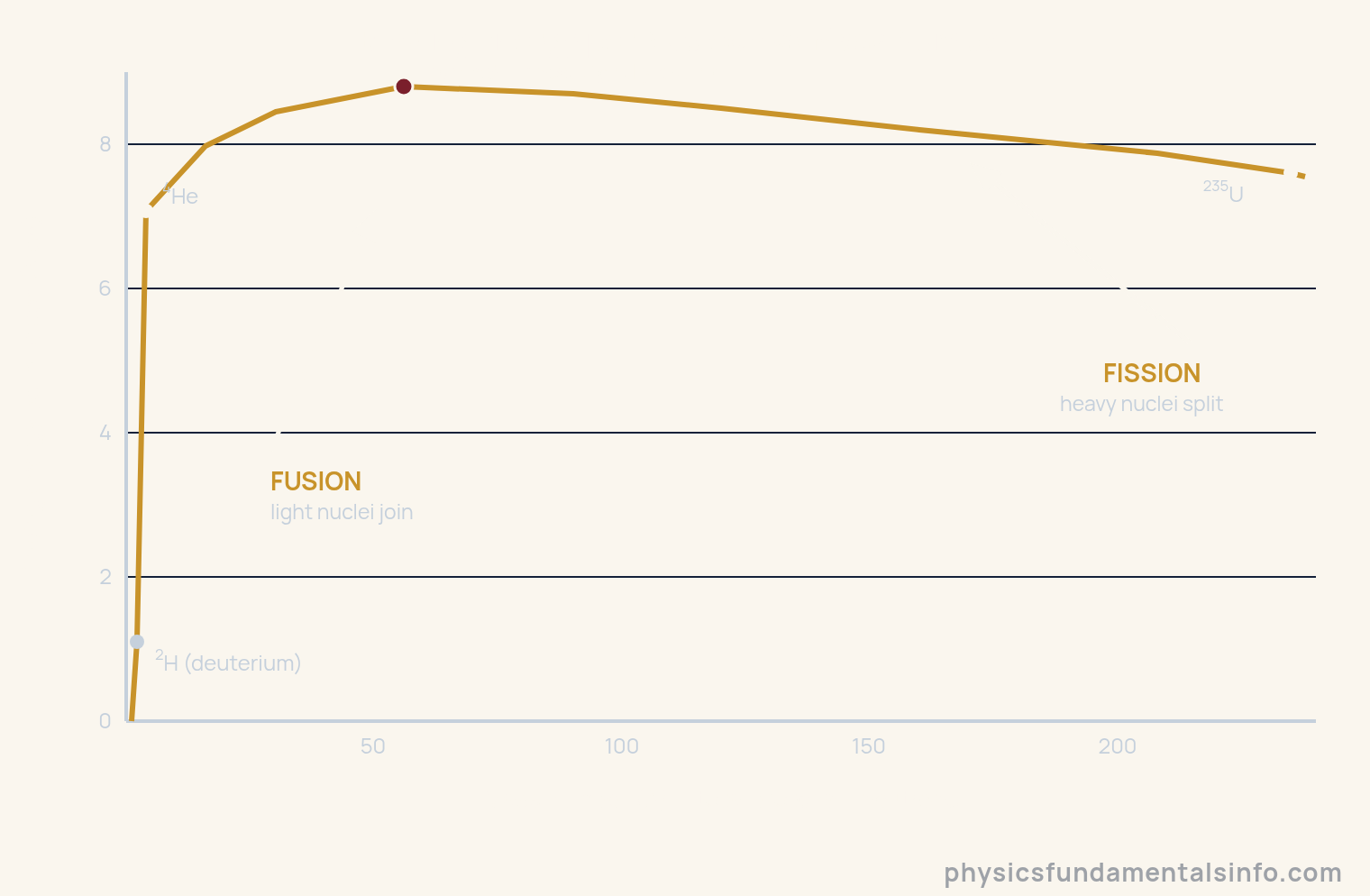
The binding-energy curve. Both fusion (from the left) and fission (from the right) move nuclei up toward the iron peak — and moving up always releases energy.
Light nuclei on the left are loosely bound, so fusing them climbs the curve toward the peak. Heavy nuclei on the right also sit below the peak, so splitting them climbs the curve too. Iron-56 sits at the very top — the most stable nucleus there is. You cannot squeeze energy out of iron by either route.
So where does the released energy actually come from? Climbing the curve means the products are bound a little more tightly, which makes them weigh a little less than the ingredients. That missing mass — the mass defect — is converted straight into energy by Einstein’s famous equation.
- E — energy released, in joules (J)
- m — mass converted (the mass defect, Δm), in kilograms (kg)
- c — the speed of light in vacuum, c = 299,792,458 m/s
Because c is so large, c2 is about 9 × 10¹⁶ m2/s2. Convert a mere speck of mass and you get a colossal amount of energy. That is the whole secret of nuclear power. The same idea, written for a whole nucleus, defines its binding energy:
- E_b — total binding energy of the nucleus, in joules (J) or MeV
- Δm — mass defect, in kg (or atomic mass units, u)
- Z — number of protons; m_p — proton mass = 1.007276 u
- N — number of neutrons; m_n — neutron mass = 1.008665 u
- m_nucleus — measured mass of the assembled nucleus, in u
This whole picture is a direct consequence of special relativity, where mass and energy are two faces of the same coin, and the constant tying them together is the speed of light.
Magnitude check: fully fissioning one kilogram of uranium-235 releases roughly the energy of burning about 3,000 tonnes of coal — a few million times more energy per kilogram. Nuclear fuel is in a different league entirely.
The Fission and Fusion Reactions
Numbers make the comparison concrete. Here is a representative fission of uranium-235 — note that it can split many different ways, but the energy released is always about the same.
- 235U — a uranium-235 nucleus (the fuel)
- n — a neutron; one is absorbed, about two to three are released
- 141Ba, 92Kr — example fission products (barium and krypton)
- ~200 MeV — energy released per fission ≈ 3.2 × 10⁻¹¹ J, mostly as kinetic energy of the flying fragments
And here is the workhorse fusion reaction, the one earthly reactors aim for because it is the easiest to ignite.
- 2H — deuterium (one proton, one neutron)
- 3H — tritium (one proton, two neutrons)
- 4He — a helium-4 nucleus, carrying about 3.5 MeV
- n — a fast neutron, carrying about 14.1 MeV of the total
- 17.6 MeV — energy released per fusion ≈ 2.8 × 10⁻¹² J
Want to see the mass-to-energy conversion for yourself? Drop a mass defect into our E = mc2 Calculator and watch a fraction of a gram turn into a vast number of joules.
How Fission and Fusion Actually Work
Fission: the chain reaction
Fission is a domino run. The trick is that each split releases more neutrons than it consumes, and those neutrons can trigger fresh splits.
- A slow neutron is absorbed by a uranium-235 nucleus, which becomes unstable.
- The bloated nucleus deforms and splits into two fragments, releasing ~200 MeV and two to three new neutrons.
- Those neutrons strike more uranium nuclei, each causing another fission — a self-sustaining chain reaction.
Left unchecked, the chain doubles and re-doubles in a fraction of a second — that is a fission bomb, which needs a critical mass of fuel packed together. A reactor does the opposite: control rods soak up spare neutrons and a moderator slows them, holding the reaction at a steady, controllable simmer.
In a power station that heat boils water into steam, the steam spins a turbine, and the turbine drives a generator. It is, at heart, a very exotic kettle.
Fusion: beating the Coulomb barrier
Fusion’s challenge is getting the nuclei to touch at all. Two positive charges repel, and that repulsion — described by Coulomb’s law — forms a wall called the Coulomb barrier.
To climb it, the nuclei must move at blistering speeds, which means heating the fuel to tens of millions of degrees until it becomes a plasma. They also need to be squeezed densely enough, for long enough, to collide. Only then does the short-range strong force grab hold and fuse them.
The Sun manages this with crushing gravity, fusing ordinary hydrogen through the slow proton–proton chain at its ~15-million-degree core. On Earth we have no such gravity, so we use magnetic fields to bottle the plasma (tokamaks like ITER, a 35-nation project coordinated through the IAEA) or giant lasers to crush a fuel pellet (inertial confinement, as at the National Ignition Facility).
That laser approach made history. In December 2022 the National Ignition Facility achieved fusion ignition — its fuel pellet gave out more energy than the laser delivered to it — and the feat has been repeated and exceeded since. (More on what that does, and does not, mean below.)
Real-World Examples of Fission and Fusion
Both reactions are already part of daily life — one quietly, one cosmically.
Fission in action
- Nuclear power plants. Fission supplies roughly a fifth of U.S. electricity and over two-thirds of France’s — reliable, carbon-free baseload power.
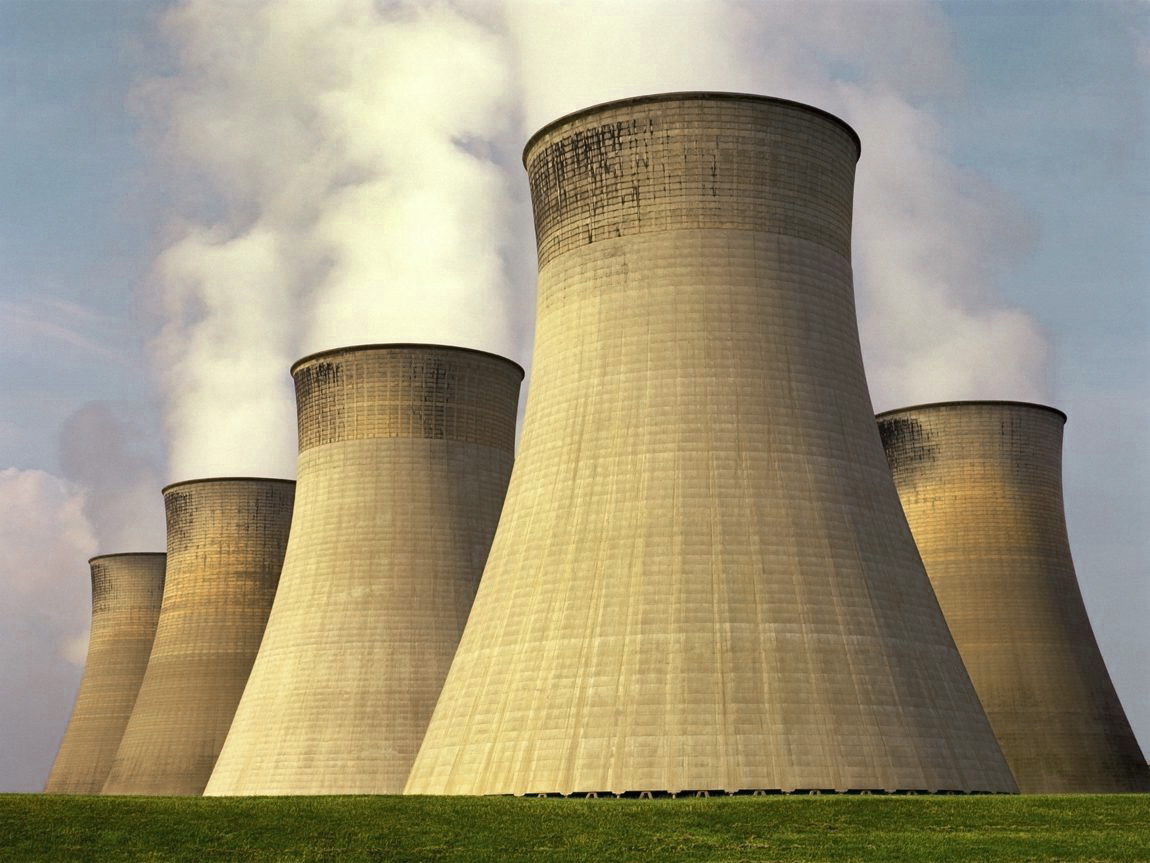
- Submarines and aircraft carriers. A compact fission reactor lets a vessel run for years between refuellings, with no air needed for combustion.
- Atomic bombs. The weapons used on Hiroshima (uranium-235) and Nagasaki (plutonium-239) were uncontrolled fission chain reactions.
Fusion in action
- The Sun and every star. Stellar fusion forged the helium, carbon and oxygen in your body, building elements all the way up to iron.
- Hydrogen bombs. A thermonuclear weapon uses a fission explosion as a match to ignite a far larger fusion blast.
- Experimental reactors. ITER, the giant tokamak under construction in southern France, is expected to begin operations in the mid-2030s, with deuterium–tritium fusion not planned until around 2039. The U.S. Nuclear Regulatory Commission is already building frameworks for future fusion facilities — but no fusion plant feeds electricity to the grid today.
Common Misconceptions About Fission vs Fusion
“Fusion always releases more energy than fission”
It depends what you measure. Per single reaction, fission wins easily: about 200 MeV versus 17.6 MeV for one deuterium–tritium fusion. Per kilogram of fuel, fusion wins, releasing roughly four times as much, because its nuclei are so feather-light. Both statements are true — people just quote one and forget the other.
“Fusion is 100% clean, with zero radioactivity”
Fusion is far cleaner than fission — no long-lived high-level waste and no meltdown risk. But it is not radiation-free. Deuterium–tritium fusion fires off fast neutrons that make the reactor’s walls radioactive over time, and tritium itself is a radioactive gas that must be handled carefully.
“We already make electricity from fusion”
Not yet. The 2022 ignition milestone produced more energy than the laser delivered to the fuel pellet, but the facility’s lasers drew hundreds of megajoules from the grid to deliver just a couple of megajoules to the target. That is a scientific landmark, not net power — and no fusion plant feeds electricity to homes today.
“The Sun fuses like a hydrogen bomb”
Per cubic metre, the Sun’s core is astonishingly gentle — it generates only a few hundred watts in each cubic metre, less power density than your own body. It is the Sun’s sheer, planet-dwarfing size, not the violence of each reaction, that makes it blaze.
How Fission and Fusion Connect to the Rest of Physics
Nuclear reactions are not an island. They sit at the crossroads of several big ideas you can explore on their own.
At the centre is energy and how it transforms: nuclear potential energy becomes the kinetic energy of flying fragments and neutrons, which becomes heat, then steam, then electricity. The bridge between mass and that energy is mass–energy equivalence, and the repulsion fusion must overcome is pure electrostatics. Master those building blocks and the nucleus stops feeling mysterious.
Worked Problems
Show Solution
Solution:
Step 1: Convert MeV to joules. E = 200 MeV × 1.602 × 10−13 J/MeV.
Step 2: E = 3.204 × 10⁻¹¹ J.
Answer: ≈ 3.2 × 10⁻¹¹ J per fission.
Show Solution
Solution:
Step 1: Rearrange E = mc2 to m = E / c2.
Step 2: c2 = (2.998 × 10⁸)2 = 8.988 × 10¹⁶ m2/s2.
Step 3: m = 3.204 × 10⁻¹¹ / 8.988 × 1016 = 3.565 × 10⁻²⁸ kg.
Answer: ≈ 3.6 × 10⁻²⁸ kg (about 0.21 u) — a tiny sliver of the nucleus’s mass.
Show Solution
Solution:
Step 1: E = 17.6 MeV × 1.602 × 10−13 J/MeV = 2.819 × 10⁻¹² J.
Step 2: Compare with fission: 200 MeV ÷ 17.6 MeV ≈ 11.
Answer: ≈ 2.8 × 10⁻¹² J. One fission releases about 11× more energy than one D–T fusion.
Show Solution
Solution:
Step 1: Mass defect Δm = [2(1.007825) + 2(1.008665)] − 4.002602. (Using 1H atoms, the electron masses cancel.)
Step 2: Δm = 4.032980 − 4.002602 = 0.030378 u.
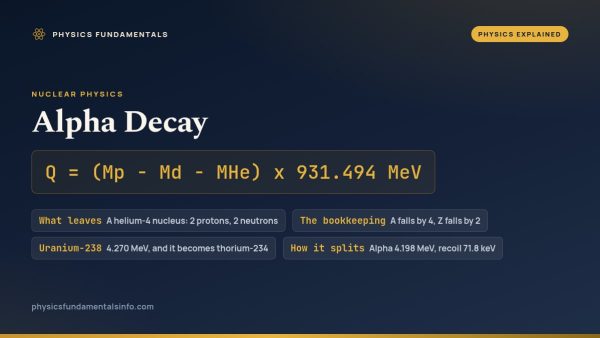
Step 3: Binding energy E_b = 0.030378 × 931.494 = 28.30 MeV. Per nucleon = 28.30 ÷ 4.
Answer: ≈ 7.07 MeV per nucleon — placing helium-4 high on the binding-energy curve.
Show Solution
Solution:
Step 1: Number of atoms = (1000 g ÷ 235 g/mol) × 6.022 × 1023 = 2.563 × 1024.
Step 2: Total energy = 2.563 × 1024 × 3.204 × 10−11 J.
Step 3: Total energy = 8.21 × 10¹³ J.
Answer: ≈ 8.2 × 10¹³ J per kg — comparable to burning roughly 3,000 tonnes of coal.
Show Solution
Solution:
Step 1: Mass per reaction = 5 × 1.661 × 10−27 = 8.303 × 10⁻²⁷ kg.
Step 2: Reactions per kg = 1 ÷ 8.303 × 10−27 = 1.204 × 1026.
Step 3: Energy = 1.204 × 1026 × 2.819 × 10−12 = 3.40 × 10¹⁴ J. Ratio to fission = 3.40 × 10¹⁴ ÷ 8.2 × 10¹³ ≈ 4.1.
Answer: ≈ 3.4 × 10¹⁴ J per kg — about 4 times the energy of fission per kilogram.
Show Solution
Solution:
Step 1: Number of half-lives n = 90 ÷ 30 = 3.
Step 2: Fraction remaining = (½)n = (½)3 = 1/8.
Answer: 1/8, or 12.5% — which is why fission waste must be stored safely for a very long time.
Show Solution
Solution:
Step 1: Coulomb energy U = k·e2 / r = 8.988 × 109 × (1.602 × 10−19)2 ÷ (1.0 × 10⁻¹⁵).
Step 2: U = 2.31 × 10⁻¹³ J ≈ 1.4 MeV.
Step 3: A naïve temperature where k_BT equals this is T = U ÷ k_B ≈ 1.7 × 10¹⁰ K.
Answer: ≈ 2.3 × 10⁻¹³ J (~1.4 MeV). Yet the Sun fuses at only ~107 K — quantum tunnelling lets nuclei slip through the barrier far below the classical estimate.