Snell’s law states that when light passes from one transparent medium into another, n1 sin θ1 = n2 sin θ2: the refractive index of each medium multiplied by the sine of its ray’s angle from the normal is equal on both sides of the boundary. It predicts exactly how much a light ray bends when it crosses between materials.
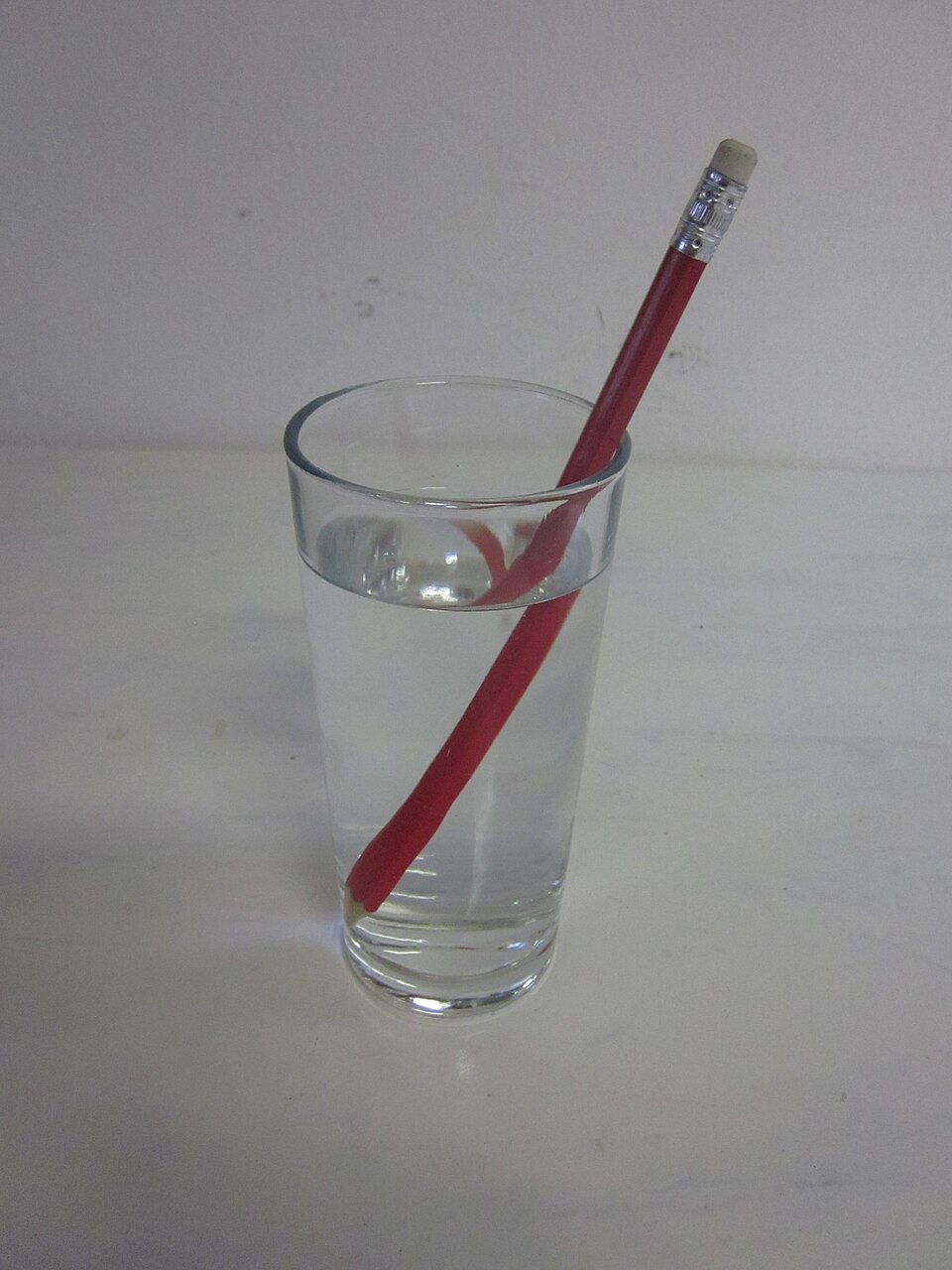
Push a straw into a glass of water and it appears to snap sideways at the surface. Kneel at the edge of a swimming pool and the bottom looks temptingly close — then you jump in and discover it is a good third deeper than it looked.
Neither the straw nor the pool is broken. Light simply changes direction the instant it crosses between water and air, and Snell’s law is the rule that says exactly how far it swings. By the end of this guide you will be able to calculate that swing in seconds — and spot the traps that catch most students.
What Is Snell’s Law?
Strip away the Greek letters and Snell’s law says something surprisingly tidy: every transparent material gets a number, and that number decides how sharply light bends on the way in or out. The number is the refractive index, n — a measure of how much a material slows light down.
Formally, Snell’s law (also called the law of refraction) states that for a ray crossing the boundary between two media, the product of refractive index and the sine of the ray’s angle — always measured from the normal, the line perpendicular to the surface — is the same on both sides. One boundary, one equation, one unknown: that is why examiners love it.
The direction of the bend follows a simple pattern. Entering a slower, optically denser medium (air into water, say), the ray bends toward the normal; heading back out into a faster medium, it bends away from it.
Who Discovered Snell’s Law?
The name is an accident of history. The law was first accurately described in 984 CE by Ibn Sahl, a mathematician working in Baghdad, who used it in his treatise on burning mirrors and lenses to design lens shapes that focus light without geometric aberration.
It was then rediscovered independently several times: by Thomas Harriot in 1602 (unpublished), by the Dutch astronomer Willebrord Snellius in 1621 (also unpublished in his lifetime), and by René Descartes, who finally published it in 1637 — which is why in France it is known as the Snell–Descartes law.
The Snell’s Law Formula
Here is the equation in its standard form:
- n1 — refractive index of the first medium, the one the ray starts in (dimensionless)
- θ1 — angle of incidence, measured from the normal, not the surface (degrees or radians)
- n2 — refractive index of the second medium, the one the ray enters (dimensionless)
- θ2 — angle of refraction, again measured from the normal (degrees or radians)
The refractive index itself comes from a second, equally important relation:
Here c is the speed of light in a vacuum (exactly 299,792,458 m/s) and v is the speed of light inside the material. Water has n = 1.33 because light travels 1.33 times slower in water than in a vacuum. An index can never make light bend past the surface itself, so a quick sanity check on any answer: a real refracted angle always lands between 0° and 90°.
A ray crossing from air into water at 45° bends to about 32.1° — toward the normal, exactly as n1 sin θ1 = n2 sin θ2 predicts.
Refractive Indices of Common Materials
The table below gives typical values for yellow light (589 nm). The index drifts slightly with colour — that drift is called dispersion, and it is the reason prisms split white light.
| Material | Refractive index n | Speed of light inside | Critical angle (to air) |
|---|---|---|---|
| Vacuum | 1 (exactly) | 299,792 km/s | — |
| Air | 1.0003 | ≈ 299,700 km/s | — |
| Ice | 1.31 | ≈ 229,000 km/s | 49.8° |
| Water | 1.33 | ≈ 225,000 km/s | 48.8° |
| Ethanol | 1.36 | ≈ 220,000 km/s | 47.3° |
| Acrylic (Perspex) | 1.49 | ≈ 201,000 km/s | 42.2° |
| Crown glass | ≈ 1.52 | ≈ 197,000 km/s | 41.1° |
| Flint glass | ≈ 1.62 | ≈ 185,000 km/s | 38.1° |
| Sapphire | 1.77 | ≈ 169,000 km/s | 34.4° |
| Diamond | 2.42 | ≈ 124,000 km/s | 24.4° |
Glass values vary by recipe, which is why crown and flint are quoted as typical figures. Measured indices for hundreds of materials are collated in university references such as the refraction pages at HyperPhysics (Georgia State University).
How Snell’s Law Works
A ray does not bend because the surface deflects it, the way a ball ricochets off a wall. It bends because its speed changes — and if the ray arrives at an angle, one side of the light wave slows down before the other.
Picture a marching band striding off firm tarmac into soft mud at an angle. The marchers who hit the mud first slow down while their row-mates on tarmac keep full stride, so the whole column pivots toward the mud-side. Light wavefronts do precisely this at a boundary, and the geometry of that pivot is Snell’s law.
Work through the wavefront geometry and a clean ratio drops out: sin θ1 / sin θ2 = v1 / v2 = n2 / n1. Rearranged, that is n1 sin θ1 = n2 sin θ2 — the speed picture and the formula are the same statement.
There is a deeper way to see it, too. Fermat showed that light takes the path of least time between two points, like a lifeguard who runs along the beach before angling into the slower water; do the calculus and Snell’s law falls straight out. Feynman devotes a whole lecture to the idea — Optics: The Principle of Least Time — and it remains one of the great reads in physics.
Better than reading about it, though, is bending the ray yourself. Drag the angle in the lab below and watch the refracted and reflected rays respond in real time.
How to Use Snell’s Law: A 5-Step Method
Most lost marks on refraction questions come from setup, not algebra. This routine removes the guesswork:
- Sketch the boundary and draw the normal. Label medium 1 (where the ray starts) and medium 2 (where it is heading) — getting these backwards flips the whole answer.
- Write down n1, n2 and the known angle. Angles are measured from the normal, never from the surface. If a question gives the angle to the surface, subtract it from 90° first.
- Rearrange and substitute: sin θ2 = (n1 / n2) sin θ1.
- Pause before pressing inverse sine. If (n1 / n2) sin θ1 comes out greater than 1, stop — no refracted ray exists and you have found total internal reflection (more below).
- Take arcsin and sanity-check the direction. Into a slower medium the ray should bend toward the normal; into a faster one, away from it. If your answer breaks that rule, revisit step 1.
A common student slip: leaving the calculator in radian mode, which turns a tidy 22° answer into nonsense. Check the mode before the exam starts, not during. You can also verify any answer instantly with our Snell’s Law Calculator, which handles refraction angles, indices and the critical angle in one place.
Critical Angle and Total Internal Reflection
Send light from a slow medium toward a fast one — water toward air — and something dramatic happens as you steepen the angle. The refracted ray bends further and further from the normal until, at one particular incidence angle, it skims along the surface at exactly 90°. That incidence angle is the critical angle, θc.
The formula only makes sense when n1 is greater than n2 — the sine of an angle cannot exceed 1. For water to air, sin θc = 1.00 / 1.33 = 0.752, giving θc ≈ 48.8°. For crown glass it is about 41°, and for diamond a remarkably small 24.4°.
Beyond the critical angle, refraction switches off entirely and the boundary behaves like a perfect mirror: total internal reflection (TIR). Not 95% reflection — total. No everyday mirror, with its metal coating, reflects as cleanly as a humble glass–air boundary past θc.
One underwater source, three fates: escape below the critical angle, a 90° graze at it, and total internal reflection beyond it.
TIR is not a curiosity — it is infrastructure. Optical fibres trap laser pulses by making every internal bounce steeper than the critical angle, so the light ricochets down the glass core for kilometres with barely any loss. Every video call you make rides on Snell’s law failing on purpose.
Real-World Examples of Snell’s Law
Pools, straws and archerfish. Refraction makes water look about three-quarters of its true depth and shifts the apparent position of everything beneath the surface. Archerfish, which spit jets of water to knock insects off branches, instinctively correct for the bend — a spear fisher must learn the same trick: aim below where the fish appears.
Glasses, cameras and your own eyes. A lens is nothing more than Snell’s law applied millions of times across a curved surface, engineered so every ray converges at one focus. Your cornea does most of your eye’s bending; spectacles simply add or subtract a little refraction to land the focus on the retina.
Fibre-optic internet. As above — hair-thin glass strands use total internal reflection to pipe data as light across oceans. Endoscopes use the same trick to carry an image around corners inside the human body.
Diamond sparkle. With n = 2.42, diamond’s critical angle is only 24.4°, so light entering a well-cut stone gets trapped, bounces between facets, and finally erupts out of the top toward your eye. Cutters angle facets specifically to exploit that tiny θc — brilliance is applied Snell’s law.
Mirages. Hot air just above summer tarmac is less optically dense than the cooler air higher up, so n changes gradually with height and light from the sky curves upward into your eye. The shimmering “water” on the road is a refracted patch of sky.
4 Common Misconceptions About Snell’s Law
1. “Light always bends toward the normal”
Only when it enters a slower medium. Travelling from glass or water back into air, the ray bends away from the normal — that is precisely why a critical angle exists in that direction. Always check which side of the boundary is optically denser before predicting the bend.
2. “Refraction changes the light’s frequency”
It never does. Frequency is set by the source and stays fixed across the boundary; it is the speed and the wavelength that change together, keeping v = fλ balanced. Blue light entering water is still blue — its waves are simply packed closer while they travel slower.
3. “Optical density is just ordinary density”
Tempting, but wrong. Ethanol is physically less dense than water (it floats on it), yet its refractive index, 1.36, is higher than water’s 1.33. Optical density is about how a material’s electrons interact with light, not how much mass is packed into it.
4. “Total internal reflection can happen in either direction”
TIR only occurs going from a higher index to a lower one — water to air, glass to air. Light entering a denser medium always gets in, no matter how glancing the angle. That is why you can always see down into a pool, while a fish looking up sees the world squeezed into a bright circle.
How Snell’s Law Connects to Other Physics
Because n = c / v, refraction is really a chapter in the story of light’s speed — Snell’s law is what that speed change looks like from the outside. Historically it ran the other way: indices were measured from bending angles long before anyone could clock light in water directly.
What survives the crossing untouched is frequency. Since wave speed, frequency and wavelength are locked together by the frequency formula (v = fλ), a fixed f means the wavelength shrinks in exact proportion to the slowdown: λ2 = λ1 × (n1 / n2).
It also matters that light is a transverse electromagnetic wave — if wave types are new to you, start with our guide to transverse and longitudinal waves. Being transverse is what lets reflected light become polarised, which is how polarising sunglasses kill glare off water.
Two more threads lead onward. Every refraction is accompanied by a weak partial reflection (glance back at the first diagram) — the reason windows turn mirror-like at night. And because n drifts slightly with colour, a prism fans white light into a spectrum: dispersion, the physics behind every rainbow.
Worked Problems
Grab a calculator — in degree mode — and work through these in order. Each one adds a wrinkle the previous one lacked.