Torque unit converter: this tool converts torque between metric newton-metres (N·m) and imperial foot-pounds (ft·lb), in either direction. Note that this is a torque unit converter, not the automotive "torque converter" (a fluid coupling in an automatic transmission). Enter one value to get the equivalent.
What Is the Nm to ft-lb Converter?
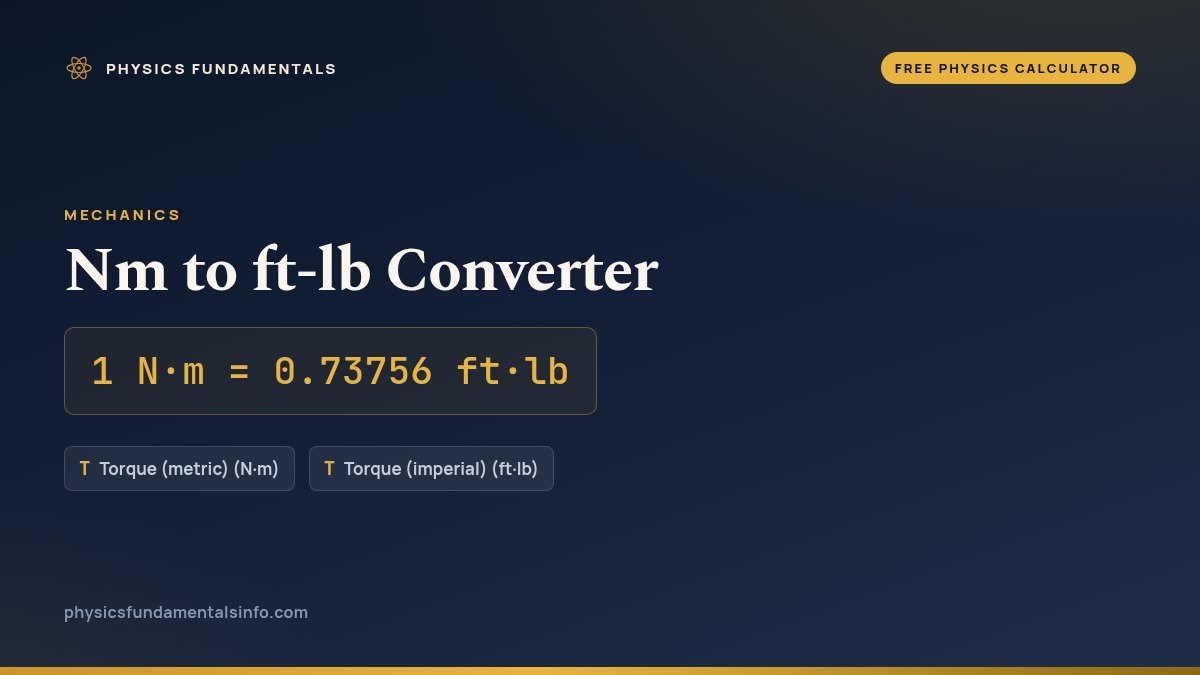
The nm to ft-lb converter is a free online tool built on the formula 1 N·m = 0.73756 ft·lb. Enter the values you already know, in whichever units suit you, and it solves for torque converted between metric and imperial units and shows every step of the substitution. Nm to ft-lb Converter is convert torque between newton-metres and foot-pounds, both ways.
| Symbol | Quantity | Default unit | Also accepts | Example value |
|---|---|---|---|---|
| T | Torque (metric) | N·m | kN·m, mN·m, kgf·m | 100 |
| T | Torque (imperial) | ft·lb | in·lb, ozf·in | — |
How to convert Nm to ft-lb
Torque is force times lever arm, so its units convert with the force and length factors together. One newton-metre equals 0.737562 foot-pounds, and one foot-pound equals 1.35582 newton-metres. These two factors are exact reciprocals of each other, so you never need to remember more than one of them.
To go from N·m to ft·lb, multiply by 0.737562; to go back, multiply by 1.35582. Enter a value in either box and the calculator gives the other, showing the working so you can check it by hand. On the metric side you can also work in kN·m, mN·m or kgf·m, and on the imperial side in in·lb or ozf·in — handy when a spec sheet mixes units.
Because torque and the moment of a force share the same physical definition, the same factors let you read across any turning-effect problem. If you want to compute a torque from a force and a distance rather than convert one, use the torque calculator; to relate torque to the rate of doing work, see the work and power calculator or look up the term in the physics glossary.
Worked example
Suppose a wheel-nut spec calls for 100 N·m. Converting to imperial units gives 100 × 0.737562 = 73.76 ft·lb, so a torque wrench reading in foot-pounds should be set to about 73.8. Going the other way, a 25 ft·lb setting from a US manual is 25 × 1.35582 = 33.9 N·m. And if a value is quoted in kilogram-force metres, a 1 kgf·m (kilogram-force metre) torque equals 9.80665 N·m, which is then 7.23 ft·lb.
Why it matters
Torque specifications appear in both unit systems — European service manuals use N·m while many US tools read in ft·lb (and smaller fasteners in in·lb). Torque wrenches, engine build specs and bolt tables all require confident conversion to avoid under- or over-tightening, either of which can strip a thread or leave a joint loose. Getting the same trade-off between force and distance right also underlies levers and gearing, covered by the mechanical advantage calculator.
Frequently asked questions
How do I convert Nm to ft-lb?
Multiply the newton-metre value by 0.737562. For example, 100 N.m = 73.76 ft.lb. This works because one newton-metre of torque equals 0.737562 foot-pounds.
How do I convert ft-lb to Nm?
Multiply the foot-pound value by 1.35582. For example, 50 ft.lb = 67.79 N.m. One foot-pound of torque equals 1.35582 newton-metres, the reverse of the Nm to ft-lb factor.
Is foot-pound the same as pound-foot?
For torque they are used interchangeably (lbf.ft) — the force in pounds acting on a lever arm in feet. Note that "foot-pound" as an energy unit is the same size numerically but describes a different physical quantity, so keep torque and energy separate.
What about inch-pounds (in-lb)?
1 ft.lb = 12 in.lb, and 1 N.m = 8.8507 in.lb. Small fasteners are often specified in inch-pounds because a foot-pound would be too coarse a unit for a delicate screw.
Is this the same as a car's torque converter?
No. A torque converter is a fluid coupling inside an automatic gearbox that transmits engine torque to the transmission. This page only converts torque units between N.m and ft.lb, and does nothing to do with transmission parts.
References & formula source
- Young & Freedman — University Physics with Modern Physics, §10.1 (Torque).
- NIST Special Publication 811 — Guide for the Use of the SI (unit conversion factors).
- Bosch Automotive Handbook — units and tightening torques.
- Further reading: Torque — Wikipedia