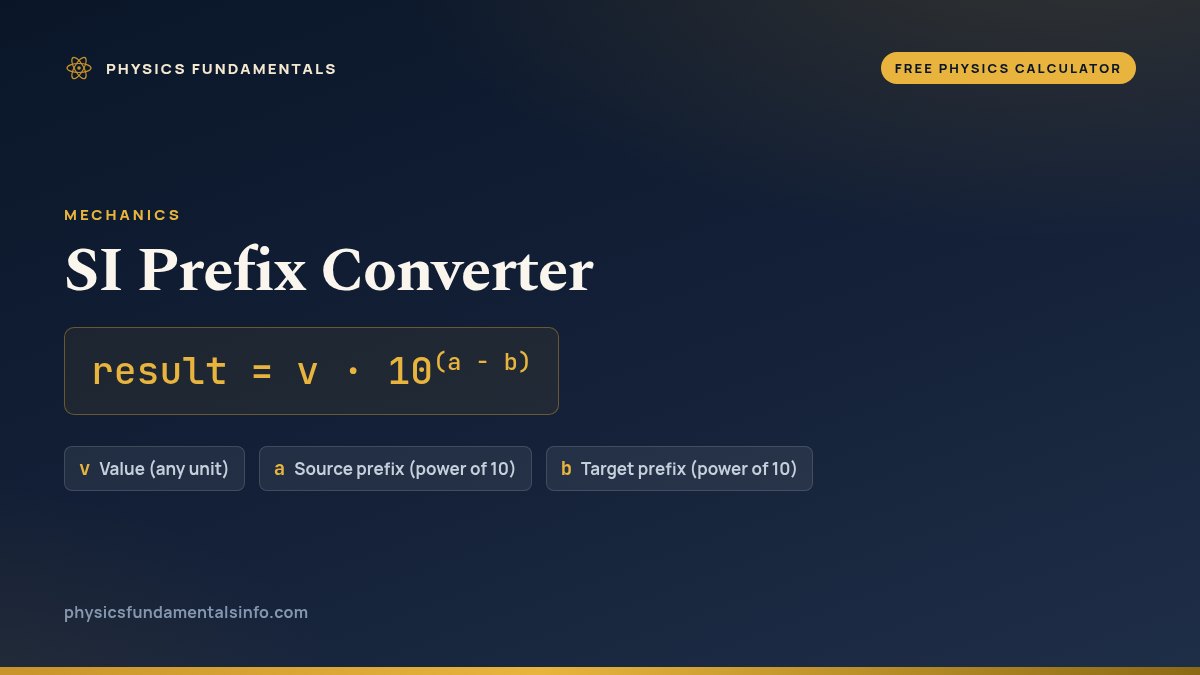
An SI prefix multiplies a unit by a power of ten, so re-expressing a quantity in a different prefix is a subtraction of exponents: result = v · 10(a - b), where a is the exponent of the prefix you have and b the one you want. Enter a value, pick the two prefixes, and read the same quantity under its new name.
What Is the SI Prefix Converter?
The SI prefix converter is a free online tool built on the formula result = v · 10(a - b). Enter the values you already know, in whichever units suit you, and it solves for a value re-expressed in a different SI prefix and shows every step of the substitution. Convert a value between any two SI prefixes, quetta to quecto, or straight to the coherent SI unit.
| Symbol | Quantity | Default unit | Also accepts | Example value |
|---|---|---|---|---|
| v | Value | any unit | — | 4.7 |
| a | Source prefix | power of 10 | — | -6 |
| b | Target prefix | power of 10 | — | -9 |
How to convert between SI prefixes
Every SI prefix is a pure power of ten, which is what makes this arithmetic so much simpler than converting between unit systems. Write the prefix you have as 10a and the one you want as 10b; the quantity itself is unchanged, so the number in front must absorb the whole difference. That gives result = v · 10(a - b) and nothing else. There is no lookup table to memorise and no division by a user-supplied number anywhere, so the calculation cannot fail on a bad input.
Because it is a subtraction, the conversion is exactly reversible. Swap a and b, feed the answer back in, and you land on the number you started with. It also tells you which direction the number moves: converting to a smaller prefix (nano is smaller than micro) makes the number bigger, because you need more of a smaller thing. Students who go the wrong way are almost always subtracting the exponents in the wrong order.
Two dropdowns cover all 24 prefixes, from quetta at 1030 down to quecto at 10-30. Selecting one fills the exponent box beside it, so the power of ten stays visible rather than hidden behind a name. Set the target to no prefix to land on the coherent SI unit, which is the form every formula in physics actually wants. If you would rather watch the whole ladder at once, the SI units simulator slides a marker along it, and the full guide to SI units covers the base units and the 2019 redefinition behind them.
Worked example
A semiconductor feature is quoted as 4.7 µm and you need it in nanometres. Micro is 10-6 and nano is 10-9, so a - b = -6 - (-9) = 3 and the conversion is 4.7 · 103 = 4700 nm. The number grew by a thousand because the unit shrank by a thousand.
Going the other way is the same sum with the exponents swapped: 4700 · 10(-9 - (-6)) = 4700 · 10-3 = 4.7 µm, back where you started. And to reach the coherent unit, set the target to no prefix: 2.5 km becomes 2.5 · 10(3 - 0) = 2500 m, which is the figure you would substitute into an equation.
Why it matters
Nearly every formula in physics is written for coherent SI units, and feeding it a prefixed number is the most common source of answers that are wrong by exactly a thousand. A capacitance in microfarads, a wavelength in nanometres or a current in milliamperes all have to be converted before they go anywhere near an equation — and a mass in grams has to be converted twice, because the coherent unit of mass is the kilogram rather than the gram. Getting the exponent bookkeeping right also underpins the unit work in the density calculator and the cross-system conversions in the Nm to ft-lb converter.
Frequently asked questions
What does an SI prefix actually do to the number?
It multiplies the unit by a power of ten, which divides the number in front by the same amount. A prefix changes nothing physical: 4.7 micrometres and 4700 nanometres are the same length written two ways. Because both prefixes are pure powers of ten, converting between them is a subtraction of exponents rather than a lookup, which is why one formula covers all 24 of them.
Why does the kilogram need special handling?
Because the kilogram is the only SI base unit whose name already carries a prefix. Prefixes attach to the gram, not to the kilogram, so you write milligram and megagram, never microkilogram. The practical effect is a shift of three: a mass sitting at 10^n on the gram ladder is 10^(n-3) kilograms, and the kilogram itself lives at 10^3 rather than at 10^0.
Which exponents have no prefix name?
Most of them. Above 10^3 the prefixes jump in steps of three, so 10^4, 10^5, 10^7, 10^8 and every other non-multiple of three has no name at all. The same is true going down past 10^-3. Only the region right around the unit is dense: hecto 10^2, deca 10^1, deci 10^-1 and centi 10^-2 fill in the gaps there. A value at 10^4 must be written in scientific notation, or shifted to kilo and given a bigger number in front.
How do I convert a squared or cubed unit, such as cm² to m²?
Raise the conversion factor to the same power as the unit. Centi is 10^-2, so 1 cm = 10^-2 m, but 1 cm² = (10^-2)² m² = 10^-4 m², and 1 cm³ = 10^-6 m³. This is the single most common mistake in unit work: people apply 10^-2 to an area and land a factor of 100 out. To use this converter on an area, double the exponent you would have used for the length; for a volume, triple it.
How do I go straight to the coherent SI unit?
Set the target prefix to "no prefix", which is 10^0. That returns the value in the unprefixed base unit — metres, seconds, amperes — which is the form every physics formula expects. The one exception is mass, where the coherent SI unit is the kilogram rather than the gram, so a result in grams still needs dividing by a thousand before it goes into an equation.
References & formula source
- Bureau International des Poids et Mesures — The International System of Units (SI), 9th edition, chapter on decimal multiples and submultiples of SI units.
- NIST Special Publication 811 — Guide for the Use of the International System of Units (SI), sections on prefixes and on rules for writing unit symbols.
- NIST Special Publication 330 — The International System of Units (SI), the US edition of the SI Brochure.
- Further reading: Metric prefix — Wikipedia