The center of mass is the mass-weighted average position of a set of masses — the single point that behaves as though the whole system's mass were concentrated there. Drag the sliders below to set three masses and where they sit, and watch the balance point move.
Finding the Center of Mass
Three masses sit on a plane. Move them, or change how heavy they are, and the gold cross tracks the mass-weighted average of their positions — which is very often a spot where nothing actually is.
Mass 1
Mass 2
Mass 3
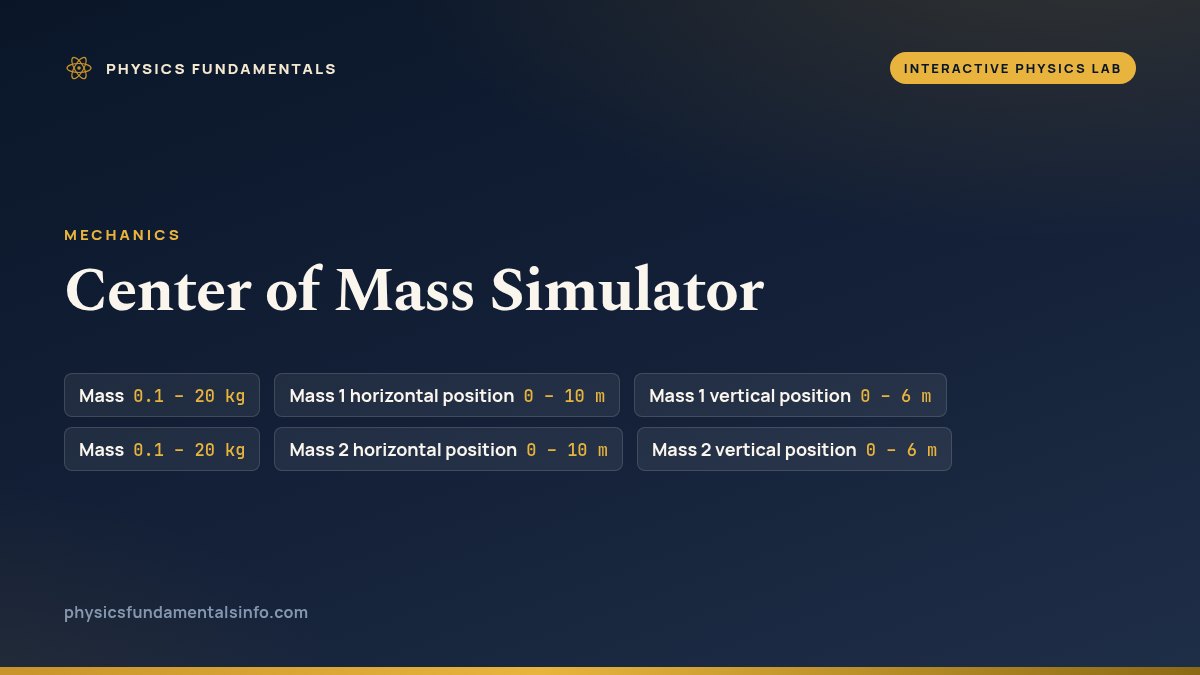
What Is the Center of Mass Simulator?
The center of mass simulator is a free interactive physics lab that runs in your browser — nothing to install and no sign-up. Slide three masses and watch the balance point move as x_cm = Sum(m*x)/Sum(m) updates live. Test it in your browser. It reports center of mass xcm as you drag the sliders.
| Control | Range | Step |
|---|---|---|
| Mass | 0.1 – 20 kg | 0.1 |
| Mass 1 horizontal position | 0 – 10 m | 0.1 |
| Mass 1 vertical position | 0 – 6 m | 0.1 |
| Mass | 0.1 – 20 kg | 0.1 |
| Mass 2 horizontal position | 0 – 10 m | 0.1 |
| Mass 2 vertical position | 0 – 6 m | 0.1 |
| Mass | 0.1 – 20 kg | 0.1 |
| Mass 3 horizontal position | 0 – 10 m | 0.1 |
| Mass 3 vertical position | 0 – 6 m | 0.1 |
Using the center of mass simulator
Nine sliders drive the lab, three for each disc. The mass slider changes how strongly that disc pulls the balance point — think of it as how much say that disc gets in the final answer — while the two position sliders move it around the plane. Nothing is animated on a timer and nothing is hidden: the readouts marked xcm and ycm are the mass-weighted averages, recomputed from all three discs on every single change, with the running total mass shown underneath.
What the live readouts prove is worth walking through deliberately. Set all three masses equal and the cross settles at the plain average of the three positions, the centroid of the triangle they form. Now make one mass dominate and the cross snaps almost onto it, because the other two barely register in the sum. Finally, arrange the discs in a wide ring-like triangle and watch the cross land in the empty middle, where there is no matter at all. That is the idea that the center of mass can sit outside the object, made tangible in about ten seconds of sliding.
The formula the sim solves is xcm = Sum(m*x) / Sum(m), with the identical expression in y for the vertical axis. Each mass multiplies its own coordinate, the products are added, and the total is divided by the combined mass. Because every disc is held at a minimum of 0.1 kg, the denominator is always positive, so the tool never divides by zero and never returns a broken reading. To run the same arithmetic on your own numbers rather than by dragging, the center of mass calculator takes the values directly.
The misconception this corrects is the assumption that the center of mass is simply the geometric middle of an arrangement. Drag mass onto one side and the cross follows the mass, not the shape. That distinction matters well beyond the diagram: it is the reason a system's center of mass keeps moving smoothly unless an external force acts on it, the principle behind conservation of momentum, and the reason a wrench spun across a table tumbles about one specific point.
Frequently asked questions
What does the center of mass simulator calculate?
It computes the mass-weighted average position of the masses you place, updating the x and y coordinates of the center of mass live. Every time you move a disc or change how heavy it is, both coordinates are recalculated from scratch and the gold cross glides to the new balance point.
Why does the balance point move toward the heavier mass?
Because each position is weighted by its mass in the sum, so a larger mass contributes more to the average. A 20 kg disc pulls the result roughly two hundred times harder than a 0.1 kg one, which is why pushing a single slider to the top drags the cross almost on top of that disc.
Can the marked center of mass sit where there is no disc?
Yes; with masses spread around a gap the average lands in empty space between them. That is the point the simulator is built to make, and it is why a doughnut, a boomerang or a high jumper arching over the bar can all have a center of mass outside their own material.
What formula is the simulator using?
x_cm = Sum(m*x)/Sum(m), and the same expression with y for the vertical axis. The numerator adds up each mass multiplied by its coordinate, and the denominator is the total mass, which the tool keeps above zero so the division is always defined.
Does the simulator handle equal masses?
Yes; equal masses place the center of mass at the plain geometric average (the centroid) of their positions. Set all three sliders to the same value and the weighting drops out of the formula entirely, leaving the ordinary average of the three coordinates.
References & formula source
- Halliday, Resnick & Walker — Fundamentals of Physics, Chapter 9 (Center of Mass and Linear Momentum).
- Young & Freedman — University Physics with Modern Physics, §8.5 (Center of Mass).
- R. Nave — HyperPhysics, Georgia State University, "Center of Mass" section.
- Further reading: Center of mass — Wikipedia