Center of gravity physics identifies the single point through which an object’s entire weight can be treated as acting. In uniform gravity it coincides with the center of mass, the mass-weighted average position given by xCG = Σmixi / Σmi. An object balances while this point stays above its base of support and topples once it moves beyond it.
Stand with your heels and back pressed against a wall, then try to touch your toes without bending your knees. You will tip forward every single time.
Normally your hips shuffle backward to compensate as your head goes down; the wall steals that move, your weight drifts past your toes, and gravity wins. One invisible point just decided your fate — and learning to read it is what this guide is about.
What Is the Center of Gravity?
Balance a pencil across your finger and slide it around until it rests level. Congratulations: you have just located a center of gravity by hand.
Gravity does not pull on an object in one tidy place. It tugs on every particle separately — every gram of wood and graphite in that pencil. The center of gravity (CG) is the one special point where all of those tiny pulls combine into a single resultant force: the object’s weight.
Support an object exactly at its CG and the weight produces no turning effect at all, so it sits perfectly balanced. NASA’s Glenn Research Center describes it as the average location of an object’s weight — and pinning that location down is one of the first jobs in designing any aircraft, because a plane in flight rotates about its CG.
For a uniform, symmetric object the answer is easy: the CG sits at the geometric center. A plain ruler balances at its halfway mark. Things only get interesting when the mass is spread unevenly — which is most of the real world.
Center of Gravity vs Center of Mass: What’s the Difference?
Here is the honest answer up front: for everything you will ever lift, throw, or trip over, they are the same point. The distinction only matters at extreme scales — but knowing why sharpens both ideas.
The center of mass is a property of the object alone. It is the mass-weighted average position of all the matter, and it exists whether or not any gravity is present.
The center of gravity is the weight-weighted average instead, so it needs a gravitational field to be defined at all. When gravity is uniform — the same strength everywhere across the object — the field cancels out of the average and the two points coincide exactly. That is why physicists treat the terms as synonyms in a uniform field, and why your textbook quietly switches between them.
They separate only when gravity itself changes measurably from one end of the object to the other. Even a uniform tower a full kilometer tall would carry its CG barely a few centimeters below its center of mass, because the lower floors sit in slightly stronger gravity. For a book, a bus, or a bridge, the gap is unmeasurable.
| Aspect | Center of mass | Center of gravity |
|---|---|---|
| What it averages | Mass — how matter is distributed | Weight — mass × local gravity |
| Needs gravity to exist? | No — defined for any object, anywhere | Yes — defined only in a gravitational field |
| What it governs | Motion: F = Ma, momentum, collisions | Balance: the weight’s line of action, torque, tipping |
| When they coincide | Whenever g is uniform across the object — effectively every everyday case | |
| When they differ | Only when g varies over the object itself — kilometer-scale structures, orbiting bodies | |
A common student slip is panicking over which term an exam wants. Unless the question involves a non-uniform field — planets, enormous structures, orbital mechanics — either term earns the mark.
The Center of Mass Formula
How do you calculate the balance point when the mass is lumpy? Treat the object as a set of pieces, then take a weighted average of their positions — heavier pieces count for more.
- xCG — position of the center of gravity, in meters (m), measured from any reference point you choose
- m1, m2, … mn — masses of the individual pieces, in kilograms (kg)
- x1, x2, … xn — positions of those pieces, in meters (m), from the same reference point
- Strict CG version: replace each mass with its weight wi = migi, in newtons (N); when g is the same everywhere it cancels — which is exactly why the CG and the center of mass agree
The reference point is your free choice: the left end, the wall, the origin of a graph. Change it and every x changes, but the physical balance point stays put.
Working in two or three dimensions? Run the same average once per axis to get yCG and zCG. For a continuous object rather than separate lumps, the sum grows into an integral:
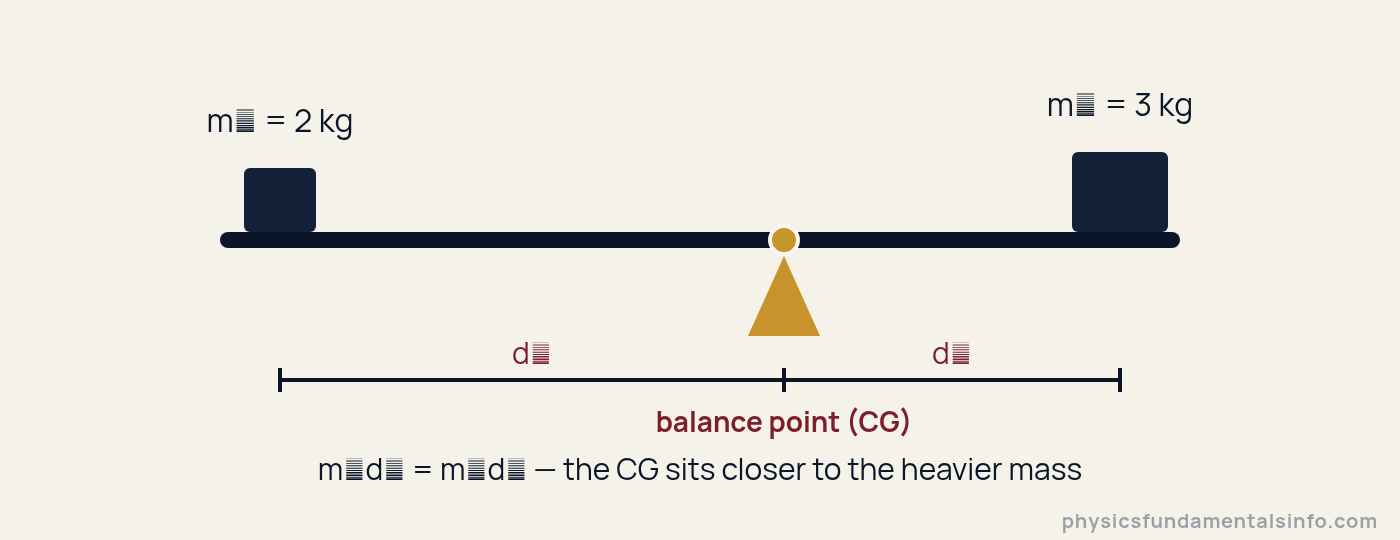
The lever arms are in inverse ratio to the masses: m1d1 = m2d2.
Notice what the two-mass picture shows: the balance point always lands between the masses, pulled toward the heavier one in exact inverse proportion to the arms. That single fact powers every problem at the end of this article.
How to Find the Center of Gravity
Three practical routes, from pen-and-paper to string-and-pin. Pick whichever suits the object in front of you.
Method 1: Symmetry and calculation
Uniform and symmetric? The CG lies on every line of symmetry — dead center for a rectangle, a sphere, or a plain rod. For composite objects, treat each simple part as a point mass sitting at its own CG, then feed those into the formula above.
Engineers locate an aircraft’s CG exactly this way: wings, engines, fuel, and payload each contribute a weight-times-distance term, summed and divided by the total weight.
Method 2: The plumb-line method (irregular flat shapes)
- Punch a small hole near the edge of the shape and hang it from a pin so it swings freely.
- Hang a plumb line — a weighted string — from the same pin.
- Wait for everything to settle, then trace the string’s line onto the shape.
- Repeat from a second hole in a different spot.
- The center of gravity sits where the two lines cross. A third line makes a satisfying check: it should pass through the same point.
Why it works: a freely hanging object rotates until its CG lies directly below the support, so the tension force in the string and the object’s weight act along one vertical line. Draw that line from two different points and the CG must sit on both.
Method 3: The balance method
Balance the object on a fingertip, a knife edge, or a rod. The support point — or line — passes through the CG. For a flat sheet, balance it along two different lines; the crossing point is your answer.
In practice, a card balanced near its CG feels oddly indecisive: it wobbles slowly rather than falling. That mushy response is your signal that you are within a millimeter or two of the true point.
Balance, Stability and the Base of Support
Now for the payoff — predicting falls. Every balance question reduces to two geometric players: the CG and the base of support.
The base of support is the outline traced around every contact point with the ground. Stand on two feet and it is not just your soles; it includes the strip of floor between them. Widen your stance and the base grows without your feet growing at all.
Standing still is really Newton’s first law of motion at work: you remain at rest only while all forces and all turning effects cancel. Weight, acting at the CG, supplies the turning effect that matters here.
The rule: drop an imaginary vertical line from the center of gravity. While that line lands inside the base of support, gravity’s torque rotates the object back down onto its base. The instant the line crosses the edge, the same torque flips direction — and tips the object over.
Everything in this article compresses into five rules worth memorizing:
- Gravity pulls on every particle, but you can treat the whole weight as one force acting at the center of gravity.
- An object balances while the vertical line through its CG passes inside its base of support.
- It topples the moment that line crosses the edge of the base — no exceptions.
- Lowering the CG lets an object tilt further before the line escapes, so a low CG means more stability.
- Widening the base does the same job from the other side: more tilt allowed before the fall.
For a uniform block tilted about one edge, the critical tilt angle follows straight from that geometry:
- θc — critical tilt angle, in degrees (°): tilt past it and the block topples
- b — width of the base, in meters (m)
- h — height of the center of gravity above the base, in meters (m)
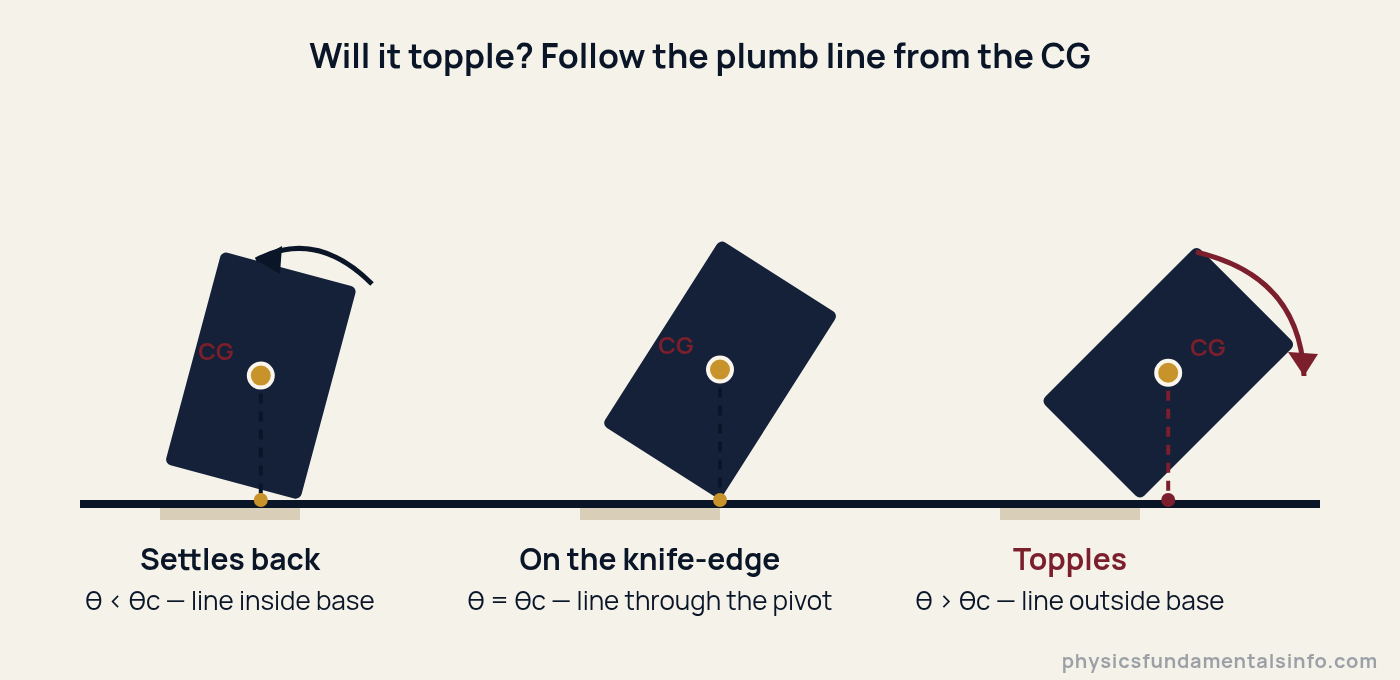
Tip a block and its fate hangs on one question: does the vertical line through the CG still fall inside the base of support?
Physicists sort balanced states into three flavors, judged by what a small tilt does to the CG’s height.
Stable: the tilt raises the CG, so the object drops back — a cone resting on its base. Unstable: the tilt lowers the CG, so it keeps falling — a cone poised on its tip. Neutral: the CG height never changes — a ball on a flat floor rolls but never rights itself or topples.
Play with the trade-off yourself: stretch the base, raise the load, and watch the critical angle move.
Center of Gravity Physics in the Real World
Once you know what to look for, you see this point being managed everywhere — by athletes, engineers, and your own nervous system.
The high jumper whose CG passes under the bar
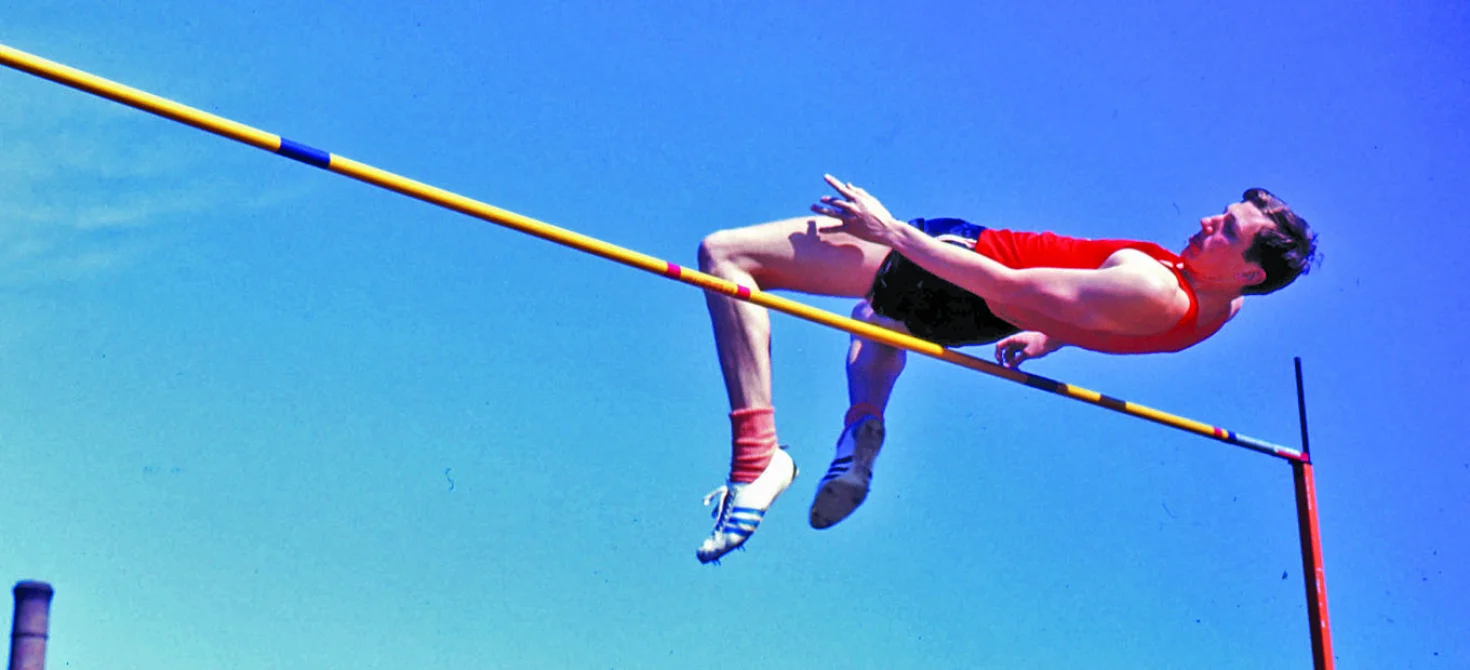
The Fosbury flop looks theatrical, but it is applied physics. By arching backward over the bar, the jumper drapes their mass so the body’s CG sits outside the body, in the hollow beneath the arch — and that point can pass below a bar the body clears above.
Once the feet leave the ground, no mid-air wriggle can steer that point. The CG of any airborne body follows the same curved arc as a ball in a projectile motion problem; the flop simply arranges the body around that fixed arc as efficiently as possible.
Racing cars, SUVs, and the rollover problem
A race car hugs the tarmac because its designers pushed b up and h down in the tipping formula: a wide track plus a CG barely above the road gives an enormous critical angle. A tall, narrow SUV inverts both numbers — and loading cargo onto the roof raises h further still, which is why roof loads measurably increase rollover risk in sharp turns.
Cranes and their counterweights
Watch a tower crane lift and you are watching CG management in slow motion. The concrete blocks on the short arm are movable ballast that drags the combined CG of crane-plus-load back over the base, and operators obey strict load-versus-reach charts because the geometry is unforgiving: reach too far and the plumb line from the CG simply walks off the support.
Balancing toys and tightrope walkers
A toy bird that balances on its beak hides curved, weighted wings that pull the whole system’s CG below the support point. Nudge it and the CG rises, so gravity swings it straight back — stable equilibrium by design.
Tightrope walkers chase the same trick with a long, drooping pole. The sagging ends bring the combined CG down toward the wire, and the pole’s sheer rotational sluggishness slows every wobble enough to correct it.
Your own body, constantly recalculating
Rise from a chair and you lean forward first — not habit, necessity. Seated, your CG hangs behind your feet; the lean carries its plumb line over your new base before your legs push.
Carry a heavy backpack and you tilt forward; hold a suitcase in one hand and you lean the other way. Your body solves center of gravity physics dozens of times a minute without telling you.
Common Misconceptions About the Center of Gravity
Four wrong beliefs cause most of the mistakes on this topic. Clear them out now.
Misconception 1: “The CG must be inside the object”
A donut’s CG floats in the hole. A boomerang’s sits in the empty angle between its arms, and an L-shaped plate’s can lie just off the material entirely — worked problem 4 below proves it with numbers.
The CG is a mathematical average of positions, and averages are free to land where no mass exists.
Misconception 2: “An object’s CG is fixed forever”
It is fixed only while the shape and loading are fixed. Crouch and your CG drops; raise both arms and it climbs several centimeters; an airliner’s CG creeps as fuel burns, which is why crews calculate weight and balance before every departure.
Misconception 3: “Heavier means harder to tip over”
Look back at the critical-angle formula: mass appears nowhere. Base width and CG height alone set the tipping angle, because weight powers the restoring torque and the toppling torque equally.
A heavier wardrobe does demand a bigger push to start tilting — but once past the same critical angle, it goes over just like a light one.
Misconception 4: “Centroid, center of mass — same thing”
The centroid is the average position of an object’s geometry; the center of mass weights that average by density. They match only when the density is uniform.
A hammer makes the difference tangible: its geometric middle sits halfway up the handle, yet it balances just below the steel head.
How the Center of Gravity Connects to Other Mechanics Ideas
The CG is not an isolated curiosity; it is the hinge between several of the biggest ideas in mechanics.
Torque. Weight acting at the CG, multiplied by its horizontal distance from a pivot, is the moment that tips, rights, or balances everything in this article. Every stability argument above was secretly a torque argument.
Force and motion. Slide a spinning wrench across the ice and, however wild the tumble looks, its center of mass obeys Newton’s second law as if the wrench were a single point. That one simplification is why physics can treat planets, cars, and people as dots.
Momentum. In an isolated system the center of mass never accelerates. A firework shell explodes into a hundred sparks, yet the cloud’s center of mass keeps gliding along the original arc — conservation of momentum wearing different clothes.
Rotation. Watch a hammer thrower lean back as they spin: athlete and hammer whirl about their shared center of mass, with the wire supplying the centripetal force. The lean keeps that shared point planted over the thrower’s feet.
Gravitation. Even the Moon does not orbit the Earth’s middle. Both bodies circle their common center of mass — a point you will locate yourself in the final worked problem.
Worked Problems
Seven problems, easiest first. Cover the solutions and attempt each one before reading on — the method is identical every time: choose a reference point, take moments, divide by the total.
Show Solution
Solution:
Step 1: Place the reference at the 2.0 kg mass and use xCG = (m1x1 + m2x2) / (m1 + m2). The rod itself is light, so it contributes nothing.
Step 2: xCG = (2.0 kg × 0 m + 3.0 kg × 1.0 m) / (2.0 kg + 3.0 kg)
Step 3: xCG = 3.0 kg·m / 5.0 kg = 0.60 m
Answer: 0.60 m from the 2.0 kg mass (2 s.f.) — closer to the heavier end, as expected.
Show Solution
Solution:
Step 1: The uniform ruler acts as a point mass at its own CG, the 0.50 m mark. Take moments about the 0 m end: xCG = Σmixi / Σmi.
Step 2: Σmixi = (0.10 kg × 0.50 m) + (0.20 kg × 0.20 m) + (0.30 kg × 0.80 m) = 0.050 + 0.040 + 0.240 = 0.330 kg·m
Step 3: Total mass = 0.10 + 0.20 + 0.30 = 0.60 kg, so xCG = 0.330 kg·m / 0.60 kg = 0.55 m
Answer: at the 0.55 m mark (2 s.f.) — the loaded ruler balances there, not at 0.50 m.
Show Solution
Solution:
Step 1: Apply the weighted average once per axis. Total mass M = 1.0 + 2.0 + 3.0 = 6.0 kg.
Step 2: xCM = (1.0 × 0 + 2.0 × 4.0 + 3.0 × 0) kg·m / 6.0 kg = 8.0 / 6.0 = 1.33 m. yCM = (1.0 × 0 + 2.0 × 0 + 3.0 × 4.0) kg·m / 6.0 kg = 12.0 / 6.0 = 2.0 m.
Step 3: Combine the two components into one position.
Answer: (1.3 m, 2.0 m) to 2 s.f. — pulled toward the two heavier masses.
Show Solution
Solution:
Step 1: A uniform sheet’s mass is proportional to area, so use areas as the “masses”. Horizontal strip: area A1 = 0.30 × 0.10 = 0.030 m2, centroid at (0.15 m, 0.05 m). Vertical strip: A2 = 0.10 × 0.20 = 0.020 m2, centroid at (0.05 m, 0.20 m).
Step 2: xCG = (0.030 × 0.15 + 0.020 × 0.05) / 0.050 = 0.0055 / 0.050 = 0.11 m. yCG = (0.030 × 0.05 + 0.020 × 0.20) / 0.050 = 0.0055 / 0.050 = 0.11 m.
Step 3: Check the point (0.11 m, 0.11 m) against the plate: the horizontal strip only reaches y = 0.10 m and the vertical strip only reaches x = 0.10 m — so this point lies in the empty notch of the L.
Answer: (0.11 m, 0.11 m) — just outside the material itself, proving a CG needs no mass underneath it.
Show Solution
Solution:
Step 1: The ruler’s whole weight acts at its CG, the 0.50 m mark. For balance, the moments about the pivot must cancel: m g d1 = mruler g d2 — and g cancels from both sides.
Step 2: Lever arms from the 0.20 m pivot: unknown mass, d1 = 0.20 − 0.05 = 0.15 m; ruler’s weight, d2 = 0.50 − 0.20 = 0.30 m. So m × 0.15 m = 0.080 kg × 0.30 m.
Step 3: m = 0.024 kg·m / 0.15 m = 0.16 kg
Answer: 0.16 kg (160 g), to 2 s.f.
Show Solution
Solution:
Step 1: The box topples when the vertical line through its CG passes over the pivot edge. That happens at the critical angle tan θc = (b/2) / h.
Step 2: tan θc = (0.40 m / 2) / 0.50 m = 0.20 / 0.50 = 0.40
Step 3: θc = arctan(0.40) = 21.8°
Answer: about 22° (2 s.f.). Halve the CG height and the safe angle nearly doubles — the whole logic of the low-slung race car.
Show Solution
Solution:
Step 1: Put the origin at the Earth’s center. Then xCM = mMoon d / (mEarth + mMoon).
Step 2: xCM = (7.35 × 1022 kg × 3.84 × 108 m) / (5.97 × 1024 kg + 7.35 × 10²² kg) = 2.82 × 1031 kg·m / 6.04 × 1024 kg
Step 3: xCM = 4.67 × 10⁶ m ≈ 4,670 km
Answer: 4.67 × 10⁶ m (3 s.f.) from the Earth’s center — inside the Earth, since its radius is about 6,370 km. Both bodies orbit this buried point.