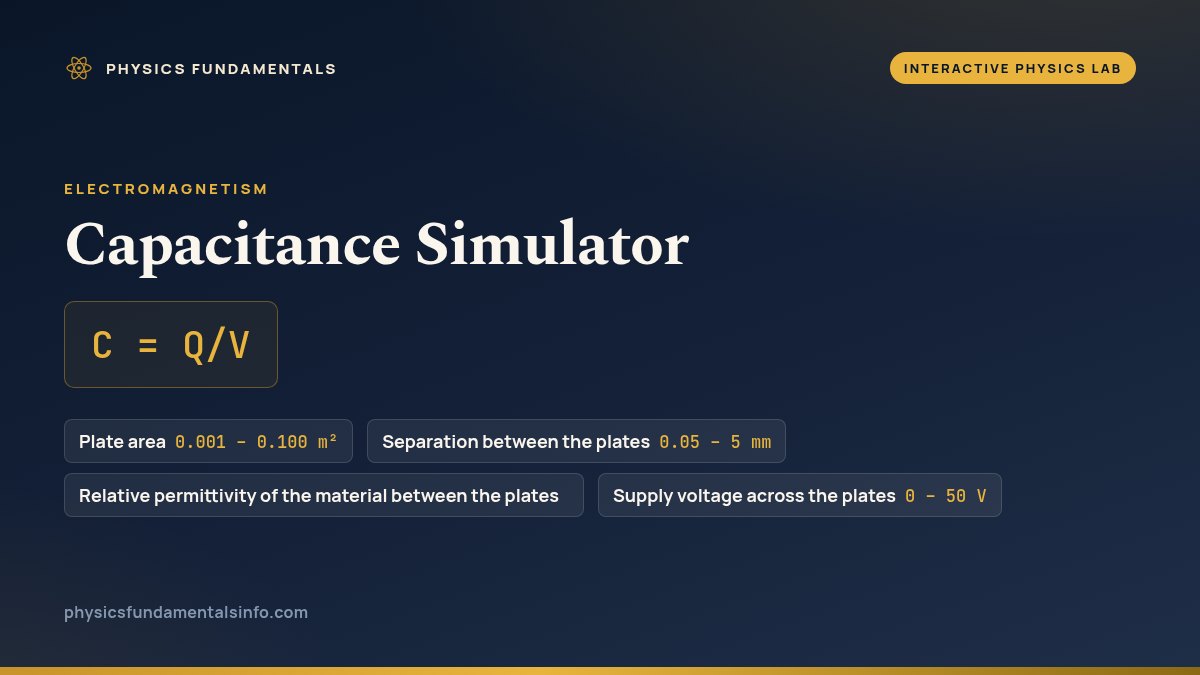
Capacitance is how much charge a pair of plates holds per volt across them, C = Q/V, and for a parallel-plate capacitor it is fixed by geometry: C = ε0εrA/d. Drag the sliders below to change the plate area, gap, dielectric and supply voltage, and watch the capacitance, stored charge, stored energy and field strength respond in real time.
Capacitance of a Parallel-Plate Capacitor
Bigger plates and a narrower gap store more charge at the same voltage. Change the geometry, slide in a dielectric, and watch C, Q and U move — while the field E = V / d stays exactly where the voltage and gap put it.
What Is the Capacitance Simulator?
The capacitance simulator is a free interactive physics lab that runs in your browser — nothing to install and no sign-up. Drag plate area, gap and dielectric to see capacitance, charge and stored energy update live from C = Q/V. No sign-up. It reports capacitance, stored charge, stored energy and field strength as you drag the sliders.
| Control | Range | Step |
|---|---|---|
| Plate area | 0.001 – 0.100 m² | 0.001 |
| Separation between the plates | 0.05 – 5 mm | 0.01 |
| Relative permittivity of the material between the plates | 1 – 10 | 0.1 |
| Supply voltage across the plates | 0 – 50 V | 0.5 |
Four Sliders, and the One Readout That Refuses to Move
Take the panel a slider at a time. Plate area is the straightforward one: widen the plates on the canvas and the capacitance rises in step, because there is more surface for charge to sit on. Plate gap works the other way and works harder, since it sits underneath the fraction — squeeze the plates from 1.00 mm down to 0.10 mm and the capacitance goes up tenfold. Supply voltage does not touch the capacitance at all; it decides how much charge that fixed capacitance collects. The dielectric slider is the one worth lingering over.
Raise the dielectric from 1 to 4 and three readouts jump while a fourth sits perfectly still. Capacitance, stored charge and stored energy all multiply by four; field strength does not move a hair. That is not a bug in the model — the field readout is E = V/d, and a slab of plastic changes neither the supply voltage nor the separation. Watch the canvas as you drag: the field lines keep identical spacing, but extra charge symbols crowd onto the plates and a shaded slab appears carrying bound charge along each face. The material lets more free charge pile up for the same push.
Underneath, the simulator is solving two expressions and nothing more. Capacitance comes from C = ε0εrA/d, using the CODATA value of the vacuum permittivity printed under the sliders, and the energy readout comes from U = ½CV². Because voltage appears squared there but only once in Q = CV, dragging the voltage slider makes energy climb visibly faster than charge — double the volts and charge doubles while energy quadruples. To run those numbers on a capacitor of your own, the capacitance calculator solves the same relationships for whichever quantity you leave blank.
The habit this lab is built to break is treating capacitance as something the power supply decides. Sweep the voltage slider from 0 V to 50 V and watch the top readout: it never budges. Capacitance belongs to the plates — their area, their spacing, the stuff between them — and would be the same number with nothing connected. C = Q/V defines it as a ratio, and raising the potential difference raises the charge by the same factor, so the ratio stands still. For what the field readout is tracking, the electric field guide covers field strength between two charged surfaces, and the electric current guide picks up what happens when that stored charge is finally allowed to flow.
Frequently asked questions
What does the dielectric slider do in the capacitance simulator?
It sets the relative permittivity of the material filling the gap, written er. Air is 1, so nothing changes there; slide up to 4 and the capacitance readout multiplies by 4, and the stored charge and stored energy follow it. The material lets the plates hold more charge at the same voltage, because its own molecules line up and partly cancel the field the free charge would otherwise produce. The banner under the capacitance readout keeps score of that multiple against a vacuum gap.
Why does the energy readout change faster than the charge readout when I raise the voltage?
Charge is Q = C x V, so it tracks voltage in a straight line: double the voltage slider and the charge readout doubles. Energy is U = 0.5 x C x V x V, so voltage enters twice and the energy readout quadruples for that same doubling. Watch the two numbers together as you drag the voltage slider from 12 V to 24 V. The gap between linear and square is the reason a capacitor rated a little below its working voltage fails so much harder than the numbers suggest.
Why does the plate gap have such a big effect?
The gap sits in the denominator of C = e0 x er x A / d, so it works in inverse. Halving the gap doubles the capacitance, while widening it from 0.10 mm to 1.00 mm cuts the capacitance to a tenth. The gap also sets the field, E = V / d, so a narrow gap raises both at once. That is why real capacitors chase the thinnest insulating layer their working voltage will survive, and why the simulator refuses to let the gap reach zero.
What happens to the field when I add a dielectric?
Nothing, as long as the voltage stays fixed. The field readout is E = V / d, and a dielectric changes neither the supply voltage nor the plate separation, so it holds steady while the capacitance, charge and energy readouts all climb. Slide the dielectric from 1 to 10 and watch the field figure sit still. The field lines drawn between the plates keep exactly the same spacing too, while extra charge symbols appear on the plates.
Does capacitance depend on the voltage I apply?
No, and the simulator is built to prove it. Drag the voltage slider across its whole range and the capacitance readout does not move at all, while charge and energy respond immediately. Capacitance is fixed by geometry and material alone, so only the area, gap and dielectric sliders touch it. The familiar C = Q / V is a definition rather than a dependence: raising V raises Q by exactly the same factor, leaving their ratio where it was.
References & formula source
- Halliday, Resnick & Walker — Fundamentals of Physics, Chapter 25 (Capacitance), parallel-plate capacitors and dielectrics.
- Young & Freedman — University Physics with Modern Physics, §24.1–24.4 (Capacitors, Energy Storage and Dielectrics).
- R. Nave — HyperPhysics, Georgia State University, "Capacitance" / parallel plate capacitor section.
- CODATA 2022 recommended value of the vacuum electric permittivity, e0 = 8.8541878188e-12 F/m (NIST).
- Further reading: Capacitance — Wikipedia