Lenz’s law says that an induced current always flows in the direction whose own magnetic field opposes the change in flux that produced it. It is the minus sign in Faraday’s law: the rate of flux change fixes the size of the induced EMF, and Lenz’s law fixes its direction.
Hold a magnet near a coil of wire and nothing at all happens. Push it towards the coil and a current appears in the wire — and the magnet starts pushing back, as though the coil had grown a pole to meet it.
Pull the magnet away again and every direction reverses, yet the magnet still resists you. That stubbornness is not friction and it is not a coincidence. It is the rule that keeps induction from being a source of free energy, and it is exactly what the minus sign in Faraday’s law is doing there.
What Is Lenz’s Law?
Lenz’s law states that an induced current flows in whichever direction its own magnetic field opposes the change in flux that created it.
One word in that sentence carries all the weight: change. The induced current does not oppose the magnetic field. It opposes the change in the flux threading the circuit, which is a different claim altogether.
A steady field induces nothing, however strong it is. Park the most powerful magnet you own inside a coil and leave it there for a year; the flux through that coil is large and utterly constant, and not one electron is pushed round the loop.
- The trigger is a change of flux. Magnetic flux is the amount of magnetic field threading the loop, counted with a sign. Move a magnet, rotate the coil, squash it, or vary the field, and the flux changes.
- The response always fights the trigger. The induced current makes a field of its own, and that field points whichever way slows the change down: against the existing flux while it grows, along it while it shrinks.
- No change means nothing at all. No changing flux, no EMF, no current, no force. This is the single most common slip students make on this topic.
The rule is named after Heinrich Lenz, who set it out in the 1830s, and it is the direction half of electromagnetic induction. Faraday’s law tells you how big the induced EMF is. Lenz’s law tells you which way it drives.
One housekeeping point before any direction is named. A direction is meaningless without a viewpoint, so every clockwise and anticlockwise on this page is stated as it would look to somebody standing at the right-hand end of the coil’s axis, looking back along it.
Why Faraday’s Law Carries a Minus Sign
The minus sign in Faraday’s law is Lenz’s law written as algebra, and nothing more. Strip it out and the equation still gives you the right size; it simply stops telling you which way the EMF pushes.
Suppose for a moment that the sign were a plus. Push a magnet towards a coil and the induced current would turn the near face into the pole that pulls it in.
Watch what happens next. The magnet accelerates, so the flux changes faster, so the current grows, so the pull grows, so the magnet accelerates harder still. Meanwhile the circuit is heating up the whole time, and nothing anywhere is paying for it.
That is a perpetual-motion machine, built out of a sign error. The minus sign is what rules it out, which is why Lenz’s law is usually described as conservation of energy wearing a disguise.
The Lenz’s Law Formula, and What It Does Not Tell You
Lenz’s law has no formula of its own. It lives inside Faraday’s law as a minus sign, so the equation to reach for is Faraday’s:
| Symbol | Quantity | Unit | Notes |
|---|---|---|---|
| ε | induced EMF | volt (V) | its sign says which way the EMF drives current round the loop; drop the sign and you are left with the size alone |
| N | number of turns the flux threads | none | every turn sees the same flux, so the coil links N times it; the product NΦ is called the flux linkage |
| Φ | magnetic flux through one turn | weber (Wb) | 1 Wb = 1 T·m2; the field strength multiplied by the area it threads, counted with a sign against the coil’s chosen normal |
| dΦ/dt | rate of change of that flux | Wb/s | the only quantity that drives anything; the value of Φ itself never appears in the equation |
| the minus sign | Lenz’s law | none | the induced EMF acts against the change in flux, never against the flux itself |
Signs only mean something once you have fixed a convention, so here is the one used throughout this page. Take the axis positive to the right, let that be the coil’s positive normal, and call a current positive when it runs anticlockwise as seen from the right-hand end. A negative EMF then means a clockwise drive.
If you already know a flux change and how long it took, the arithmetic is short, and our Faraday’s law calculator will do it for you: it takes a uniform field changing over a flat area, so that the flux change is the area multiplied by the field change, and solves for the EMF, the turns, the area, the field change or the time. What it hands back is a size. The sign it leaves off is precisely what Lenz’s law supplies, and the lab below is where you can watch that sign behave. Our Faraday’s law formula guide takes the algebra of the size apart separately.
That lab puts a magnet on the axis of a coil and hands you the controls: where the magnet sits, how fast and which way it moves, how many turns the coil carries and what resistance the circuit presents. A button turns the magnet end for end.
Two behaviours are worth hunting for deliberately. Drop the resistance and the current, the force and the heat all climb while the EMF does not budge. Slide the magnet to the coil’s exact centre and the EMF collapses to zero at the very moment the flux is largest. Watch the readouts rather than the drawing while you do that: the force arrow under the magnet is not drawn to scale, since its length grows as sqrt(force) from a fixed minimum stub, whereas the motion arrow above it does follow the speed.
How to Find the Direction in Three Steps
Finding the direction of an induced current takes three steps, and they work for any change of flux, not only for a magnet on the move.
- Work out which way the existing flux points through the coil, and whether it is growing or shrinking. A magnet’s field leaves its north end, so a north end pointing right sends flux rightwards through a coil in front of it. Closing on the coil makes that flux grow; retreating makes it shrink.
- Point the induced field the opposite way to the change. If the flux is growing, the induced current’s own field inside the coil points against it. If the flux is shrinking, the induced field points along it, propping the flux up.
- Curl your right hand round the coil with your thumb along that induced field. Your fingers now run the way the current runs. Say which end you are looking from, and you have a direction somebody else can check.
Notice that step two never mentions the magnet. It only asks what the flux is doing. That is why the same three steps handle a coil being rotated, a switch being opened in a neighbouring circuit, or a field that is simply being turned up.
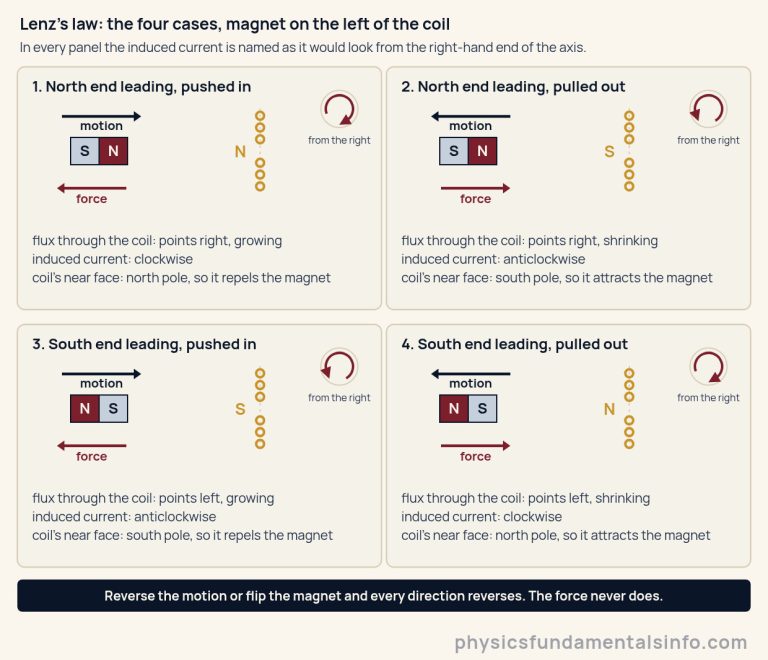
Those four cases are worth learning as a set, because they are the whole law. Two of them repel and two attract, and in every one of them the force points against the motion.
| Magnet end leading | Motion | Flux through the coil | Induced current, seen from the right | Coil’s near face | Force on the magnet |
|---|---|---|---|---|---|
| north | towards the coil | points right, growing | clockwise | north pole | repels: pushes it back out |
| north | away from the coil | points right, shrinking | anticlockwise | south pole | attracts: pulls it back in |
| south | towards the coil | points left, growing | anticlockwise | south pole | repels: pushes it back out |
| south | away from the coil | points left, shrinking | clockwise | north pole | attracts: pulls it back in |
Read the last two columns together and the pattern lands. The coil always presents the magnet with the face it least wants to see: a matching pole while the magnet closes in, an opposite pole while it leaves.
What Happens as a Magnet Goes Through a Coil
As a magnet travels along a coil’s axis the induced EMF starts small, climbs to a peak before the magnet arrives, collapses to exactly zero as it passes the centre, then climbs to an equal and opposite peak on the way out.
Every number that follows comes from one deliberately simple model, and it is worth stating plainly what that model is. Picture 200 coincident circular turns of radius 20.0 mm. The magnet is a point dipole of moment 1.00 A·m2 travelling along the axis, and the circuit is a pure resistance of 10.0 Ω.
The 20.0 mm radius and the 1.00 A·m2 moment are a chosen scale, not measurements of any real coil or magnet. Treat every number on this page as a number for this model.
The model has real edges, and they are easy to state. A bar magnet is not a point dipole, so within roughly its own length of the coil, and inside it, the true flux departs from the formula below. The turns are treated as sitting at one place, while a real coil has length. And a real circuit has self-inductance, which delays and reduces the current at high speed; this model ignores it.
Here z is the magnet’s position measured from the coil centre, a is the coil radius, m is the dipole moment, and μ0 is the magnetic constant, 4π × 10-7 T·m/A. Since the 2019 revision of the SI that constant is a measured quantity rather than a defined one, but it departs from 4π × 10-7 only around the tenth significant figure — far below anything printed here. The measured figure is published by NIST as the vacuum magnetic permeability.
Everything else follows from one quantity: S = d(NΦ)/dz, the slope of the flux linkage with the magnet’s position, measured in webers per metre. Three short lines then give the whole story.
The last of those three is Lenz’s law in one glance. The force carries S squared, so it cannot care about the sign of S, and it carries a bare minus in front of v. Whichever way the magnet moves, the force points the other way.
The current comes straight from Ohm’s law, which is why the resistance changes the current and the force without touching the EMF at all. The EMF is made by the moving flux; the resistance only decides how much current that EMF manages to drive.
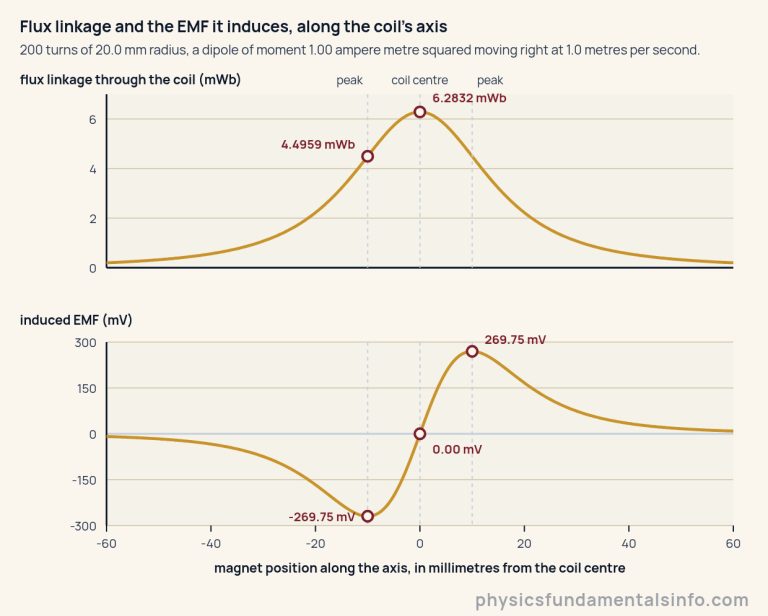
Two features of that picture come out of the algebra rather than the arithmetic. The slope S carries a factor of z, so it vanishes exactly at the centre; and the size of S peaks at exactly half a coil radius, which for this 20.0 mm coil puts the two EMF peaks at 10.0 mm either side.
| Position z (mm) | Flux per turn (µWb) | Slope S (Wb/m) | EMF (mV) | Current (mA) | Force (mN) | What the force does |
|---|---|---|---|---|---|---|
| -60 | 0.993 | 0.0089411 | -8.94 | -0.89 | 0.007994 | repels |
| -40 | 2.810 | 0.033719 | -33.72 | -3.37 | 0.1137 | repels |
| -20 | 11.107 | 0.16661 | -166.61 | -16.66 | 2.776 | repels |
| -10 | 22.479 | 0.26975 | -269.75 | -26.98 | 7.277 | repels, hardest here |
| 0 | 31.416 | 0 | 0.00 | 0.00 | 0 | nothing at all |
| +10 | 22.479 | -0.26975 | 269.75 | 26.98 | 7.277 | attracts, hardest here |
| +20 | 11.107 | -0.16661 | 166.61 | 16.66 | 2.776 | attracts |
| +60 | 0.993 | -0.0089411 | 8.94 | 0.89 | 0.007994 | attracts |
Every figure in that table is rounded for display, at N = 200, R = 10.0 Ω and v = 1.0 m/s with the north end pointing right. Work out ratios from the formulae rather than by dividing two rounded entries, which is a habit that quietly costs marks.
The last column is the honest headline. On the way in the magnet is pushed back; on the way out it is pulled back; at the centre it is left alone for an instant. The one thing that never happens is a shove in the direction it was already going.
Why Lenz’s Law Is Really Energy Conservation
Lenz’s law is not a separate law of nature. It is conservation of energy turning up as a sign, and in this model the two sums agree to the last digit the arithmetic can carry.
Take the default push: the magnet 10 mm short of the 200-turn coil, closing at 1.0 m/s. The mechanical power you supply against the induced force is 7.27666 mW, and the electrical power dissipated in the 10.0 Ω circuit is 7.27666 mW.
Those two numbers arrive by different routes. One is force multiplied by velocity; the other is current squared multiplied by resistance. They come out identical because the algebra makes them identical, not because they were tuned to match.
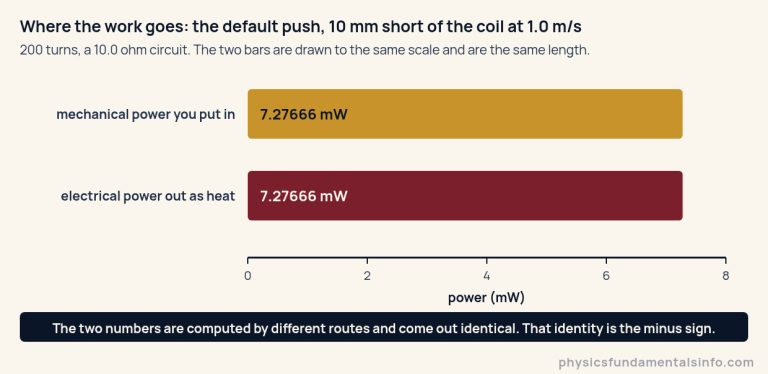
Push the magnet the full way through, from 60 mm out to 60 mm past at a steady 1.0 m/s, and the work done against the induced force is 217.859 µJ. That figure is a numerical integral along the path rather than a single reading, and the pass takes 0.120 s, so the average electrical power is 1.8155 mW.
That is a tiny amount of energy, and this page will not pretend otherwise. The point is not that it is large; the point is that it is not zero, and that it came out of your arm.
This is also why a generator gets harder to turn the instant somebody switches a lamp on. With the switch open there is an EMF and no current at all, so nothing but friction opposes the rotation. Close the switch, current flows, the induced forces appear, and the extra effort at the handle is what pays for the light.
Where You Meet Lenz’s Law Every Day
Lenz’s law shows up wherever a conductor and a changing magnetic field share a room, and most of the time it is felt as unexpected resistance rather than seen as a current.
- A bicycle dynamo. Switch the lamp on and the wheel becomes measurably harder to turn. Nothing has touched the wheel; the load simply let current flow, and the induced forces did the rest.
- Magnetic braking. Trains, roller-coasters and gym flywheels are slowed by dragging a conductor past a magnet. The braking force appears only while there is relative motion, which is why these brakes fade smoothly to nothing rather than locking.
- Induction hobs and metal detectors. Both drive a rapidly changing field into a conductor and rely on the currents it induces — one to heat a pan, the other to give away a buried coin.
- Moving-coil meters. The needle settles instead of swinging for a minute, because its own motion induces a current that opposes that motion.
- An electromagnet being switched off. The collapsing flux induces an EMF that tries to keep the current going, which is why coils spark at a switch and why a diode is often fitted across them.
It even reaches national infrastructure. A geomagnetic storm makes the Earth’s field vary, that varying flux threads the enormous circuit formed by a power grid, and real current flows in the lines, running the way Lenz’s law says it must; the NOAA Space Weather Prediction Center describes the consequences for electric power transmission.
The famous classroom demonstration belongs here too, with one caveat. A magnet dropped down a copper pipe drifts down far more slowly than it has any right to, and the principle is exactly the one on this page. The difference is that the currents circulate inside the bulk metal rather than round a wire loop, which makes it a question about eddy currents; it gets its own article rather than a number here.

Common Misconceptions About Lenz’s Law
Four beliefs account for most of the marks lost on this topic, and every one of them can be tested against the lab above in under a minute.
- “The induced current opposes the magnetic field.” It opposes the change in flux. A field as strong as you like, held steady, induces absolutely nothing; a feeble field that is changing quickly induces plenty.
- “The force is always a repulsion.” Only while the magnet is closing in. Pull it away and the coil attracts it instead. What stays constant is not the sense of the force but its relationship to the motion: it always opposes it.
- “Turning the magnet round makes it easier or harder to push.” It makes no difference whatever. Flipping the magnet reverses the flux, the EMF and the current, and leaves the force on the magnet exactly where it was, because the force depends on the square of the linkage slope.
- “The flux is biggest at the centre, so the EMF must be too.” Precisely backwards. The EMF follows the slope of the flux linkage, and a hump is flattest at its summit, so the EMF is zero exactly where the flux is greatest.
There is a fifth worth adding, because it is a reading error rather than a physics error. Lenz’s law does not give you the size of an induced EMF; Faraday’s law does. Asking Lenz’s law how many millivolts you will get is like asking a compass how far away the town is.