Time dilation is the difference in elapsed time between two clocks, caused by relative motion or by a difference in gravitational potential. A clock moving at speed v is measured to tick slow by the Lorentz factor: the observed time equals the clock’s own proper time divided by the square root of one minus v squared over c squared.
Somewhere above your head, right now, about thirty atomic clocks are being deliberately run at the wrong speed. They are aboard GPS satellites, and they were built slightly slow on purpose — because once in orbit, they gain roughly 38 microseconds a day on every clock down here.
That is not a manufacturing fudge. It is Einstein, corrected for in hardware, so that your phone can tell you which side of the street you are standing on. Time really does run at different rates for different observers, and we have been measuring it for over sixty years.
What Is Time Dilation?
Time dilation is the effect where a clock is measured to tick more slowly than an identical clock you are holding, because the first clock is either moving relative to you or sitting deeper in a gravitational field.
Here is the part that trips people up. Nothing goes wrong with the moving clock. Its springs are fine, its atoms behave normally, and an astronaut travelling with it sees it tick once per second, forever.
The disagreement is about duration itself — how much time passed between two events. Two observers in relative motion genuinely measure different amounts, and both are right.
Proper time: the one thing you must get straight
Every clock measures its own proper time, written t0. That is the time between two events as read by a clock that was present at both of them.
Everyone else — anyone who sees that clock move — measures a longer interval. Proper time is always the shortest time anyone measures between two events, and it is always the value on the bottom of the fraction.
The Time Dilation Formula
The time dilation formula relates the time t measured by a stationary observer to the proper time t0 ticked by the moving clock itself:
That messy denominator appears so often it gets its own name and symbol — the Lorentz factor, γ (gamma):
Every symbol, with its SI unit:
- t — dilated time measured by the observer who sees the clock moving, in seconds (s)
- t0 — proper time measured by the moving clock itself, in seconds (s)
- v — relative speed between clock and observer, in metres per second (m/s)
- c — speed of light in vacuum, exactly 299,792,458 m/s
- γ — Lorentz factor, a pure number with no units, always ≥ 1
Because γ is never less than 1, t is never smaller than t0. Moving clocks are measured to run slow — never fast.
You can check any of the numbers below against our Time Dilation Calculator, which takes a proper time and a speed and returns both the dilated time and γ, so you can see how brutally the answer changes in the last decimal places of v.
How big is γ at real speeds?
This table is the fastest cure for the usual intuition that “going fast slows time down a bit”. Below about a tenth of light speed, the effect is essentially nothing.
| Speed | v / c | Lorentz factor γ | Clock lag over 1 year |
|---|---|---|---|
| Motorway car, 100 km/h | 9.27 × 10⁻⁸ | 1 + 4.3 × 10⁻¹⁵ | 135 nanoseconds |
| Airliner, 900 km/h | 8.34 × 10⁻⁷ | 1 + 3.5 × 10⁻¹³ | 11 microseconds |
| ISS orbit, 7.66 km/s | 2.56 × 10⁻⁵ | 1 + 3.3 × 10⁻¹⁰ | 10.3 milliseconds |
| One tenth light speed | 0.100 | 1.00504 | 1.8 days |
| Half light speed | 0.500 | 1.1547 | 56.5 days |
| Fast starship | 0.900 | 2.2942 | 1.29 years |
| Cosmic-ray muon | 0.995 | 10.01 | 9.01 years |
| Extreme relativistic | 0.99999 | 223.6 | 222.6 years |
Sanity check before you trust a calculation: at everyday speeds γ − 1 lands somewhere around 10−13. If your working shows a noticeable effect for a car or a plane, you have dropped a decimal place — not discovered anything.
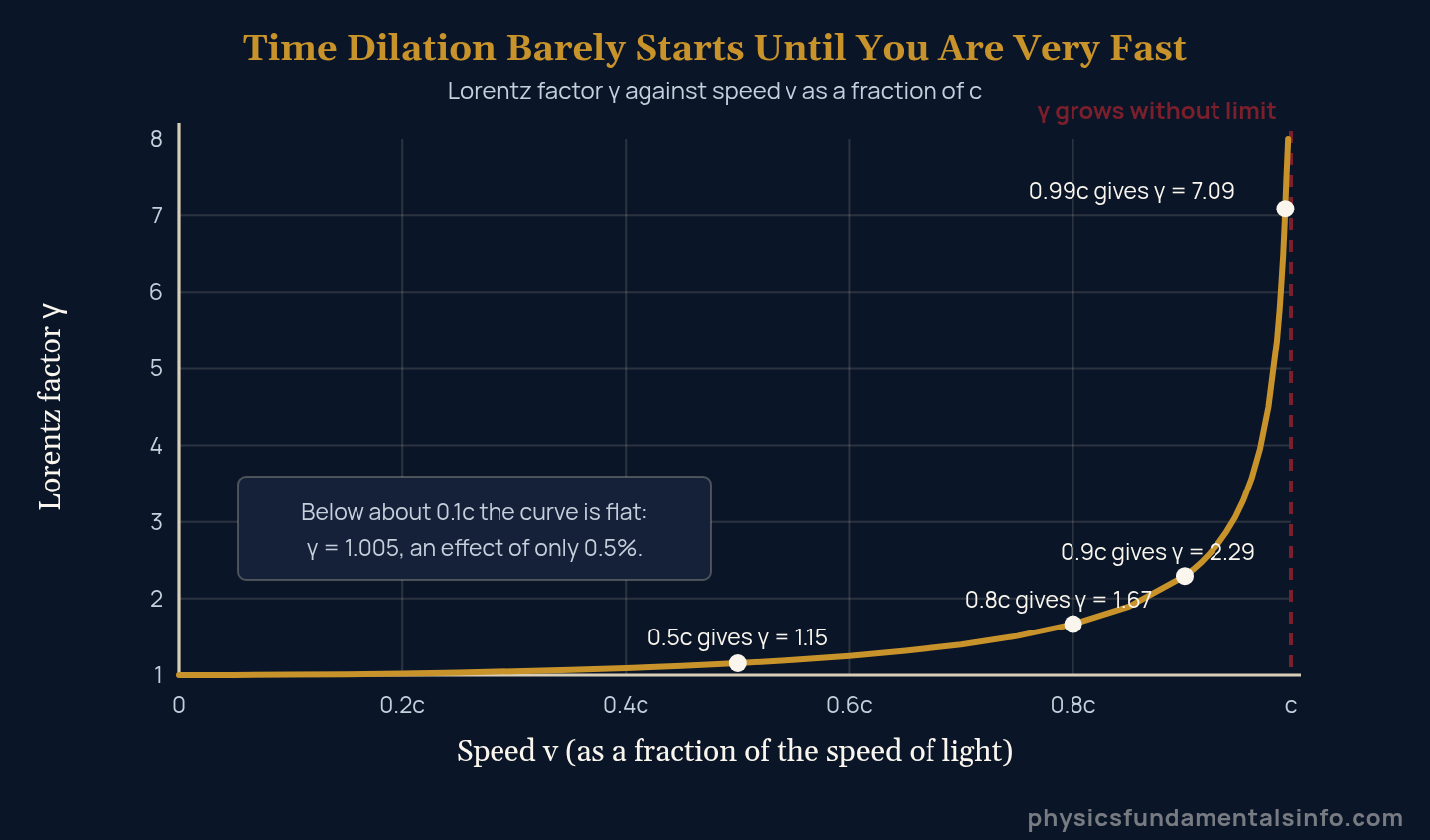
The Lorentz factor barely leaves 1 until speeds approach c — which is why time dilation is invisible in everyday life.
How Time Dilation Works: The Light Clock
Time dilation follows from one stubborn fact: every observer measures light travelling at the same speed c, no matter how they are moving. Hold that fixed, and something else has to give — and that something is time.
Imagine the simplest possible clock. Two mirrors face each other, a distance L apart, and a pulse of light bounces between them. One tick is one round trip.
Standing next to it, the light travels straight up and back: a distance 2L, taking t0 = 2L/c.
Now watch that same clock fly past you at speed v. During one tick, the whole apparatus shifts sideways, so the pulse traces a stretched V — a longer path.
But the pulse cannot travel faster to compensate. Its speed is still exactly c. A longer path at the same speed can only mean one thing: the tick takes longer.
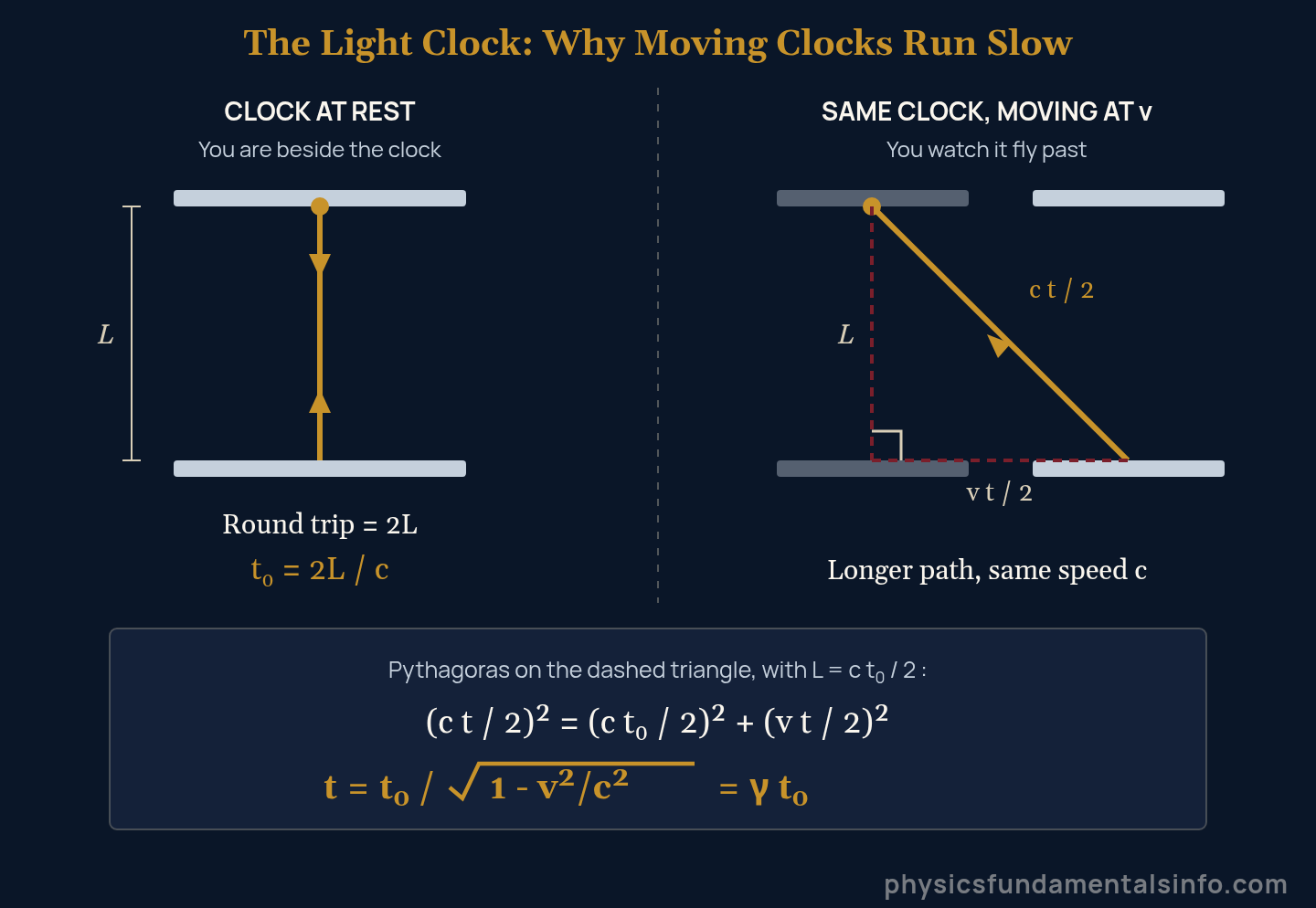
The light clock: with c fixed for every observer, the moving clock’s pulse covers a longer path, so one tick takes longer.
Getting the formula out of the triangle
Apply Pythagoras to half a tick. The vertical side is L, the horizontal side is v·t/2, and the light path is the hypotenuse c·t/2.
Substituting L = c·t0/2 and rearranging for t gives exactly the time dilation formula. No new assumptions are needed — only constant c and a right-angled triangle.
That is worth sitting with for a moment. One experimental fact about light, plus GCSE geometry, produces the whole result.
Velocity vs Gravitational Time Dilation
There are two distinct causes of time dilation, and mixing them up is the single most common conceptual error in this topic.
Velocity time dilation comes from special relativity and depends on relative speed. Gravitational time dilation comes from general relativity: clocks deeper in a gravitational well run slow compared with clocks higher up.
For weak fields near Earth’s surface, the gravitational shift over a height h is close to gh/c2, where g is the gravitational field strength. It is the same g that governs gravitational potential energy — higher potential, faster clock.
| Feature | Velocity time dilation | Gravitational time dilation |
|---|---|---|
| Theory | Special relativity (1905) | General relativity (1915) |
| Cause | Relative speed v | Difference in gravitational potential |
| Weak-field formula | Δt/t ≈ v2/2c2 | Δt/t ≈ gh/c2 |
| Which clock runs slow | The one that is moving, as judged by the observer | The lower one, and everyone agrees |
| Symmetric? | Yes — each sees the other’s clock slow | No — the asymmetry is absolute |
| Effect on a GPS satellite | Loses about 7 μs per day | Gains about 45 μs per day |
Notice the sign clash in that last row. On a GPS satellite the two effects fight each other, and gravity wins by about 38 microseconds a day.
The Twin Paradox, and What Actually Resolves It
The twin paradox is resolved by the fact that only one twin changes inertial frames: the traveller turns around, the stay-at-home twin does not, so their situations are not symmetric and the traveller genuinely returns younger.
Set it up properly first. One twin flies to a star 4.0 light years away at 0.8c and comes straight back; the other stays on Earth.
Earth’s clock records 10 years for the round trip. With γ = 1.667, the traveller’s own clock records only 6 years. She comes home four years younger than her sister — no metaphor, actually younger.
So where is the paradox?
Motion is relative, so the traveller could claim she stood still while Earth flew away and came back. By that logic her sister should be the younger one. Both cannot be right.
The escape is that the two stories are not mirror images. The stay-at-home twin sits in a single inertial frame the whole time.
The traveller does not. To come home she must decelerate and accelerate, switching to a different frame — and she feels it, pressed into her seat.
That turnaround breaks the symmetry. It is not that acceleration magically ages her; it is that her outbound and inbound frames disagree about which distant events are simultaneous, and the switch between them is what the accounting must include.
4 Experiments That Proved Time Dilation Is Real
Time dilation has been confirmed directly by flying atomic clocks around the world, by cosmic-ray muons reaching sea level, by optical clocks moved by a few centimetres, and by the continuous operation of GPS. These are measurements, not thought experiments.
1. Hafele and Keating flew four atomic clocks (1971)
In October 1971 two researchers bought airline tickets for four caesium-beam atomic clocks and flew them around the world — eastward first, then westward — comparing them afterwards against clocks at the US Naval Observatory.
Flying east adds to Earth’s rotation and flying west subtracts, so the two trips shift the velocity term in opposite directions while altitude raises both clocks out of the gravity well. The predictions were genuinely different for the two directions, which makes it a sharp test.
| Trip | Predicted change | Measured change |
|---|---|---|
| Eastward | −40 ± 23 ns | −59 ± 10 ns |
| Westward | +275 ± 21 ns | +273 ± 7 ns |
The westward agreement is remarkable: a prediction of +275 ns against a measurement of +273 ns. Both results were published in Science in 1972.
2. Muons that should never reach the ground
Muons are created when cosmic rays strike the upper atmosphere, and they are unstable, with a mean lifetime of about 2.2 microseconds at rest. Travelling at 0.995c, a typical muon covers only about 660 metres in one mean lifetime.
Mount Washington is roughly 1,900 metres above the sea-level detector. Without time dilation, only about 5% of the muons counted at the summit should survive the trip down.
They do not behave that way. Because γ ≈ 10, the muons’ own clocks record only about 0.64 μs for a journey that takes 6.4 μs in our frame, and roughly three quarters of them arrive.
Frisch and Smith measured exactly this at Mount Washington in 1963, extracting a time dilation factor of 8.8 ± 0.8. Later storage-ring work at CERN pushed the same test to γ ≈ 29 at the 0.1% level.
A slip worth avoiding: that 2.2 μs figure is the mean lifetime, not the half-life. The muon half-life is 2.2 × ln2 ≈ 1.52 μs, and swapping them silently wrecks any survival calculation. If you are shaky on the distinction, our guide to half-life in physics sorts it out.
3. Optical clocks raised by 33 centimetres (2010)
You do not need a mountain any more. Physicists at NIST compared two aluminium-ion optical clocks and detected the gravitational shift after raising one of them by just 33 cm.
The same team also measured velocity time dilation at speeds under 10 m/s — jogging pace. NIST’s report on the experiment puts the height effect at roughly 90 billionths of a second over a 79-year lifetime.
Run gh/c2 yourself for h = 0.33 m and 79 years and you get 9.0 × 10⁻⁸ s. The back-of-envelope estimate and the world’s best clocks agree.
4. GPS: relativity running continuously since 1978
GPS satellites orbit at about 20,000 km and move at roughly 3.87 km/s. Velocity dilation costs their clocks about 7 μs a day; the weaker gravity up there gains them about 45 μs a day.
The net 38 μs per day is not negligible — multiply it by c and you get an 11 km positioning error accumulating daily. Ohio State’s summary of GPS and relativity notes a fix would be measurably wrong within about two minutes.
Engineers solved it before launch: the onboard oscillators are set to 10.22999999543 MHz so that, once in orbit, they tick at the intended 10.23 MHz.
Common Misconceptions About Time Dilation
“You would feel time slowing down”
You never do. Your own proper time always advances at one second per second, whether you are sitting still or crossing the galaxy at 0.999c.
Time dilation is strictly a comparison between clocks, not a sensation. The traveller notices nothing odd until she gets home and compares calendars.
“It is just clocks malfunctioning”
If moving clocks merely broke, the muons would still decay on schedule and never reach the ground. They arrive because less time genuinely elapsed for them.
Every physical process — decay, chemistry, ageing, thought — slows by the identical factor, because it is the time interval itself that differs.
“It only matters near the speed of light”
GPS satellites crawl along at 0.0013% of light speed, and the effect still breaks navigation within minutes if ignored. NIST measured it at walking pace.
What is true is that the effect is small at low speed, not that it is absent. Precision, not velocity, decides whether you notice.
“Time dilation would let you travel back in time”
It only ever runs one way. A fast traveller can leap far into Earth’s future — fly around for a year at γ = 100 and a century passes back home.
Getting back is another matter. Nothing in the formula reverses the sign, because γ is always ≥ 1.
How Time Dilation Connects to the Rest of Physics
Time dilation is one consequence of a single framework, so it never travels alone. It comes packaged with length contraction, relativistic momentum and mass–energy equivalence.
The full picture — both postulates, the other consequences, and where the theory’s limits lie — is laid out in our guide to special relativity.
The whole edifice rests on c being invariant, which is stranger than it first sounds and is worth reading about on its own in the speed of light.
Push γ high enough and the energy cost explodes too, which is where E = mc2 enters: reaching γ = 10 means supplying nine times the particle’s rest energy as kinetic energy. That is why accelerators are expensive, and why starships stay fictional.
Worked Problems
Show Solution
Solution:
Step 1: The clock on the spacecraft is present at both events, so it reads proper time: t0 = 1.00 h. Use t = t0 / √(1 − v2/c2).
Step 2: Evaluate the Lorentz factor. v2/c2 = (0.800)2 = 0.640, so 1 − 0.640 = 0.360 and √0.360 = 0.600.
Step 3: γ = 1 / 0.600 = 1.667. Therefore t = 1.00 h × 1.667 = 1.67 h.
Answer: 1.67 hours (100 minutes)
Show Solution
Solution:
Step 1: The muon’s rest-frame lifetime is the proper time: t0 = 2.20 μs.
Step 2: v2/c2 = (0.995)2 = 0.990025, so 1 − 0.990025 = 0.009975 and √0.009975 = 0.09987.
Step 3: γ = 1 / 0.09987 = 10.01. So t = 2.20 μs × 10.01 = 22.0 μs.
Answer: 22.0 μs — about ten times longer
Show Solution
Solution:
Step 1: Distance is speed × time, with v = 0.995 × 2.998 × 108 m/s = 2.983 × 10⁸ m/s.
Step 2: With dilation: d = 2.983 × 10⁸ m/s × 22.0 × 10⁻⁶ s = 6.57 × 10³ m.
Step 3: Without dilation: d = 2.983 × 10⁸ m/s × 2.20 × 10⁻⁶ s = 656 m.
Answer: 6.57 km with time dilation, versus only 656 m without — which is why muons reach sea level
Show Solution
Solution:
Step 1: Start from γ = 1 / √(1 − v2/c2) and rearrange: √(1 − v2/c2) = 1/γ.
Step 2: Square both sides: 1 − v2/c2 = 1/γ2 = 1/4.00 = 0.250, so v2/c2 = 0.750.
Step 3: v/c = √0.750 = 0.866, giving v = 0.866 × 2.998 × 108 m/s.
Answer: v = 0.866c, about 2.60 × 10⁸ m/s
Show Solution
Solution:
Step 1: Compute v/c = 3874 / (2.998 × 10⁸) = 1.292 × 10⁻⁵.
Step 2: Δt/t ≈ v2/2c2 = (1.292 × 10⁻⁵)2 / 2 = 8.35 × 10⁻¹¹.
Step 3: Over one day: Δt = 8.35 × 10−11 × 86,400 s = 7.21 × 10⁻⁶ s.
Answer: the satellite clock loses about 7.2 μs per day from motion alone
Show Solution
Solution:
Step 1: In Earth’s frame the round trip covers 8.00 ly at 0.800c, so t = 8.00 / 0.800 = 10.0 years.
Step 2: The traveller’s clock reads proper time: t0 = t / γ, with γ = 1.667 as in Problem 1.
Step 3: t0 = 10.0 / 1.667 = 6.00 years. Age difference = 10.0 − 6.00 = 4.00 years.
Answer: the traveller returns 4.00 years younger
Show Solution
Solution:
Step 1: Δt/t ≈ gh/c2 = (9.81 × 0.33) / (2.998 × 10⁸)2 = 3.24 / 8.99 × 10¹⁶.
Step 2: Δt/t = 3.60 × 10⁻¹⁷. Convert 79 years to seconds: 79 × 3.156 × 107 = 2.49 × 10⁹ s.
Step 3: Δt = 3.60 × 10−17 × 2.49 × 109 s = 9.0 × 10⁻⁸ s.
Answer: about 90 nanoseconds — matching NIST’s measured result
Show Solution
Solution:
Step 1: v/c = 7660 / (2.998 × 10⁸) = 2.555 × 10⁻⁵, so Δt/t ≈ v2/2c2 = 3.26 × 10⁻¹⁰.
Step 2: Mission duration = 340 × 86,400 s = 2.938 × 10⁷ s.
Step 3: Δt = 3.26 × 10−10 × 2.938 × 107 s = 9.6 × 10⁻³ s.
Answer: about 9.6 milliseconds younger from motion — though weaker gravity in orbit cancels part of this, so the net figure is smaller